
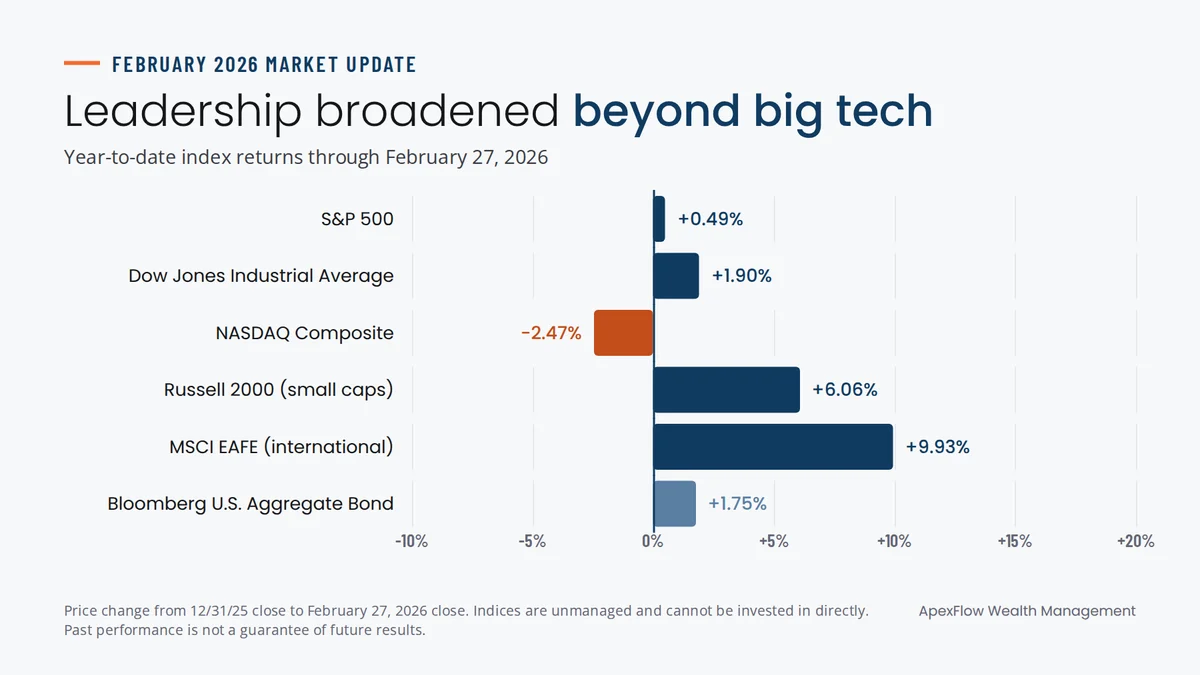
At first glance, February looked quiet. The S&P 500 ended the month essentially flat. Beneath the surface, though, meaningful rotation was underway. In this February 2026 market update, we look at why market leadership is broadening, what we expect from interest rates and how trade policy, sentiment and oil prices fit into the picture.

Key takeaways
- The S&P 500 finished February essentially flat, but money rotated toward energy, consumer staples, small and mid-sized companies and international markets.
- AI leadership is broadening from the chipmakers to the companies that build and power AI at scale.
- Markets are pricing in two interest rate cuts in 2026. We expect closer to one.
- Oil reached a seven-month high on tensions involving Iran.
A flat month with real rotation underneath
Leadership shifted away from the mega-cap technology companies that have dominated returns in recent years. Capital moved toward areas that had been overlooked, including energy, consumer staples, small and mid-sized companies and several international markets.
Rotations can feel uncomfortable. Headlines shift and narratives change, and it can feel like something is breaking. What we’re seeing isn’t a breakdown. It’s a transition, and it’s why we build portfolios to adapt to changing environments rather than depend on a single theme.
AI leadership is broadening
The companies that built the core AI infrastructure have driven performance for years. Now the story is moving from early innovation toward implementation, and toward the businesses that will put AI to work at scale, including:
- Semiconductor manufacturing
- Networking and data infrastructure
- Data center construction
- Power generation and grid support
Historically, transitions like this expand market leadership rather than end it. Broadening participation is a sign of a maturing trend, not a deteriorating one.
Interest rates: patience remains essential
Markets are pricing in two interest rate cuts for 2026. Our expectation is closer to one, and the timing is uncertain. Both 2024 and 2025 started with early optimism about cuts that arrived later than expected, and that could happen again.
For long-term investors, the takeaway is simple. Portfolios should be built around durable fundamentals, not short-term rate predictions. Patience, not forecasting, drives long-term outcomes.
Trade policy: headline risk, not structural risk
The Supreme Court struck down the administration’s tariffs under the International Emergency Economic Powers Act (IEEPA). A baseline 10% tariff was reinstated under Section 122 of the Trade Act of 1974. These measures are temporary unless Congress extends them, and the refund process remains unclear.
Trade news creates volatility, but markets adapt, capital reallocates and businesses adjust. Headline risk isn’t the same as systemic risk, though it does call for emotional discipline.

Sentiment, oil and geopolitics
Consumer confidence remains lower than a year ago, weighed down by slower job growth, housing affordability and inflation expectations. Monthly data showed modest improvement as labor conditions stabilized. Households remain cautious but resilient.
Oil reached a seven-month high as tensions involving Iran raised supply concerns. Geopolitical premiums like this have historically tended to fade once conditions stabilize, and energy exposure can help steady a diversified portfolio during periods of geopolitical stress.
Year-to-date index returns
| Index | 12/31/25 close | 2/27/26 close | Year-to-date change |
|---|---|---|---|
| Dow Jones Industrial Average | 48,063.29 | 48,977.92 | 1.90% |
| NASDAQ Composite | 23,241.99 | 22,668.21 | -2.47% |
| S&P 500 | 6,845.50 | 6,878.88 | 0.49% |
| MSCI EAFE | 2,892.71 | 3,179.91 | 9.93% |
| Russell 2000 | 2,481.91 | 2,632.36 | 6.06% |
| Bloomberg U.S. Aggregate Bond | 2,348.85 | 2,389.86 | 1.75% |
Performance reflects index values as of market close on February 27, 2026.
What it means for your plan
Investing is behavioral as much as analytical. During a rotation, it can feel like former leaders are losing momentum and it’s time to react quickly. Discomfort doesn’t equal dysfunction. Most long-term mistakes come from emotional reactions, not market structure. We explore that pull in Recency Bias in Investing and Loss Aversion: Why Market Downturns Feel Worse Than They Are.
When markets rotate, we come back to four questions:
- Is your allocation aligned with your time horizon?
- Is your level of risk appropriate for your stage of life? (See Risk Tolerance vs. Risk Capacity.)
- Is your tax strategy positioned efficiently?
- Does your plan still support your long-term goals?
If the answer is yes, discipline remains the right response. February was a month of transition, not deterioration.

Talk it through with us
If a market shift has you wondering whether your portfolio still fits your goals, we’d be glad to talk it through. Book a 20-minute Fit Call. It’s virtual, no prep is needed and there’s no obligation.
With clarity and confidence,
Any opinions are those of ApexFlow Wealth Management and not necessarily those of Raymond James. Expressions of opinion are as of this date and are subject to change without notice. Raymond James and its advisors do not offer tax or legal advice. You should discuss any tax or legal matters with the appropriate professional. Investing involves risk and you may incur a profit or loss regardless of strategy selected, including diversification and asset allocation. Prior to making an investment decision, please consult with your financial advisor about your individual situation. The indices shown are unmanaged and cannot be invested in directly. Index returns do not reflect fees or expenses. Past performance is not a guarantee of future results.