
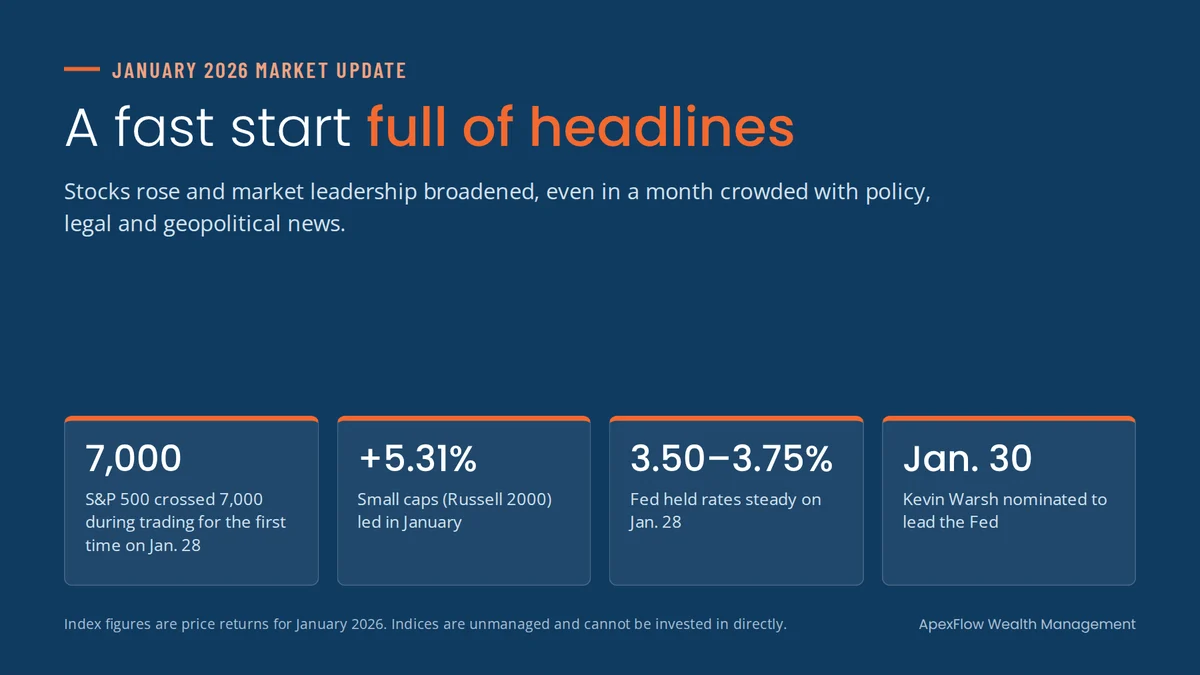
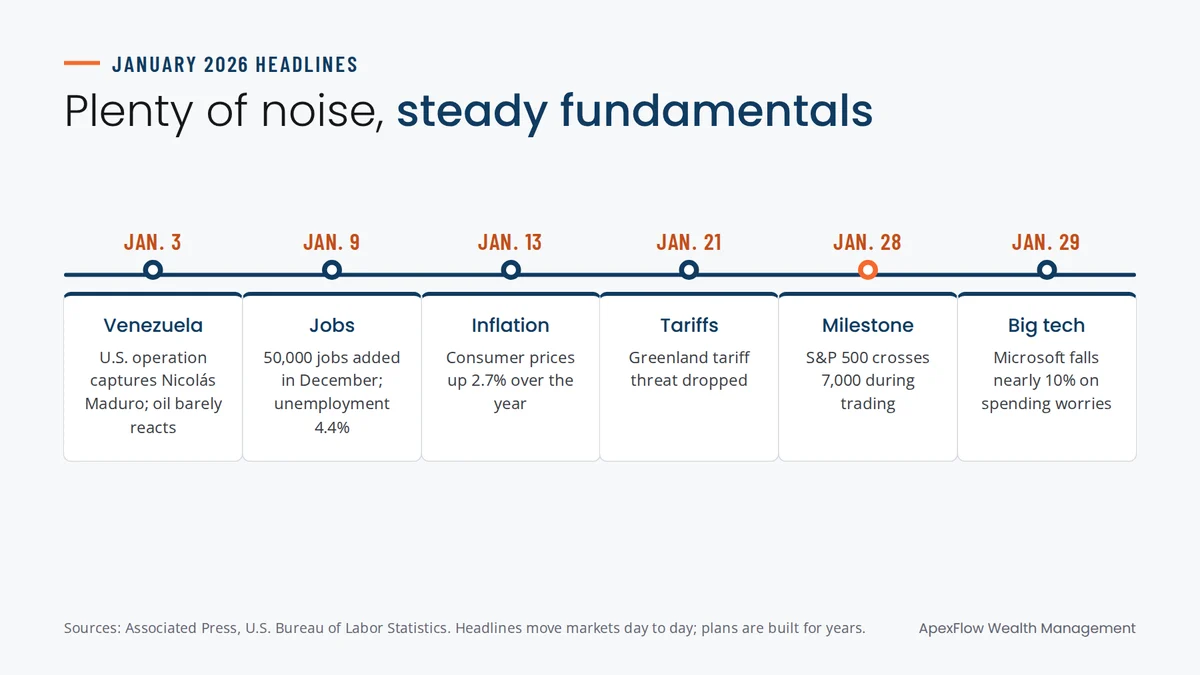
January packed a lot into a few weeks. A U.S. operation in Venezuela, a tariff threat over Greenland, subpoenas aimed at the Federal Reserve and a new Fed chair nomination all landed in the same month. Through it all, stocks moved higher, the S&P 500 crossed 7,000 for the first time and market leadership broadened. In this January 2026 market update, we look at what drove markets and what it means for your plan.
Key takeaways
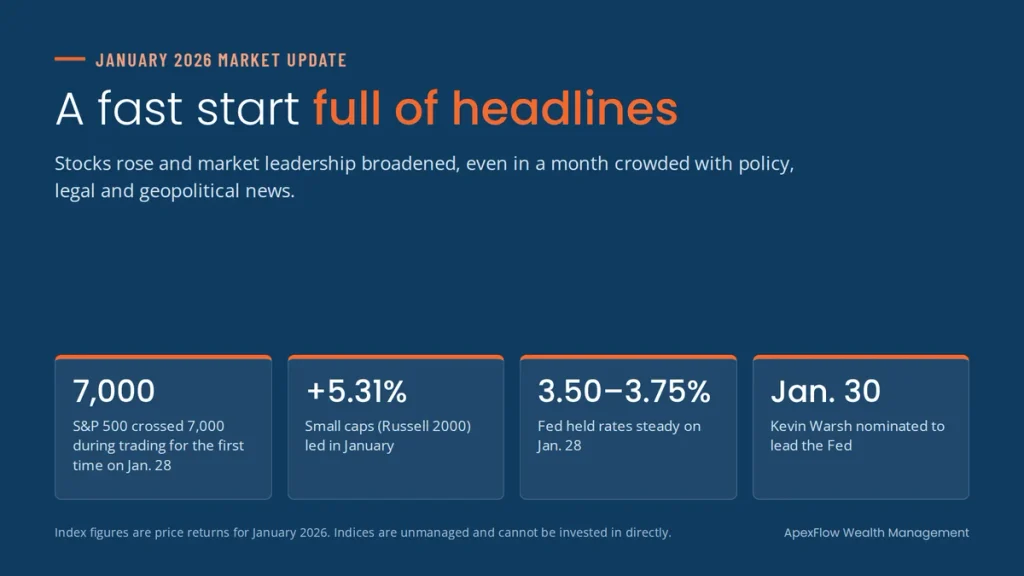
- The S&P 500 rose 1.37% in January and crossed 7,000 during trading for the first time on January 28.
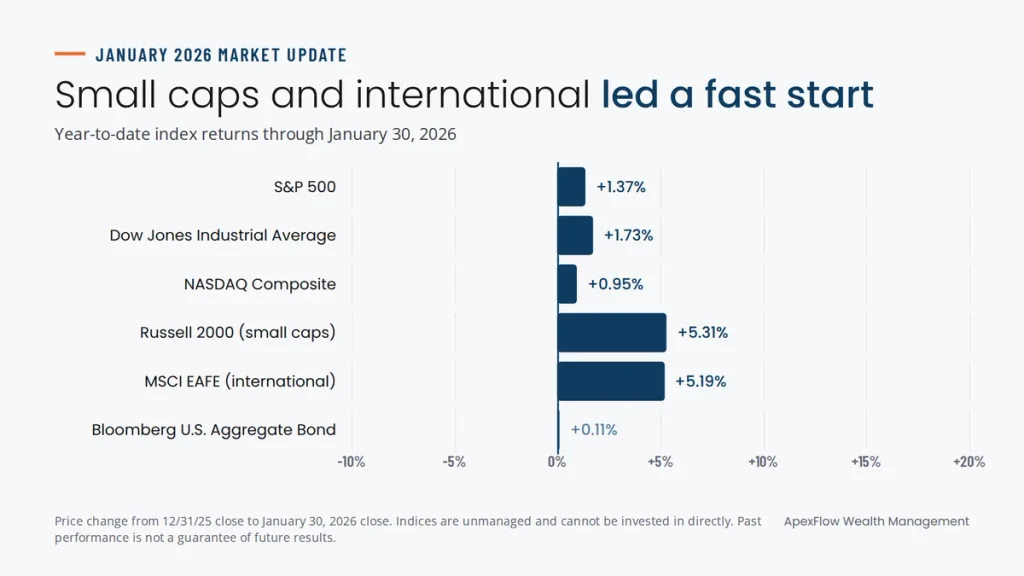
- Small caps (up 5.31%) and international stocks (up 5.19%) led, while the NASDAQ trailed at 0.95%.
- The Federal Reserve held rates at 3.50% to 3.75% on January 28.
- On January 30, President Trump nominated Kevin Warsh to succeed Jerome Powell as Fed chair when Powell’s term ends in May.
A fast start full of headlines
The year opened with a U.S. operation in Caracas on January 3 that captured Venezuelan President Nicolás Maduro. Oil markets barely reacted at first. Later in the month, the administration threatened tariffs on eight European countries over Greenland, then dropped the plan on January 21 after announcing the framework of a future deal.
As Raymond James Chief Investment Officer Larry Adam put it in mid-January, “In just the first two weeks, we’ve seen a flurry of headlines – rapid-fire policy proposals, legal uncertainties, and fast-moving geopolitical developments – all with the potential to influence the economy and financial markets.”
Markets took most of it in stride. Headline risk isn’t the same as lasting economic damage.
Leadership broadened beyond big tech
The S&P 500 crossed 7,000 during trading for the first time on January 28. Beneath the surface, leadership broadened. Small-cap and international stocks gained more than 5%, while the tech-heavy NASDAQ lagged.
Investors grew more selective about AI spending. Microsoft fell nearly 10% on January 29, its worst day since 2020, after reporting heavy capital spending. Earnings season was solid overall: about 77% of S&P 500 companies that had reported beat estimates by month-end.
Year-to-date index returns
| Index | 12/31/25 close | 1/30/26 close | Year-to-date change |
|---|---|---|---|
| Dow Jones Industrial Average | 48,063.29 | 48,892.47 | 1.73% |
| NASDAQ Composite | 23,241.99 | 23,461.82 | 0.95% |
| S&P 500 | 6,845.50 | 6,939.03 | 1.37% |
| MSCI EAFE | 2,892.71 | 3,042.84 | 5.19% |
| Russell 2000 | 2,481.91 | 2,613.74 | 5.31% |
| Bloomberg U.S. Aggregate Bond | 2,348.85 | 2,351.36 | 0.11% |
Performance reflects index values as of market close on January 30, 2026.
The Fed holds, and a new chair is named
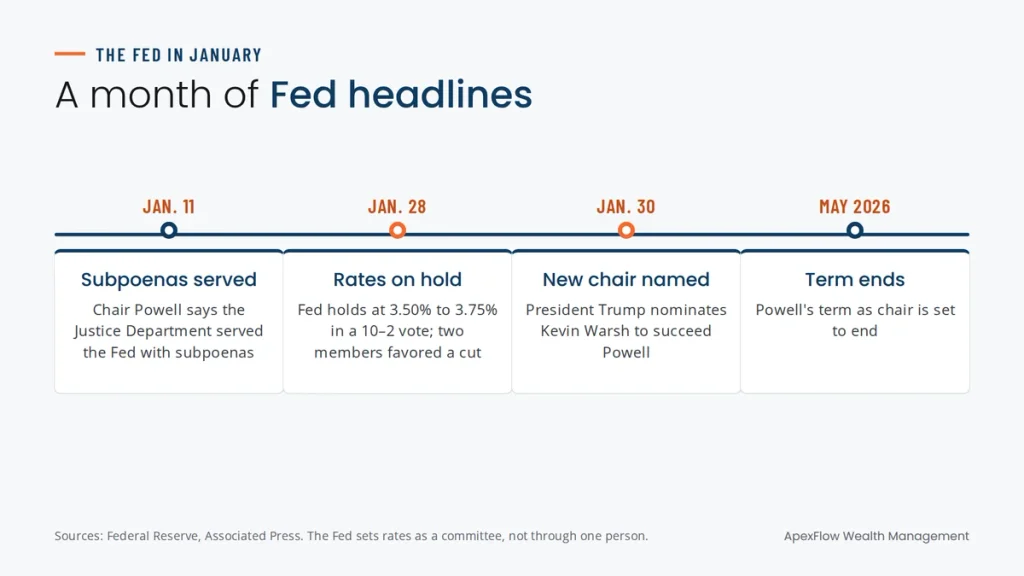
The Federal Reserve held its target range at 3.50% to 3.75% on January 28. Two members dissented in favor of a cut. The statement described economic growth as solid and dropped its reference to rising risks to employment.
The Fed also made headlines for other reasons. On January 11, Chair Powell said the Justice Department had served the Fed with subpoenas, which he called an attempt to pressure the Fed over its rate decisions. Then on January 30, President Trump nominated Kevin Warsh to lead the Fed when Powell’s term as chair ends in May. Questions about the Fed’s independence are worth watching, but the Fed sets policy as a committee, not through one person.
Inflation, jobs and sentiment
- Inflation: consumer prices rose 2.7% over the year through December, with core inflation at 2.6%. Producer prices ran hotter, up 3.0%.
- Jobs: employers added 50,000 jobs in December, and unemployment was 4.4%.
- Sentiment: the University of Michigan’s consumer sentiment index finished January at 56.4, better than its early-month reading, and year-ahead inflation expectations eased to 4.0%.
Commodities, yields and the dollar
Oil rose about 14% in January to around $65 a barrel. Gold rallied sharply for most of the month, then fell about 10% on January 30 alone. The 10-year Treasury yield edged up from 4.16% to 4.24%, and the U.S. dollar slipped about 1%. Moves like these are a reminder of why we don’t build portfolios around a single asset or theme.
What it means for your plan
One month doesn’t set the tone for a year, and a busy news cycle isn’t a reason to change a well-built plan. What January did show is the value of diversification: when the biggest names stalled, small-cap and international holdings did the heavy lifting. If headlines like these make you want to step aside, read Should You Move to Cash Before Retirement? first, and revisit how much risk your plan can actually absorb in Risk Tolerance vs. Risk Capacity.
Talk it through with us
If the start of the year has you wondering whether your plan is set up for what’s ahead, we’d be glad to help. Book a 20-minute Fit Call. It’s virtual, no prep is needed and there’s no obligation.
With clarity and confidence,
Any opinions are those of ApexFlow Wealth Management and not necessarily those of Raymond James. Expressions of opinion are as of this date and are subject to change without notice. Raymond James and its advisors do not offer tax or legal advice. You should discuss any tax or legal matters with the appropriate professional. Investing involves risk and you may incur a profit or loss regardless of strategy selected, including diversification and asset allocation. Prior to making an investment decision, please consult with your financial advisor about your individual situation. The indices shown are unmanaged and cannot be invested in directly. Index returns do not reflect fees or expenses. Past performance is not a guarantee of future results.