
Last reviewed: November 6, 2026
Two minutesHow much of your retirement is actually decided?Get my Clarity ScoreOctober was a month of push and pull, and a reminder of why a plan is never built on a single storyline. On the surface, October brought plenty to react to. Technology and communication services stocks fell more than 7%, oil and diesel prices climbed on tensions with Iran, and inflation ran hotter than expected. The Nasdaq fell about 5.3% for the month.
Beneath the surface, the picture was more balanced. The US economy kept expanding at a moderate pace, supported by healthy consumer spending and solid business activity. Most sectors finished the month higher, the Dow gained about 1.7%, and bonds helped cushion portfolios as Treasury yields fell.
What we are currently seeing
- Technology and communication services stocks down more than 7%
- Most other sectors finishing the month higher
- Treasury yields falling as investors sought safety
- Bonds helping cushion portfolios
- Inflation and producer prices running hotter than expected
- The Fed holding rates steady after September’s increase
- Oil and diesel prices elevated on tensions with Iran
- An economy still expanding at a moderate pace
Every major stock index in our table remains up for the year, with the S&P 500 and Russell 2000 up more than 10%. This is where diversification earns its keep. When the market’s biggest storyline stumbles, a portfolio spread across asset classes, sectors and regions does not have to stumble with it. This month’s briefing looks at what that means, and what it does not.
Our role is to clear the fog. We want you to see the whole portfolio, not just the part making headlines, so you can make decisions with clarity rather than reaction.
A month of push and pull
October was not a one-storyline month. The US economy kept expanding at a moderate pace, supported by healthy consumer spending and solid business activity. At the same time, markets had to absorb higher energy prices, renewed inflation concerns and heightened geopolitical tensions.
The bond market showed that push and pull clearly. Rising oil prices added to inflation expectations, which can push Treasury yields higher. But concerns about AI-related spending and challenges overseas increased demand for US Treasurys, which pulled yields lower. The second force won. The 10-year Treasury yield declined, finishing the month just under 5%, and longer-term bonds benefited as investors sought safety.
Stocks held up better than the headlines suggested. Weakness in areas closely tied to AI was offset by strength in more value-oriented sectors, and moderating interest rates helped improve sentiment toward traditionally rate-sensitive parts of the market. The result was a market that broadened beyond growth and technology.
“Volatility gets investors’ attention, but it shouldn’t change their game plan. In fact, this is exactly why diversification matters. The technology and communication services sectors were both down more than 7% this month, yet most other sectors were higher, and bonds helped cushion the portfolio as yields fell,” said Raymond James Chief Investment Officer Larry Adam.
If the tech headlines this month made you wonder whether something needs to change, that is a fair question, and it is exactly the kind of question we want you to bring to us.
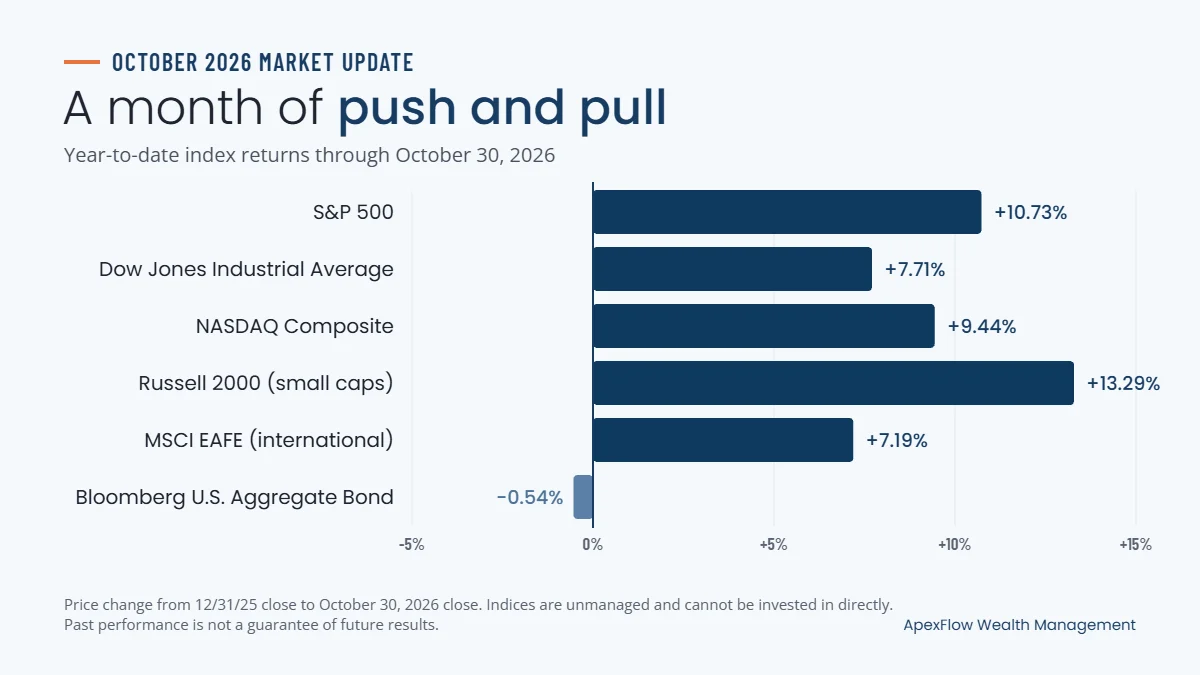
October market review: year-to-date index performance
| Index | 12/31/25 close | 10/30/26 close | Change YTD | % gain/loss YTD |
|---|---|---|---|---|
| DJIA | 48,063.29 | 51,770.31 | 3,707.02 | +7.71% |
| NASDAQ | 23,241.99 | 25,437.00 | 2,195.01 | +9.44% |
| S&P 500 | 6,845.50 | 7,580.07 | 734.57 | +10.73% |
| MSCI EAFE | 2,892.71 | 3,100.62 | 207.91 | +7.19% |
| Russell 2000 | 2,481.91 | 2,811.84 | 329.93 | +13.29% |
| Bloomberg Agg. Bond | 2,348.85 | 2,336.13 | -12.72 | -0.54% |
Data represents index values as of market close on October 30, 2026.
Looking beneath the headline index
The headline performance of the stock market did not tell the full story in October. The S&P 500 slipped about 0.9% for the month by our calculation,** and it has moved largely sideways since early August. Beneath the surface, nearly half of the stocks in the S&P Composite 1500, an index representing about nine-tenths of the US market by capitalization, were well below their highs.
The monthly changes show how differently the pieces moved. By the same calculation, the Nasdaq fell about 5.3%, while the Dow rose about 1.7%, the Russell 2000 about 0.5% and the Bloomberg Aggregate Bond Index about 2.3%. MSCI EAFE, which tracks developed international markets, slipped about 0.5%.**
October at a glance: approximate change for the month**
| Index | Approximate change for the month |
|---|---|
| Bloomberg Agg. Bond | +2.3% |
| Dow Jones (DJIA) | +1.7% |
| Russell 2000 | +0.5% |
| MSCI EAFE | -0.5% |
| S&P 500 | -0.9% |
| Nasdaq | -5.3% |
The market has also become increasingly divided between companies closely tied to AI and everything else. That kind of split is a reminder of why diversification matters as leadership rotates.
**ApexFlow calculation using index values from the Raymond James September and October 2026 market letters. Changes run from September 30 to October 30, except MSCI EAFE and the Bloomberg Aggregate Bond Index, which run from September 29 to October 30. Figures are approximate and may differ from index provider returns. Past performance is not indicative of future results.
This month’s focus: when the leaders stumble
For much of the past year, technology and AI-related companies carried a large share of the market’s gains. In October, those same areas led the decline. Moments like this are when diversification stops being a textbook idea and starts showing up in real portfolios.
What concentration means
When a few large companies make up a big share of an index, the index’s ups and downs can depend heavily on how those few companies do. That can work in your favor when they are rising. It can work against you when they stumble.
The same idea applies to a portfolio. If most of your holdings are tied to one theme, one sector or one region, your results may depend more on that one story than you realize.
What diversification does, and what it does not
Diversification means spreading investments across different asset classes, sectors and regions, so that no single part of the market carries the whole plan. In October, that looked like this: technology and communication services fell more than 7%, while most other sectors rose and bonds gained as yields fell.
Diversification has limits, and it is worth being clear about them. It does not guarantee a profit or protect against a loss, and in some periods many investments fall at the same time. It also means that some part of a diversified portfolio will almost always be lagging. That is not a flaw. It is the point. When different pieces take turns leading, a portfolio is less dependent on any one of them.
Three layers of diversification
| Layer | What it means | October |
|---|---|---|
| 1. Asset classes | Balancing stocks, bonds and cash so the plan is not riding on one kind of investment. | Bonds rose about 2.3% while the Nasdaq fell about 5.3%.** |
| 2. Sectors | Owning many parts of the economy, such as technology, health care, energy, financials and more. | Technology and communication services fell more than 7%, while most other sectors rose. |
| 3. Regions | Including companies and markets beyond the US. | Developed international stocks (MSCI EAFE) slipped about 0.5%,** while France’s bond market came under pressure. |
Bonds, one month later
Last month, we explained why bond prices fall when interest rates rise, and why a lower bond balance may not tell the whole story. October offered a reminder that the relationship works in both directions. As the 10-year Treasury yield declined, the Bloomberg Aggregate Bond Index rose about 2.3% for the month by our calculation,** recovering much of its decline for the year. It is now down about 0.5% year to date, compared with about 2.8% at the end of September.
One month does not make a trend, and yields can rise again. But it shows why we encourage clients to look at bonds over their full holding period, not one statement at a time. If bonds are sold prior to maturity, you may receive more or less than your initial investment.
Rebalancing when leadership rotates
When one part of a portfolio runs ahead of the others, the mix can drift away from what was originally intended. Rebalancing means periodically bringing it back toward its target, which can involve trimming what has grown and adding to what has lagged.
In its second-quarter 2026 review, Raymond James Asset Management Services summed up its approach this way: “Hold on, diversify, and rebalance asset classes when prudent.”
Rebalancing does not guarantee better results and should always fit your own plan. Rebalancing a non-retirement account could be a taxable event that may increase your tax liability.
Market leadership tends to rotate over time. Our job is to make sure your plan does not depend on guessing which part of the market leads next.
The headlines behind the numbers
Growth continued as inflation pressures built. Economic data continued to point to an expanding US economy, though the picture was far from uniform. Both manufacturing and services remained in expansion territory, industrial production rose more than expected, and durable goods orders pointed to continued investment in AI and data centers.
At the same time, nonfarm payrolls rose only slightly, and the Producer Price Index saw its largest increase since March 2022, driven largely by fuel prices. At its October meeting, the Federal Reserve held interest rates steady at a range of 3.75% to 4.00%, as policymakers indicated they would wait for more data to assess the effects of September’s increase. Two members voted for another increase.
Geopolitical risks remained in focus. Iran posed the largest geopolitical threat in October. The US expanded its regional military presence as attacks on Gulf shipping and energy infrastructure kept oil and diesel prices elevated. The administration responded with measures intended to ease diesel prices, including temporarily expanding the use of tax-exempt dyed diesel and pursuing greater fuel supplies. Those steps offered some near-term relief to fuel-intensive industries, though they do not address the underlying supply constraints.
Diesel costs rippled through the economy. Higher energy prices reached well beyond the gas pump. Diesel has been hit particularly hard by disruptions tied to Russia’s war in Ukraine and the US-Iran conflict, with prices more than doubling year to date and approaching record highs. Because diesel fuels trucking, freight railroads and much of the country’s farm equipment, sustained increases can ripple through supply chains and raise the cost of moving goods. The effects vary by region. New England households rely more heavily on heating oil, which is another term for diesel, while Midwest farmers face higher diesel costs on top of higher fertilizer costs.
France puts fiscal discipline in the spotlight. France was the standout story in international markets. Political and public opposition made it harder to cut government spending and stabilize the country’s debt. Those concerns spilled into the bond market: France’s 10-year government bond yield climbed to multi-year highs, and the gap between its yield and comparable German bonds widened sharply. France’s primary budget deficit is substantially larger than those of other major euro area economies, adding pressure on policymakers to rein in spending despite resistance to austerity measures.
The tug of war: safety vs. inflation
October pulled bonds in two directions at once. On one side, headline consumer inflation and producer prices rose more than expected, and oil stayed elevated. Conditions like those would ordinarily push yields higher. On the other side, weakness tied to AI technology sparked a late-month move toward Treasury securities. Demand for safety became strong enough to outweigh both inflation and the economy’s resilience, and yields fell.
That tug of war is worth remembering. Inflation has not gone away, the Fed is watching each new report closely, and yields can move quickly in either direction. Markets are likely to stay sensitive to inflation reports, job numbers and Fed meetings in the months ahead.
Why this matters for investors
Months like October are exactly why we do not build plans around a single storyline. Leadership in the market rotates, sometimes quickly, and a plan that depends on one sector or theme can feel every one of those rotations.
As Larry Adam put it, “Successful investing isn’t about avoiding every market pullback. It’s about staying disciplined, staying diversified and staying invested.”
That does not mean ignoring what is happening. AI, energy prices and inflation all deserve attention, especially where they touch specific parts of a portfolio. But reacting to every headline, instead of understanding how it fits into the bigger picture, is usually where good decisions go sideways.
Long-term success rarely comes from predicting the next leader. It comes from staying disciplined, staying diversified, and keeping decisions aligned with your goals rather than the news cycle. Diversification does not guarantee a profit or protect against a loss.
Also from us: With the midterm elections now behind us, we have put together a separate Special Insight on what elections may, and may not, mean for your plan. Read The Midterms and Your Plan.
The emotional side of investing
Investing isn’t purely analytical. It’s behavioral. When the stocks everyone talks about have a rough month, it can feel like the whole market is in trouble, even when much of it is not. That feeling is human. It can also lead to decisions that chase whatever worked most recently, or abandon a plan at the wrong moment.
Diversification can help with the emotional side, too. When different parts of a portfolio move differently, no single headline has to define how you feel about your money.
Most long-term mistakes aren’t caused by markets moving. They’re caused by letting fear, whether about a tech selloff or a Fed decision, drive a decision that a calmer moment wouldn’t have made. At ApexFlow, we help clients cut through the noise, clear the fog, and stay focused on what matters most.
Staying rooted in what matters most
Your financial plan was never built to bet on one company, one sector or one headline. It was built to hold up when the market’s favorite story has a bad month.
When the biggest names fall, it is tempting to move everything into whatever is working right now. When volatility picks up, it is tempting to step aside entirely. Both reactions can pull people away from the bigger picture.
Instead, we come back to the questions that actually matter:
- Is your portfolio still spread across the asset classes, sectors and regions your plan calls for?
- Has recent market movement pulled your mix away from its target?
- Is your risk level still appropriate for this stage of life?
- Does your strategy still support your family, your business and your legacy?
If those answers still hold, your plan may be working as designed. If something has changed, that is exactly the conversation we should have.
At ApexFlow, our role is to clear the fog, remove the guesswork, and help you move forward with confidence, no matter what the headlines bring next. If you would like to look at how your own portfolio is diversified, please reach out or Book a 20-Minute Fit Call. We would be glad to walk through it with you.
With clarity and confidence,

Trevor Hanson
President, Founder and Wealth Advisor, RJFS
P.S. If this month’s tech headlines had you checking your accounts more than usual, give us a call at 385-606-0358. No question is too small.
Important disclosures
Any opinions are those of ApexFlow Wealth Management and not necessarily those of Raymond James. Expressions of opinion are as of this date and are subject to change without notice. Raymond James and its advisors do not offer tax or legal advice. You should discuss any tax or legal matters with the appropriate professional. Investing involves risk and you may incur a profit or loss regardless of strategy selected, including diversification and asset allocation. Prior to making an investment decision, please consult with your financial advisor about your individual situation.
This material is for informational purposes only and is not a recommendation. Investing involves risk, and investors may incur a profit or a loss. All expressions of opinion reflect the judgment of the Raymond James Chief Investment Officer and are subject to change. There is no assurance the trends mentioned will continue or that the forecasts discussed will be realized. Past performance may not be indicative of future results. Economic and market conditions are subject to change. Diversification does not guarantee a profit nor protect against loss.
The Dow Jones Industrial Average is an unmanaged index of 30 widely held stocks. The NASDAQ Composite Index is an unmanaged index of all common stocks listed on the NASDAQ National Stock Market. The S&P 500 is an unmanaged index of 500 widely held stocks. The MSCI EAFE (Europe, Australasia and Far East) index is an unmanaged index that is generally considered representative of the international stock market. The Russell 2000 is an unmanaged index of small-cap securities. The Bloomberg Barclays US Aggregate Bond Index is a broad-based flagship benchmark that measures the investment grade, US dollar-denominated, fixed-rate taxable bond market. An investment cannot be made in these indexes. The performance mentioned does not include fees and charges, which would reduce an investor’s returns.
Consumer Price Index (CPI) A consumer price index is a price index, the price of a weighted average market basket of consumer goods and services purchased by households.
Companies engaged in business related to a specific sector, including the technology sector, are subject to fierce competition and their products and services may be subject to rapid obsolescence. There are additional risks associated with investing in an individual sector, including limited diversification. Bond prices and yields are subject to change based upon market conditions and availability. If bonds are sold prior to maturity, you may receive more or less than your initial investment. Income from municipal bonds is not subject to federal income taxation; however, it may be subject to state and local taxes and, for certain investors, to the alternative minimum tax. Income from taxable municipal bonds is subject to federal income taxation, and it may be subject to state and local taxes. Treasury securities are direct obligations of the United States Government. If bonds are sold prior to maturity, you may receive more or less than your initial investment. US government bonds are issued and guaranteed as to the timely payment of principal and interest by the federal government.
Investing in oil or the energy sector involves special risks, including the potential adverse effects of state and federal regulation and may not be suitable for all investors. Investing in small-cap stocks generally involves greater risks, and therefore, may not be appropriate for every investor. The prices of small company stocks may be subject to more volatility than those of large company stocks. International investing involves additional risks such as currency fluctuations, differing financial accounting standards, and possible political and economic instability. These risks are greater in emerging markets.
Fixed-income securities (or “bonds”) are exposed to various risks including but not limited to credit (risk of default or principal and interest payments), market and liquidity, interest rate, reinvestment, legislative (changes to the tax code), and call risks. There is an inverse relationship between interest rate movements and fixed income prices. Generally, when interest rates rise, fixed income prices fall and when interest rates fall, fixed income prices generally rise. Rebalancing a non-retirement account could be a taxable event that may increase your tax liability. The foregoing content reflects the opinions of Raymond James Asset Management Services and is subject to change at any time without notice.
Material created by Raymond James for use by its advisors.