
Last reviewed: November 6, 2026
Two minutesHow much of your retirement is actually decided?Get my Clarity ScoreSpecial Insight, separate from our monthly briefing. The votes have been cast, and the headlines will keep coming for weeks. Here is how we think about what the 2026 midterm elections may, and may not, mean for markets and for your plan.
We are sharing this separately from our October 2026 market update because elections deserve their own conversation. This is not a market update. It is a look at a topic many of you have been thinking about, and one that will stay in the news well beyond November.
Some races may still be finalized in the days ahead, so we wrote this to apply no matter how the final count lands. It draws on research Raymond James published ahead of the election.
The short version: Divided government is common, sweeping policy change tends to be harder after a midterm, and markets have historically moved through election cycles. Your plan is built around your goals, not around who wins.
- About 30% of the time since 1980, one party has held unified control of the White House, House and Senate.
- 10 of 11 midterms since 1980 saw the party out of power gain one or both chambers of Congress. The exception was 2002.
- About 15% average S&P 500 gain in the 12 months after post-WWII midterms, which rose in every case.*
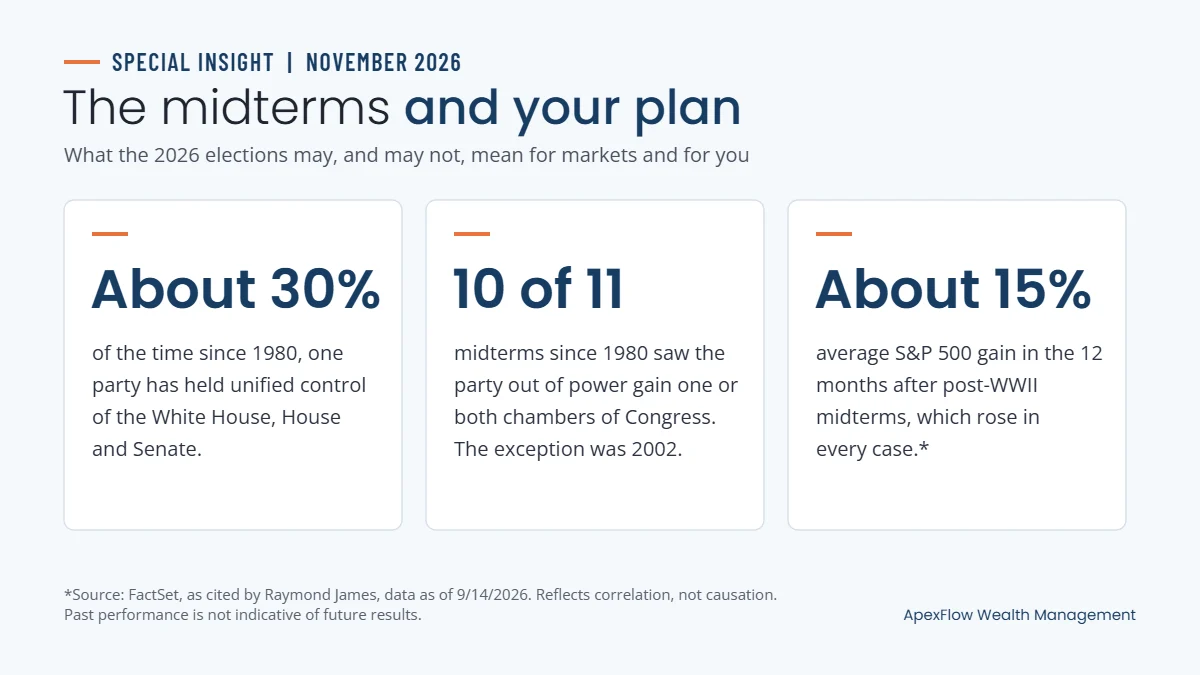
*Source: FactSet, as cited by Raymond James, data as of 9/14/2026. Past performance is not indicative of future results. Raymond James notes this reflects correlation, not causation.
Divided government is the norm, not the exception
Since 1980, one party has controlled the White House, the House and the Senate at the same time only about 30% of the time. Midterms often shift that balance. In 10 of the 11 midterm elections since 1980, the party out of power gained control of one or both chambers of Congress. The one exception was 2002.
Divided government can sound unsettling, but it has been the more common arrangement for most of the past four decades, and markets have worked through it many times.
Sweeping policy change tends to be harder
Major legislation usually needs support from both parties. When control of Washington is split, that support is harder to find, which often means fewer sweeping changes. The president also keeps veto power through January 2029 and can pursue some priorities through executive action. The courts remain an important check, as the Supreme Court’s ruling against the IEEPA tariffs showed.
For investors, that can mean fewer surprises from Congress, and more attention on executive actions, the courts and, before long, the 2028 presidential race.
State races can matter, too
This year, 39 states held elections for governor and 46 held elections for their legislatures. These races get less attention, but they can matter for certain industries. Utilities are one example. State commissions regulate them, and data centers are driving higher demand for electricity. New York paused new data center approvals for one year, and Pennsylvania tightened its rules. Health care policy, by contrast, is set mostly at the federal level.
What history says, and what it does not
According to FactSet data cited by Raymond James, the S&P 500 has risen in the 12 months following every midterm election since World War II, by about 15% on average.* Raymond James is careful to note that this is correlation, not causation. Elections are one factor among many, and past results do not guarantee future ones.
Other cycles can point in different directions. Because President Trump’s terms are not consecutive, 2027 is technically the seventh year of his presidency, and seventh years have historically brought more modest market gains. The takeaway is not to lean on any single pattern.
Rhetoric is not policy
Political rhetoric tends to get louder around elections, and certain industries, such as oil and gas, data centers and pharmaceuticals, are frequent targets. Strong words can move markets in the short term, but rhetoric is not the same as policy. Short-term volatility around headlines is normal, and it rarely changes the long-term direction of a well-built plan.
*Source: FactSet, as cited by Raymond James, data as of 9/14/2026. Past performance is not indicative of future results.
What this means for your plan
Our approach does not change based on who wins. We build plans around your goals, your time horizon and your need for income, not around election outcomes. Here is what we focus on instead:
- Staying diversified, so no single policy change or industry carries your whole plan.
- Keeping your risk level matched to your stage of life, not to the news cycle.
- Watching for policy changes that could touch your situation directly, such as taxes or specific industries, and talking them through with you and your tax professional.
- Expecting some volatility, and not letting it make decisions for you.
Elections matter. They shape policy, and policy can shape markets over time. But a well-built plan is designed to hold up through changes in Washington, the same way it is designed to hold up through changes in interest rates or market leadership.
Elections and emotions
Elections stir strong feelings, and it is natural to want your investments to reflect how you feel about the outcome. But portfolios built around political views can end up concentrated in ways that add risk. Keeping politics and portfolios separate is one of the simplest ways to protect a plan.
Most long-term mistakes aren’t caused by markets moving. They’re caused by letting fear or excitement drive a decision that a calmer moment wouldn’t have made. At ApexFlow, we help clients cut through the noise, clear the fog, and stay focused on what matters most.
If you have questions about how policy changes could affect your situation, please reach out or Book a 20-Minute Fit Call. We would be glad to talk them through.
At ApexFlow, our role is to clear the fog, remove the guesswork, and help you move forward with confidence, no matter what the headlines bring next.
With clarity and confidence,

Trevor Hanson
President, Founder and Wealth Advisor, RJFS
P.S. If the election has you wondering whether to make changes, call us at 385-606-0358 before you act. No question is too small.
Important disclosures
Any opinions are those of ApexFlow Wealth Management and not necessarily those of Raymond James. Expressions of opinion are as of this date and are subject to change without notice. Raymond James and its advisors do not offer tax or legal advice. You should discuss any tax or legal matters with the appropriate professional. Investing involves risk and you may incur a profit or loss regardless of strategy selected, including diversification and asset allocation. Prior to making an investment decision, please consult with your financial advisor about your individual situation.
This material is for informational purposes only and is not a recommendation. It is not intended to support or oppose any political party or candidate. Investing involves risk, and investors may incur a profit or a loss. There is no assurance the trends mentioned will continue or that the forecasts discussed will be realized. Past performance may not be indicative of future results. Economic and market conditions are subject to change. Diversification does not guarantee a profit nor protect against loss.
Sources: Raymond James, “Midterm elections: Potential political shifts and market volatility,” October 8, 2026. Historical S&P 500 data from FactSet, as cited by Raymond James, as of 9/14/2026.
The S&P 500 is an unmanaged index of 500 widely held stocks. An investment cannot be made in these indexes. The performance mentioned does not include fees and charges, which would reduce an investor’s returns.
Companies engaged in business related to a specific sector are subject to fierce competition and their products and services may be subject to rapid obsolescence. There are additional risks associated with investing in an individual sector, including limited diversification. Investing in oil or the energy sector involves special risks, including the potential adverse effects of state and federal regulation and may not be suitable for all investors.