
At a glance
- Cottonwood Heights is an east bench city at the entrance to Big and Little Cottonwood Canyons, with Snowbird, Alta, Brighton and Solitude a short drive up.
- Home prices sit above the valley average, in line with Holladay and Sandy’s east side, with larger lots and mountain views priced accordingly.
- State taxes are moderate: a flat 4.45 percent income tax for 2026, a credit that shields most retirees’ Social Security, and no estate tax.
- St. Mark’s Hospital, Alta View Hospital and Intermountain Medical Center are all within fifteen minutes.
- An active retirement here is a cash-flow plan with a healthy outdoor budget and a careful look at how much of your net worth sits in the house.
If you want to ski in the morning and be home for lunch, Cottonwood Heights is where you live. The city sits on the east bench of the Salt Lake Valley where Big and Little Cottonwood Canyons open, with four resorts within half an hour and hundreds of miles of trails out the back door. It is also quiet, well-kept and close to excellent hospitals, which is why so many of our clients retire here or stay here after the kids leave.
Two minutesHow much of your retirement is actually decided?Get my Clarity ScoreHousing on the east bench
Cottonwood Heights housing ranges from 1960s and 1970s ranches and split-levels on generous lots to newer custom homes higher on the bench with valley and canyon views. Prices are above the Salt Lake County average and comparable to Holladay and the east side of Sandy. Condos and townhomes near Fort Union Boulevard and the Old Mill area offer a lower entry point and are popular with downsizers who want the location without the yard.
Utah property tax favors full-time residents: a primary residence is taxed on 55 percent of its market value, and Salt Lake County rates are moderate. Many retirees who downsize within Cottonwood Heights find their property tax bill falls meaningfully with the smaller home. Utilities are inexpensive. The outdoor budget is the line item unique to this area: ski passes, bikes, gear and the occasional canyon-related vehicle expense.
Homes on the upper bench sit in wildland fire interface zones and on the Wasatch Fault. Earthquake insurance is a separate policy worth pricing, and homeowners insurance availability and cost in the highest neighborhoods should be confirmed before you buy.
Utah taxes in brief
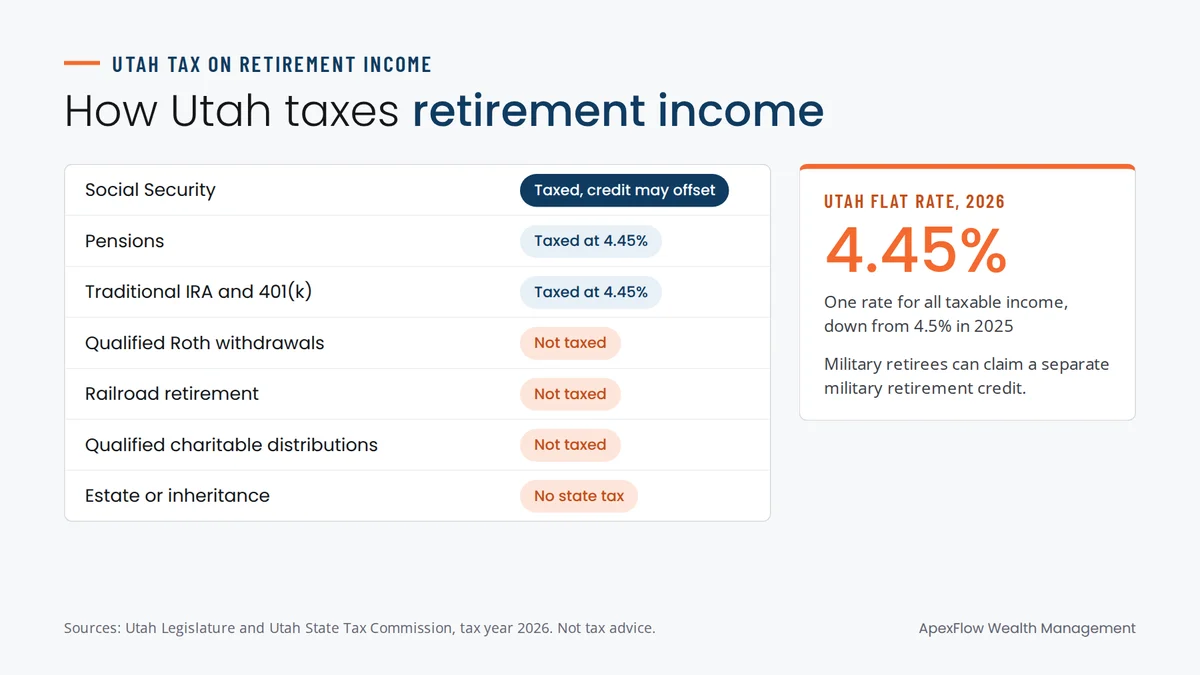
Utah’s rules fit in a sentence: a flat 4.45 percent income tax for 2026 on pensions, IRA withdrawals and capital gains, a credit that removes the tax on Social Security for retirees below an income limit, and no estate or inheritance tax. Because the rate is flat, the state side of decisions like Roth conversions is easy to estimate, and the real planning happens in the federal brackets. How Utah taxes retirement income has the details.
Hospitals close by
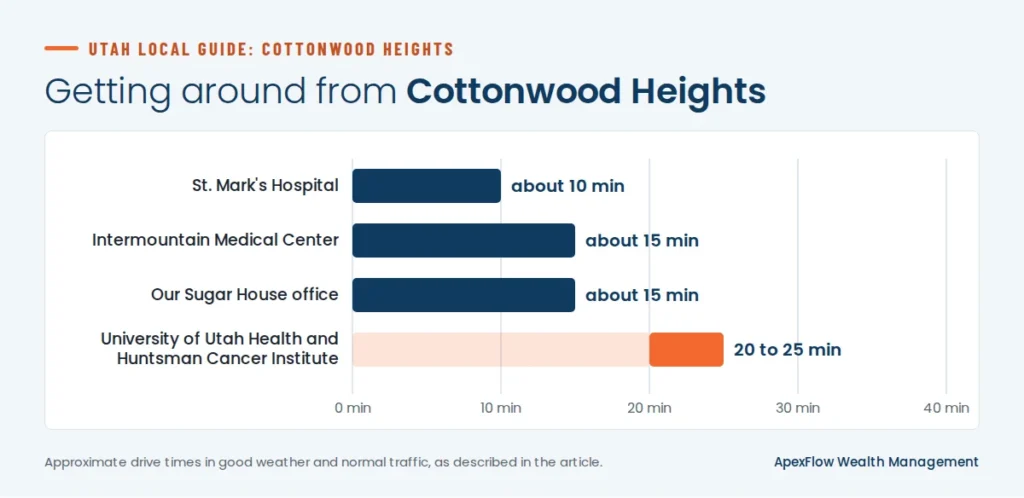
Few retirement locations in the West are better placed for care. St. Mark’s Hospital in Millcreek is ten minutes away. Alta View Hospital in Sandy is about the same. Intermountain Medical Center in Murray, one of the region’s largest hospitals, is fifteen minutes down Fort Union and Interstate 215. University of Utah Health, with the Huntsman Cancer Institute, is twenty to twenty-five minutes north. Both major health systems have clinics along Fort Union Boulevard and Highland Drive. For Medicare, traditional Medicare with a supplement gives access to all of them; Medicare Advantage plans should be checked for the specific hospitals and physicians you expect to use.
Two canyons out the back door
Four ski resorts, two canyons, the Bonneville Shoreline Trail and a city that keeps its parks and streets in good order. Winter inversions affect the valley floor more than the bench; Cottonwood Heights sits high enough to escape some of the worst days. Canyon traffic on powder weekends is a real inconvenience, and the Little Cottonwood transportation debate continues. Shopping, dining and services are concentrated along Fort Union and in nearby Holladay and Sandy.
Stay, downsize and the rest of the plan
How much house. Retirees who stay in the family home often hold half or more of their net worth in it. That is fine if the income plan works without touching the equity; it is a problem if it does not. We model both staying and downsizing before anyone decides.
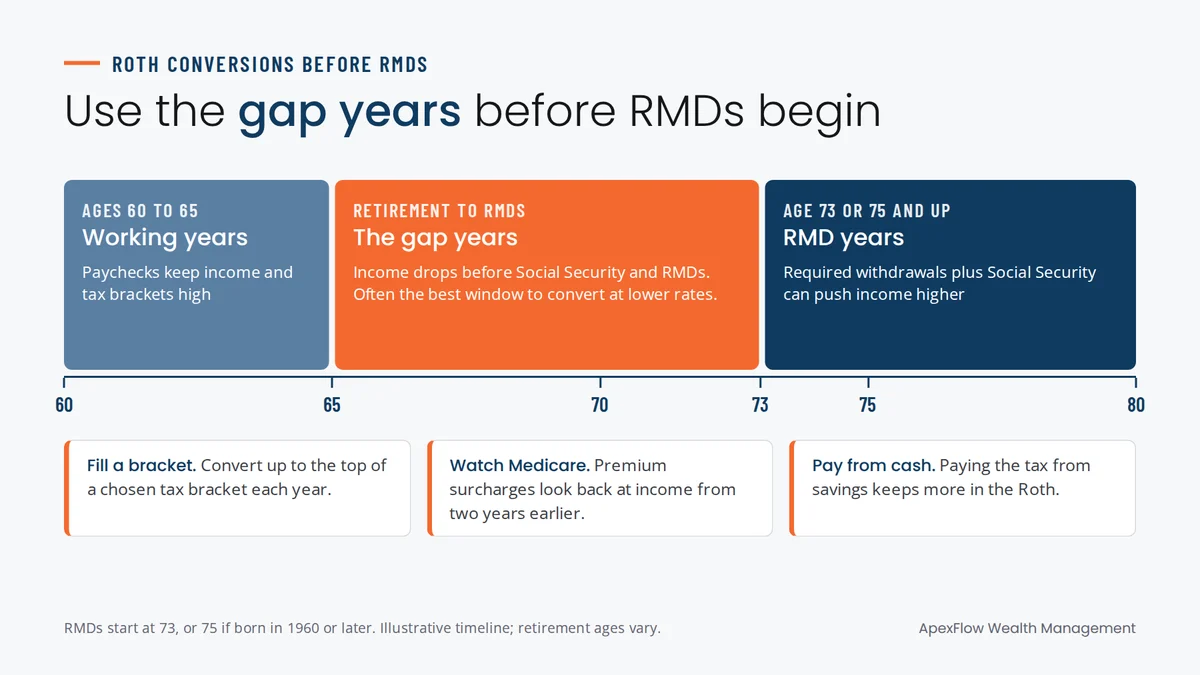
Income and taxes. Social Security timing, pension options, the order of withdrawals across taxable, traditional and Roth accounts, and whether Roth conversions in the early years make sense under Utah’s flat rate. Our article on Roth conversions before RMDs explains the window.
Health costs. Medicare premiums, a supplement or Advantage plan, and a long-term care plan, whether insurance, self-funding or a hybrid.
The estate plan. Utah documents, a trust holding the home so it passes without probate, and a clear plan for the house itself. Our article on leaving a home to your kids without a fight is written for exactly this situation.
The portfolio. Built from the plan, with enough liquidity that a market decline does not force a sale of the house or of stocks at the wrong time. See portfolio management.
Hypothetical example: A couple, 66 and 64, have lived in Cottonwood Heights for thirty years. The home is worth about $1.2 million and is half their net worth. They compare staying with a reverse-mortgage line of credit as a backstop against downsizing to a townhome near Old Mill and investing the difference. The downsizing plan lowers property tax and maintenance, adds enough to the portfolio to delay Social Security to 70 and fund Roth conversions through the low-income years, and keeps them five minutes from the canyons. They choose it. The example is illustrative only and is not a recommendation.
Working with us
Our office is fifteen minutes down the hill in Sugar House. Most Cottonwood Heights clients come to us with some version of the same question, stay or downsize, and we answer it with real numbers rather than a rule of thumb. See our Salt Lake City financial planning page for more on how we work.
Frequently asked questions
Housing is above the valley average, in line with other east bench communities. Property tax, utilities and healthcare costs are moderate, and Utah’s flat income tax is lower than many states’ top rates.
St. Mark’s, Alta View and Intermountain Medical Center are all within about fifteen minutes. University of Utah Health is twenty to twenty-five minutes north.
It depends on whether your income plan works without the home equity and on how you want to spend your time. We model both before recommending either.
Probably not, if your income is below the state credit’s limit. Utah starts with the federally taxable portion of your benefits and then gives a credit that cancels the tax; above the limit the credit shrinks.
Free one-page checklist
Moving to Utah: your financial checklist. Every step from before the move through your first year, on one printable page.
Talk it through with us
Every situation is a little different. If you want to talk through yours, book a 20-Minute Fit Call with one of our advisors, by video or in person. No prep and no obligation. Want to see how we work first? Start with the Purposeful Planning Process or our services.

The information in this article is general in nature and is not a recommendation for any individual. Consider your own circumstances or speak with an advisor before acting on it. Any opinions are those of the author and not necessarily those of Raymond James.
ApexFlow Wealth Management does not provide tax or legal advice. Please consult your tax or legal professional before acting on any strategy mentioned here.
Examples labeled as hypothetical are for illustration only. They are not based on any actual client and do not represent actual or expected results.
Related Articles
Dig deeper into our resource library
-
 October 29, 2026
How to Leave a Home to Your Kids Without Creating a Fight
The family home is the asset most likely to divide siblings after a death. Here is how to pass it on in a way that is clear, tax-smart and fair, with Utah-specific tools.Read more -
 November 5, 2026
Does Utah Tax Retirement Income? Social Security, Pensions and 401(k)s in 2026
If you’re planning to retire in Utah, or you already have, it’s worth knowing exactly how the state treats your income. The short answer: UtahRead more -
 November 5, 2026
Roth Conversions Before RMDs: Making the Most of the Gap Years
For many retirees, the years between leaving work and starting required minimum distributions are the lowest-tax years they’ll ever have. The paycheck has stopped, SocialRead more