

At a glance
- Homes cause more sibling conflict than any other asset because they carry memories, unequal use and a price nobody agrees on.
- Decide now whether the house should be sold, kept by one child or shared, and write the decision down with the reasoning.
- Inheriting a home at death gives the children a stepped-up cost basis, which usually makes it a mistake to gift the house during life.
- Utah allows a transfer on death deed, and a revocable trust avoids probate entirely. Adding a child to the deed now is usually the worst option.
- Equalize with other assets or life insurance when one child keeps the house, and name a clear process for valuing it.
When we ask clients what they most want to avoid, the answer is rarely taxes. It is their children not speaking to each other. The family home is where that risk concentrates. It cannot be split like a brokerage account, each child has a different relationship with it, and the one who lives nearby often ends up caring for it while the others wonder what it is worth.
Two minutesHow much of your retirement is actually decided?Get my Clarity ScoreWhy the house is different
Three things make a home harder to inherit than money. It is indivisible: three children cannot each take a third of a kitchen. It is emotional: one child wants to keep it, another sees a check, and both feel the other is wrong. And it has carrying costs: taxes, insurance, repairs and a mortgage keep arriving while the siblings decide.
Add an unequal history, where one child lived at home as an adult or provided care in the final years, and the ingredients for a dispute are all present. The solution is not a clever legal structure. It is a decision, made by you, communicated while you are alive.
Step one: decide what should happen to the house
There are really only three outcomes.
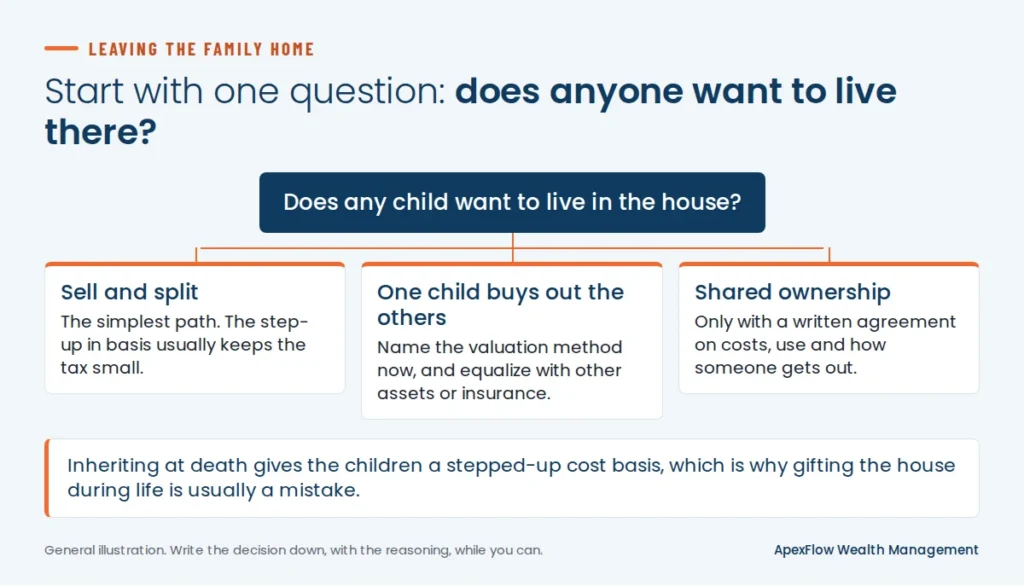
Sell it and divide the proceeds. The simplest and, for most families, the least contentious. The house is sold by the trustee or personal representative, costs are paid, and the children receive cash. Any sentimental items are handled separately.
One child keeps it and buys out the others. This works when a child wants the house and can afford it, either with their own funds, a mortgage, or by taking less of the other assets. The plan should say how the house will be valued (an appraisal by a named method, not a guess) and the timeline.
The children own it together. A cabin or a family home that everyone uses can work as shared property, but only with a written agreement covering who pays what, how decisions are made, how a sibling can exit and what happens when one of them dies or divorces. Without that agreement, shared ownership is where fights start. An LLC is often the cleanest container.
Write down which of these you want and why. Then tell your children. Our article on talking to adult children about inheritance has a format for that conversation.
Step two: use the tax rule in your favor
A home inherited at death receives a new cost basis equal to its fair market value on the date of death. If you bought a house in Sugar House in 1990 for $140,000 and it is worth $800,000 when you pass, your children’s basis is $800,000. They can sell it the next month with little or no capital gains tax.
A home gifted during your life carries your original basis. The same children selling the same house would face a gain of roughly $660,000. In Utah that gain is taxed federally and at the state’s flat rate. Gifting the home early to “avoid probate” is one of the most expensive well-intentioned mistakes we see.
The exception is a home you expect to sell soon anyway or one with little appreciation. Even then, the step-up usually wins. Confirm with your CPA before any deed is signed.
Step three: choose the right transfer tool
Revocable living trust. The house is deeded to your trust now; you remain in control; at death the successor trustee sells or distributes it according to your instructions with no probate. This is the most flexible option and the one we see most often for Utah homeowners with children. Our comparison of a trust versus a will in Utah covers the costs.
Transfer on death deed. Utah has allowed these since 2018. You record a deed naming the beneficiaries, keep full ownership during life, and the house passes to them at death without probate. It is inexpensive and revocable. Its limits: it gives no instructions about selling or buying out, it does not handle incapacity, and if a beneficiary dies first or the children disagree, there is no trustee to resolve it. It fits a simple situation with one or two cooperative heirs.
Joint ownership with a child. Adding a child to the deed now avoids probate, but it gives away half the house today, exposes the home to the child’s creditors and divorce, forfeits part of the step-up in basis, and can require a gift tax return. We almost never recommend it.
Will alone. The house goes through probate. Utah probate is manageable, but it is public, takes months and costs attorney time, which is exactly the environment where sibling tensions grow.
Step four: equalize and specify
If one child keeps the house, decide how the others are made whole. Options include a larger share of the retirement accounts or investments, a life insurance policy payable to the other children, or a note from the child who keeps the house. If the shares will not be equal, say so and say why. An unequal inheritance that is explained is accepted far more often than an equal one that feels unfair.
Specify the mechanics. Name the appraisal method. Set a deadline for the buyout decision. Say who pays the mortgage and utilities during administration. Give the trustee authority to sell if the children cannot agree within a set period. These sentences prevent most disputes.
Hypothetical example: A widow in Millcreek owns a home worth about $900,000, a $700,000 IRA and modest savings. Her daughter lives nearby and wants the house; her two sons live out of state. Her trust directs that the daughter may buy the home at appraised value within nine months, with the right to credit her share of the estate toward the price. The IRA is left to the three children equally, and the sons receive a larger share of the remaining cash so the totals are close. She explains the plan at a family dinner. The example is illustrative only.
Keep the plan current
Property values change, children’s circumstances change and the child who wanted the house at 35 may not at 50. Revisit the decision every few years, the same way you would the rest of your plan. Our estate planning page describes how we work with your attorney on it.
Frequently asked questions
In almost every case, no. It gives away ownership now, exposes the home to the child’s creditors, and costs part of the step-up in basis. A revocable trust or a Utah transfer on death deed avoids probate without those problems.
A recorded deed that names who receives the property at your death. You keep full ownership and can revoke it at any time. It avoids probate but gives no instructions for selling, buying out or handling incapacity.
Name the method in your documents: for example, the average of two independent appraisals ordered by the trustee within a set number of days after death. The more specific the instruction, the less room for argument.
If they inherit it at your death, their basis is the value at that date, so a sale soon after produces little or no capital gain. If you gift it during life, they inherit your original basis and could owe substantial tax.
Talk it through with us
Every situation is a little different. If you want to talk through yours, book a 20-Minute Fit Call with one of our advisors, by video or in person. No prep and no obligation. Want to see how we work first? Start with the Purposeful Planning Process or our services.

The information in this article is general in nature and is not a recommendation for any individual. Consider your own circumstances or speak with an advisor before acting on it. Any opinions are those of the author and not necessarily those of Raymond James.
ApexFlow Wealth Management does not provide tax or legal advice. Please consult your tax or legal professional before acting on any strategy mentioned here.
Examples labeled as hypothetical are for illustration only. They are not based on any actual client and do not represent actual or expected results.
Related Articles
Dig deeper into our resource library
-
 October 29, 2026
A Financial Checklist After Losing a Spouse: The First Year, Step by Step
After a spouse dies, only a few financial tasks are urgent and most can wait. A calm, time-ordered checklist for the first two weeks, the first 90 days and the first year, with Utah specifics.Read more -
 October 29, 2026
Utah Trust vs. Will: What Each Actually Costs and Covers
A will and a revocable trust do different jobs, cost different amounts and leave your family with different work to do. Here is an honest comparison for Utah families.Read more -
 November 5, 2026
How to Talk to Your Adult Children About Inheritance
There’s a particular kind of silence that shows up around estate planning. Parents don’t want to talk about it because it means talking about theirRead more