
At a glance
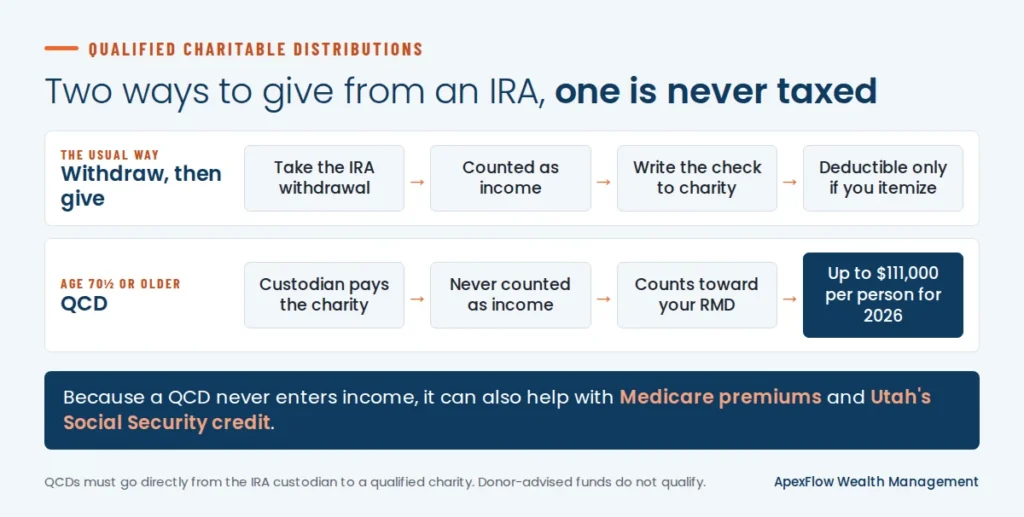
- A qualified charitable distribution (QCD) is a direct transfer from your IRA to a qualified charity. It is never included in your income.
- You must be at least 70½ on the day of the transfer. The 2026 limit is $111,000 per person.
- A QCD counts toward your required minimum distribution, which makes it a way to satisfy the RMD without raising your taxable income.
- Because it lowers adjusted gross income, a QCD can also protect Social Security taxation, Medicare premiums and Utah’s Social Security credit.
- Donor-advised funds and private foundations do not qualify, and the check must go from the custodian to the charity, not through you.
Most retirees who give to charity do it the expensive way. They take money from an IRA, pay tax on it, write a check to the charity and then, because the standard deduction is large, receive little or no tax benefit for the gift. A qualified charitable distribution reverses that. The money goes straight from the IRA to the charity and never touches your tax return. For a retiree who is already giving, it is close to free money, and it is one of the first things we check for clients past 70.
Two minutesHow much of your retirement is actually decided?Get my Clarity ScoreHow a QCD works
You instruct your IRA custodian to send a payment directly to a qualified public charity. The custodian either mails a check to the charity or issues a check payable to the charity that you deliver. The amount is reported on your Form 1099-R as a distribution, and you note on your tax return that it was a QCD. It is excluded from your gross income entirely. You do not itemize to get the benefit; it simply never counts as income.
The requirements are specific.
- You must be 70½ or older on the date of the distribution, not just during the year.
- The gift must come from an IRA: traditional, inherited, inactive SEP or SIMPLE. It cannot come from a 401(k) or other employer plan without first rolling to an IRA.
- The recipient must be a 501(c)(3) public charity. Donor-advised funds, private foundations and supporting organizations do not qualify.
- You cannot receive anything of value in return. A gala ticket or a benefit dinner disqualifies the portion that pays for it.
- The limit is per person, not per couple. For 2026 it is $111,000, indexed for inflation each year.
Why it beats a normal donation
Three reasons, in order of how often they matter.
It satisfies your RMD. From the year you turn 73 (or 75 for younger retirees), you must take required minimum distributions. A QCD counts toward that amount. If your RMD is $30,000 and you give $10,000 by QCD, you take $20,000 as a taxable distribution and the other $10,000 goes to charity untaxed. Our article on the 2026 RMD rules covers the rest of that calculation. Note that you can begin QCDs at 70½, before RMDs start, which reduces the balance future RMDs are based on.
It lowers adjusted gross income, not just taxable income. A standard charitable deduction reduces taxable income only if you itemize. A QCD reduces AGI, which drives a long list of other calculations: how much of your Social Security is taxed, whether you cross a Medicare premium threshold, whether you qualify for Utah’s Social Security tax credit, and whether net investment income tax applies. For a retiree near any of those lines, a QCD can save more than the income tax on the gift itself.
It works even if you take the standard deduction. Most retirees do. A QCD gives the full tax benefit of the gift regardless.
Hypothetical example: A retired couple in Bountiful, both 74, have a combined RMD of $42,000 and give about $12,000 a year to their church and a local food bank. Previously they took the full RMD, paid tax on all of it and donated from their checking account, with no deduction because they take the standard deduction. Switching to QCDs removes $12,000 from their income. At a 22 percent federal bracket plus Utah’s 4.45 percent, that is roughly $3,200 of tax saved each year, and their lower AGI keeps them under a Medicare premium threshold they were close to crossing. The figures are illustrative and not a projection for any individual.
Mistakes that disqualify a QCD
- Taking the money yourself first. If the distribution is paid to you and you then donate it, it is a normal taxable distribution followed by a normal donation. The check must be payable to the charity.
- Giving to a donor-advised fund. These are popular and useful for other gifts, but they do not qualify for QCDs.
- Timing after an RMD is already taken. The first dollars out of an IRA each year count toward the RMD. If you take your full RMD in January and do a QCD in November, the QCD still excludes the gift from income, but it did not reduce the taxable RMD. Do the QCD first.
- Deducting it too. A QCD cannot also be claimed as an itemized charitable deduction.
- Making deductible IRA contributions after 70½. These reduce the amount you can treat as a QCD. Working retirees who contribute to an IRA should check this rule.
- Not telling your tax preparer. The 1099-R does not distinguish a QCD from a taxable distribution. You or your preparer must mark it on the return.
A note on the one-time split-interest option
Since 2023 you may make a one-time QCD of up to $55,000 (the 2026 figure) to a charitable gift annuity or charitable remainder trust that pays you income. It is a narrow option with specific rules, and it counts against your annual QCD limit. It can fit a retiree who wants both a gift and lifetime income, and it is worth a conversation rather than a decision from an article.
Where this fits in your plan
Charitable giving is a values decision first, and it usually comes up early, when we ask clients what their money is for. The QCD is simply the most efficient way to carry out a decision you have already made. It sits alongside the rest of your estate plan: beneficiary designations that name charities on retirement accounts, gifts of appreciated stock from taxable accounts for those under 70½, and the plan for what passes to children. Our estate planning page describes how we coordinate these with your attorney and CPA.
Frequently asked questions
Yes, if each of you is 70½ or older and has your own IRA. The limit applies per person, so a couple could give up to $222,000 in 2026 through QCDs.
No. QCDs are available only from IRAs. Many retirees roll a 401(k) into an IRA after retiring, which then makes QCDs possible.
There is no RMD to satisfy yet, but the QCD still removes money from the IRA tax-free, which reduces the balance that future RMDs will be calculated on.
Yes. Many retirees give exactly what they would have given anyway through QCD and take the remainder of the RMD as a taxable distribution.
Free one-page checklist
Required minimum distributions: a planning checklist for 2026. Start dates, deadlines and the ways to reduce the tax, on one printable page.
Talk it through with us
Every situation is a little different. If you want to talk through yours, book a 20-Minute Fit Call with one of our advisors, by video or in person. No prep and no obligation. Want to see how we work first? Start with the Purposeful Planning Process or our services.
The information in this article is general in nature and is not a recommendation for any individual. Consider your own circumstances or speak with an advisor before acting on it. Any opinions are those of the author and not necessarily those of Raymond James.
ApexFlow Wealth Management does not provide tax or legal advice. Please consult your tax or legal professional before acting on any strategy mentioned here.
Examples labeled as hypothetical are for illustration only. They are not based on any actual client and do not represent actual or expected results.
Related Articles
Dig deeper into our resource library
-
 October 29, 2026
A Financial Checklist After Losing a Spouse: The First Year, Step by Step
After a spouse dies, only a few financial tasks are urgent and most can wait. A calm, time-ordered checklist for the first two weeks, the first 90 days and the first year, with Utah specifics.Read more -
 October 29, 2026
The Inherited IRA 10-Year Rule: What to Do When You Inherit an IRA or 401(k)
Most people who inherit an IRA or 401(k) now have ten years to empty it, and many must also withdraw something every year. How the rules sort beneficiaries, what spouses can do, and how to spread the tax.Read more -
 October 29, 2026
Required Minimum Distributions: The 2026 Rules and How to Reduce Them
RMDs start at 73 for most retirees today and 75 for younger ones. Here are the 2026 rules, the penalties, and the five ways to shrink the tax bill they create.Read more