
At a glance
- Rebalancing means selling what has grown beyond its target and buying what has fallen below it, to bring a portfolio back to the mix your plan calls for.
- Its main job is controlling risk, not boosting returns. A portfolio left alone drifts toward whatever has done well, which is usually also what is riskiest.
- We rebalance when an asset class drifts outside a preset band, not on a fixed calendar date, and we use new deposits, withdrawals and dividends to do as much of it as possible.
- In taxable accounts, rebalancing is coordinated with tax-loss harvesting and gains management so the tax cost stays small.
- The rules are written into your investment policy before you invest, which is what makes them easy to follow in a hard month.
If you set a portfolio to 60 percent stocks and 40 percent bonds and then did nothing for ten years, you would not own a 60/40 portfolio at the end. Stocks usually grow faster, so you might own 75 percent stocks, with the risk that implies, right when you are closer to needing the money. Rebalancing is the discipline of putting the mix back.
Two minutesHow much of your retirement is actually decided?Get my Clarity ScoreWhy drift matters
Your target allocation is not arbitrary. It comes from your plan: how much you need, when you need it and how much decline you can tolerate along the way. We describe that work on our portfolio management page. Drift quietly undoes it. After a strong run in stocks, a portfolio carries more risk than you agreed to. After a sharp decline, it carries less, and you own fewer of the assets that tend to recover. In both cases the portfolio has stopped matching the plan.
Rebalancing’s first job is to keep the risk level where you chose it. Any return benefit is secondary and smaller than people expect. We do not rebalance to beat the market. We rebalance so the portfolio keeps doing the job the plan assigned it.
Bands, not birthdays
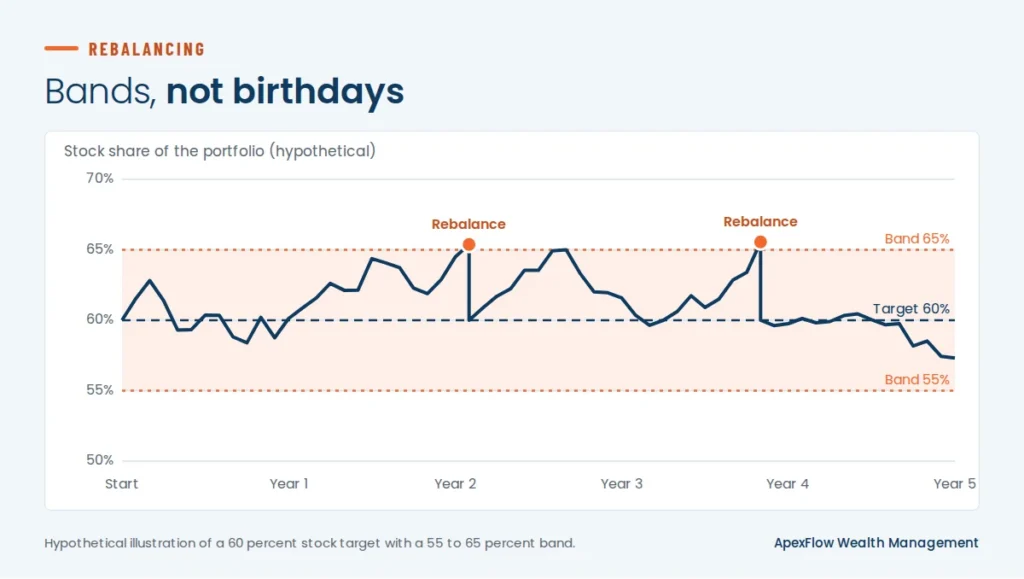
Many investors rebalance once a year on a fixed date. It is simple and better than nothing. We prefer tolerance bands: each asset class has a target and an allowed range around it, and we act when the range is breached. A 60 percent stock target might have a band of 55 to 65 percent. If stocks rally to 66 percent, we trim. If they fall to 54 percent, we add.
Bands have two advantages. They respond to markets rather than to the calendar, so a large move in March is addressed in March rather than next January. And they avoid trading when nothing meaningful has changed, which keeps costs and taxes down. The width of the band is a judgment: too narrow and you trade constantly, too wide and the portfolio wanders. We set bands by asset class, wider for volatile holdings and narrower for the core.
Cash flows do most of the work
The cheapest rebalancing trade is the one you never place. When a client adds money, we direct it to whatever is below target. When a client takes a withdrawal, it comes from whatever is above target. Dividends and interest are pointed the same way. For a portfolio with regular contributions or distributions, this alone keeps the allocation close, and the band-triggered trades become rare.
Rebalancing in taxable accounts
In a retirement account, rebalancing is free of tax consequences and we simply follow the bands. In a taxable account, selling a winner creates a capital gain, so we are more careful.
- We rebalance across accounts, not within each one. If stocks are over target, we sell them in the IRA where there is no tax, and leave the taxable account alone where possible.
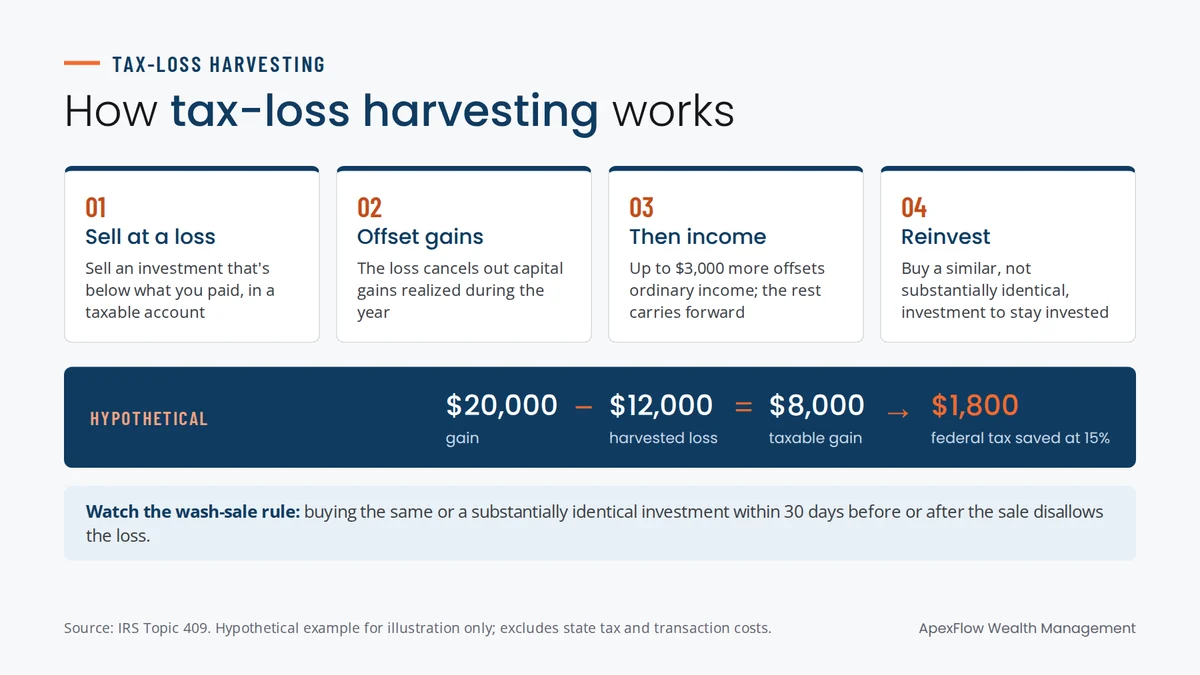
- We harvest losses when markets offer them, which creates room to realize gains elsewhere. Our article on tax-loss harvesting explains the mechanics.
- We check the holding period and the specific tax lots before any sale, and we look at the year’s tax picture with the client’s CPA when a large trade is on the table.
- Sometimes we accept a slightly wider drift in a taxable account rather than trigger a large gain, and note that decision in the file.
Rebalancing a non-retirement account can be a taxable event. We think the risk control is usually worth a modest tax cost, and we work to keep it modest.
Hypothetical example: A couple in Cottonwood Heights hold a $2 million portfolio with a 60 percent stock target across an IRA, a Roth and a joint taxable account. After a strong year, stocks reach 67 percent. We sell stock funds inside the IRA to bring the household allocation back to 60, buy bonds there, and leave the taxable account untouched. Their quarterly withdrawal is taken from the stock fund in the taxable account, which also nudges the mix back and uses a high-basis lot. No capital gains are realized. The example is illustrative only.
The rule is written before the storm
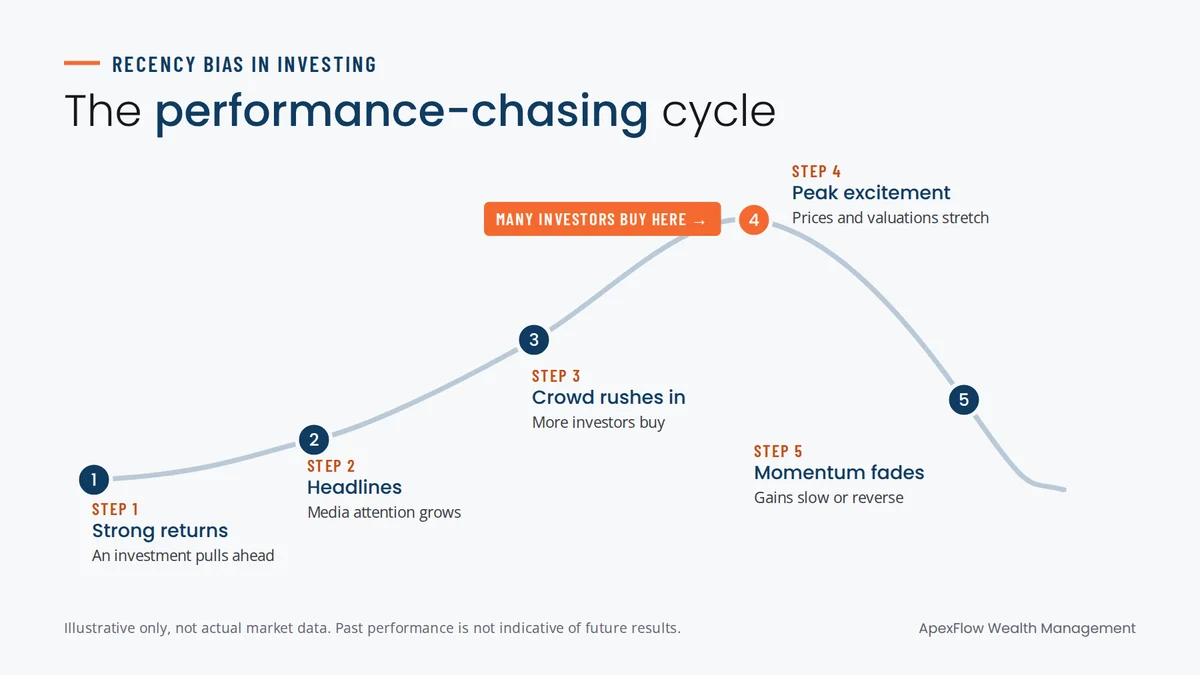
The hardest rebalancing trade is the one that feels wrong: buying stocks after they have fallen 25 percent, or selling them after a euphoric run. Every instinct argues against it. That is why the rules live in a written investment policy statement agreed to before anything is invested. In a hard month we are not deciding what to do; we are doing what we already decided. Our articles on loss aversion and recency bias describe the instincts the rules are designed to override.
What rebalancing is not
It is not market timing. We do not move the target because we have a view on next quarter. It is not a guarantee against loss; a 60/40 portfolio can still fall meaningfully. And it is not a substitute for the plan. If your goals or time horizon change, the target changes through the planning process, not through drift. That is step four of the Purposeful Planning Process, Adjust with Intention: the portfolio is reviewed alongside the plan at least once a year and whenever life changes.
If you would like to see how your current portfolio compares to its intended mix, that is a reasonable thing to bring to a 20-Minute Fit Call.
Frequently asked questions
Whenever an asset class moves outside its band, which in a typical year might be a few times or not at all, plus continuously through deposits, withdrawals and dividends. We also review the allocation at every planning meeting.
Its purpose is to control risk. Over long periods it has sometimes added a small amount of return by systematically buying low and selling high, but that is not reliable and not why we do it.
In retirement accounts, no. In taxable accounts we rebalance across accounts, use cash flows and harvest losses to keep realized gains small, and we discuss any large trade with you first.
Yes. Most plans offer automatic rebalancing on a schedule. Turning it on, with a target that matches your overall plan, is a sensible step. We can include your 401(k) in the household allocation even though we do not manage it directly.
Talk it through with us
Every situation is a little different. If you want to talk through yours, book a 20-Minute Fit Call with one of our advisors, by video or in person. No prep and no obligation. Want to see how we work first? Start with the Purposeful Planning Process or our services.

The information in this article is general in nature and is not a recommendation for any individual. Consider your own circumstances or speak with an advisor before acting on it. Any opinions are those of the author and not necessarily those of Raymond James.
Investing involves risk, and you may incur a profit or loss regardless of the strategy selected, including diversification and asset allocation. Past performance does not guarantee future results.
Examples labeled as hypothetical are for illustration only. They are not based on any actual client and do not represent actual or expected results.
Related Articles
Dig deeper into our resource library
-
 November 5, 2026
Tax-Loss Harvesting: How It Works and How to Avoid the Wash-Sale Rule
No one likes seeing an investment lose value. But in a taxable account, a loss can have a silver lining. Tax-loss harvesting means selling anRead more -
 November 5, 2026
Recency Bias in Investing: Why Chasing Recent Winners Often Backfires
There’s a moment many investors recognize. A sector is surging. A fund is outperforming. An investment seems to be winning everywhere you look. The urgeRead more -
 November 5, 2026
Loss Aversion Investing: Why Market Downturns Feel Worse Than They Are
A market drops 3% in a week and it feels like the beginning of something bad. A market climbs 3% in a week and itRead more