

At a glance
- “Alternatives” means investments outside public stocks, bonds and cash: private credit, private equity, private real estate, hedge strategies and similar.
- Their appeal is return sources that do not move in lockstep with public markets. Their cost is illiquidity, higher fees, less transparency and more paperwork.
- Most are limited to accredited investors or qualified purchasers, and some newer fund structures open the door a little wider.
- They suit investors with a long horizon, a fully funded core portfolio, ample liquidity elsewhere and a real tolerance for not being able to sell.
- For many families the right allocation is zero. For some it is a modest slice. For very few is it the center of the plan.
A few years ago, alternative investments were something clients asked about after reading about a university endowment. Now they are advertised during sports broadcasts. Private credit funds, real estate interval funds and private equity vehicles are reaching investors who were never offered them before, with marketing that emphasizes yield and “access” and says less about what you give up. We get asked about them most weeks now, and our answer is more often no than yes.
Two minutesHow much of your retirement is actually decided?Get my Clarity ScoreWhat counts as an alternative
The label covers anything outside the traditional public markets.
- Private credit: loans made directly to companies, often mid-sized businesses that do not issue public bonds. Returns come from interest, which has been attractive in a higher-rate environment. Risks include borrower defaults, limited pricing transparency and the fact that the loans cannot be sold quickly.
- Private equity: ownership stakes in companies that are not publicly traded, acquired with the intent to improve and sell them years later. Capital is called over time and returned over a decade or more.
- Private real estate: direct property or funds that hold it, offering income and potential appreciation with less daily price noise than public REITs, partly because the holdings are appraised rather than traded.
- Hedge and absolute return strategies: funds that use leverage, shorting or derivatives to pursue returns independent of market direction.
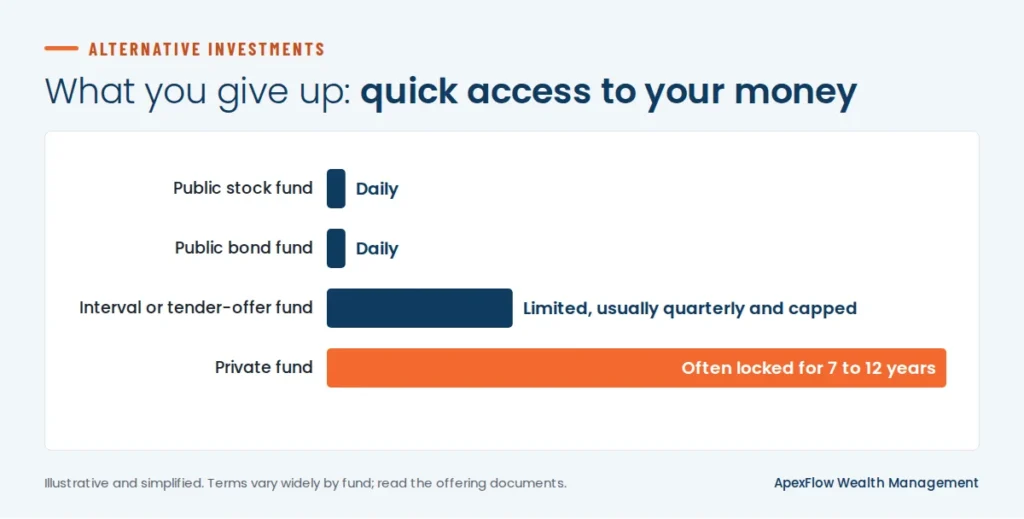
Interval funds and tender-offer funds are newer wrappers that hold these kinds of assets and allow limited redemptions, usually quarterly and capped. They are more accessible, but “limited redemptions” is the key phrase: in a stressed period, you may not be able to get out when you want.
What you actually give up
Liquidity. This is the big one. A public stock fund can be sold today. A private fund may lock your money for seven to twelve years, with no secondary market worth the name. An interval fund may let you redeem 5 percent of the fund per quarter, shared among everyone who asks. If your plan might need that money, it does not belong here.
Fees. Management fees are typically higher than for public funds, and many structures add a performance fee on gains. Those costs are not disqualifying if the strategy earns them, but they raise the bar.
Transparency and valuation. Private holdings are valued by appraisal or model, not by a market. Smooth reported returns partly reflect that method. A lack of visible volatility is not the same as a lack of risk.
Complexity. Capital calls, K-1 tax forms that arrive late and sometimes require extensions, state tax filings in multiple places, and subscription documents that run dozens of pages. Each is manageable; together they are a cost in time and in accounting fees.
Who is eligible
Most private funds require you to be an accredited investor, which under current rules means roughly $200,000 of income ($300,000 with a spouse) in each of the last two years, or $1 million of net worth excluding your home, or certain professional licenses. Some funds require qualified purchaser status, generally $5 million in investments. Interval funds and some registered vehicles have lower or no thresholds. Eligibility is a legal floor, not a recommendation; qualifying does not mean you should.
Who they are for
In our practice, alternatives make sense for a client when all of the following are true.
- The core portfolio of diversified public stocks and bonds is already built and funded for the plan’s goals.
- There is a long horizon for the money in question, measured in a decade or more, and no realistic scenario in which it is needed sooner.
- Cash reserves and liquid investments cover several years of spending without touching the private allocation.
- The client understands and accepts that the money cannot be accessed on demand, and that reported values are estimates.
- The specific fund has been evaluated on its manager, strategy, fees, terms and the role it plays, not on a yield in an advertisement.
- The allocation is sized so that even a poor outcome does not change the plan.
For a retiree living on portfolio withdrawals, that often means a small allocation or none. For a business owner or executive with a long horizon and substantial liquid assets, a modest slice of private credit or real estate can add a return source that behaves differently from public markets. We are candid when the answer is no.
Hypothetical example: A 52-year-old executive in Park City has a $4 million diversified portfolio, a paid-off home, three years of spending in short-term bonds and a long horizon. After the core portfolio is in place, we evaluate allocating roughly 10 percent to a private credit fund and a private real estate fund with quarterly liquidity, sized so a disappointing result would not alter her retirement date. A 68-year-old retiree drawing 4 percent a year from a $1.5 million portfolio, by contrast, would likely be better served keeping the full portfolio liquid. Both examples are illustrative and not recommendations.
How we evaluate a specific fund
Where suitable, and where a client meets the eligibility requirements, we may include alternative investments through the platform available to us. Each one is assessed on who manages it and their record through difficult periods, what the strategy actually does, the full fee load including performance fees, the redemption terms in plain language, the tax reporting burden, and the role it plays in the portfolio. We say no to far more than we say yes to.
Where this fits
Alternatives are the last thing we add to a portfolio, never the first. The order on our portfolio management page is deliberate: the plan decides the allocation, the allocation is built from diversified public markets, and only then do we ask whether a private allocation adds something the plan needs. If you have been offered a private investment and want a second opinion before signing, that is a good use of a 20-Minute Fit Call.
Frequently asked questions
Lower reported volatility often reflects infrequent appraisal-based pricing rather than lower risk. Private investments can and do lose money, and the inability to sell during a downturn is itself a risk.
A registered fund that holds less liquid assets and offers to repurchase a limited percentage of shares at set intervals, usually quarterly. You can buy any time but can only sell when the fund offers, and requests may be prorated if too many investors want out at once.
A legal category based on income, net worth or professional credentials that determines who may invest in certain private offerings. It is an eligibility rule, not a judgment that the investment is suitable for you.
For many investors, none. Where they fit, allocations are typically modest and sized so a poor outcome does not change the plan. The answer depends on your horizon, liquidity, goals and tolerance for complexity, which is a planning conversation rather than a rule of thumb.
Talk it through with us
Every situation is a little different. If you want to talk through yours, book a 20-Minute Fit Call with one of our advisors, by video or in person. No prep and no obligation. Want to see how we work first? Start with the Purposeful Planning Process or our services.
The information in this article is general in nature and is not a recommendation for any individual. Consider your own circumstances or speak with an advisor before acting on it. Any opinions are those of the author and not necessarily those of Raymond James.
Investing involves risk, and you may incur a profit or loss regardless of the strategy selected, including diversification and asset allocation. Past performance does not guarantee future results.
Alternative investments involve substantial risks that may be greater than those associated with traditional investments and are not suitable for all investors. These risks include limited liquidity, tax considerations, incentive fee structures, potentially speculative strategies and different regulatory and reporting requirements.
Examples labeled as hypothetical are for illustration only. They are not based on any actual client and do not represent actual or expected results.
Related Articles
Dig deeper into our resource library
-
 November 6, 2026
How We Think About Rebalancing
Rebalancing is the least exciting thing we do for a portfolio and one of the most important. Here is what it is, why we use bands instead of dates, and how taxes change the approach.Read more -
 November 5, 2026
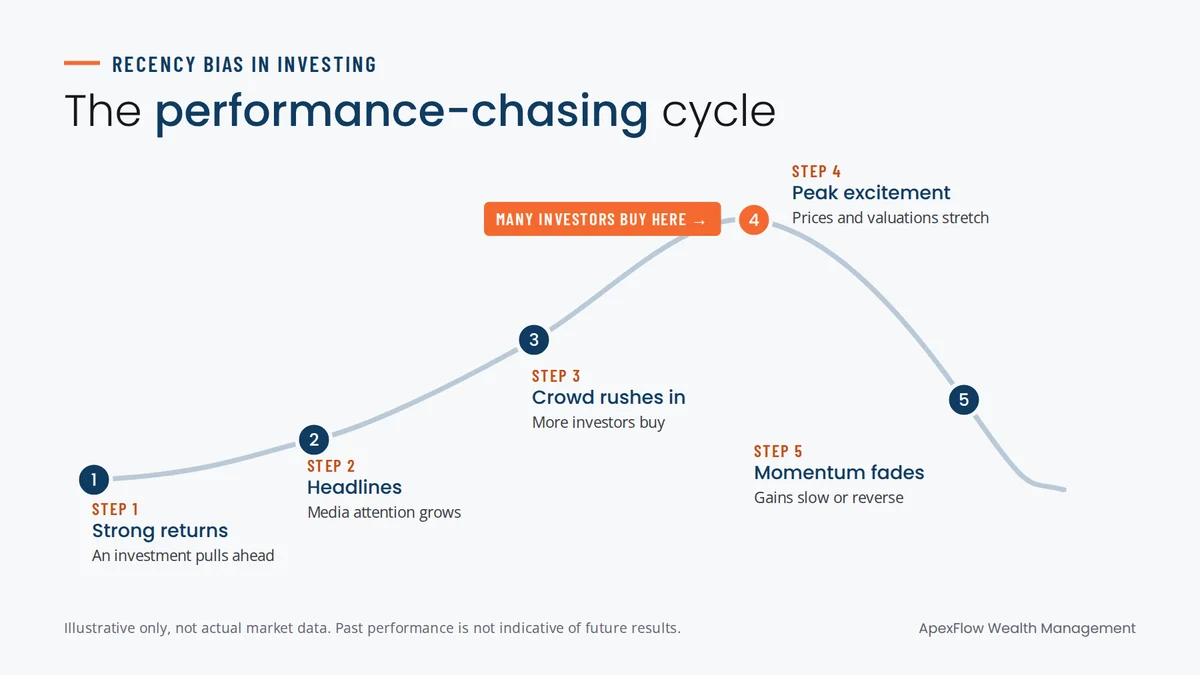
Recency Bias in Investing: Why Chasing Recent Winners Often Backfires
There’s a moment many investors recognize. A sector is surging. A fund is outperforming. An investment seems to be winning everywhere you look. The urgeRead more