
At a glance
- Housing is the dominant cost. Park City home prices are far above the Utah average, and the primary-residence property tax exemption only applies if you actually live there.
- Utah taxes income at a flat 4.45 percent for 2026, has no estate or inheritance tax, and offers a Social Security credit for retirees under an income threshold.
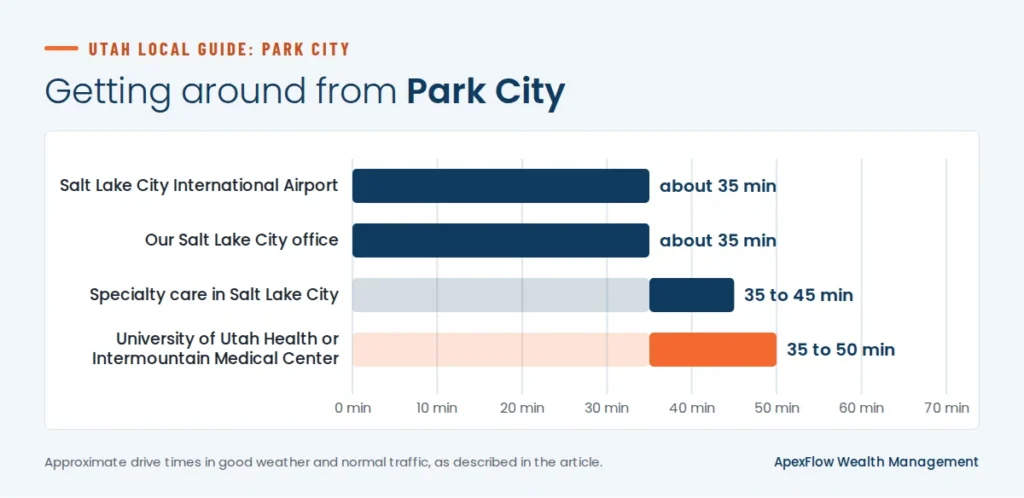
- Intermountain Park City Hospital covers most needs; specialty care usually means a drive to Salt Lake City, about 35 to 45 minutes in good weather.
- Altitude, winter driving and a seasonal economy are real lifestyle factors to test before you buy.
- A retirement in Park City is a cash-flow plan first: the carrying cost of the home shapes everything else.
Park City draws retirees for obvious reasons: two major ski resorts, hundreds of miles of trails, a walkable historic Main Street, a real arts calendar and an international airport 35 minutes away. We work with clients who have retired here from California, Texas, the Midwest and the East Coast, and with longtime Utahns who moved up the canyon. The appeal is not in question. The planning is.
Two minutesHow much of your retirement is actually decided?Get my Clarity ScoreWhat a Park City home really costs
Park City and the surrounding Snyderville Basin are the most expensive residential markets in Utah. Prices in Old Town, Deer Valley and the newer developments along the Jordanelle sit well above the Wasatch Front, and homeowners association fees in resort communities can be substantial. Kimball Junction, Jeremy Ranch, Pinebrook and Silver Springs offer somewhat lower entry points with easier access to Interstate 80, and many retirees find the trade worthwhile.
Utah’s property tax has a feature that matters here. A primary residence is taxed on 55 percent of its market value because of the 45 percent residential exemption. A second home is taxed on 100 percent. If you keep a home elsewhere and treat Park City as the second residence, your property tax bill will be nearly double what a full-time resident pays on the same house. Summit County requires a signed declaration to claim the exemption.
Everyday costs beyond housing, such as groceries, fuel and services, run higher than in the Salt Lake Valley but not dramatically so. Utah applies a reduced state sales tax rate to groceries. Winter brings snow removal, higher heating costs and, for many, a second vehicle with four-wheel drive.
State taxes, and the second-home trap
Utah’s income tax is a flat 4.45 percent for 2026, and it applies to pensions, IRA withdrawals and capital gains alike. Social Security is the exception for many retirees: a state credit removes the tax on benefits below an income limit. There is no estate or inheritance tax.
For Park City buyers the bigger lever is often property tax. As noted above, keeping Utah as your primary residence nearly halves the bill on the same house. On the income side, retirees from California or Oregon usually come out ahead, while those from Nevada or Texas take on a new cost. Our article on Utah’s income tax for retirees moving from other states runs the comparison.
Healthcare up the canyon
Intermountain Park City Hospital, near Kimball Junction, is a full-service community hospital with an emergency department, surgery, imaging and a growing roster of specialists. For complex cardiac, cancer or neurological care, most residents go down to University of Utah Health or Intermountain Medical Center in Murray, each 35 to 50 minutes away depending on weather and traffic. Heber Valley Hospital is a second nearby option.
Two practical points. If you plan to use Medicare Advantage, confirm that the plan’s network includes the Park City and Salt Lake providers you expect to use; networks are regional and a plan from your previous state will not travel. And if you have a condition that is sensitive to altitude, talk with your physician before committing. Park City sits near 7,000 feet, with many neighborhoods higher.
Lifestyle factors to test before you buy
- Winter. Snowy roads, early darkness and a season that lasts from November into April. Many retirees love it; some discover they would rather visit.
- Seasonality. The town fills at Christmas, Sundance and summer weekends, and quiets considerably in the spring and fall shoulder seasons. Services and restaurants adjust accordingly.
- Distance to family. The airport is close, which helps, but the drive from the valley in a storm is a different experience than in July.
- Rent first. A ski-season lease followed by a summer stay tells you more than any number of visits.
Questions to settle before you buy
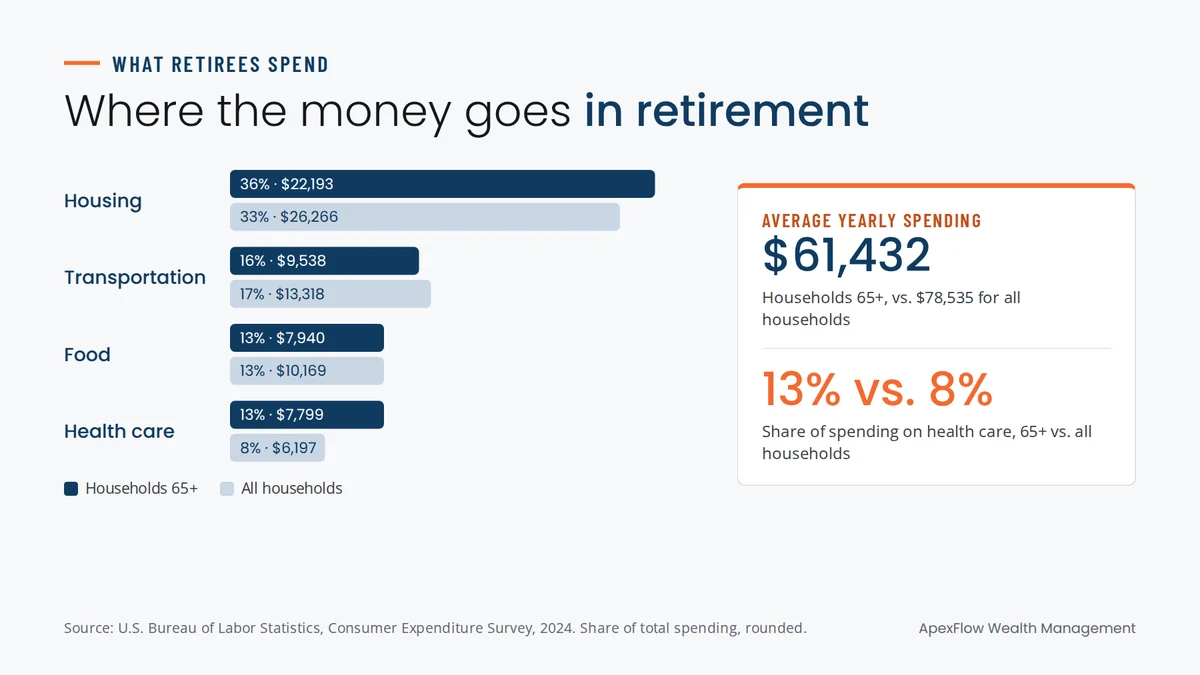
Cash flow. The carrying cost of a Park City home, including property tax, insurance, HOA dues, utilities and maintenance, is the anchor of the budget. We build the retirement income plan around it, then ask whether Social Security timing, pension options and withdrawal sequencing still work. Our article on building a retirement budget is a starting point.
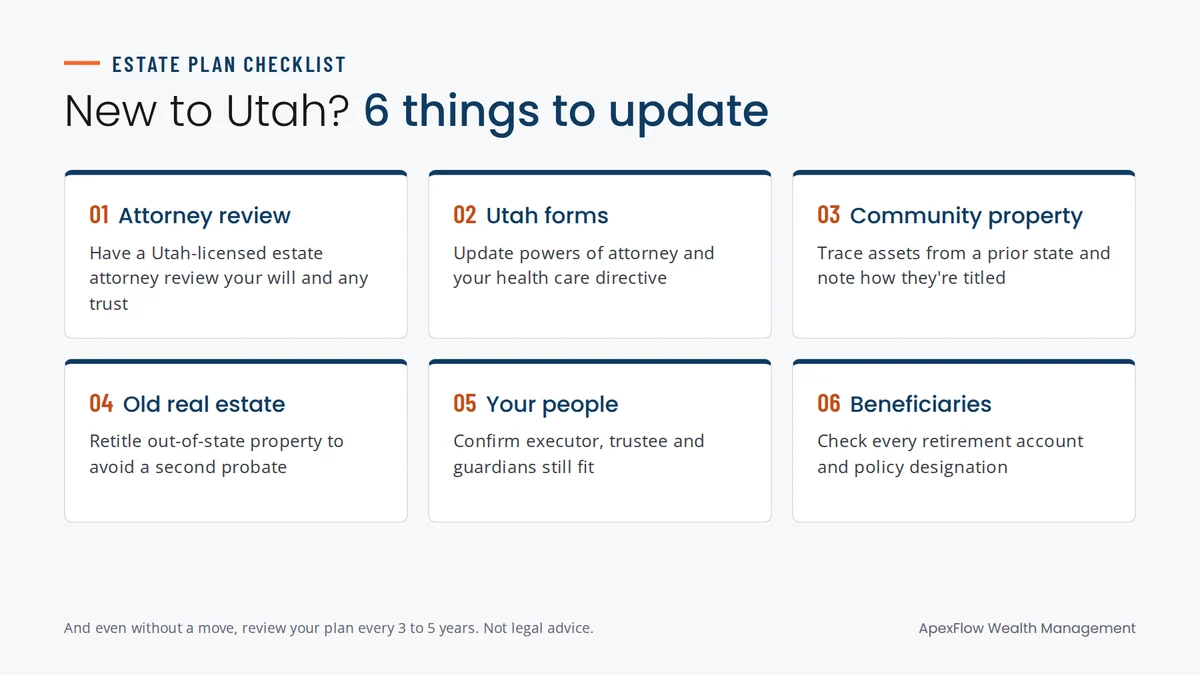
Selling the old home. Timing the sale against the purchase, the capital gains exclusion on a primary residence and the state you are leaving all matter. Leaving a high-tax state requires clear evidence that your domicile has moved; our article on updating your estate plan after moving to Utah covers the documents that establish it.
Estate plan. Utah documents, Utah beneficiary review and, if you keep property in another state, a trust that avoids two probates.
The portfolio. A home that represents a large share of net worth argues for a more conservative, liquid investment portfolio, since the house cannot be sold in pieces. That is a conversation for the Plan with Purpose step.
Hypothetical example: A couple from the Bay Area, 64 and 62, sell a home there and buy in Pinebrook with no mortgage. Their property tax falls sharply once they file the primary residence declaration, their state income tax drops from California’s rates to Utah’s flat 4.45 percent, and their health plan is replaced with Medicare and a supplement that works in both Summit and Salt Lake counties. The plan funds their first six years from a taxable account and a modest pension while delaying Social Security, with Roth conversions filling the low brackets. The example is illustrative only and omits many details.
Meeting with us from Park City
Our Salt Lake City office is about 35 minutes down Parleys Canyon, and we meet Park City clients there, at their kitchen table or by video. The first conversation is usually about the home: what it will cost to carry, and how the income plan has to work around it. More on our approach is on the Salt Lake City financial planning page.
Frequently asked questions
Utah’s flat 4.45 percent rate applies to most retirement income, offset by a Social Security credit for retirees under an income threshold and no estate tax. It is lower than many coastal states and higher than states with no income tax. Property tax on a primary residence is moderate; on a second home it is nearly double.
Intermountain Park City Hospital is in town. University of Utah Health and Intermountain Medical Center are 35 to 50 minutes away in Salt Lake County.
It can. Park City sits near 7,000 feet, and some heart and lung conditions are affected. Discuss it with your physician and spend extended time at altitude before committing.
Renting for a full year, including a winter, is a low-cost way to confirm the lifestyle and the neighborhood before committing a large share of your net worth to a home.
Free one-page checklist
Moving to Utah: your financial checklist. Every step from before the move through your first year, on one printable page.
Talk it through with us
Every situation is a little different. If you want to talk through yours, book a 20-Minute Fit Call with one of our advisors, by video or in person. No prep and no obligation. Want to see how we work first? Start with the Purposeful Planning Process or our services.

The information in this article is general in nature and is not a recommendation for any individual. Consider your own circumstances or speak with an advisor before acting on it. Any opinions are those of the author and not necessarily those of Raymond James.
ApexFlow Wealth Management does not provide tax or legal advice. Please consult your tax or legal professional before acting on any strategy mentioned here.
Examples labeled as hypothetical are for illustration only. They are not based on any actual client and do not represent actual or expected results.
Related Articles
Dig deeper into our resource library
-
 November 2, 2026
Utah’s Income Tax and What It Means for Retirees Moving From Other States
Utah’s flat tax is simple, but how it compares with your current state depends on what kind of income you have. Here is how Utah treats pensions, Social Security, retirement withdrawals and capital gains, and how to establish residency cleanly.Read more -
 November 5, 2026
How to Build a Retirement Budget That Lasts
For decades, your budget had a built-in safety net: the next paycheck. Retirement changes that. Your income now comes from Social Security, maybe a pension,Read more -
 November 5, 2026
Moved to Utah? Why Your Estate Plan Needs a Fresh Look
There’s a comforting myth about estate planning: that it’s a project with an end date. You meet with an attorney, sign the documents and checkRead more