

At a glance
- Utah taxes nearly all income at a single flat rate, 4.45 percent for 2026, with no local income taxes and no brackets.
- Pensions, IRA and 401(k) withdrawals and capital gains are fully taxed. Social Security is taxed but a state credit eliminates the tax for retirees under an income threshold.
- Utah has no estate or inheritance tax, moderate property tax with a 45 percent exemption on primary homes, and a reduced sales tax rate on groceries.
- Compared with California, Oregon or Minnesota, Utah is usually a tax cut. Compared with Nevada, Texas, Washington or Florida, it is a new cost.
- Leaving a high-tax state requires establishing Utah domicile clearly and promptly.
Retirees moving to Utah ask us the same question in different words: will I pay more or less tax here? It depends on where you are coming from and what your income is made of. Utah’s system has few moving parts, which makes the comparison easier than most. We are not tax preparers, and your CPA should confirm the details for your situation.
Two minutesHow much of your retirement is actually decided?Get my Clarity ScoreThe basics of Utah’s income tax
Utah has a flat individual income tax. For 2026 the rate is 4.45 percent, after several consecutive years of small cuts by the Legislature. There are no brackets, no local or city income taxes and no separate capital gains rate. The state starts from your federal adjusted gross income, makes a short list of adjustments and applies the rate. A taxpayer tax credit, based on a percentage of your federal deductions and exemptions, phases out as income rises, which gives the system a mild progressivity at lower incomes.
Because it is flat, the state side of most retirement decisions is easy to price: every dollar of pension, withdrawal or gain costs 4.45 cents in Utah tax. The federal side is where bracket management happens.
How each type of retirement income is treated
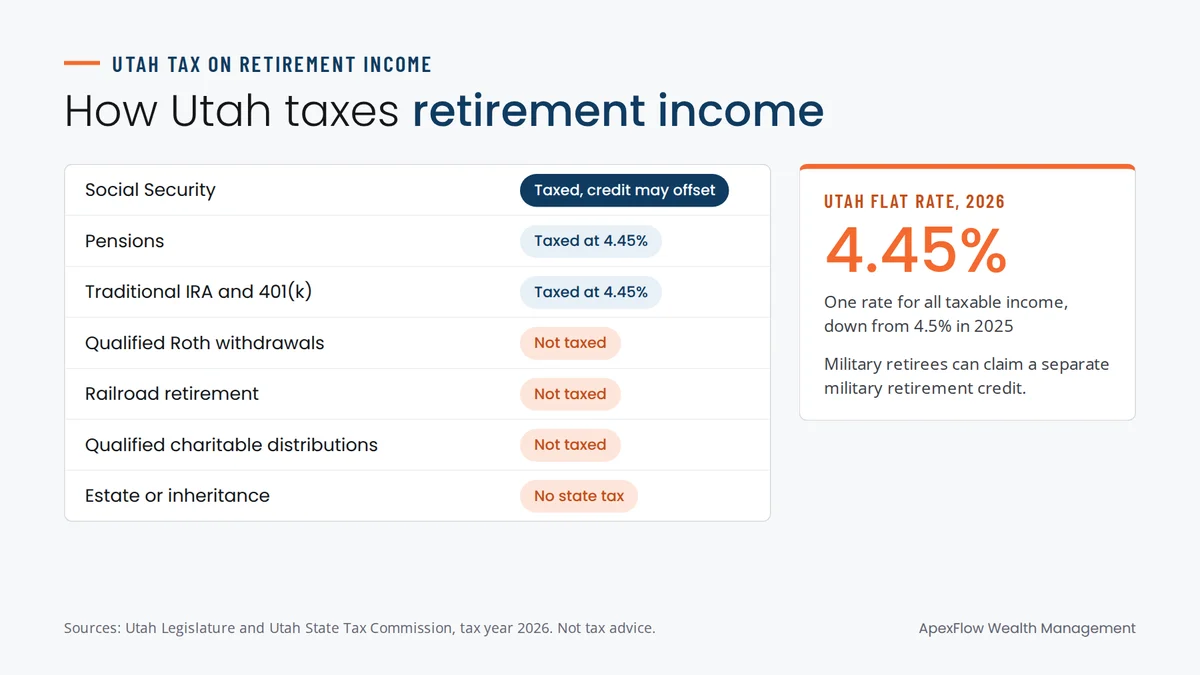
Pensions and annuities. Fully taxed at the flat rate. Utah has no general pension exclusion. Retirees born before 1953 may claim a small retirement credit, but it phases out at modest incomes and few receive the full amount.
IRA, 401(k) and 403(b) withdrawals. Fully taxed. Roth withdrawals that are tax-free federally are also tax-free in Utah.
Social Security. Utah includes whatever portion of your benefits is taxable federally, then applies a nonrefundable credit equal to the tax on that amount for retirees below an income threshold. The credit phases out above the threshold. The Legislature has expanded eligibility several times, and for 2026 the joint-filer threshold is $90,000 ($54,000 for single filers). The exact figures for each year are in the TC-40 instructions and are worth checking before you plan around them.
Capital gains and dividends. Taxed as ordinary income at the flat rate. There is no preferential rate. A narrow capital gain credit exists for gains reinvested in qualifying Utah small businesses, which rarely applies to retirees.
Military retirement. Utah offers a credit that effectively exempts military retirement pay.
Interest on U.S. Treasury securities. Exempt from Utah tax, as in every state.
Our earlier article on how Utah taxes retirement income covers the mechanics for current residents in more detail.
The other taxes that matter to retirees
Property tax. Moderate by national standards, and a primary residence is taxed on 55 percent of its market value because of the 45 percent residential exemption. Second homes are taxed on the full value. Utah also offers a property tax abatement and a deferral program for lower-income seniors.
Sales tax. The combined state and local rate is in the middle of the national range. Groceries are taxed at a reduced state rate.
Estate and inheritance tax. None. Utah has no estate tax and no inheritance tax. Only the federal estate tax applies, and its exemption is $15 million per person for 2026.
How Utah compares with the states retirees come from
The comparison depends entirely on your income mix, so treat these as patterns rather than conclusions.
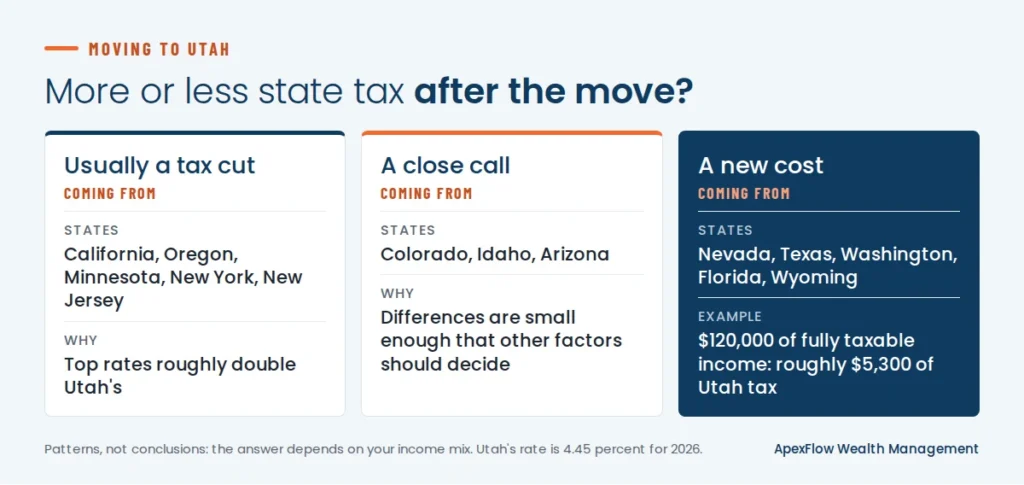
- From California, Oregon, Minnesota, New York or New Jersey: Utah is almost always a meaningful reduction. Those states have top rates roughly double Utah’s, and several tax retirement income with few breaks.
- From Colorado, Idaho or Arizona: closer. Colorado’s flat rate is a little lower than Utah’s and it offers a pension and annuity subtraction for retirees. Idaho’s flat rate is higher than Utah’s but it exempts Social Security entirely. Arizona’s flat rate is lower. For many retirees the difference among these states is small enough that other factors should decide.
- From Nevada, Texas, Washington, Florida or Wyoming: Utah is a new cost. A retiree with $120,000 of fully taxable income would owe roughly $5,300 in Utah tax that they did not owe before. Whether that is offset by lower housing costs, healthcare access or family is a personal calculation.
Hypothetical example: A couple moving from Portland, Oregon, has $48,000 of Social Security, a $40,000 pension and $30,000 of IRA withdrawals. In Oregon, nearly all of it was taxable at rates up to 8.75 percent, with a partial credit for the pension. In Utah, the pension and IRA withdrawals are taxed at 4.45 percent, and because their income is near the threshold, most or all of the state tax on Social Security is removed by the credit. Their state income tax falls by several thousand dollars a year. A second couple moving from Las Vegas with the same income goes from zero state income tax to roughly $3,000 to $4,000. Both figures are illustrative and depend on details not shown.
Establishing Utah residency
If you are leaving a state with an aggressive tax department, the move itself is a planning task. States such as California and New York audit departing residents and look for evidence that the move was real. The steps are straightforward and worth doing promptly.
- Obtain a Utah driver license and register your vehicles in Utah.
- Register to vote in Utah and cancel your prior registration.
- Update your address with Social Security, Medicare, your pension payer, your custodians and the IRS.
- Spend more days in Utah than in your prior state and keep a simple log the first year.
- Move the things that signal home: your physician, your church or community membership, your safe deposit box.
- Sign new Utah estate documents. Our article on updating your estate plan after moving to Utah explains what changes and why.
Part-year residents file in both states for the year of the move, and income is generally allocated to the state where you lived when it was received. Timing a large IRA withdrawal, Roth conversion or asset sale for after the move can matter. That is a conversation to have with your CPA before you pack.
Planning around a flat tax
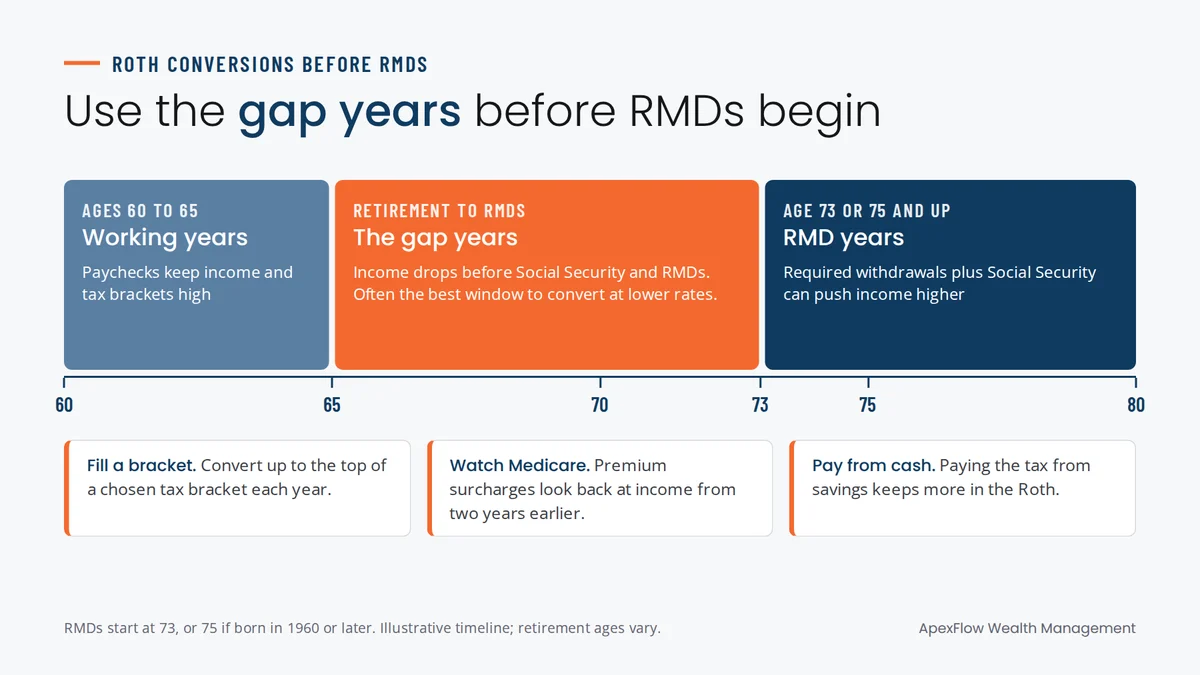
Utah’s simplicity frees up attention for the decisions that matter: when to take Social Security, in what order to draw from taxable, traditional and Roth accounts, and whether Roth conversions in your early retirement years make sense. Those are federal bracket questions with a small, predictable Utah cost attached. They are the core of the Plan with Purpose step in our process. Our article on Roth conversions before RMDs walks through the window many retirees have between leaving work and age 73.
Where we come in
Many of our clients moved to Utah from somewhere else, and the first year is when the plan is worth the most. We take inventory of your income sources and what Utah will tax, coordinate with your CPA on the year of the move, and build an income plan that uses the flat rate well.
Frequently asked questions
Utah includes the federally taxable portion in income but provides a credit that eliminates the tax for retirees under an income threshold, which the Legislature has expanded several times. Above the threshold the credit phases out.
It is in the middle. The flat rate is low compared with high-tax states and there is no estate tax, but pensions and retirement withdrawals are fully taxed with no exclusion. Compared with no-income-tax states, Utah costs more.
No. Capital gains are taxed as ordinary income at the flat rate. The federal preferential rate still applies on your federal return.
Primary residences receive a 45 percent exemption, and Utah offers a tax abatement for lower-income homeowners over 66 and a deferral program for some seniors. Applications go through the county.
Free one-page checklist
Moving to Utah: your financial checklist. Every step from before the move through your first year, on one printable page.
Talk it through with us
Every situation is a little different. If you want to talk through yours, book a 20-Minute Fit Call with one of our advisors, by video or in person. No prep and no obligation. Want to see how we work first? Start with the Purposeful Planning Process or our services.

The information in this article is general in nature and is not a recommendation for any individual. Consider your own circumstances or speak with an advisor before acting on it. Any opinions are those of the author and not necessarily those of Raymond James.
ApexFlow Wealth Management does not provide tax or legal advice. Please consult your tax or legal professional before acting on any strategy mentioned here.
Examples labeled as hypothetical are for illustration only. They are not based on any actual client and do not represent actual or expected results.
Related Articles
Dig deeper into our resource library
-
 November 5, 2026
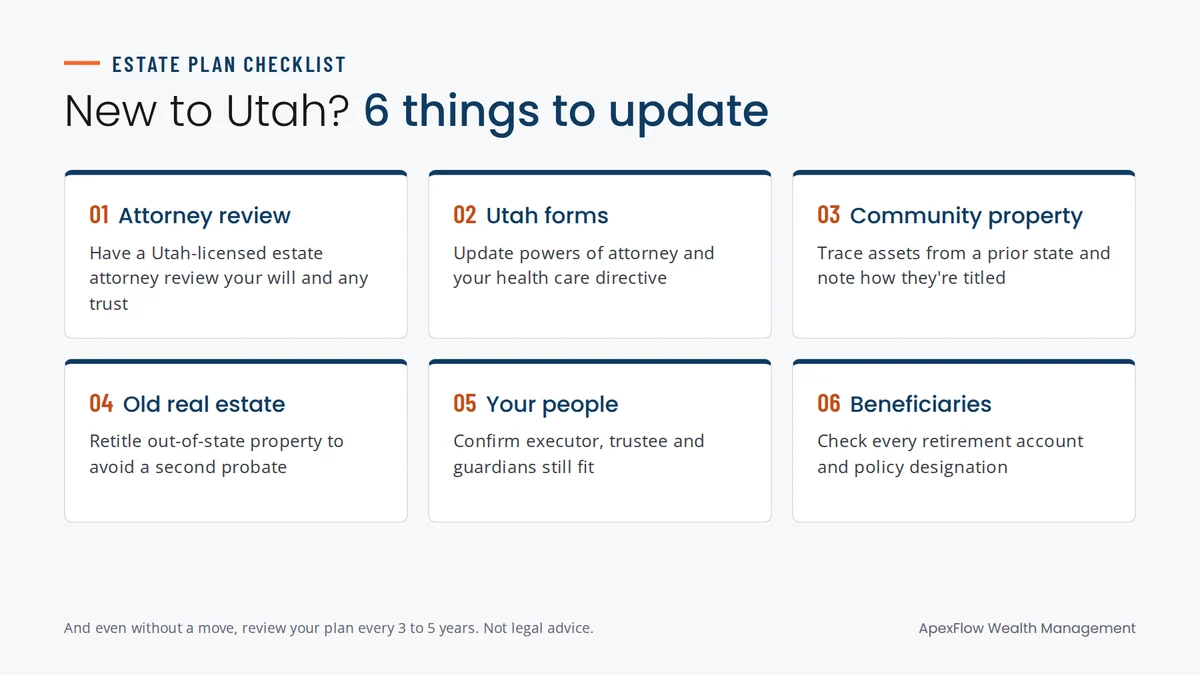
Moved to Utah? Why Your Estate Plan Needs a Fresh Look
There’s a comforting myth about estate planning: that it’s a project with an end date. You meet with an attorney, sign the documents and checkRead more -
 November 5, 2026
Does Utah Tax Retirement Income? Social Security, Pensions and 401(k)s in 2026
If you’re planning to retire in Utah, or you already have, it’s worth knowing exactly how the state treats your income. The short answer: UtahRead more -
 November 5, 2026
Roth Conversions Before RMDs: Making the Most of the Gap Years
For many retirees, the years between leaving work and starting required minimum distributions are the lowest-tax years they’ll ever have. The paycheck has stopped, SocialRead more