

At a glance
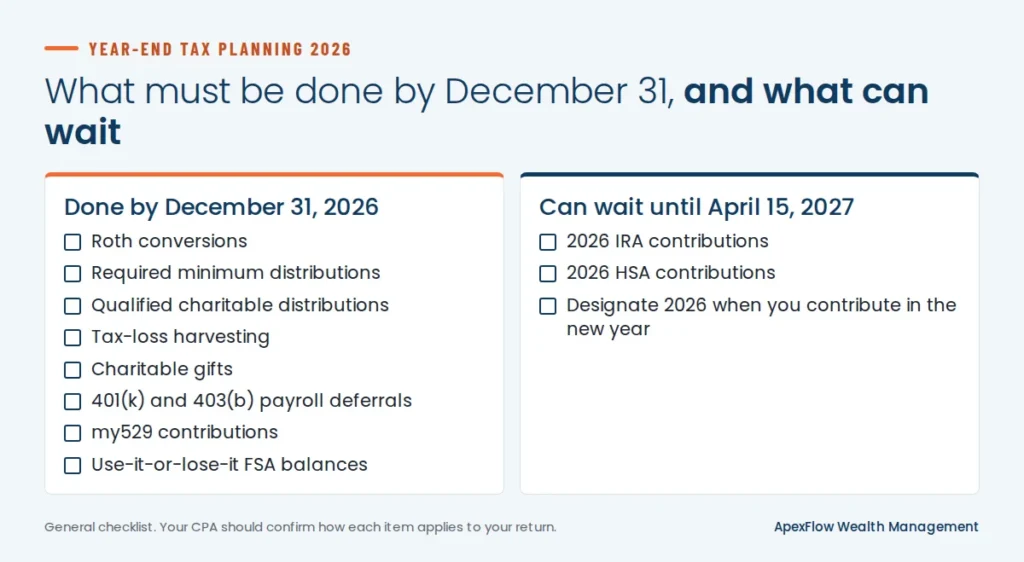
- Roth conversions, required minimum distributions, qualified charitable distributions, loss harvesting, charitable gifts, payroll deferrals and my529 contributions count for 2026 only if completed by December 31.
- IRA and HSA contributions for 2026 can still be made until the April 15, 2027 filing deadline.
- Starting in 2026, itemizers can deduct charitable gifts only above 0.5 percent of AGI, while non-itemizers can deduct up to $1,000 of cash gifts ($2,000 on a joint return).
- The $6,000 senior deduction shrinks by 6 percent of income above $75,000 ($150,000 joint), so a Roth conversion or capital gain can reduce it.
- The 2026 SALT cap is $40,400, but it phases down above $505,000 of income, which makes extra income in that range cost more than the bracket suggests.
Most of next spring’s tax return is settled by what happens before December 31. Year-end tax planning 2026 comes down to two lists: moves that must be finished this calendar year, and moves that can wait until the April 15, 2027 filing deadline. This is also the first year the charitable deduction changes in the One Big Beautiful Bill Act apply, alongside the senior deduction and higher SALT cap that began in 2025. The rules below are general, and your CPA should confirm how each one applies to your return.
Two minutesHow much of your retirement is actually decided?Get my Clarity ScoreYear-end tax planning 2026: what must happen by December 31
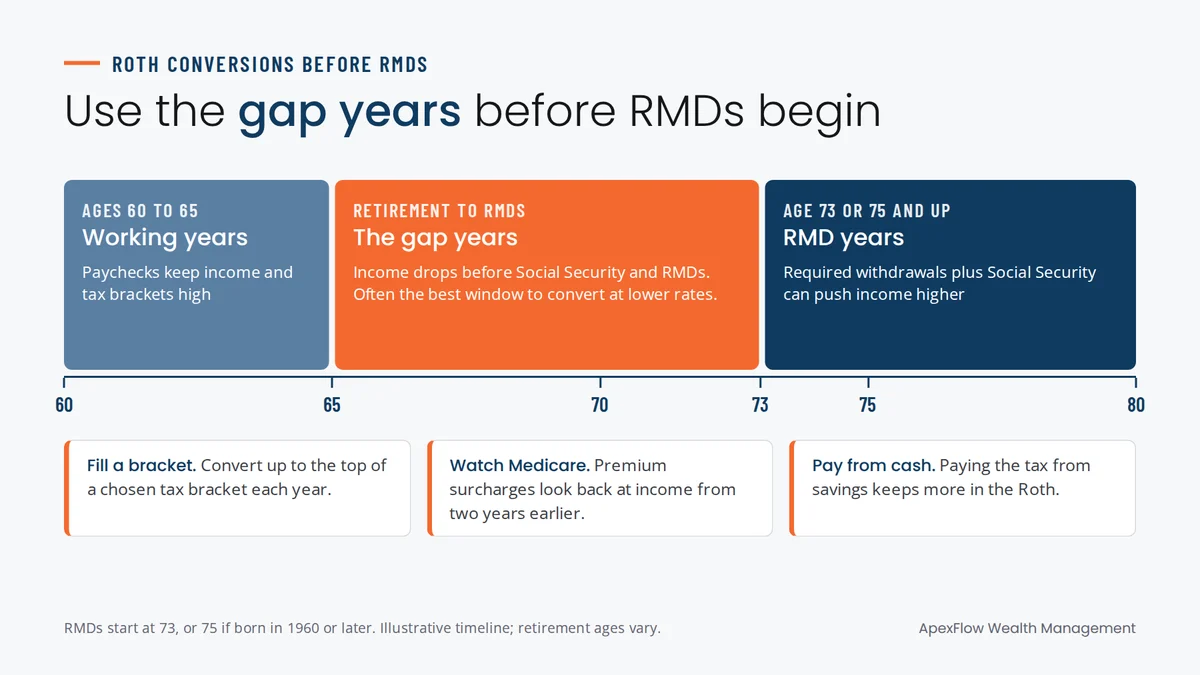
Roth conversions. A conversion counts in the year the money leaves the traditional IRA. Conversions made after 2017 cannot be reversed, so many retirees wait until November or December, when the year’s income is mostly known, and convert enough to fill a chosen bracket. Our article on Roth conversions before RMDs explains why the years before RMDs begin are often the widest window.
Required minimum distributions. Anyone already taking RMDs must take the 2026 amount by December 31. A first RMD can wait until April 1, 2027, but then two distributions land in 2027. The penalty for a missed RMD is 25 percent of the shortfall, or 10 percent if corrected within two years. Our guide to the 2026 RMD rules covers the calculation.
Qualified charitable distributions. IRA owners 70½ or older can send up to $111,000 each for 2026 directly to a public charity. The gift counts toward the RMD and stays out of income, but it has to leave the IRA by December 31, and custodians often set earlier processing cutoffs. The mechanics are in qualified charitable distributions explained.
Workplace plan deferrals. 401(k), 403(b) and 457(b) contributions happen only through payroll, so the last 2026 paycheck is the real deadline. For 2026 the employee limit is $24,500, with an $8,000 catch-up at 50 or older and $11,250 for those aged 60 to 63.
my529 contributions. Utah allows a credit at the state income tax rate, 4.45 percent for 2026, on my529 contributions up to a per-beneficiary limit that is adjusted each year. Contributions generally must be received by December 31 to count for the year.
Flexible spending accounts. Health FSA balances are generally use-it-or-lose-it. An employer may offer a grace period of up to two and a half months or a carryover of up to $680 from 2026 into 2027, or neither, but not both. The plan document says which applies.
Harvesting losses and the wash-sale rule
Selling investments at a loss in a taxable account offsets realized gains, and up to $3,000 of net losses beyond that ($1,500 if married filing separately) can offset ordinary income. Unused losses carry forward to later years. The sale has to happen by December 31 to count for 2026.
The wash-sale rule disallows the loss if substantially identical stock or securities are bought within 30 days before or after the sale, and that includes purchases in your own IRA or Roth IRA. Automatic dividend reinvestment in the same fund can trigger it by accident. Investors who want to stay invested often move to a fund that is similar but not substantially identical, a judgment worth confirming before the trade.
Lower-income retirees sometimes do the reverse. For 2026 the 0 percent federal rate on long-term gains applies up to $98,900 of taxable income for joint filers ($49,450 for single filers), so realizing gains to reset cost basis can carry no federal tax. Utah still taxes the gain at 4.45 percent, and the added income can reduce the senior deduction described below. Our article on tax-loss harvesting has more on the mechanics.
Charitable gifts under the 2026 rules
Three changes apply to gifts made in 2026.
- A deduction for non-itemizers. Taxpayers who take the standard deduction can deduct up to $1,000 of cash gifts to qualifying charities, or $2,000 on a joint return. Gifts to donor-advised funds generally do not qualify.
- A floor for itemizers. Itemized charitable gifts are deductible only to the extent they exceed 0.5 percent of adjusted gross income. At $300,000 of AGI, the first $1,500 of giving produces no deduction.
- A limit for the top bracket. For households whose taxable income reaches the 37 percent bracket (above $768,700 joint or $640,600 single for 2026), itemized deductions are reduced so that each deducted dollar saves about 35 cents of tax rather than 37.
These changes reward some habits more than others. Bunching, which means giving two or three years of gifts in one year, often through a donor-advised fund, now does two jobs: it can lift itemized deductions above the standard deduction ($32,200 for joint filers in 2026), and it meets the 0.5 percent floor once instead of every year. Giving appreciated stock held more than a year still avoids the capital gain and produces a deduction at market value, generally up to 30 percent of AGI. For IRA owners 70½ or older, qualified charitable distributions sidestep both the floor and the top-bracket limit, because the gift never enters income.
The senior deduction and why income timing matters
For 2025 through 2028, each taxpayer who is 65 or older by year-end can claim an extra $6,000 deduction, whether or not they itemize. Married couples must file jointly, and each qualifying spouse needs a valid Social Security number. It sits on top of the long-standing additional standard deduction for age, which for 2026 is $1,650 per married spouse and $2,050 for a single filer.
The deduction shrinks by 6 percent of modified AGI above $75,000, or $150,000 on a joint return. When both spouses qualify, each $6,000 shrinks separately, so the couple loses 12 cents of deduction for every dollar above $150,000, and it is gone at $250,000. A single filer loses it entirely at $175,000.
Income in that range therefore costs more than the bracket suggests. A $20,000 Roth conversion or capital gain for a qualifying couple in the phaseout also removes $2,400 of deduction, which adds about $530 of federal tax in the 22 percent bracket. The extra cost is temporary: the deduction ends after 2028, while a conversion’s benefits can run for decades. Spreading conversions over several years, or pairing them with QCDs that hold other income down, are common responses.
Hypothetical example: A retired couple in Holladay, both 74, expect about $150,000 of modified AGI for 2026, including a $40,000 RMD, and give $12,000 a year to their church and a local food bank from checking. They take the standard deduction, so under the new rules only $2,000 of that giving would be deductible. Sending the $12,000 as qualified charitable distributions instead satisfies part of the RMD and brings modified AGI down to about $138,000. They then look at a December Roth conversion. Converting $50,000 would cut their combined $12,000 senior deduction by about $4,600, while converting $30,000 would cut it by about $2,200. They choose $30,000 for 2026 and plan to revisit the amount next fall. The figures are hypothetical and illustrative and do not represent any client.
The SALT cap and its phaseout
The cap on deducting state and local taxes is $40,400 for 2026 ($20,200 if married filing separately). It is reduced by 30 percent of modified AGI above $505,000 and cannot fall below $10,000. Utah’s flat 4.45 percent income tax means a household earning $400,000 may pay roughly $17,000 to $18,000 in state income tax before property tax, so itemizing is worth checking again for households that stopped under the old $10,000 cap.
Between $505,000 and about $606,000 of modified AGI, each additional $1,000 of income can remove $300 of SALT deduction for a household paying more than the cap. In the 35 percent bracket, that adds roughly 10 percentage points to the effective rate on that income. A year-end bonus, a large capital gain or a Roth conversion that falls in this range is worth a second look, and moving it into January can change the result.
Medicare premiums look back two years
Medicare Part B and Part D premiums are set using modified AGI from two years earlier, so 2026 income determines 2028 premiums. Roth conversions, capital gains and RMDs all count. Anyone 63 or older this year is already inside that window. Our article on Medicare open enrollment and IRMAA covers the surcharge tiers in more detail.
What can wait until April 15, 2027
- IRA contributions. Contributions for 2026 to a traditional or Roth IRA can be made until April 15, 2027. The 2026 limit is $7,500, plus $1,100 at 50 or older. Direct Roth IRA eligibility phases out between $242,000 and $252,000 of modified AGI for joint filers and between $153,000 and $168,000 for single filers.
- HSA contributions. With HSA-eligible coverage, 2026 contributions can also be made until April 15, 2027: up to $4,400 for self-only coverage or $8,750 for family coverage, plus $1,000 at 55 or older.
- Designating the year. Contributions made between January 1 and April 15 need to be designated as 2026 contributions when they are made.
Equity pay and deferred compensation follow a separate calendar. Those deadlines are in our year-end checklist for executives.
One projection, several deadlines
Each of these moves changes the others: a conversion affects the senior deduction, a gift interacts with the new floor, and both reach Medicare premiums two years out. We build a multi-year tax projection with clients during the Plan with Purpose step and update it each fall before the December deadlines. Our Salt Lake City financial planning page describes that work.
Frequently asked questions
Yes. Traditional and Roth IRA contributions for 2026 can be made until April 15, 2027, the filing deadline without extensions. HSA contributions for 2026 follow the same deadline.
Generally no. The deduction of up to $1,000, or $2,000 on a joint return, applies to cash gifts made in 2026 to qualifying charities, and gifts to donor-advised funds generally do not count.
Yes. The $6,000 senior deduction shrinks by 6 percent of modified AGI above $75,000, or $150,000 for joint filers, and a conversion adds to modified AGI in the year it happens.
December 31, 2026. A conversion counts in the year the money leaves the traditional IRA, and conversions made after 2017 cannot be undone, so many people decide the amount late in the year.
Talk it through with us
Every situation is a little different. If you want to talk through yours, book a 20-Minute Fit Call with one of our advisors, by video or in person. No prep and no obligation. Want to see how we work first? Start with the Purposeful Planning Process or our services.

The information in this article is general in nature and is not a recommendation for any individual. Consider your own circumstances or speak with an advisor before acting on it. Any opinions are those of the author and not necessarily those of Raymond James.
ApexFlow Wealth Management does not provide tax or legal advice. Please consult your tax or legal professional before acting on any strategy mentioned here.
Investing involves risk, and you may incur a profit or loss regardless of the strategy selected, including diversification and asset allocation. Past performance does not guarantee future results.
Examples labeled as hypothetical are for illustration only. They are not based on any actual client and do not represent actual or expected results.
Related Articles
Dig deeper into our resource library
-
 October 29, 2026
Charitable Giving From an IRA: Qualified Charitable Distributions Explained
If you are over 70½, give to charity and have an IRA, a qualified charitable distribution is usually the cheapest way to give. Here is how it works, the 2026 limits and the mistakes to avoid.Read more -
 October 29, 2026
Required Minimum Distributions: The 2026 Rules and How to Reduce Them
RMDs start at 73 for most retirees today and 75 for younger ones. Here are the 2026 rules, the penalties, and the five ways to shrink the tax bill they create.Read more -
 November 5, 2026
Roth Conversions Before RMDs: Making the Most of the Gap Years
For many retirees, the years between leaving work and starting required minimum distributions are the lowest-tax years they’ll ever have. The paycheck has stopped, SocialRead more