
At a glance
- If you were born in 1951 through 1959, RMDs begin at 73. If you were born in 1960 or later, they begin at 75.
- Your first RMD can be delayed to April 1 of the following year, but that stacks two distributions in one tax year.
- The penalty for a missed RMD is 25 percent of the shortfall, reduced to 10 percent if corrected within two years.
- Roth IRAs and, since 2024, Roth 401(k)s have no RMDs for the original owner.
- Roth conversions in the 60s, qualified charitable distributions, working-plan exceptions and smart account ordering can all reduce RMDs or their tax.
Required minimum distributions are the government’s way of finally collecting tax on money that has grown tax-deferred for decades. They are not optional, the penalty for missing one is steep, and for many retirees they push income higher than they need or want in their 70s and 80s.
Two minutesHow much of your retirement is actually decided?Get my Clarity ScoreWho has to take an RMD in 2026
The starting age depends on your birth year under the SECURE 2.0 Act.
- Born 1950 or earlier: you are already taking RMDs.
- Born 1951 through 1959: RMDs begin in the year you turn 73. If you were born in 1953, your first RMD year is 2026.
- Born 1960 or later: RMDs begin at 75.
RMDs apply to traditional IRAs, SEP and SIMPLE IRAs, 401(k)s, 403(b)s, 457(b)s and other employer plans. They do not apply to Roth IRAs during the owner’s life, and since 2024 they no longer apply to Roth accounts inside employer plans either.
Deadlines
Your first RMD is due by April 1 of the year after you reach your starting age. Every RMD after that is due by December 31. Taking the first one by April 1 sounds like a gift, but it means two RMDs land in the same tax year, which can push you into a higher bracket or raise Medicare premiums two years later. Most clients are better off taking the first RMD in the year they reach the starting age.
How the amount is calculated
Divide the account balance on December 31 of the prior year by the life expectancy factor from the IRS Uniform Lifetime Table. At 73 the factor is 26.5, so the first RMD is roughly 3.8 percent of the balance. The percentage rises each year. If your spouse is more than ten years younger and is your sole beneficiary, a different table produces a smaller RMD.
IRAs can be aggregated: you may take the total RMD for all your IRAs from one of them. Employer plans cannot be aggregated with IRAs or with each other, so a retiree with two old 401(k)s and an IRA has three separate RMDs to track. Consolidating accounts simplifies this.
The penalty
Miss an RMD and the excise tax is 25 percent of the amount you should have taken. Fix it within two years and the penalty drops to 10 percent. The IRS can waive it entirely for reasonable cause if you correct the shortfall promptly and file Form 5329 with an explanation. The waiver is granted often enough that a missed RMD should be fixed immediately, not hidden.
Inherited accounts
Most non-spouse beneficiaries who inherited after 2019 must empty the account within ten years. Final regulations issued in 2024 confirmed that if the original owner had already started RMDs, the beneficiary must also take annual distributions during years one through nine, with the full balance out by the end of year ten. Penalties for missing those annual distributions were waived for 2021 through 2024 and apply from 2025 onward. Spouses, minor children, disabled beneficiaries and beneficiaries close in age to the owner have more flexible rules. Inherited Roth IRAs follow the ten-year rule but the distributions are tax-free.
Five ways to reduce RMDs or the tax they create
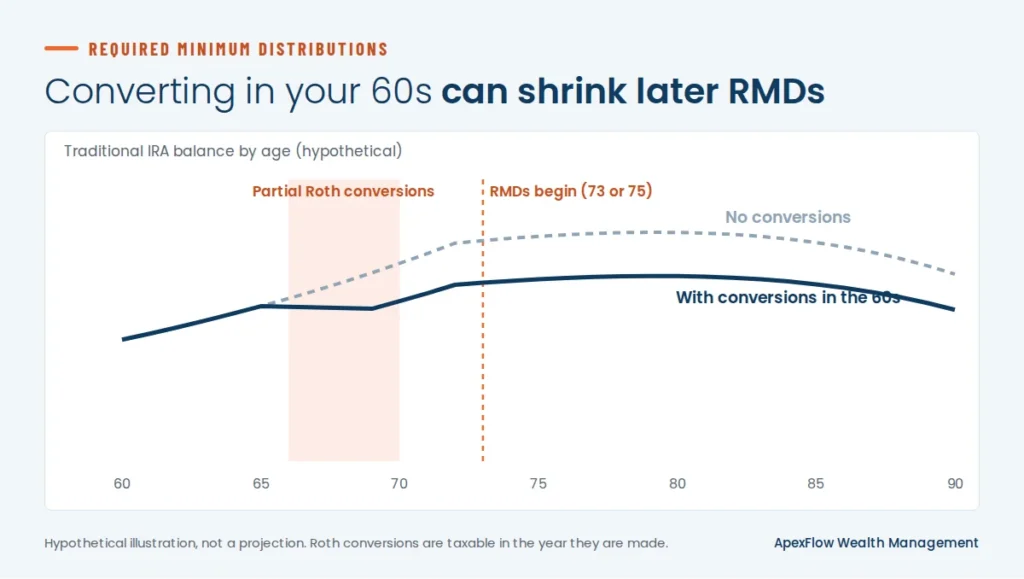
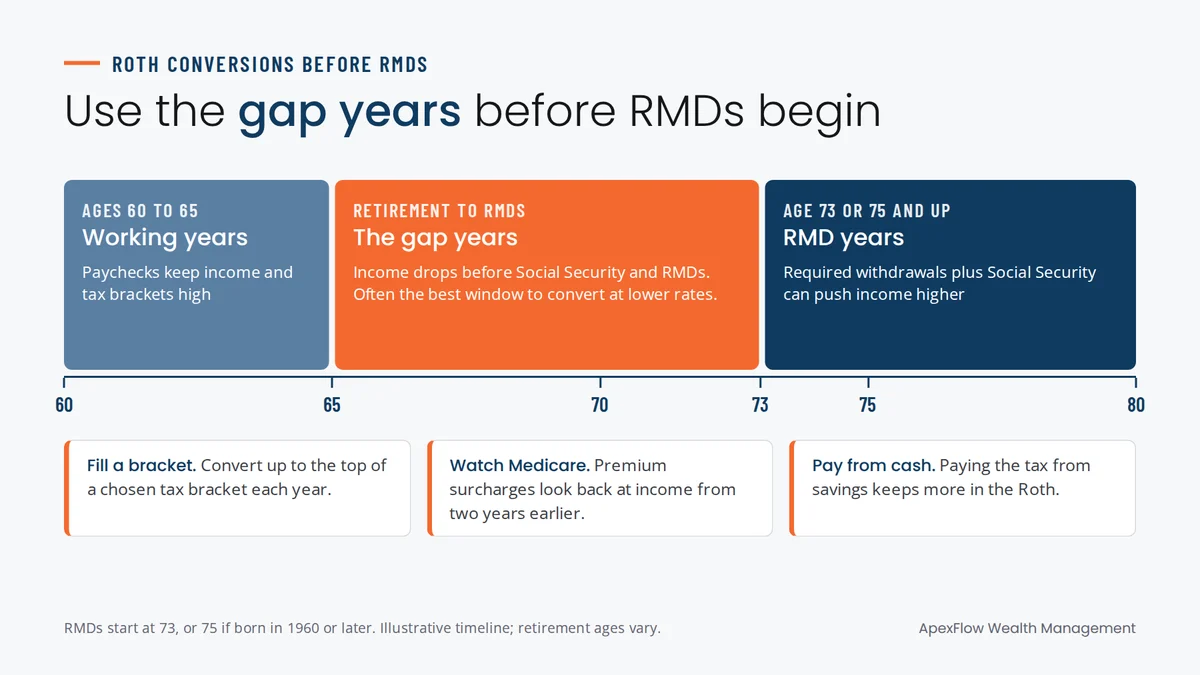
1. Roth conversions before RMDs begin. The years between retirement and your RMD age are often your lowest-income years. Converting part of a traditional IRA to a Roth each year at a low bracket shrinks the balance that RMDs will be calculated on and builds a pool of tax-free money with no RMDs at all. We wrote about this in detail in Roth conversions before RMDs. The conversions themselves are taxable, so the goal is to fill lower brackets, not to convert everything.
2. Qualified charitable distributions. Once you are 70½, you can send up to $111,000 (the 2026 limit) directly from an IRA to charity. The amount counts toward your RMD and never shows up in your income. For anyone who gives to charity and takes RMDs, this is almost always better than writing a check. Our article on qualified charitable distributions covers the mechanics.
3. The still-working exception. If you are still employed and do not own more than 5 percent of the company, you can delay RMDs from that employer’s plan until you retire. It does not apply to IRAs or old employers’ plans. Some people roll IRAs into a current employer’s plan to use this rule.
4. Qualified longevity annuity contracts. A QLAC lets you move a portion of an IRA (up to $210,000 for 2025, indexed) into a deferred income annuity that starts paying as late as 85. The amount is excluded from the RMD calculation until payments begin. This is a niche tool with trade-offs, and worth discussing rather than buying.
5. Account ordering and withdrawal sequencing. Drawing from traditional accounts earlier, even before you must, can keep RMDs smaller and spread tax over more years. The right sequence depends on your other income, Social Security timing and your estate goals, and it is one of the things we model in the Plan with Purpose step.
Hypothetical example: A retired couple in Draper, both 66, hold $1.6 million in traditional IRAs and plan to delay Social Security to 70. For four years they convert enough each year to fill the 22 percent federal bracket, paying the tax from a taxable account. By 73 their traditional balance is lower and their Roth balance is substantial, so their RMDs are smaller and a portion of future spending is tax-free. Once they reach 70½ they also route their annual charitable gifts through QCDs. The figures are hypothetical and do not represent any client.
Treat RMDs as income to plan
RMDs are not a problem to be feared; they are an income stream to be planned. The goal is to control which years you pay tax and at what rate, rather than letting the IRS table decide. That work starts well before 73. If you are approaching your RMD age, our article on the five years before retirement is a good companion.
Frequently asked questions
No. Roth IRAs have no required distributions during the owner’s lifetime. Beneficiaries who inherit a Roth do have to empty it, generally within ten years.
Yes. You must take the distribution and pay the tax, but you can invest the after-tax amount in a taxable account. You cannot contribute it to an IRA unless you have earned income.
IRAs can be combined for RMD purposes and the total taken from any one of them. Each 401(k) or 403(b) has its own RMD that must come from that plan. Consolidating old plans into one IRA simplifies the math and lowers the chance of a miss.
It can. Medicare Part B and D premiums are based on your modified adjusted gross income from two years earlier. A large RMD or a doubled first-year RMD can push you over an income threshold and raise premiums for a year.
Free one-page checklist
Required minimum distributions: a planning checklist for 2026. Start dates, deadlines and the ways to reduce the tax, on one printable page.
Talk it through with us
Every situation is a little different. If you want to talk through yours, book a 20-Minute Fit Call with one of our advisors, by video or in person. No prep and no obligation. Want to see how we work first? Start with the Purposeful Planning Process or our services.

The information in this article is general in nature and is not a recommendation for any individual. Consider your own circumstances or speak with an advisor before acting on it. Any opinions are those of the author and not necessarily those of Raymond James.
ApexFlow Wealth Management does not provide tax or legal advice. Please consult your tax or legal professional before acting on any strategy mentioned here.
Investing involves risk, and you may incur a profit or loss regardless of the strategy selected, including diversification and asset allocation. Past performance does not guarantee future results.
Examples labeled as hypothetical are for illustration only. They are not based on any actual client and do not represent actual or expected results.
Related Articles
Dig deeper into our resource library
-
 October 29, 2026
Charitable Giving From an IRA: Qualified Charitable Distributions Explained
If you are over 70½, give to charity and have an IRA, a qualified charitable distribution is usually the cheapest way to give. Here is how it works, the 2026 limits and the mistakes to avoid.Read more -
 November 5, 2026
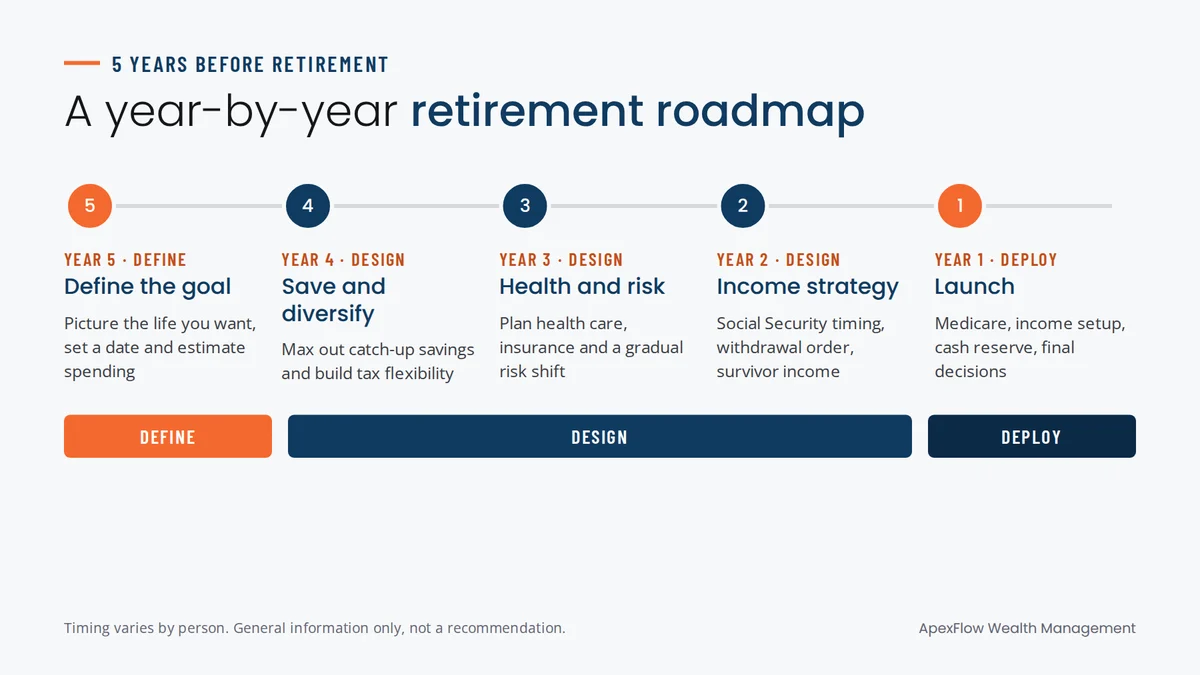
The 5 Years Before Retirement: A Year-by-Year Planning Roadmap
Ask most people what their retirement plan is, and you’ll get one of two answers. Either a number, some version of “I need two millionRead more -
 November 5, 2026
Roth Conversions Before RMDs: Making the Most of the Gap Years
For many retirees, the years between leaving work and starting required minimum distributions are the lowest-tax years they’ll ever have. The paycheck has stopped, SocialRead more