
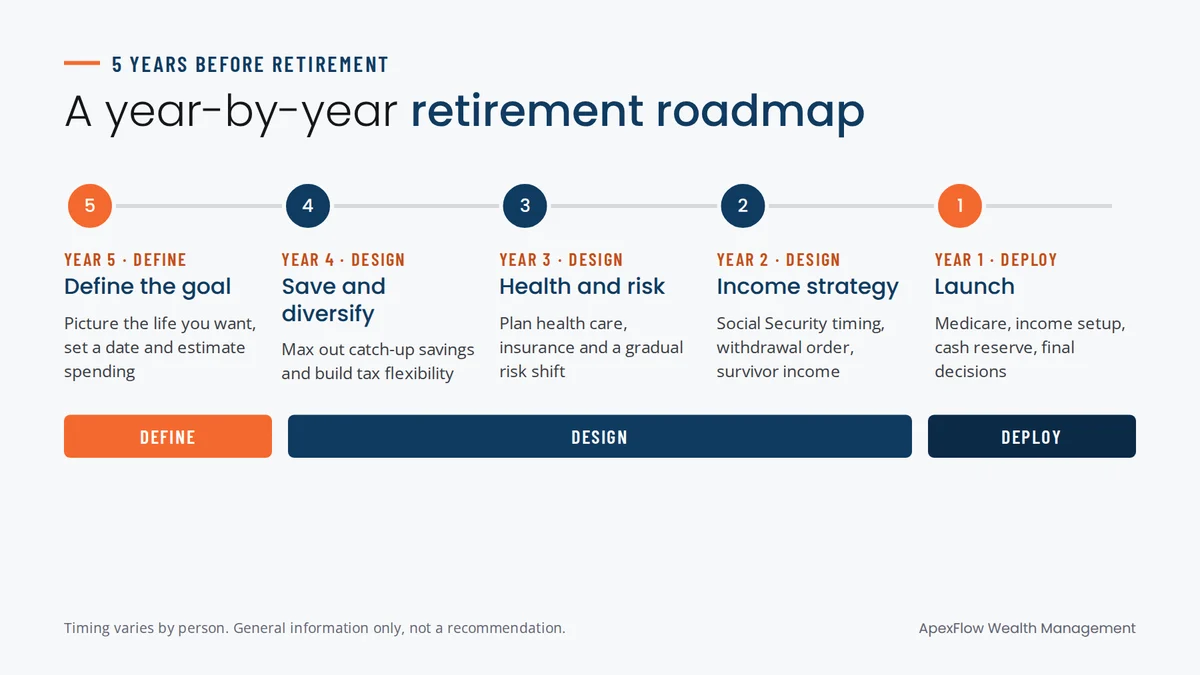
Ask most people what their retirement plan is, and you’ll get one of two answers. Either a number, some version of “I need two million dollars,” or a shrug. Neither one is a plan. A number without a purpose behind it is just anxiety with more zeros, and a shrug is just anxiety without them. The five years before retirement are when that changes. This 5 years before retirement checklist breaks the work into one year at a time, so the big decisions get made on purpose instead of in a rush.

At a glance
- Retirement isn’t a finish line. It’s a redesign, and the five years before it are the best window to plan it.
- Each year has a focus: define the life you want, maximize savings, plan health care, set your income strategy and then put it in motion.
- Several key decisions, like when to claim Social Security and how to protect against a bad market early in retirement, are much easier to get right with time on your side.
Retirement isn’t a finish line, it’s a redesign
The old model of retirement planning treats retirement like a wall you’re saving up to hit. Get to the number, stop working, done. That model breaks down fast in practice, because the hardest questions in retirement aren’t about how much you have. They’re about what you’ll do with the next 30 years, how you’ll draw down what you’ve built without running out and who you want to be when work isn’t organizing your days anymore.
We follow a three-stage process, Define, Design and Deploy, and the five years before retirement map onto it naturally.
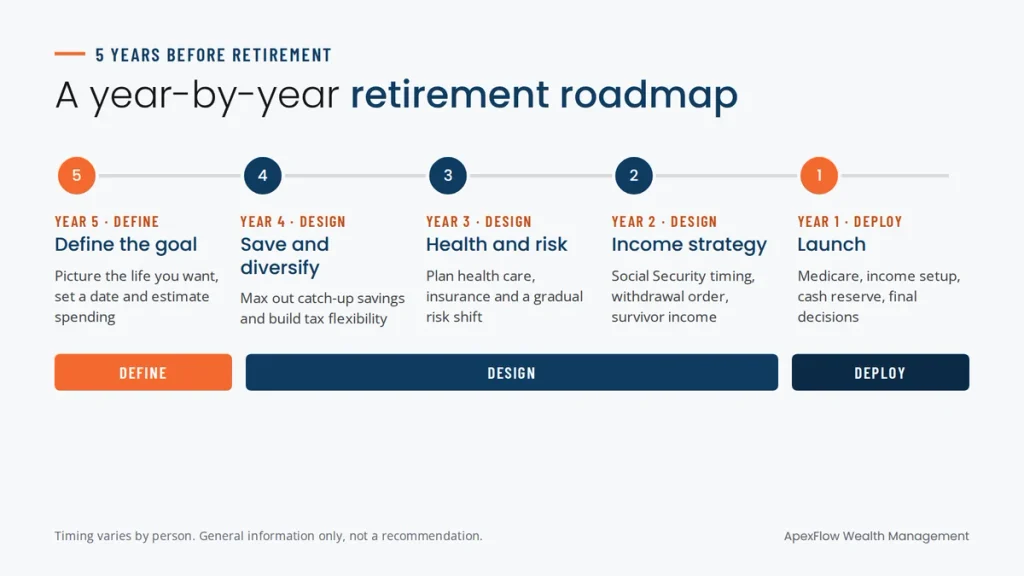
Year 5: Define what retirement is for
Before we talk about withdrawal rates or Social Security timing, we ask a more basic question: what do you want your retirement to make possible? For some clients, it’s time with grandchildren. For others, it’s finally starting the business they shelved decades ago, or simply not answering to anyone’s calendar but their own.
Your checklist for year 5:
- Picture a typical Tuesday in retirement. What are you walking toward, not just away from?
- Pick a target retirement date, or a range.
- Estimate what you’ll spend, separating essentials from flexible spending.
- Download your Social Security statement at ssa.gov and check your earnings record.
- Make a plan to pay off high-interest debt before you retire.
Clients who skip this step often retire financially ready and personally unmoored. We’d rather you arrive with both squared away.
Year 4: Maximize savings and tax flexibility
With a target in mind, this is the time to close any gap.
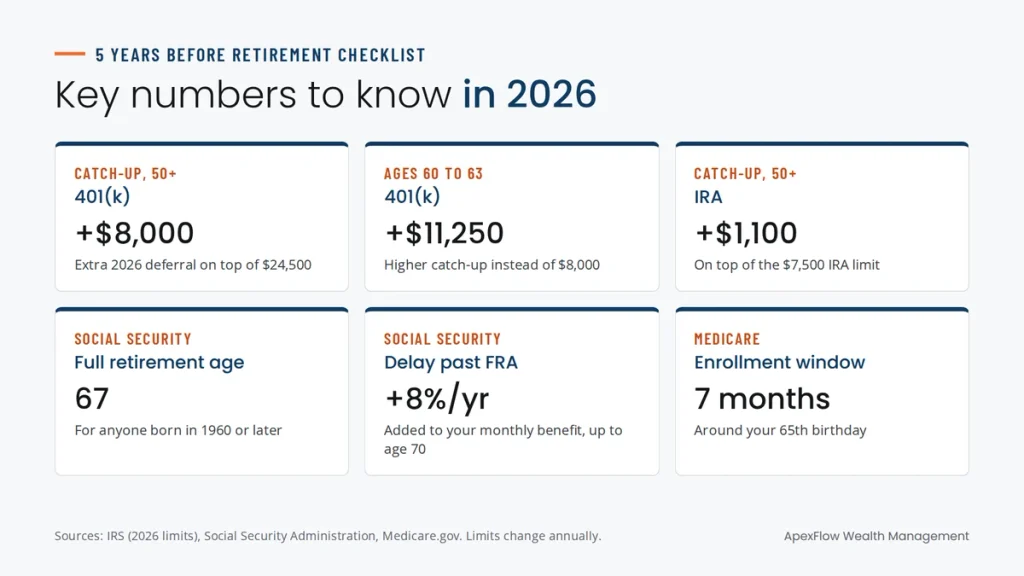
- Use catch-up contributions. For 2026, the IRS allows an extra $8,000 in a 401(k) at 50 and older, or $11,250 if you’re 60 to 63, plus an extra $1,100 in an IRA.
- Build a mix of account types. Having money in taxable, tax-deferred and Roth accounts gives you more control over your taxes later. We explain the trade-offs in Roth vs. Traditional IRA for High Earners.
- If you own a business, start planning your exit now. A sale can take years to prepare. See Retirement Savings for Business Owners.
- For Utah Specific Numbers, read Does Utah Tax Retirement Income? Social Security, Pensions and 401(k)s in 2026
Year 3: Plan for health care and risk
Health care is one of the biggest unknowns in retirement, and it needs a plan before your employer coverage ends.
- Plan coverage until 65 if you’ll retire earlier, when Medicare begins.
- Make the most of an HSA if you have one. We cover how in Using Your HSA for Retirement.
- Review your insurance, including life, disability and long-term care.
- Start shifting your investment mix. The goal isn’t to abandon stocks, but to make sure the money you’ll need in the first years of retirement isn’t exposed to a sharp downturn.

Year 2: Design your retirement income strategy
This is where your income sources, your investments, your tax approach and your estate plan stop living in separate silos and start working as one system. It’s the Design stage, and it answers the questions that keep people up at night:
- When should you claim Social Security? According to the Social Security Administration, full retirement age is 67 for anyone born in 1960 or later. You can claim as early as 62 with a permanent reduction, or wait until 70 and add 8% to your monthly benefit for each full year you delay past full retirement age.
- How will you draw income? Decide the order in which you’ll tap taxable, tax-deferred and tax-free accounts to keep taxes manageable.
- How will you protect against a bad market early on? A downturn in the first years of retirement can do lasting damage if you’re forced to sell. Setting aside cash and bonds for near-term spending helps. See Should You Move to Cash Before Retirement? and Bonds in Retirement.
- What happens to your spouse’s income if something happens to you first? Pension and Social Security survivor choices matter here.
- Is your estate plan current? Update beneficiaries and documents before the transition.
Year 1: Put the plan in motion
In the final year, the plan shifts from paper to practice.
- Enroll in Medicare on time. Your initial enrollment period runs for seven months around your 65th birthday. If you have an HSA, stop contributing six months before you apply for Medicare or Social Security.
- Set up your income. Arrange how your first year of retirement spending will be paid, and build a cash reserve that covers the next year or two.
- Finalize pension and Social Security decisions, and consider a test run living on your planned retirement budget.
- Know your future tax dates, including when required minimum distributions begin: at 73 or 75 under current law, depending on your birth year.
After you retire: stay at the table
A retirement plan isn’t something you build once and file away. It’s something you live inside of, and life doesn’t hold still. Markets move. Health changes. Grandkids show up sooner than expected. Tax law shifts underneath you whether you’re paying attention or not.
In the Deploy stage, we put your income strategy into motion and then we stay. We revisit the plan, adjust for what’s changed and make sure the strategy keeps pace with the life you’re living rather than the assumptions made years ago.

Why this approach is different
Most retirement planning starts with products: an annuity to cover this, an investment allocation to cover that. We start with purpose, and let the products follow from it. A plan built around what you want your life to look like tends to hold up under pressure better than one built around generic benchmarks, because you understand why it’s built the way it is.
We also don’t believe retirees need to be handled delicately. Our clients have spent decades running households, businesses and careers with real skill. What they need isn’t hand-holding. It’s direct guidance from people willing to tell them what they need to hear. You can see how the whole process works on our planning process page.
Frequently asked questions
Define what you want retirement to look like, estimate your spending, check your Social Security record, maximize catch-up contributions and start planning for health care, income and taxes. Each of the next five years has its own focus.
Ideally three to five years before you retire. That gives you time to coordinate Social Security, account withdrawals, taxes and investment changes instead of making those decisions all at once.
Many people gradually reduce risk as retirement approaches, especially for the money they’ll spend in the first few years. The goal is to protect near-term income, not to leave the market entirely.
It depends on your health, other income, marital status and goals. You can claim between 62 and 70; waiting increases your monthly benefit. It’s one of the most important decisions to model before you retire.
Waiting too long to plan the transition. Many key decisions, from health coverage to income timing, are much easier with a few years of lead time.
Talk it through with us
If you’re within five years of retirement and the plan currently living in your head is a number and a hope, that’s a common starting point, and it’s not where you have to stay. You don’t need to have it figured out before you call us. That’s what the first conversation is for. Book a 20-minute Fit Call. It’s virtual, no prep is needed and there’s no obligation.
With clarity and confidence,

Investing involves risk and you may incur a profit or loss regardless of strategy selected, including diversification and asset allocation. Raymond James and its advisors do not offer tax or legal advice. You should discuss any tax or legal matters with the appropriate professional.
Related Articles
Dig deeper into our resource library
-
 October 7, 2026
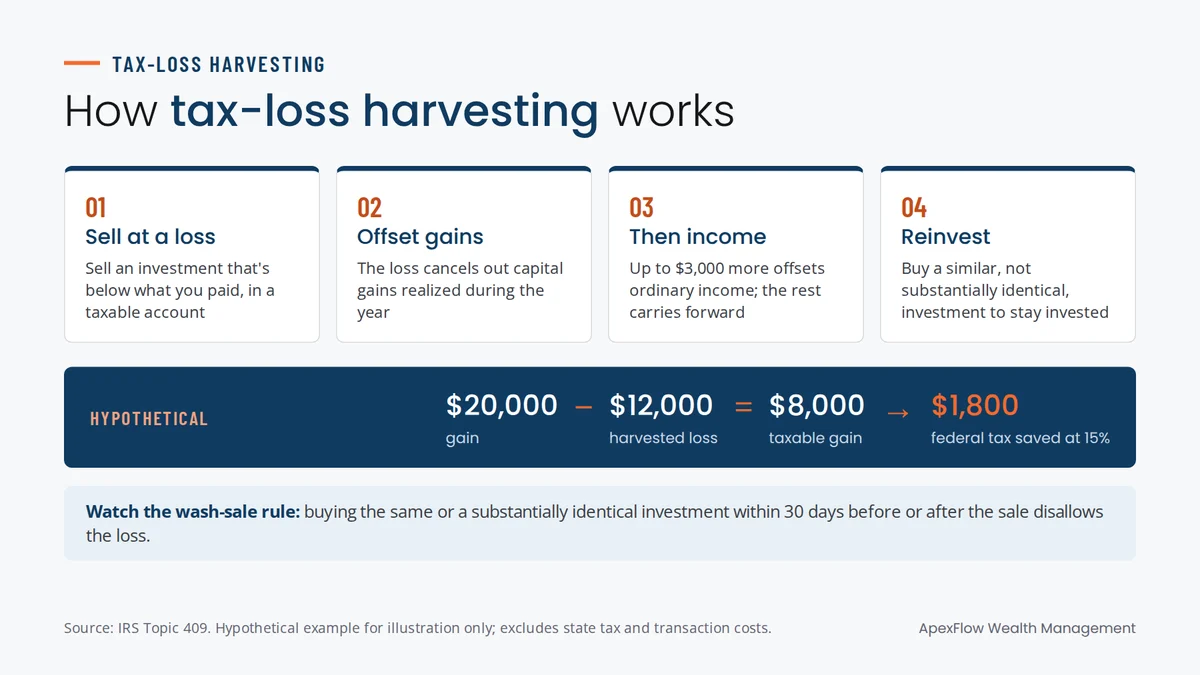
Tax-Loss Harvesting: How It Works and How to Avoid the Wash-Sale Rule
No one likes seeing an investment lose value. But in a taxable account, a loss can have a silver lining. Tax-loss harvesting means selling anRead more -
 October 7, 2026
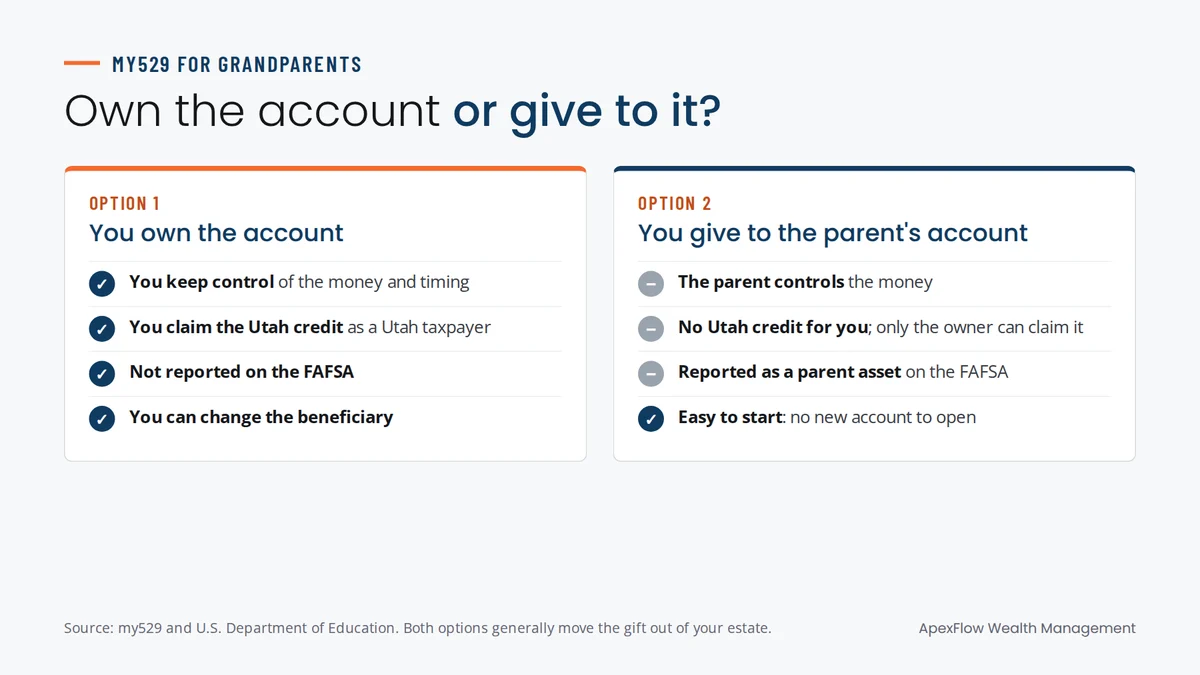
Using Utah’s my529 Plan as a Grandparent
Helping pay for a grandchild’s education is one of the most meaningful gifts a grandparent can give. It’s also one of the most tax-efficient. Utah’sRead more -
 October 7, 2026
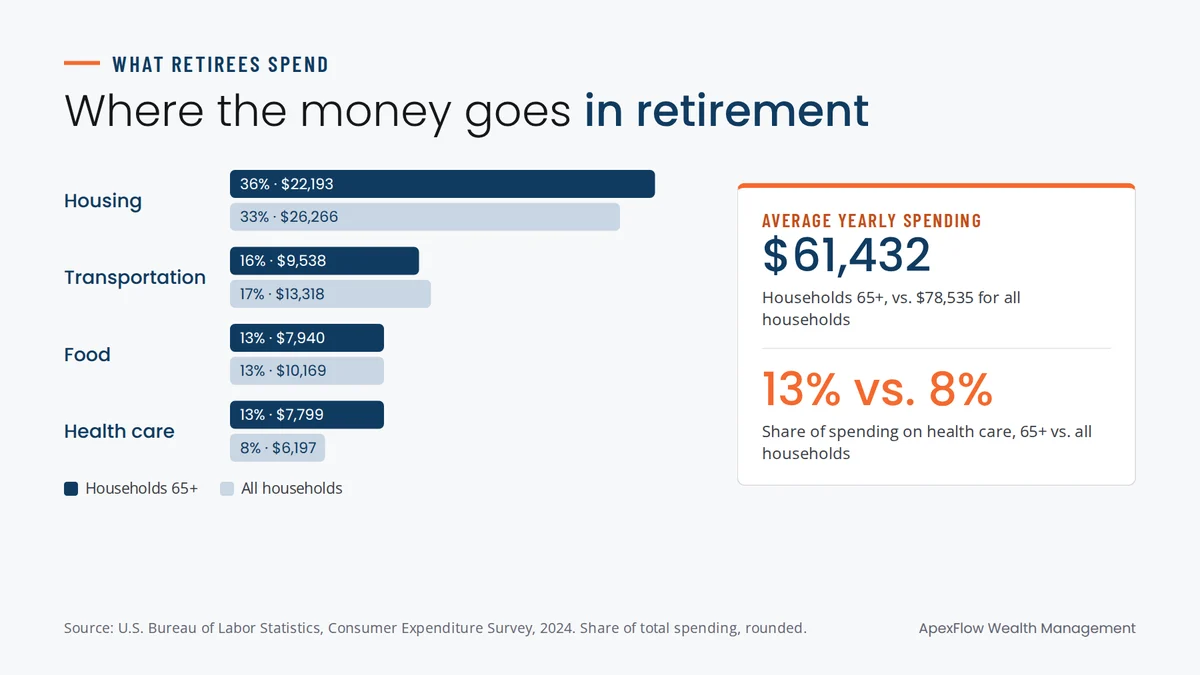
How to Build a Retirement Budget That Lasts
For decades, your budget had a built-in safety net: the next paycheck. Retirement changes that. Your income now comes from Social Security, maybe a pension,Read more