
May showed that strong markets and real uncertainty can exist at the same time. Technology stocks kept pushing markets higher, earnings beat expectations and the economy stayed resilient. Underneath, inflation persisted and interest rates climbed. In this May 2026 market update, we look at both sides of that story and what it means for long-term investors.

Key takeaways
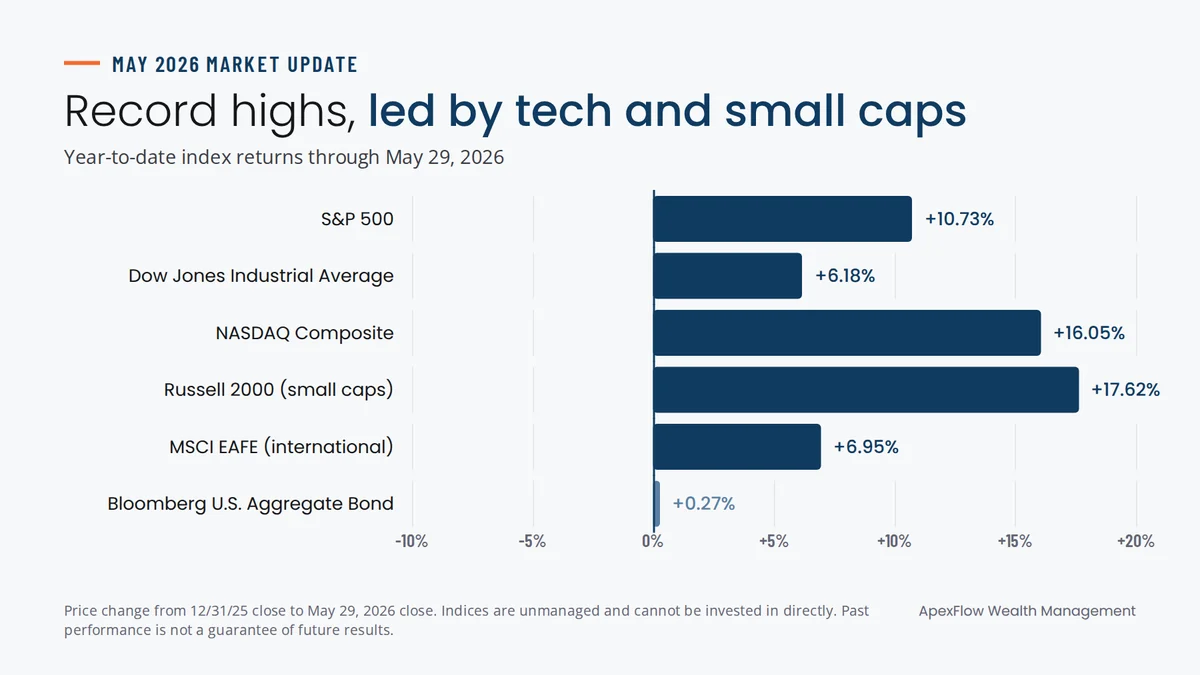
- The S&P 500 rose for eight straight weeks to new record highs and was up 10.73% for the year through May 29.
- First-quarter earnings growth is tracking near 27% year over year, more than double what analysts expected.
- Unemployment held steady at 4.3%, but inflation remains elevated.
- The 30-year Treasury yield reached its highest level since 2007.
A market driven by momentum
The S&P 500 extended its rally to eight consecutive weeks, reaching new records as companies reported stronger-than-expected results. Technology led again, fueled by continued investment in artificial intelligence and growing confidence that businesses are starting to earn measurable returns on it.
Participation also broadened. Small-cap stocks kept advancing, and international markets posted gains despite headwinds abroad. Importantly, markets are responding to real business results, not optimism alone.
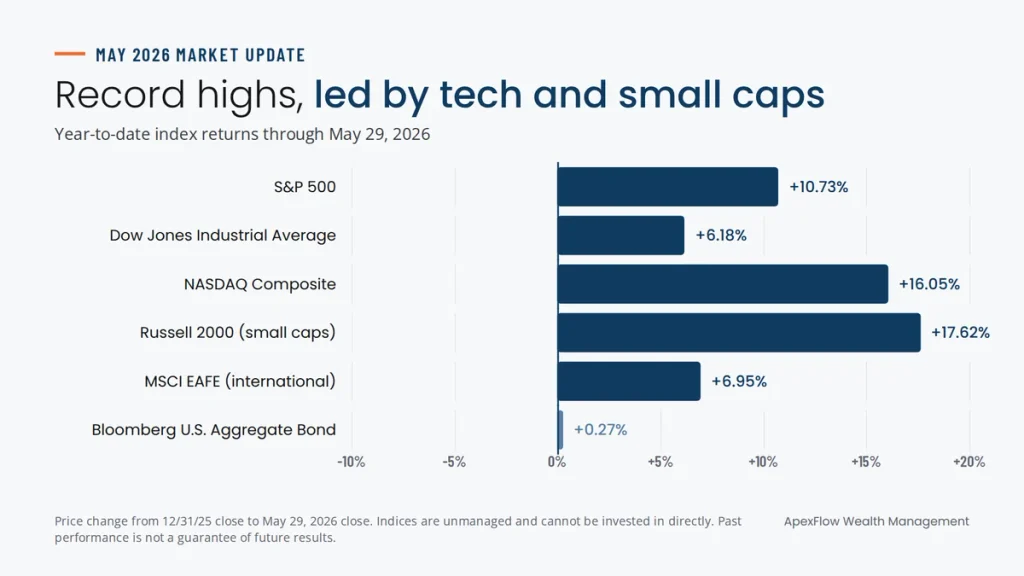
Year-to-date index returns
| Index | 12/31/25 close | 5/29/26 close | Year-to-date change |
|---|---|---|---|
| Dow Jones Industrial Average | 48,063.29 | 51,032.46 | 6.18% |
| NASDAQ Composite | 23,241.99 | 26,972.62 | 16.05% |
| S&P 500 | 6,845.50 | 7,580.06 | 10.73% |
| MSCI EAFE | 2,892.71 | 3,093.73 | 6.95% |
| Russell 2000 | 2,481.91 | 2,919.34 | 17.62% |
| Bloomberg U.S. Aggregate Bond | 2,348.85 | 2,355.21 | 0.27% |
Performance reflects index values as of market close on May 29, 2026.
The economy’s tug of war
The U.S. economy stayed durable in May. Payroll growth beat expectations, private hiring accelerated and unemployment held at 4.3%. Consumers kept spending and businesses kept investing.
At the same time, inflation remains elevated, driven partly by energy prices and global supply constraints. Growth and inflation are pulling in different directions. Markets have mostly focused on the strength, while policymakers remain focused on inflation.

Interest rates are moving higher
The Federal Reserve faces a hard balancing act. Stable jobs and growth give it little reason to cut rates, while persistent inflation keeps pressure on it to stay restrictive. Bond markets have started pricing in higher rates for longer, and Treasury yields rose through May, with the 30-year yield reaching its highest level since 2007.
There’s a silver lining for diversified investors. Higher yields have made bonds more attractive as a source of income than they’ve been in many years. We explain how bonds can support a retirement paycheck in Bonds in Retirement.
What it means for your plan
When markets reach new highs, it’s tempting to chase momentum. When rates rise, it’s tempting to focus only on risk. Both reactions pull investors away from the bigger picture. Strong returns don’t remove complexity; they just change how it looks. If a single stock or sector has grown to dominate your portfolio during this run, see How to Diversify a Concentrated Stock Position.
Investing is rarely about choosing between optimism and caution. Successful investors learn to hold both at the same time.

Talk it through with us
If you’re wondering whether to take some gains off the table or how rising rates affect your income plan, we’d be glad to help. Book a 20-minute Fit Call. It’s virtual, no prep is needed and there’s no obligation.
With clarity and confidence,
Any opinions are those of ApexFlow Wealth Management and not necessarily those of Raymond James. Expressions of opinion are as of this date and are subject to change without notice. Raymond James and its advisors do not offer tax or legal advice. You should discuss any tax or legal matters with the appropriate professional. Investing involves risk and you may incur a profit or loss regardless of strategy selected, including diversification and asset allocation. Prior to making an investment decision, please consult with your financial advisor about your individual situation. The indices shown are unmanaged and cannot be invested in directly. Index returns do not reflect fees or expenses. Past performance is not a guarantee of future results.