
April showed how quickly headlines can thicken the fog, and how quickly markets can look past it. Conflict in the Middle East dominated early in the month, but progress toward a ceasefire helped steady markets, and stocks posted one of their strongest months in years. In this April 2026 market update, we look at the rally, the economy beneath it and what a new Fed chair could mean.

Key takeaways
- The S&P 500 gained 10.4% in April, one of its strongest months since the pandemic era. The NASDAQ rose 15.3% and the Dow 7.1%.
- The S&P 500 closed at a record high on April 24 after a 13-day rally of more than 12%.
- Earnings growth is expected to stay in double digits for a sixth straight quarter.
- Treasury yields barely moved, and crude oil stayed above $90 a barrel.
A rally that looked past risk
The S&P 500 completed a 13-day rally and closed at a new all-time high on April 24, advancing more than 12% after signs of progress between the U.S. and Iran. Transits through the Strait of Hormuz remained limited, but investors were willing to look through short-term oil concerns rather than react emotionally.
Technology stocks led once again, reaching new highs. As Raymond James Chief Investment Officer Larry Adam observed, corporate earnings growth is expected to remain in double-digit territory, marking a sixth consecutive quarter above 10%. Small caps joined the rally, and strong technology demand in Korea and Taiwan pushed the MSCI Emerging Markets Index to a record high.
With crude still above $90 a barrel, volatility remains possible. Optimism and caution often coexist.
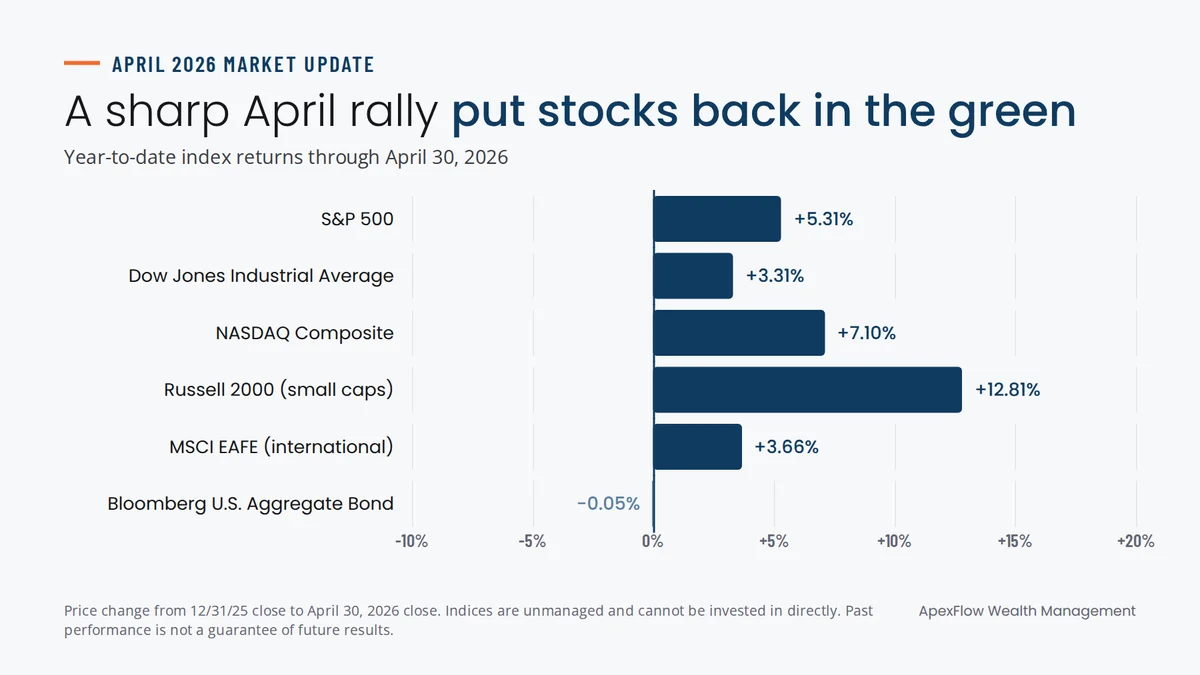
Year-to-date index returns
| Index | 12/31/25 close | 4/30/26 close | Year-to-date change |
|---|---|---|---|
| Dow Jones Industrial Average | 48,063.29 | 49,652.14 | 3.31% |
| NASDAQ Composite | 23,241.99 | 24,892.31 | 7.10% |
| S&P 500 | 6,845.50 | 7,209.01 | 5.31% |
| MSCI EAFE | 2,892.71 | 2,998.62 | 3.66% |
| Russell 2000 | 2,481.91 | 2,799.90 | 12.81% |
| Bloomberg U.S. Aggregate Bond | 2,348.85 | 2,347.68 | -0.05% |
Performance reflects index values as of market close on April 30, 2026.
Bonds offered stability
U.S. Treasury yields finished April within two basis points of March levels across the curve, from three-month bills to 30-year bonds. Elevated yields kept fixed income attractive, even with corporate and municipal bond spreads tight. For diversified portfolios, bonds again did two jobs: generating income and smoothing volatility. We explain that role in Bonds in Retirement.
Economic resilience beneath mixed emotions
Private sector hiring beat expectations in March, led by small businesses. Personal income rose more than forecast, and first-quarter GDP accelerated to 2.0%. Yet consumer sentiment fell sharply in April to its lowest level in decades, shaped by energy costs, persistent inflation and geopolitical uncertainty. How people feel and how the economy performs don’t always move together.

A new Fed chair on the way
Kevin Warsh, a known proponent of lower interest rates, is expected to be confirmed soon as the new chair of the Federal Reserve. But he’s only one member of the Federal Open Market Committee, and the committee’s overall stance is hawkish, with fighting inflation a higher priority than boosting short-term growth.
What it means for your plan
Months like April can feel unsettling because results improve while clarity stays limited. It may feel like risks should carry more weight, or like optimism is fragile. Markets often move higher in the presence of doubt. Control doesn’t come from predicting world events. It comes from preparation, perspective and patience. If a strong month has you tempted to chase what’s working, read Recency Bias in Investing.

Talk it through with us
If you’d like a second look at whether your portfolio still matches your goals after a big move in the markets, we’d be glad to help. Book a 20-minute Fit Call. It’s virtual, no prep is needed and there’s no obligation.
With clarity and confidence,
Any opinions are those of ApexFlow Wealth Management and not necessarily those of Raymond James. Expressions of opinion are as of this date and are subject to change without notice. Raymond James and its advisors do not offer tax or legal advice. You should discuss any tax or legal matters with the appropriate professional. Investing involves risk and you may incur a profit or loss regardless of strategy selected, including diversification and asset allocation. Prior to making an investment decision, please consult with your financial advisor about your individual situation. The indices shown are unmanaged and cannot be invested in directly. Index returns do not reflect fees or expenses. Past performance is not a guarantee of future results.