
“Don’t put all your eggs in one basket” is advice everyone nods along to and almost nobody applies correctly. The people most likely to break the rule are often the most successful: executives paid in company stock, longtime employees with a 401(k) full of their employer’s shares, and founders whose wealth is tied up in one business. If a single company makes up a large share of what you own, you have a concentrated stock position, and real diversification starts with understanding what that means.

At a glance
- Diversification is about how your investments behave together, not how many you own.
- A concentrated stock position is usually one company making up more than about 5% to 10% of your investments. Many executives have far more.
- You don’t have to sell everything at once. Staged sales, charitable gifts, exchange funds and hedging can spread out the risk and the taxes.
What diversification actually means
Most people think they’re diversified because they own several different stocks. Often they’re not, at least not in the way that matters.
Owning ten different technology stocks feels diversified because it’s ten different companies. But if those companies tend to rise and fall together, driven by the same economic forces and the same investor sentiment, you don’t have ten independent bets. You have one bet, made ten times.
What matters isn’t the number of holdings. It’s correlation: how much your investments move in relation to one another. Real portfolio diversification combines assets that respond differently to the same conditions.
What is a concentrated stock position?
There’s no official cutoff, but advisors often flag any single stock that makes up more than about 5% to 10% of a portfolio. Fidelity, for example, notes that a holding above about 5% can create unwanted risk.
Concentration rarely happens on purpose. It usually builds up quietly through:
- Restricted stock units (RSUs) and stock options that vest year after year
- Employee stock purchase plans that buy shares at a discount
- Company stock in your 401(k)
- Founder or early-employee equity in a business that grew
- Inherited shares that no one wanted to sell
For executives, there’s a second layer of risk. Your salary, bonus, future equity grants and investment portfolio may all depend on the same company. If it hits a rough patch, all of them can take a hit at the same time.
Why one company is riskier than it looks
It’s easy to feel safe holding stock in a company you know well, especially one that has done well. But company-specific risk can’t be planned around. A product recall, a lawsuit, a new competitor or an accounting problem can change a company’s fortunes quickly, and even strong businesses are exposed.
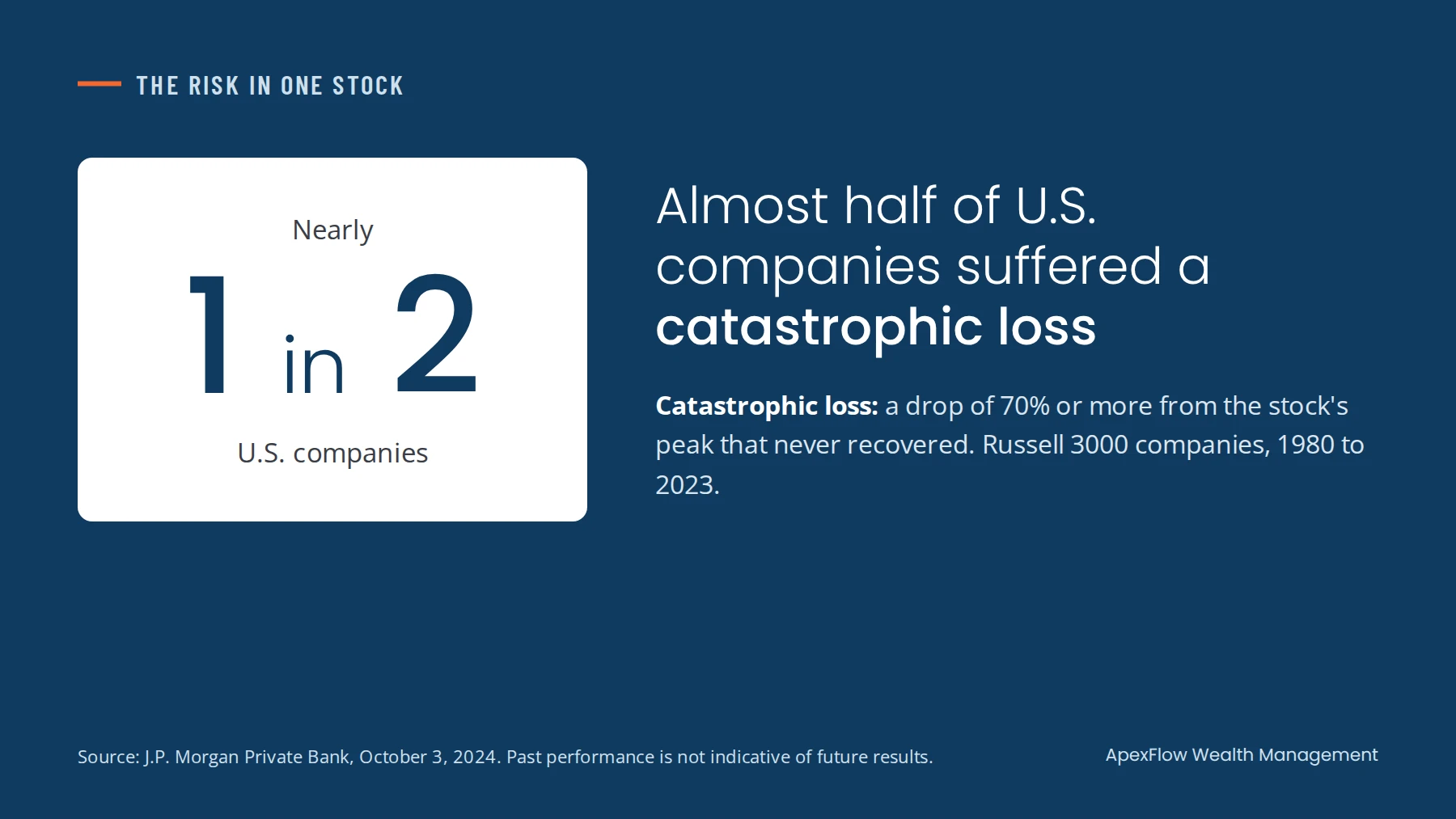
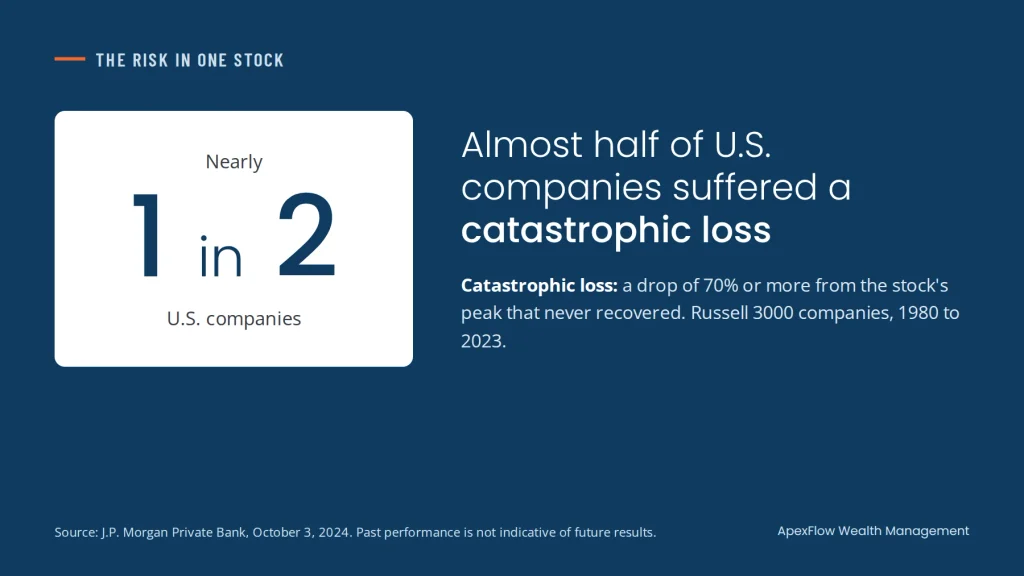
The long-term numbers are sobering. In a 2024 J.P. Morgan Private Bank analysis of Russell 3000 companies from 1980 to 2023, almost half suffered a “catastrophic loss,” defined as a drop of 70% or more from their peak that never recovered.
That doesn’t mean your company will be one of them. It means no one can reliably tell in advance which companies will be, which is exactly why diversification exists.
Past performance is not indicative of future results.
The building blocks of a diversified portfolio
Once you start moving money out of a single stock, here’s what you’re moving it toward:
- Across asset classes. Stocks, bonds, real estate and cash tend to respond differently to the same economic conditions. When one zigs, another often zags, or at least doesn’t zig as hard.
- Across sectors and industries. Spreading stock exposure across technology, healthcare, energy, financials and others reduces the chance that one industry’s downturn sinks the whole portfolio.
- Across geographies. A portfolio made up only of U.S. companies is tied to U.S. economic conditions. International stocks, in both developed and emerging markets, can behave differently.
- Across company sizes. Large established companies and smaller growth companies often react differently to interest rates and economic growth.
- Across time, through rebalancing. As investments grow at different rates, a portfolio drifts from its original mix. Rebalancing brings it back, so diversification lasts beyond day one.

Ways to reduce a concentrated stock position
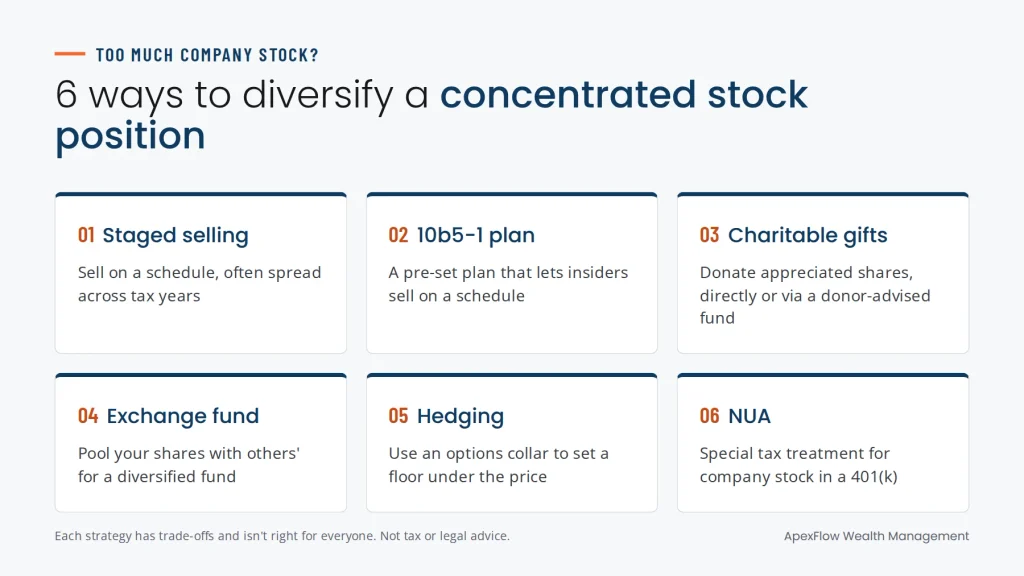
Selling everything at once is rarely the only option, and often not the best one, because of taxes and timing. Common ways to reduce company stock concentration include:
| Strategy | How it works | Trade-offs |
|---|---|---|
| Staged selling | Sell a set amount on a schedule, often spread across tax years | Simple and flexible, but you keep some exposure while you wait |
| 10b5-1 trading plan | A pre-set selling plan that lets company insiders sell on a schedule, even during blackout periods | Must be set up in advance; recent SEC rules added waiting periods before trades start |
| Gifting to charity | Donate appreciated shares directly or through a donor-advised fund | You give up the shares, but may avoid capital gains and receive a deduction |
| Exchange fund | Pool your shares with other investors’ stock in exchange for a diversified fund | Usually limited to high-net-worth investors, with long holding periods and fees |
| Hedging (collars) | Use options to set a floor under the stock’s price, usually by giving up some upside | Complex, has costs, and doesn’t reduce the position itself |
| Net unrealized appreciation (NUA) | A special tax treatment for company stock taken out of a 401(k) | Only applies in specific situations and needs careful tax planning |
None of these is right for everyone. The best approach usually combines a few, based on your tax picture, your company’s trading rules, your timeline and how much of the position you want to keep.
What diversification is not designed to do
This is worth being direct about: diversification does not ensure a profit or guarantee against loss. It won’t stop a diversified portfolio from losing value in a broad market downturn, when many asset classes can fall together, even if not by the same amount.
What diversification is designed to do is reduce the impact of any single investment, sector or event on your overall wealth. It smooths the ride rather than promising an outcome.
A quick way to check your own exposure
Ask yourself three questions:
- If the stock you’re most excited about had a bad year, what happens to the rest of your portfolio? If most of it would move the same direction, that’s a signal worth paying attention to.
- What share of your net worth is tied to one company? Include vested and unvested shares, options, your 401(k) and any deferred compensation.
- If your company struggled, would your income and your investments suffer at the same time? For many executives, the honest answer is yes.
If those answers make you uneasy, you’re not alone. Concentration often feels comfortable precisely because the stock has done well, a pattern we cover in Why Chasing Last Year’s Winners Usually Backfires. It also helps to understand how much of a loss your plan could actually absorb, which we explain in Risk Tolerance vs. Risk Capacity.
Where we fit in
Building real diversification means looking past the number of holdings to how everything behaves together, including account types, tax treatment and your whole financial picture, not just one account.
For executives and business owners, that often starts with a plan for company stock: how much to keep, how quickly to reduce the rest and how to do it tax-efficiently. It’s a core part of our executive financial planning and portfolio management work, and we coordinate with your CPA so the tax side fits.
Frequently asked questions
There’s no single rule, but a stock that makes up more than about 5% to 10% of your investments is commonly considered concentrated. The right limit for you depends on your overall wealth, income and goals.
Not necessarily. Many people keep some company stock for good reasons. The goal is to make sure that a bad stretch for one company can’t derail your plan, and to reduce the position in a way that manages taxes and timing.
Options include spreading sales over several tax years, donating appreciated shares to charity, using an exchange fund and, for stock in a 401(k), net unrealized appreciation. Each has trade-offs, so talk with your advisor and tax professional before acting.
It’s a written plan that lets company insiders sell shares on a pre-set schedule. Because the plan is set up in advance, sales can continue even during periods when insiders would otherwise be blocked from trading.
Not always. If your holdings tend to move together, such as several companies in the same industry, you can own many stocks and still be concentrated in one kind of risk
Talk it through with us
If you’re not sure whether your portfolio is truly diversified or just spread across many positions, that’s worth looking at together. Book a 20-minute Fit Call. It’s virtual, no prep is needed and there’s no obligation.

Investing involves risk and you may incur a profit or loss regardless of strategy selected, including diversification and asset allocation. Raymond James and its advisors do not offer tax or legal advice. You should discuss any tax or legal matters with the appropriate professional.
Related Articles
Dig deeper into our resource library
-
 October 7, 2026
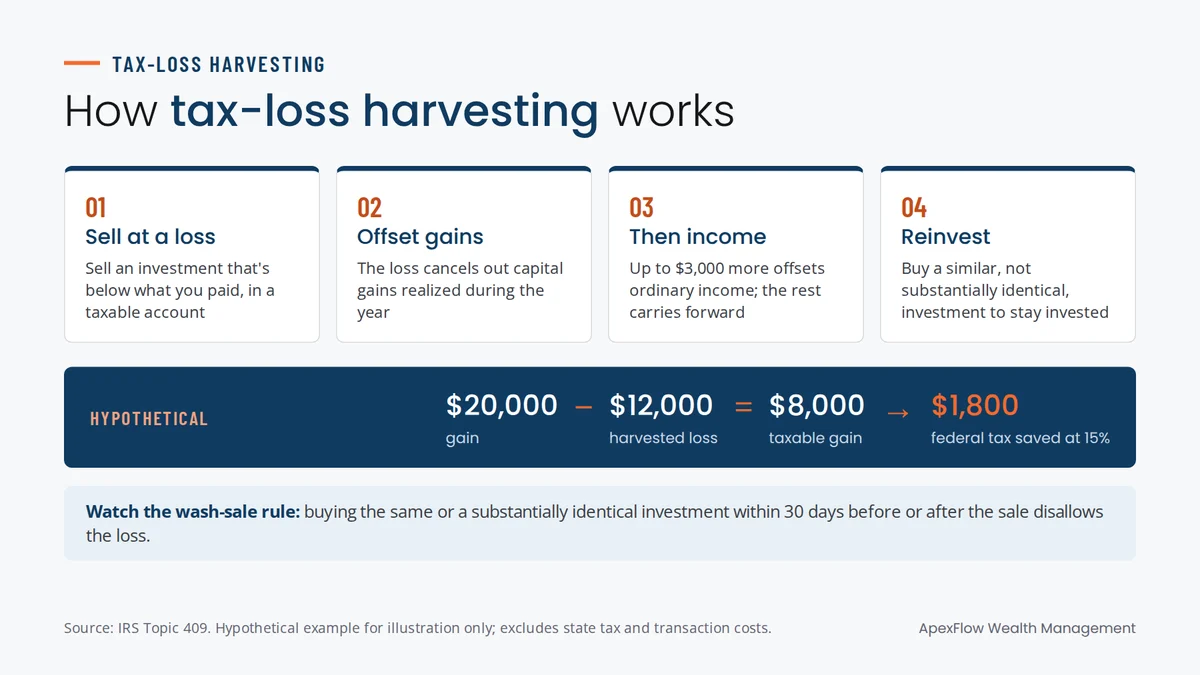
Tax-Loss Harvesting: How It Works and How to Avoid the Wash-Sale Rule
No one likes seeing an investment lose value. But in a taxable account, a loss can have a silver lining. Tax-loss harvesting means selling anRead more -
 October 7, 2026
Using Utah’s my529 Plan as a Grandparent
Helping pay for a grandchild’s education is one of the most meaningful gifts a grandparent can give. It’s also one of the most tax-efficient. Utah’sRead more -
 October 7, 2026
How to Build a Retirement Budget That Lasts
For decades, your budget had a built-in safety net: the next paycheck. Retirement changes that. Your income now comes from Social Security, maybe a pension,Read more