
Helping pay for a grandchild’s education is one of the most meaningful gifts a grandparent can give. It’s also one of the most tax-efficient. Utah’s my529 plan lets grandparents put money to work for a grandchild’s future, grow it tax-free for education and, if structured well, claim a Utah tax credit and reduce the size of their own estate along the way. Here’s how my529 for grandparents works in 2026, and the choices that matter most.

At a glance
- A 529 plan grows tax-free when used for qualified education costs, and Utah offers a state tax credit on my529 contributions.
- In Utah, only the account owner can claim the credit, so grandparents who want it should open their own account.
- Since the 2024-25 FAFSA, money from a grandparent-owned 529 no longer counts against a student’s federal financial aid.
Why grandparents use 529 plans
A 529 plan is an education savings account with three big tax advantages: contributions grow without annual taxes, withdrawals for qualified education expenses are tax-free and Utah residents can earn a state tax credit on contributions.
For grandparents, there’s a fourth advantage. Contributions are treated as gifts, so they generally move out of your taxable estate, yet you keep control of the account as owner. You decide when money is used, and you can change the beneficiary to another family member if plans change. Few other gifting tools offer that combination.
Two ways to help: own it or gift to it
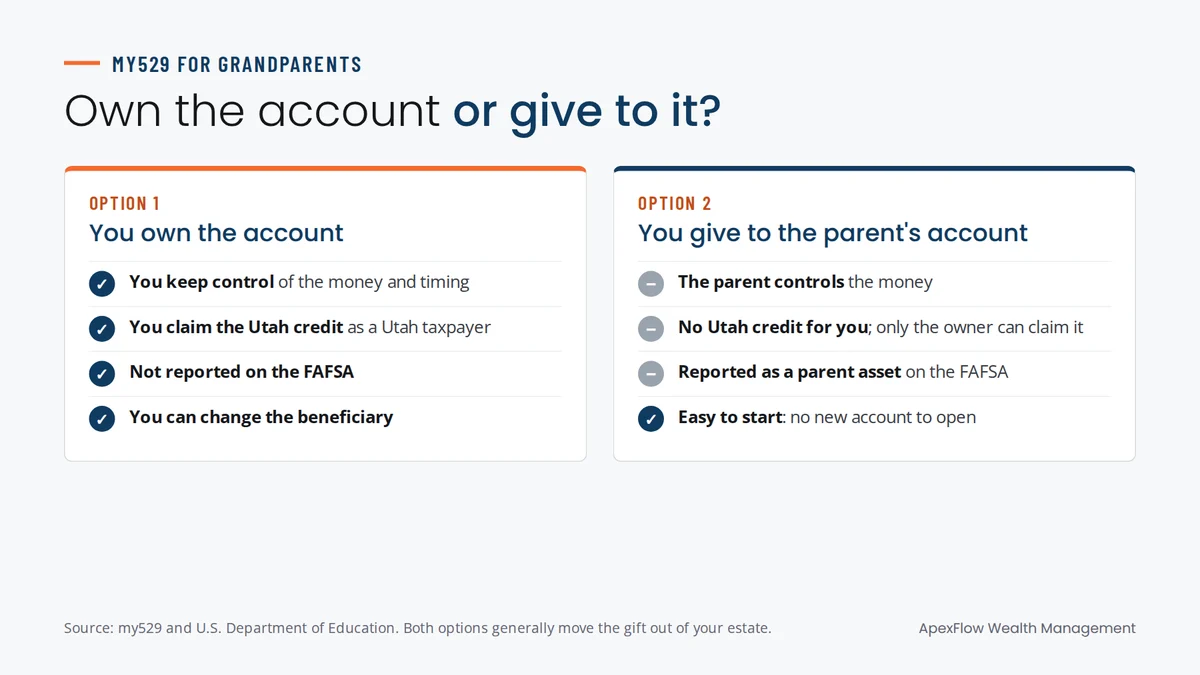
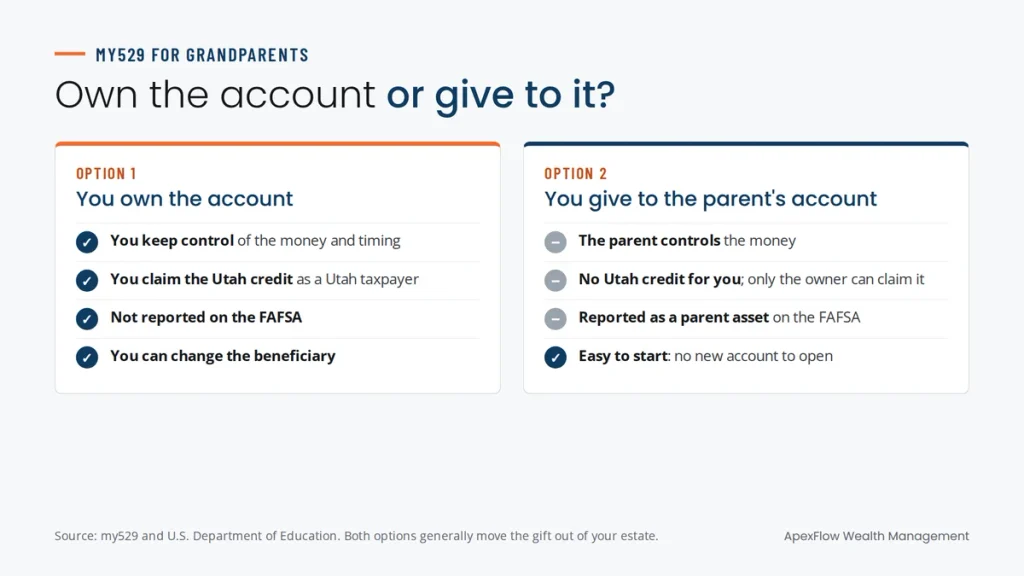
Grandparents usually choose between opening their own my529 account or contributing to an account the parents already own. The difference matters more than most families realize.
| Grandparent owns the account | Grandparent gives to parent’s account | |
|---|---|---|
| Who controls the money | You | The parent |
| Who can claim the Utah tax credit | You (if you’re a Utah taxpayer) | The parent, within the parent’s own limit |
| Federal financial aid (FAFSA) | Not reported | Reported as a parent asset |
| Out of your estate | Generally yes | Yes |
| Can change beneficiary | You decide | The parent decides |
According to my529, a Utah taxpayer can’t claim state tax benefits for contributions to an account they don’t own. If the credit matters to you, open the account in your own name.
The Utah my529 tax credit in 2026
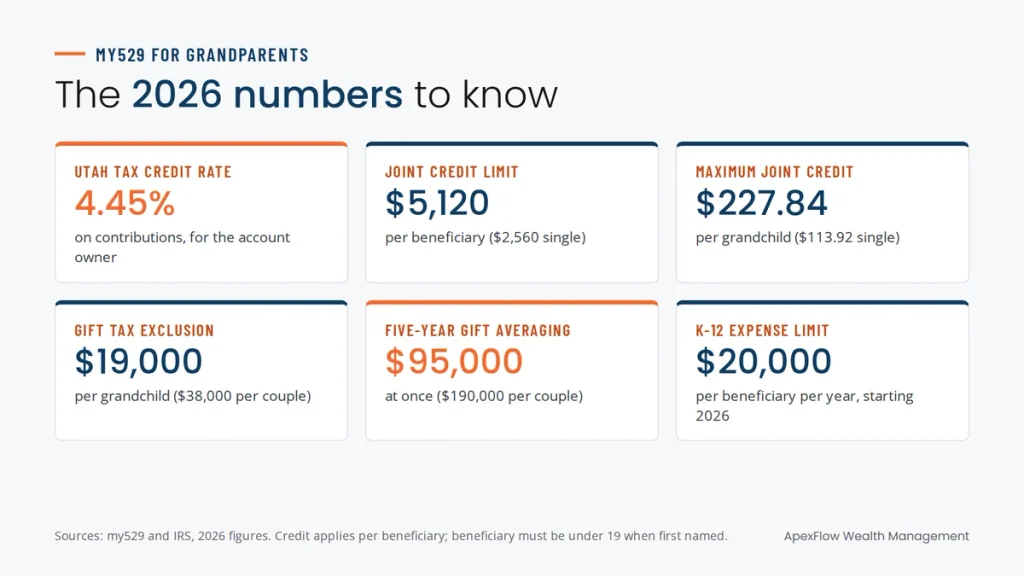
For 2026, my529 lists a Utah tax credit of 4.45% on contributions up to:
- $2,560 per beneficiary for single filers, a credit of up to $113.92
- $5,120 per beneficiary for married couples filing jointly, a credit of up to $227.84
The limits apply per beneficiary, so grandparents with several grandchildren can claim the credit for each account they own. One newer rule to know: the beneficiary must be under 19 when first named on the account.
A hypothetical example. Married grandparents who file jointly in Utah open a my529 account for each of their three grandchildren and contribute $5,120 to each in 2026. They could claim a Utah credit of up to $227.84 per grandchild, or $683.52 in total, while the money grows tax-free for education.
This example is hypothetical and for illustration only. Credit amounts depend on your tax situation.
If money is later withdrawn for something other than qualified expenses, Utah requires the owner to add back credits previously claimed, and federal tax and a 10% penalty generally apply to the earnings.
Gift and estate planning with a 529
Contributions to a 529 count toward the federal gift tax annual exclusion, which is $19,000 per recipient in 2026 ($38,000 for a married couple), according to the IRS.
529 plans also allow something unusual: five-year gift averaging, often called superfunding. A grandparent can contribute up to $95,000 per beneficiary at once ($190,000 for a couple) and elect on a gift tax return to spread it over five years. That moves a large amount out of your estate quickly while it grows tax-free. If the donor dies before the five years are up, a prorated portion is added back to the estate.
For families thinking about estate taxes or simply passing on values along with dollars, a 529 can fit neatly alongside your will or trust. We cover the bigger picture in Do You Need a Trust? and How to Talk to Your Adult Children About Inheritance.
How grandparent 529s affect financial aid now
This used to be the biggest drawback. Withdrawals from a grandparent-owned 529 once counted as student income on the FAFSA and could reduce aid. Starting with the 2024-25 FAFSA, that question was removed, according to the U.S. Department of Education. A grandparent-owned 529 isn’t reported as a parent asset either.
One caveat: some private colleges use the CSS Profile in addition to the FAFSA, and it may still ask about support from grandparents. If your grandchild is applying to those schools, check before making large withdrawals.
What a 529 can pay for
my529 funds can be used tax-free for a wide range of expenses, according to the IRS and my529:
- College and graduate school: tuition, fees, books, required supplies and equipment, and room and board for students enrolled at least half-time
- K-12 costs: up to $20,000 per beneficiary per year starting in 2026, up from $10,000, including tuition and some other educational expenses
- Registered apprenticeships and credentialing programs
- Student loan repayment: up to $10,000 per person over a lifetime
- A Roth IRA for the beneficiary: up to $35,000 over a lifetime can be rolled into the beneficiary’s Roth IRA if the account has been open at least 15 years, subject to annual IRA limits and other rules. Utah may recapture state credits on these rollovers, so confirm with my529 or your tax professional first.
That Roth option takes away much of the worry about leftover money. If a grandchild gets scholarships or chooses a different path, the account can be redirected to another family member or help start their retirement savings.
A few practical details
- Account limit: my529 accepts contributions until all accounts for a beneficiary reach $606,000.
- Costs: there’s no fee to open an account, and my529’s administrative fee is 0.08% a year, plus the underlying fund expenses.
- Successor owner: name a successor owner, often one of your children, so the account passes smoothly if something happens to you. Without one, it may get tied up in your estate.
- Investments: my529 offers age-based portfolios that grow more conservative as college approaches, plus static and customized options.

Where we fit in
A my529 account works best as part of a bigger plan that includes your retirement income, your estate plan and your family’s goals. At ApexFlow, we help grandparents decide how much they can comfortably give, which accounts to use and how gifts fit with their own security. It’s part of the Design stage of our planning process, coordinated with your estate planning.
Frequently asked questions
Yes. Anyone can open a my529 account and name a grandchild as beneficiary, as long as the beneficiary is under 19 when first named under current my529 rules.
Yes, if they’re Utah taxpayers and own the account. Only the account owner can claim the credit, so contributions to a parent-owned account don’t earn the grandparent a credit.
Up to $19,000 per grandchild in 2026, or $38,000 for a married couple. With five-year gift averaging, you can contribute up to $95,000 at once, or $190,000 as a couple, by filing a gift tax return.
Not on the FAFSA. Since the 2024-25 school year, grandparent-owned 529 accounts and their distributions aren’t reported. Some private schools using the CSS Profile may still ask.
You can change the beneficiary to another family member, use the funds for apprenticeships or K-12 costs, or roll up to $35,000 into the beneficiary’s Roth IRA if requirements are met. Non-qualified withdrawals are taxed and penalized on earnings.
Talk it through with us
If you’d like to help your grandchildren with education costs without shortchanging your own retirement, we’d be glad to help you find the right approach. Book a 20-minute Fit Call. It’s virtual, no prep is needed and there’s no obligation.
With clarity and confidence,

This material is for informational purposes only. As with other investments, there are generally fees and expenses associated with participation in a 529 plan. There is also a risk that these plans lose value or do not appreciate as much as anticipated. Investors should consider, before investing, whether their or the designated beneficiary’s home state offers any state tax or other benefits that are only available for investments in that state’s qualified tuition program. Earnings on non-qualified distributions will be subject to income tax and a 10% federal penalty tax. Investors should carefully consider the investment objectives, risks, charges and expenses associated with 529 plans before investing; this and other information is in the plan’s official statement. Examples are hypothetical. Raymond James and its advisors do not offer tax or legal advice. You should discuss any tax or legal matters with the appropriate professional.
Related Articles
Dig deeper into our resource library
-
 October 7, 2026
How to Build a Retirement Budget That Lasts
For decades, your budget had a built-in safety net: the next paycheck. Retirement changes that. Your income now comes from Social Security, maybe a pension,Read more -
 October 7, 2026
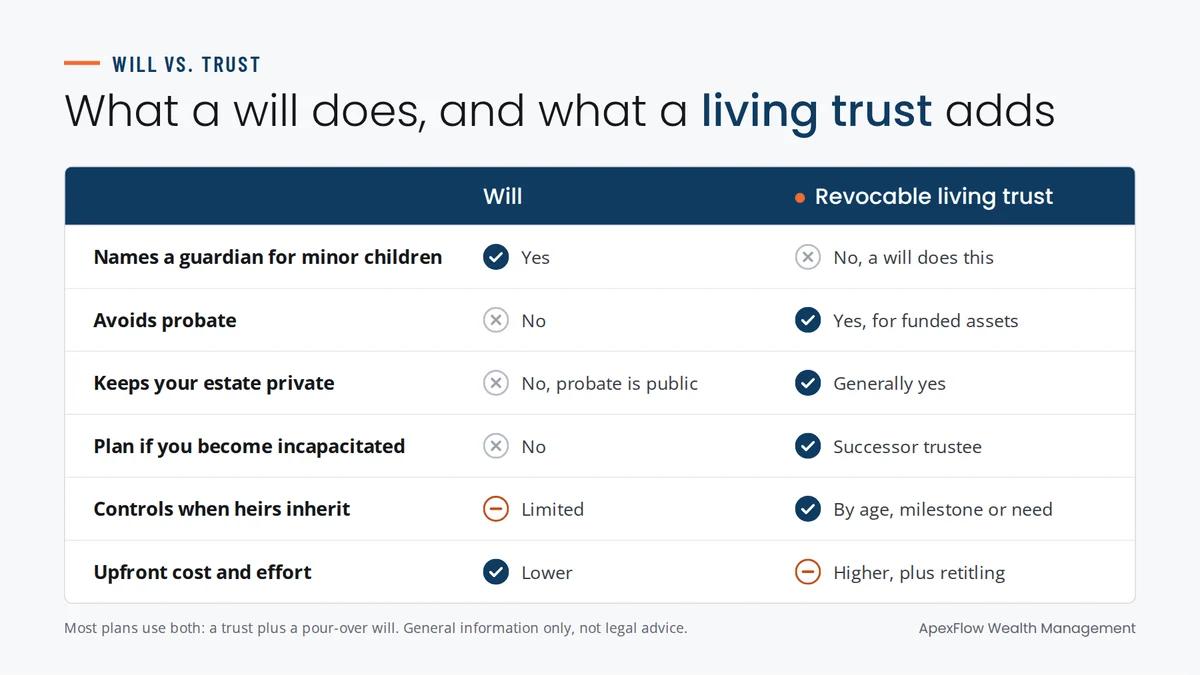
Do You Need a Trust? 6 Family Situations Where a Will Falls Short
Somewhere along the way, “trust” became a word people associate with wealth they don’t think they have. Trusts are for other people, the thinking goes:Read more -
 October 7, 2026
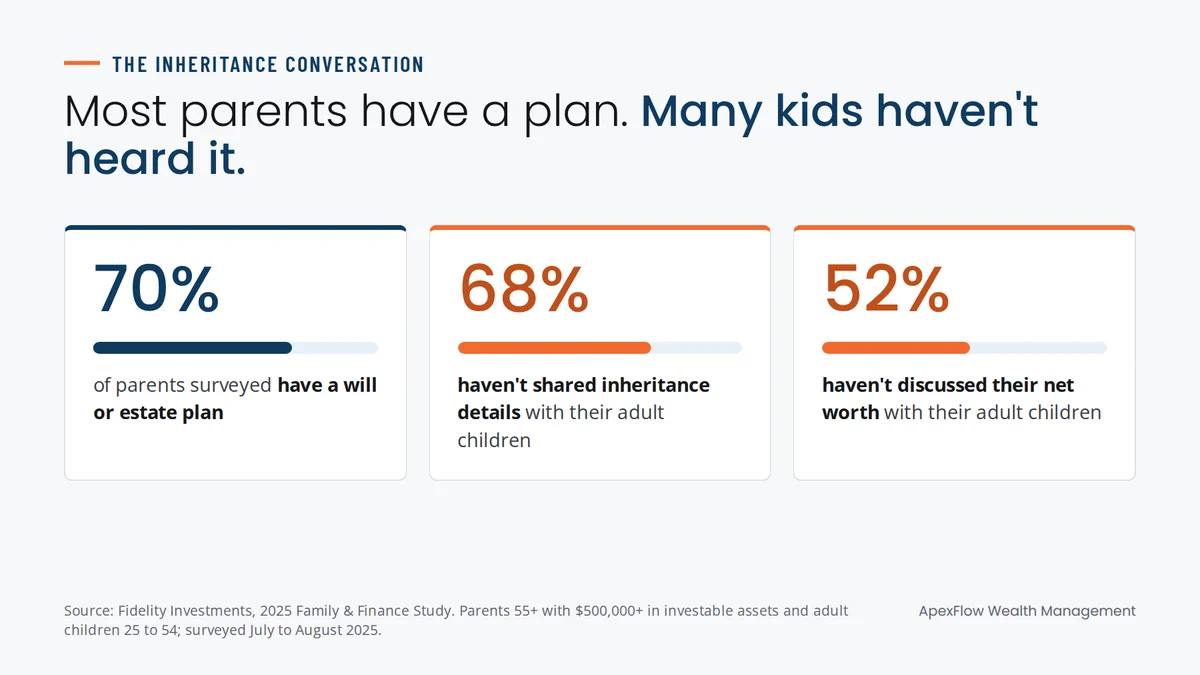
How to Talk to Your Adult Children About Inheritance
There’s a particular kind of silence that shows up around estate planning. Parents don’t want to talk about it because it means talking about theirRead more