
One of the most common questions people quietly carry is simple: “Am I on track for retirement?” For business owners, the usual answers rarely fit. Age-based benchmarks assume a steady paycheck, an employer 401(k) and a portfolio that holds most of your wealth. Owners often have none of those. Measuring retirement savings for business owners means counting what’s in your accounts, what’s in your business and how one could turn into the other.

At a glance
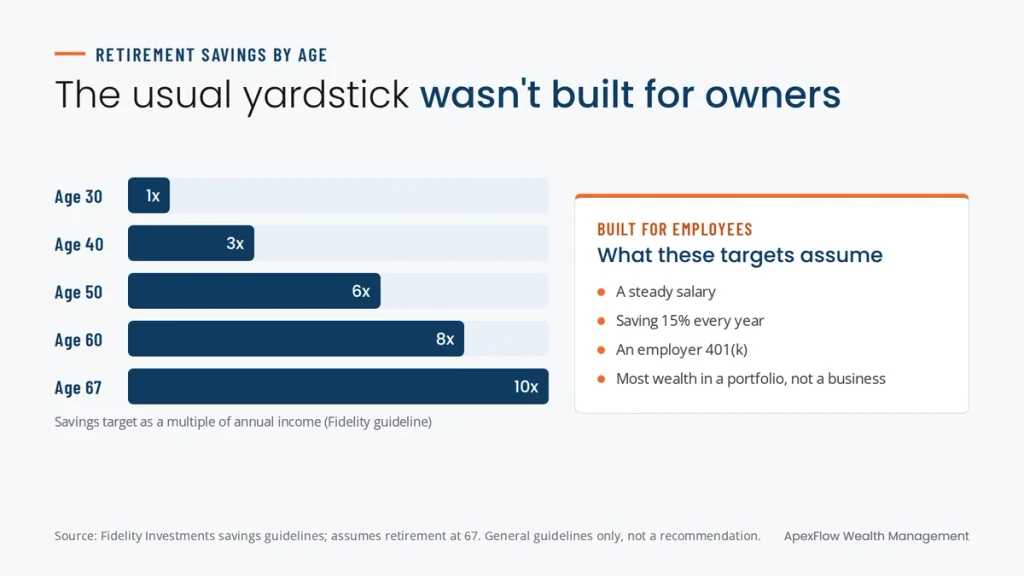
- Common benchmarks suggest saving about 1x your salary by 30, 3x by 40, 6x by 50, 8x by 60 and 10x by 67, but they assume a salaried employee.
- Business owners often reinvest in the company instead of saving, so much of their net worth is tied up in a business that’s hard to sell quickly.
- A better yardstick separates liquid retirement savings from business value, then tests how your plan holds up under different exit outcomes.
The usual retirement savings benchmarks
Financial institutions have long tried to answer “am I on track?” with age-based targets. One widely cited set comes from Fidelity:
| By age | Savings target (multiple of annual income) |
|---|---|
| 30 | 1x |
| 40 | 3x |
| 50 | 6x |
| 60 | 8x |
| 67 | 10x |
These can provide helpful context. But Fidelity’s targets assume a 15% savings rate, steady wage growth and retirement at 67. They’re not personal. Two people with similar balances may have very different levels of readiness depending on lifestyle, family obligations, health, income flexibility and goals.
Why retirement savings for business owners look different
For owners, a salary-based multiple can be misleading in either direction:
- Your income is irregular. A strong year and a lean year can look nothing alike, and your “salary” may be a fraction of what the business actually earns.
- You reinvest instead of saving. Many owners put profits back into equipment, hiring or growth. That builds value, just not in a retirement account.
- Your wealth is concentrated. The Exit Planning Institute notes that a business typically makes up 80% or more of its owner’s net worth.
- There’s no automatic plan. Without an employer 401(k) and match, saving depends entirely on the systems you set up yourself.
So an owner at 55 with “only” 2x their salary in retirement accounts might be in excellent shape, or in real trouble. It depends on the business.
How to count your business toward retirement
Your business may be your largest asset, but it’s not the same as money in the bank. Before you count it toward retirement, ask:
- What is it worth to a buyer? Not what you hope it’s worth, but what a buyer, partner or employee could realistically pay. A professional valuation helps.
- Who would buy it, and how would they pay? Sales to employees or family members are often paid over several years, not in a lump sum.
- What happens after taxes and fees? The proceeds you keep may be meaningfully less than the sale price.
- Does the business depend on you? A company that needs its owner to function is harder to sell and often worth less.
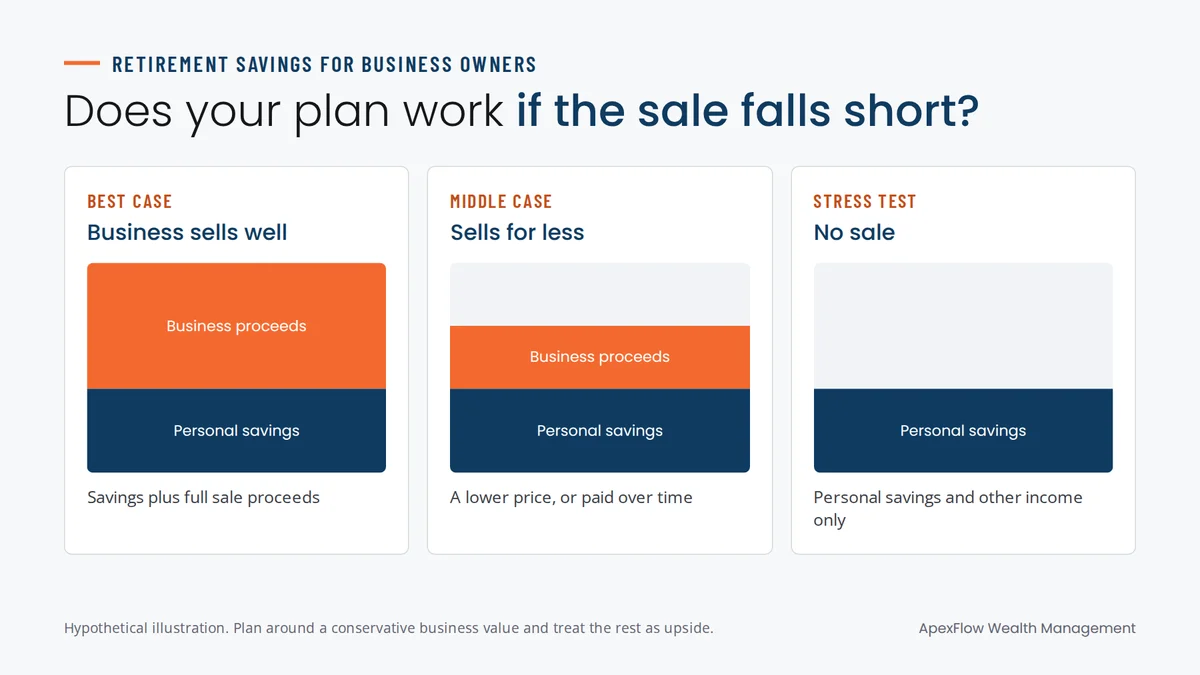
- What if the sale doesn’t happen? Could you still retire on your personal savings plus income from the business?
A practical approach is to plan around a conservative value for the business and treat anything above that as upside. If your retirement only works when the business sells for top dollar, the plan has a single point of failure.
Two hypothetical households at 55
Balances alone don’t tell the story. Consider two hypothetical households, both age 55:
| Household A | Household B | |
|---|---|---|
| Retirement savings | $850,000 | $1.4 million |
| Mortgage | Nearly paid off | Significant balance remaining |
| Monthly spending | Moderate | High |
| Debt | Minimal | Elevated |
| Other income | Pension and Social Security | Social Security only |
| Lifestyle expectations | Flexible | Expensive |
| Retirement outlook | Stable and sustainable | Needs more income |
Household B has saved more, but Household A is likely in a stronger position. Without context, comparisons can create misleading conclusions about how prepared someone is.
These households are hypothetical and for illustration only. They do not represent actual clients or specific investments.

Retirement plans built for business owners
The good news: owners often have access to retirement plans with much higher limits than an IRA. For 2026, the IRS limits include:
| Plan | Who it fits | 2026 contribution limit |
|---|---|---|
| SEP IRA | Owners with steady profits, few or no employees | Up to 25% of compensation, max $72,000 |
| Solo 401(k) | Owners with no employees other than a spouse | $24,500 employee deferral plus employer contributions, up to $72,000 total, plus catch-up if eligible |
| SIMPLE IRA | Smaller businesses with employees | $17,000 employee deferral, plus employer match |
| Cash balance plan | High-income owners who want to save more than a 401(k) allows | Based on age and income; often paired with a 401(k) |
Each comes with rules about covering employees, deadlines and administration, so the right choice depends on your business structure and your team. We compare the account types in more detail in Roth vs. Traditional IRA for High Earners.
Progress over time
Retirement planning unfolds over decades, and what progress looks like changes along the way.
In your 20s and 30s, consistency matters more than precision. For many owners, this is when the business takes everything, and that’s fine. Even small, automatic contributions build momentum.
In your 40s, financial life gets more complex. You may be raising children, supporting aging parents and running the business at full speed. This is the time to start building savings outside the business on purpose.
In your 50s and 60s, retirement becomes tangible. The focus shifts to income planning, health care, taxes, catch-up contributions and how and when you’ll step back from the business. We map those years out in The 5 Years Before Retirement.

A familiar story
A couple in their early 50s came in feeling behind. They had built stable careers, saved consistently and avoided major missteps, yet years of comparing themselves to online benchmarks had convinced them they were falling short. When we stepped back and looked at their full picture, the story changed. Their spending was reasonable, their habits were strong and their goals were realistic. What had been missing wasn’t discipline. It was context.
This is a composite example for illustration and does not represent any specific client.
What actually matters for retirement readiness
Retirement readiness is often framed as a single calculation, but in practice it’s a set of connected decisions. A thoughtful plan considers:
- The lifestyle you want to maintain or create
- The difference between essential and flexible expenses
- Reliable income sources such as Social Security, pensions, portfolio withdrawals or income from the business
- How and when you’ll transition out of your business, and what it’s realistically worth
- Risks that could disrupt the plan, including health care costs and market volatility
- Flexibility to adjust as life evolves
- The role of purpose and meaning in the next phase of life
Where we fit in
At ApexFlow, we believe retirement isn’t an ending. It’s a transition into greater intentionality. For business owners, that means planning your personal savings and your business exit together. Our business succession planning work helps you estimate what the business could realistically provide, protect it with tools like a buy-sell agreement and build savings that don’t depend on a perfect sale. It all comes together in the Design stage of our planning process.
Retirement planning shouldn’t create more pressure. It should reduce it.
Frequently asked questions
There’s no single number. Many owners use age-based benchmarks as a rough guide, but the better measure is whether your personal savings, plus a conservative estimate of what the business could provide, can support the life you want.
Yes, but carefully. Use a realistic, conservative value, account for taxes and how a sale would be paid and make sure your plan still works if the business sells for less than you hope.
It depends on your income, employees and goals. SEP IRAs are simple, solo 401(k)s offer high limits for owners without employees, SIMPLE IRAs fit smaller teams and cash balance plans can help high earners save more.
Not necessarily. Benchmarks don’t account for business value, pensions, spending or other income. A full review of your situation is a better guide than any single number.
Through a SEP IRA or solo 401(k), total contributions can reach $72,000 in 2026, plus catch-up contributions in a 401(k) if you’re 50 or older. Limits depend on your compensation and plan design.
Talk it through with us
If you’re a business owner wondering whether you’re on track, and how much your business really counts, that’s worth a conversation. Book a 20-minute Fit Call. It’s virtual, no prep is needed and there’s no obligation.
With clarity and confidence,

Investing involves risk and you may incur a profit or loss regardless of strategy selected, including diversification and asset allocation. Raymond James and its advisors do not offer tax or legal advice. You should discuss any tax or legal matters with the appropriate professional.
Related Articles
Dig deeper into our resource library
-
 October 7, 2026
Tax-Loss Harvesting: How It Works and How to Avoid the Wash-Sale Rule
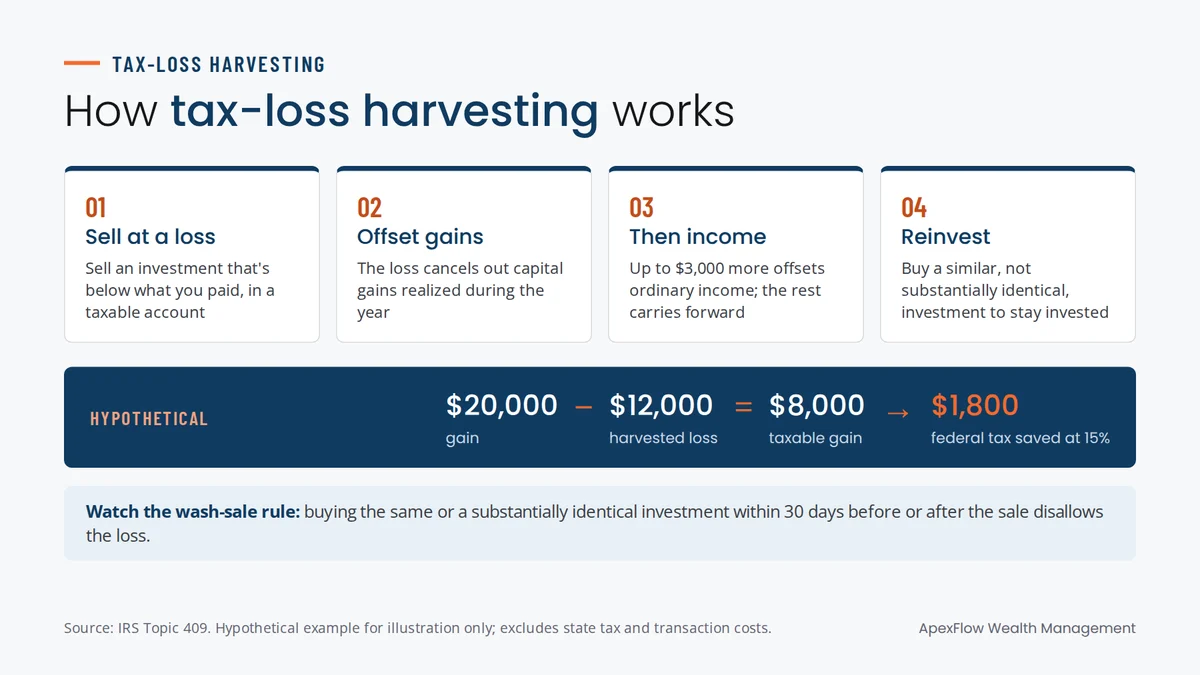
No one likes seeing an investment lose value. But in a taxable account, a loss can have a silver lining. Tax-loss harvesting means selling anRead more -
 October 7, 2026
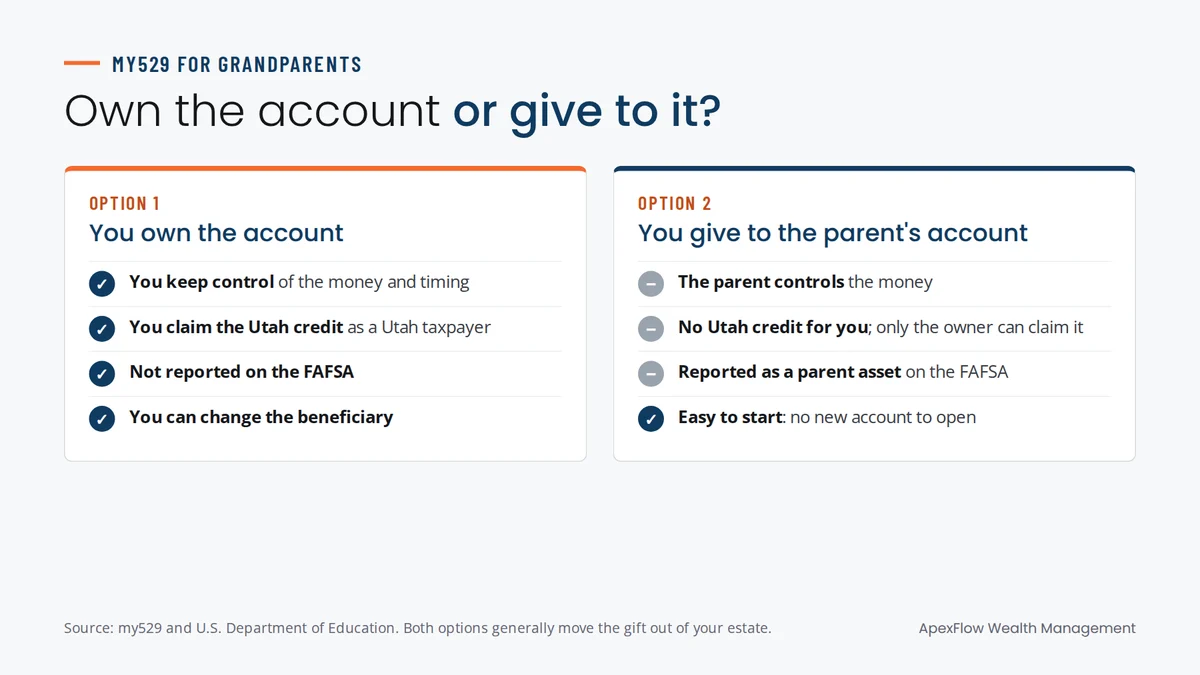
Using Utah’s my529 Plan as a Grandparent
Helping pay for a grandchild’s education is one of the most meaningful gifts a grandparent can give. It’s also one of the most tax-efficient. Utah’sRead more -
 October 7, 2026
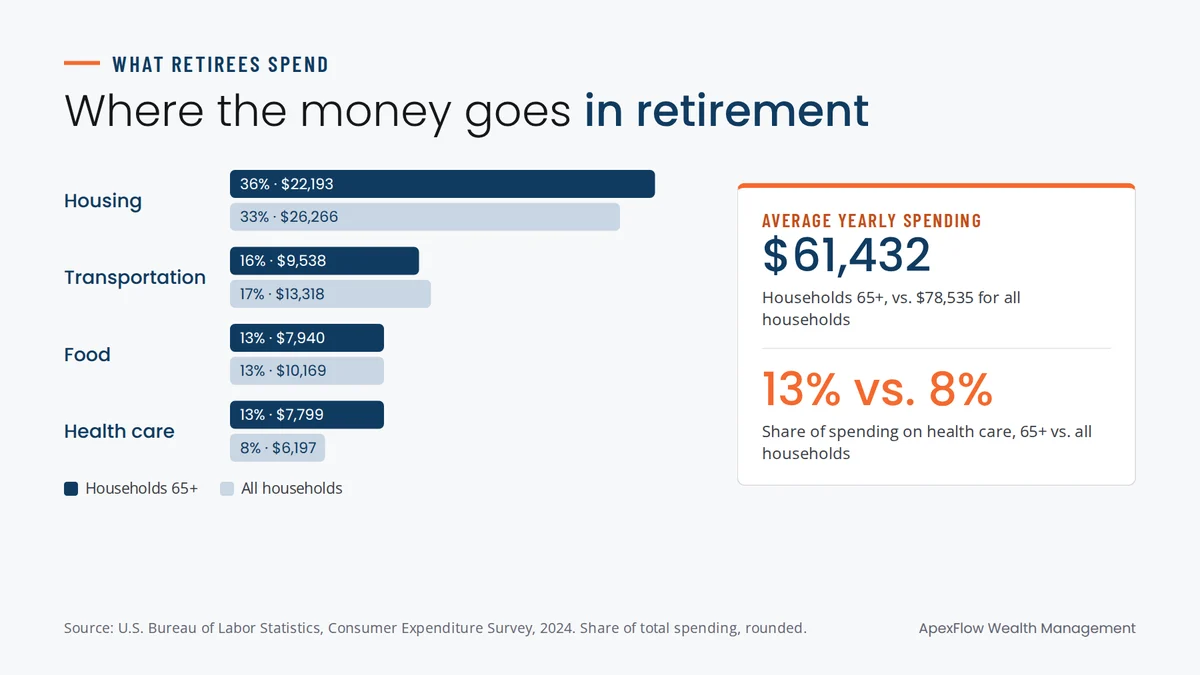
How to Build a Retirement Budget That Lasts
For decades, your budget had a built-in safety net: the next paycheck. Retirement changes that. Your income now comes from Social Security, maybe a pension,Read more