
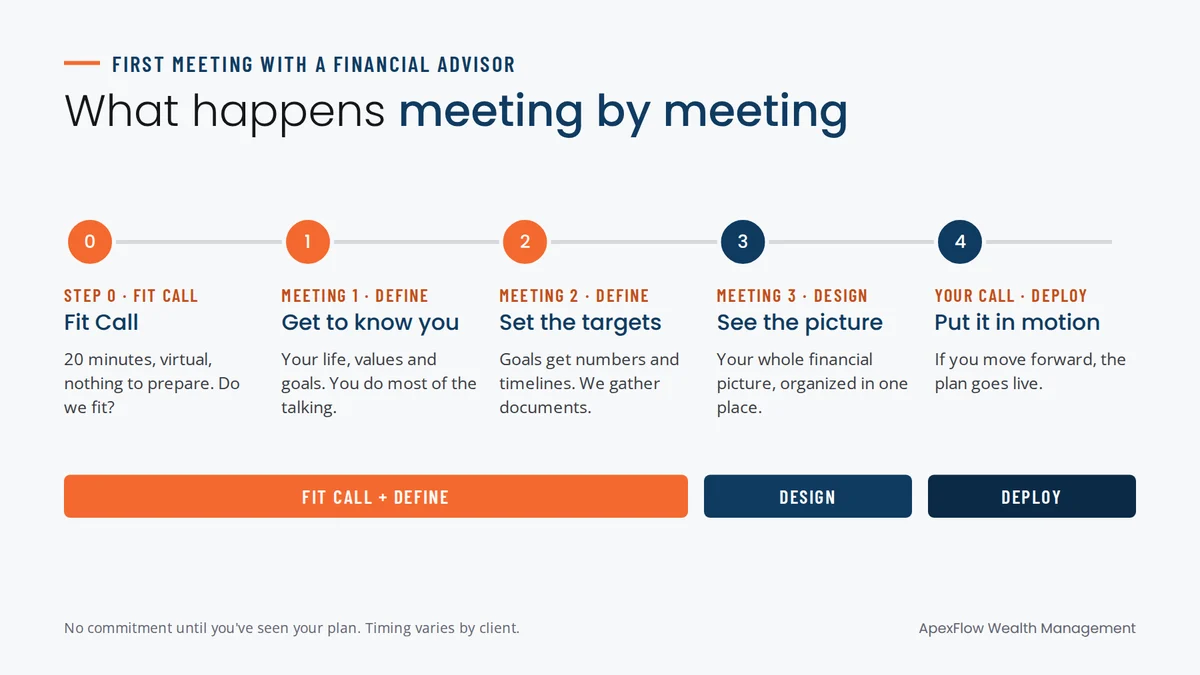
Most people put off calling a financial advisor for the same reason they put off calling a doctor. It’s not that they don’t care. It’s that they don’t know what’s about to happen to them. Will someone judge my spending? Will I be handed a stack of forms and a sales pitch? Will I walk out more confused than I walked in? We built our process so none of that happens. Here’s what to expect from your first meeting with a financial advisor at ApexFlow, meeting by meeting, from the first conversation to becoming a client, plus what to bring and the questions worth asking.

At a glance
- It starts with a 20-minute Fit Call, a short, virtual conversation to see whether we’re a good match.
- Your first meeting is about your life and goals, not your account statements. You should do more of the talking.
- By the third meeting, you’ll see your whole financial picture in one place, and only then do you decide whether to move forward.
Step zero: a 20-minute Fit Call
Before any formal meeting, we start with a Fit Call. It’s 20 minutes, it’s virtual and there’s nothing to prepare. You’ll tell us a little about where you are and what’s on your mind, and we’ll tell you how we work. If it seems like a fit on both sides, we schedule your first meeting. If not, we’ll say so and, where we can, point you somewhere better suited.
Before we talk numbers, we talk about you
The instinct in this industry is to open with a risk questionnaire and a review of your account statements. We don’t do that first, and it’s not an accident.
Our first conversation isn’t about your portfolio. It’s about your life. We want to understand what you care about: the people you’re building this for, the goals you haven’t said out loud yet and the version of your future that feels worth working toward. We call this stage Define, and it’s the foundation everything else gets built on. Skip it, and you end up with a financial plan that’s technically sound and personally meaningless. We’d rather build something that’s actually yours.
Your first meeting with a financial advisor: a conversation, not a pitch
Your first meeting with us is low-pressure by design. No spreadsheets, no jargon and no assumption that you’re ready to hand over your life savings on day one. It’s simply a conversation.
We’ll ask questions many advisors skip:
- What does financial success look like for you, specifically?
- What keeps you up at night about money?
- What do you want your wealth to make possible, not just accumulate?
This is where we start clarifying your core values and what matters most, so everything we build afterward is anchored in purpose instead of guesswork.
You should leave this meeting having done more talking than we did. If you walk out feeling listened to rather than sold to, we’ve done our job.

Meeting two: turning your goals into a plan we can act on
Once we understand what matters to you, we translate it into something concrete. This is where your values become specific, measurable goals with real numbers and real timelines attached.
We’ll also start building what we call your purpose-driven financial lens: a decision-making framework that lets us, and eventually you, weigh every future financial choice against what matters most. Should you pay off the house early or invest the difference? Should you take the new job with the pay cut and better hours? These aren’t just math problems. They’re purpose problems, and by this point you’ll have a framework built to answer them. If retirement is within sight, our 5 years before retirement roadmap shows the kinds of decisions these conversations often cover.
This is also when we’ll ask you to gather the practical pieces. We’ll tell you exactly what we need and why, so there’s no mystery homework.
What to bring to a financial advisor
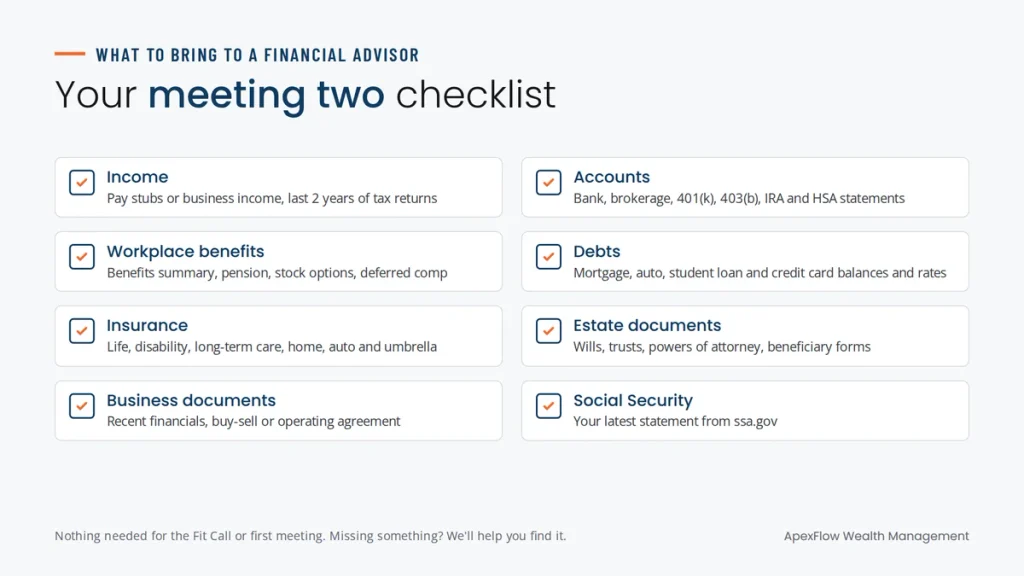
You don’t need any of this for the Fit Call or your first meeting. Before meeting two, these documents help us see the full picture:
- Income: recent pay stubs or business income statements and your last two years of tax returns
- Accounts: recent statements for bank, brokerage, retirement (401(k), 403(b), IRA) and HSA accounts
- Workplace benefits: your benefits summary, including any pension, stock options or deferred compensation
- Debts: mortgage, auto, student loan and credit card balances and rates
- Insurance: life, disability, long-term care, home, auto and umbrella policies
- Estate documents: wills, trusts, powers of attorney and current beneficiary designations, if you have them
- Business documents: if you own a business, recent financials and any buy-sell or operating agreement
- Social Security: your latest statement from ssa.gov
- Your questions: a short list of what’s on your mind. It’s often the most useful page in the stack.
If you’re missing some of it, that’s fine. Part of our job is helping you find it. If estate documents are a gap, our estate planning checklist is a good place to start.
Meeting three: seeing the whole picture for the first time
For most clients, this is the meeting that changes how they feel about their finances. We call this stage Design. We take everything scattered across different accounts, advisors and drawers and organize it into one clear financial snapshot.
We’ll walk you through how your investments and tax strategy work together, how your estate plan and protection planning support the people you care about and where the gaps or misalignments are that nobody had connected before. If you work with an accountant or an estate attorney, this is often where we start coordinating directly with them, so your whole financial team is speaking the same language.
Most people have never seen their full financial life on one page before. It tends to be the moment things click.
Becoming a client: putting the plan into motion
Once your plan is built and you’ve had the chance to ask every question you have, you decide whether to move forward. If you do, we move into Deploy. This is where the strategy stops being a document and becomes action: accounts get opened or transferred, investments get positioned, protection gets put in place and the plan you helped build goes live.
This is also where the relationship shifts from getting to know each other into an ongoing partnership. Markets move. Life moves faster. Jobs change, kids grow up, businesses get sold. As those things happen, we adjust the plan so it keeps evolving with you instead of going stale in a drawer. You can see how all three stages fit together on our planning process page.

Questions to ask a new financial advisor
A first meeting is an interview in both directions. Whoever you meet with, including us, these questions are worth asking:
- How are you paid? Fees, commissions or both, and what you’ll pay in total.
- What services will you provide, and in what capacity? Ask whether they’ll act as an investment adviser, a broker or both, and what standard of care applies to each.
- What are your credentials and experience? Ask what designations they hold and who they typically work with.
- Can I see your Form CRS? Firms that serve retail investors must provide this short relationship summary, which explains services, fees and conflicts of interest. The SEC’s investor bulletin explains what’s in it.
- What conflicts of interest do you have, and how do you manage them?
- Who else will I work with, and how often will we talk?
You can also look up any advisor’s registration and disciplinary history for free on FINRA BrokerCheck and the SEC’s Investment Adviser Public Disclosure site. The SEC explains how in How to Check Out Your Financial Professional.
What we ask in return
Not much. Show up to the first meeting willing to talk about more than money. Be patient with the process, because clarity takes a little longer to build than a quick pitch, but it lasts a lot longer too. And ask us anything. If something is unclear at any point in these first few meetings, that’s on us to fix, not on you to figure out.
Our commitment to you
Here’s the standard underneath all of it: you should walk away from this process feeling more purposeful and more in control of your future than when you started. That’s how we measure whether these first few meetings worked.
You’ve spent years building what you have. You don’t need to guess your way through the next chapter, and you don’t need to figure out where to start on your own. That’s what these first conversations are for.
Frequently asked questions
At ApexFlow, the first meeting is a conversation about your life, goals and concerns, not a review of your statements or a sales pitch. We focus on what you want your money to make possible.
Nothing for the Fit Call or first meeting. Before the second meeting, we’ll ask for account and insurance statements, recent tax returns, debt balances, estate documents and your Social Security statement.
For us, it’s typically three meetings after the Fit Call: one to define your goals, one to set specific targets and gather documents and one to review your full picture and plan.
No. You decide whether to become a client only after you’ve seen your plan and had your questions answered.
Ask how they’re paid, what services they’ll provide and in what capacity, what conflicts of interest they have and whether you can see their Form CRS. You can also check their background on FINRA BrokerCheck.
Ready for your first conversation?
If you’re ready to see what that first meeting feels like, we’d love to have it with you. Book a 20-minute Fit Call. It’s virtual, no prep is needed and there’s no obligation.
With clarity and confidence,

Investing involves risk and you may incur a profit or loss regardless of strategy selected, including diversification and asset allocation. Raymond James and its advisors do not offer tax or legal advice. You should discuss any tax or legal matters with the appropriate professional.
Related Articles
Dig deeper into our resource library
-
 October 7, 2026
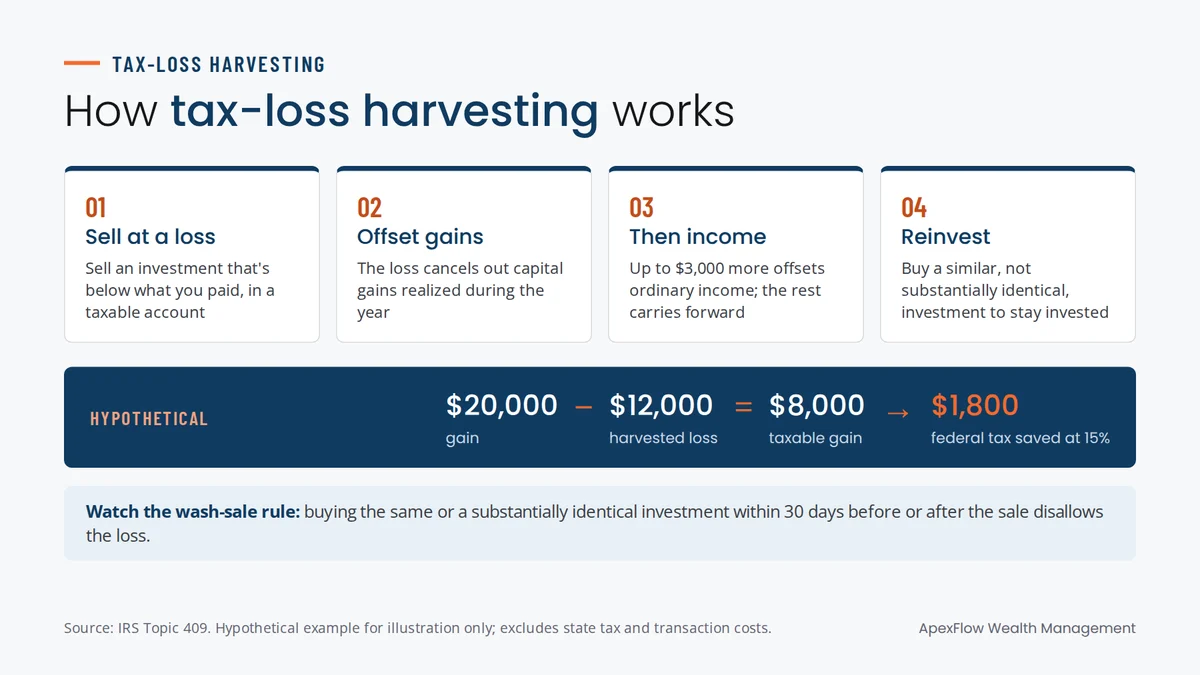
Tax-Loss Harvesting: How It Works and How to Avoid the Wash-Sale Rule
No one likes seeing an investment lose value. But in a taxable account, a loss can have a silver lining. Tax-loss harvesting means selling anRead more -
 October 7, 2026
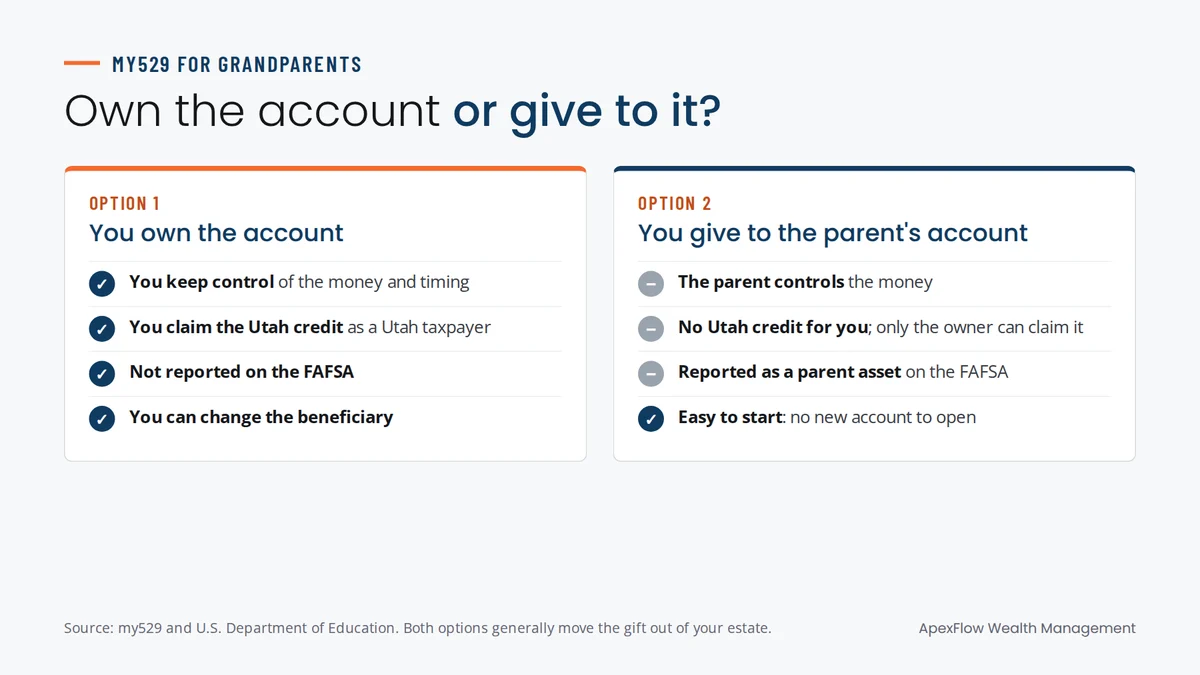
Using Utah’s my529 Plan as a Grandparent
Helping pay for a grandchild’s education is one of the most meaningful gifts a grandparent can give. It’s also one of the most tax-efficient. Utah’sRead more -
 October 7, 2026
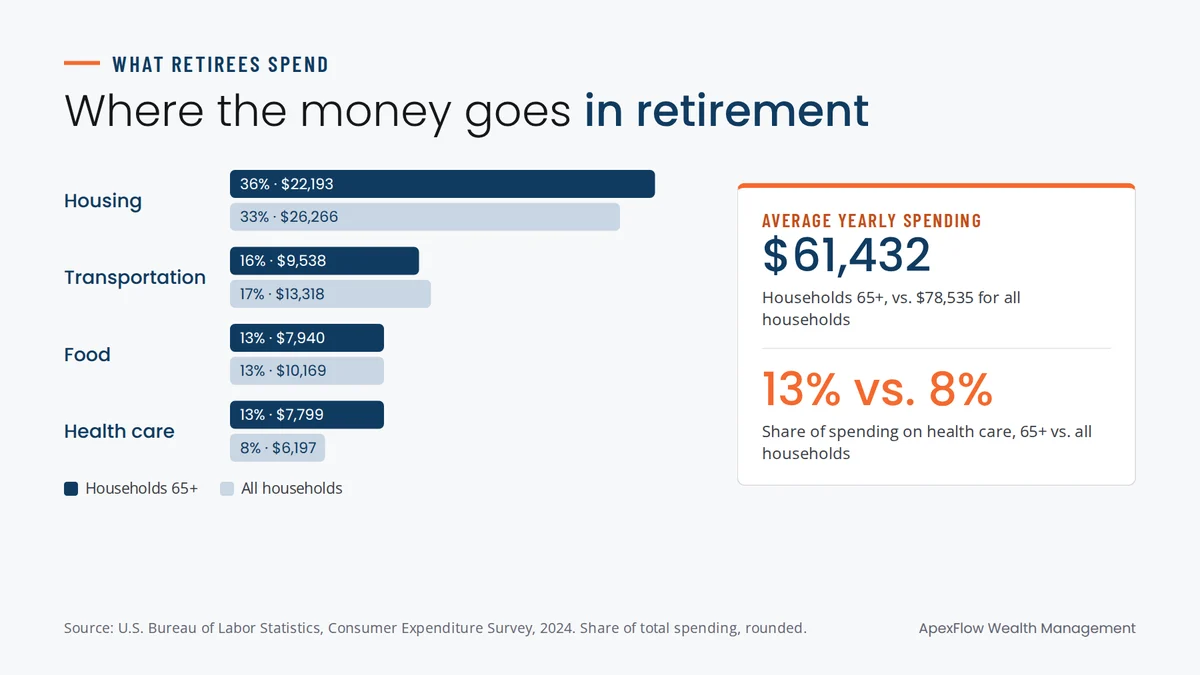
How to Build a Retirement Budget That Lasts
For decades, your budget had a built-in safety net: the next paycheck. Retirement changes that. Your income now comes from Social Security, maybe a pension,Read more