
Retirement planning often sounds like it belongs in a different language. Acronyms everywhere. Rules buried in footnotes. And once your income climbs, the rules get stranger: you may earn too much to contribute to a Roth IRA, too much to deduct a Traditional IRA and still have good reasons to use both. This guide walks through Roth vs. Traditional IRA for high earners in plain English, including the 2026 income limits, the backdoor Roth and the workplace Roth options that have no income limit at all.

At a glance
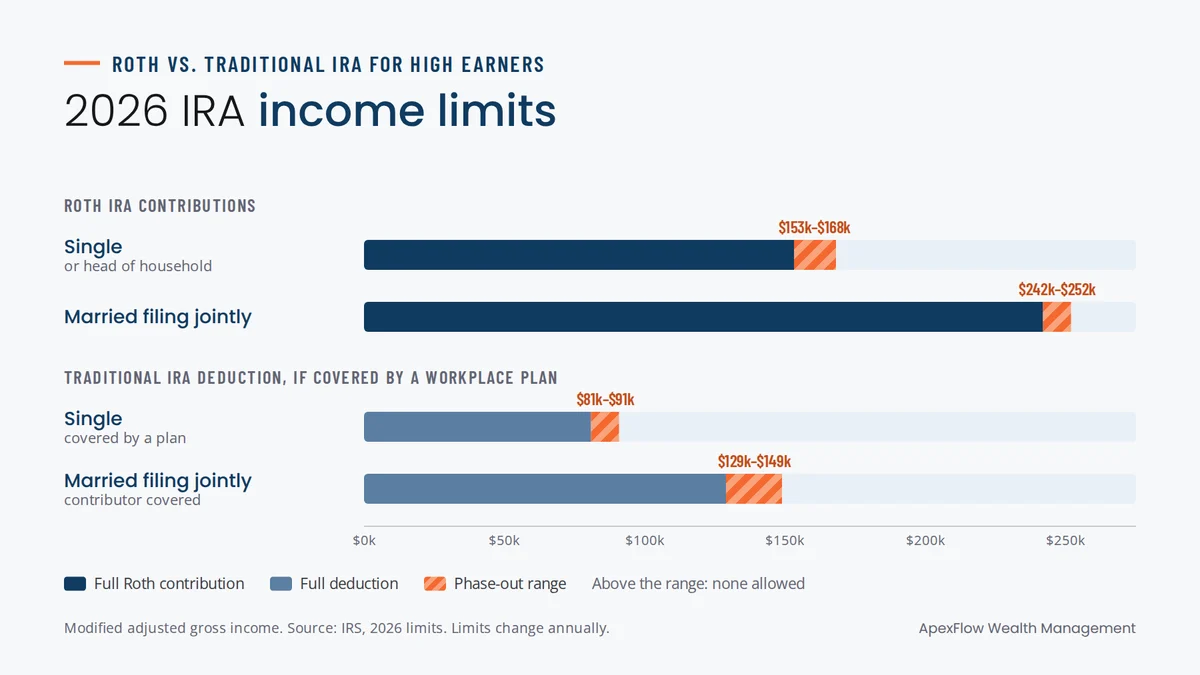
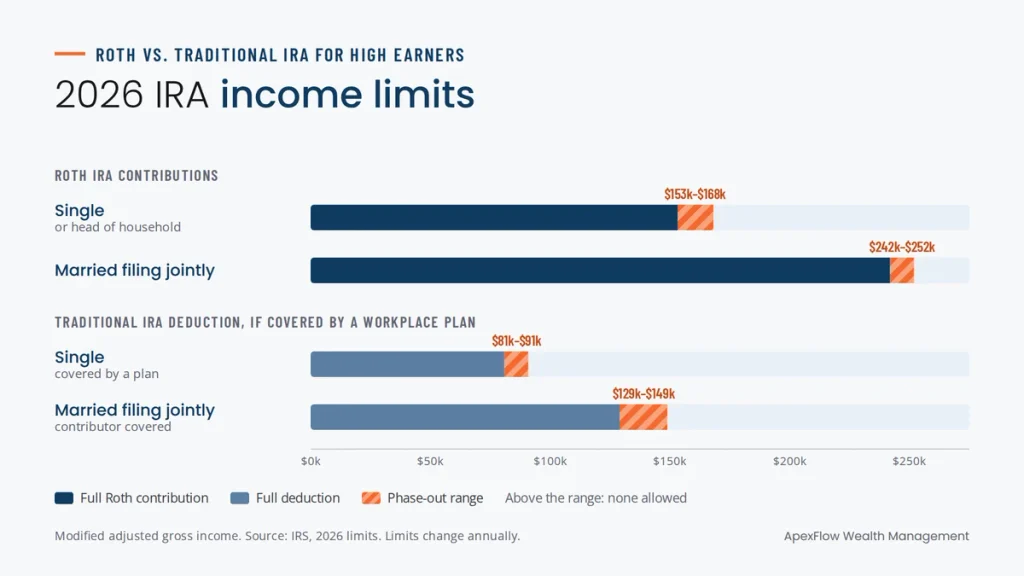
- For 2026, direct Roth IRA contributions phase out between $153,000 and $168,000 of income for single filers and $242,000 and $252,000 for married couples filing jointly.
- You can make a Traditional IRA contribution at any income, but if you or your spouse has a workplace plan, the deduction phases out at much lower incomes.
- High earners often use a backdoor Roth, a Roth 401(k) or both. The pro-rata rule is the detail that trips people up.
Roth vs. Traditional IRA for high earners: tax now or later?
Think of retirement accounts like different vehicles headed toward the same destination. Some prioritize flexibility. Others focus on tax advantages. The key isn’t finding the universally best account, but understanding which tools fit your income, your season of life and your priorities.
The core question behind every Roth vs. Traditional decision is simple: do you want to pay the tax now or later?
- Traditional IRA: you may get a deduction today, and withdrawals are taxed as income in retirement. It’s like promising to pay the tax bill in the future, ideally when your tax rate is lower.
- Roth IRA: you contribute money you’ve already paid tax on, and qualified withdrawals in retirement are tax-free. It’s like paying admission up front so everything inside the park is free later.
If tax rates rise in the future, Roth dollars gain value. If they fall, Traditional dollars may age better. No one knows the future, which is why many high earners aim for a mix.
2026 IRA income limits for high earners
These are the IRS numbers for 2026. Income means modified adjusted gross income (MAGI).
| Single or head of household | Married filing jointly | |
|---|---|---|
| IRA contribution limit | $7,500, plus $1,100 if 50 or older | $7,500 each, plus $1,100 each if 50 or older |
| Roth IRA contribution phases out | $153,000 to $168,000 | $242,000 to $252,000 |
| Traditional IRA deduction phases out, if you’re covered by a workplace plan | $81,000 to $91,000 | $129,000 to $149,000 |
| Traditional IRA deduction phases out, if only your spouse is covered | Not applicable | $242,000 to $252,000 |
Two things surprise many people:
- If neither you nor your spouse is covered by a workplace retirement plan, your Traditional IRA contribution is fully deductible at any income.
- If your income is above these ranges, you can still contribute to a Traditional IRA. You just can’t deduct it. That nondeductible contribution is the starting point for a backdoor Roth.
Traditional IRAs: tailored to today’s tax bill
A Traditional IRA is like a solo savings vehicle. You open it on your own, choose where it lives and decide how it’s invested.
It may fit if you:
- Can still deduct your contribution
- Expect your tax rate to be lower in retirement
- Want a home for a rollover from an old 401(k), though that can complicate a backdoor Roth (more on that below)
Worth knowing: Traditional IRAs are subject to required minimum distributions, starting at 73 or 75 depending on your birth year.

Roth IRAs: paying the tax up front
If Traditional accounts are about deferring taxes, Roth accounts flip the script.
Why Roth accounts appeal to people:
- Tax-free growth
- Tax-free income in retirement, once the account has been open five years and you’re 59½ or older
- No required minimum distributions for the original owner
- Tax-free money can be valuable to heirs, too
Why they’re not always the default:
- Contributions don’t lower today’s tax bill
- Income limits block direct contributions for many high earners
The backdoor Roth IRA
When your income is too high for a direct Roth contribution, there’s a well-known two-step path, often called a backdoor Roth:
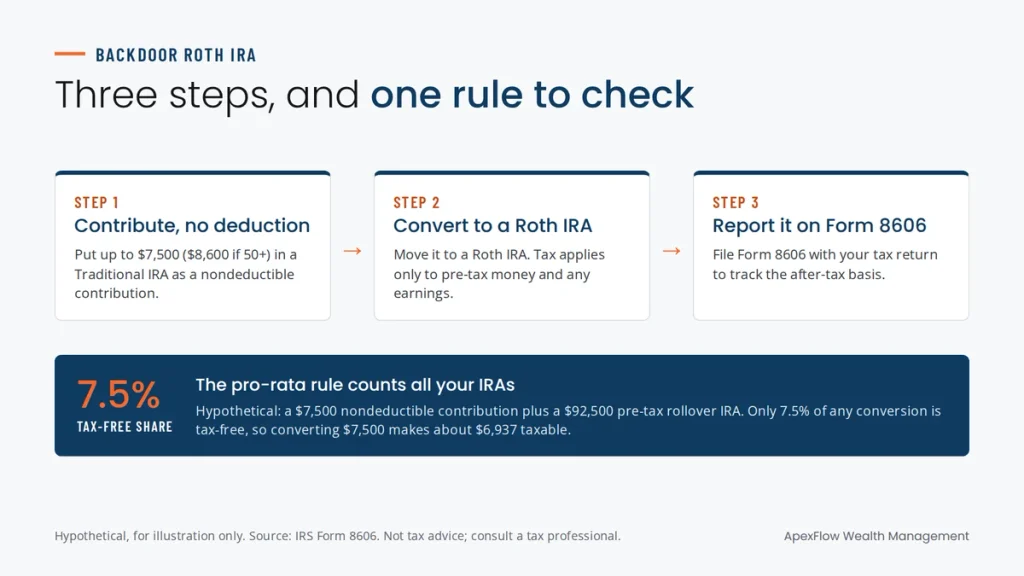
- Contribute to a Traditional IRA and don’t take a deduction. You report it as a nondeductible contribution on IRS Form 8606.
- Convert it to a Roth IRA. Because you already paid tax on the contribution, the conversion of that amount isn’t taxed again. Any earnings before the conversion are taxable.
There are no income limits on Roth conversions, which is what makes this work.
The pro-rata rule
This is the detail that catches people. When you convert, the IRS doesn’t let you pick only the after-tax dollars. It looks at all of your Traditional, SEP and SIMPLE IRA balances as of December 31 of the year you convert and treats each conversion as a proportional mix of pre-tax and after-tax money. IRS Form 8606 is where that calculation happens.
A hypothetical example. Say you make a $7,500 nondeductible contribution, and you also have $92,500 in a rollover IRA from an old 401(k), all pre-tax. Your total IRA balance is $100,000, and only 7.5% of it is after-tax. If you convert $7,500, about $6,937 of it is taxable, not $0.
This example is hypothetical and for illustration only. It ignores earnings and assumes no other IRA balances.
Some people avoid this by rolling pre-tax IRA money into their current employer’s 401(k), if the plan accepts it, before converting. Whether that makes sense depends on the plan’s investments and fees, so it’s worth reviewing with your advisor and CPA first.
Also worth knowing: each conversion has its own five-year clock. If you’re under 59½ and withdraw converted money within five years, you may owe a 10% penalty.
Roth options at work, with no income limit
For many high earners, the easiest Roth dollars are at work.
Roth 401(k), 403(b) and 457 contributions have no income limit. For 2026, you can defer up to $24,500, plus $8,000 if you’re 50 or older, or $11,250 if you’re 60 to 63. Designated Roth accounts in workplace plans are no longer subject to required minimum distributions during the owner’s lifetime, according to the IRS.
New for 2026: Roth catch-up contributions for higher earners. Under SECURE 2.0, if you earned more than $150,000 in FICA wages from your employer in 2025, any catch-up contributions you make in 2026 must go in as Roth. Your regular deferrals can still be pre-tax. This rule applies to workplace plans, not IRAs. CAPTRUST summarizes the final regulations.
Don’t skip the match. If your employer matches up to 4% and you contribute less than that, you’re leaving compensation on the table.
If you own a business
When you work for yourself, retirement planning becomes a build-your-own-benefits package. A SEP IRA is simple and allows large contributions, but it counts toward the pro-rata rule if you’re doing a backdoor Roth. A solo 401(k) can offer Roth contributions and generally doesn’t count toward the pro-rata rule. We compare the options in Retirement Savings for Business Owners.
Don’t overlook your HSA
A health savings account isn’t technically a retirement account, but it can act like one. It’s often called triple tax-advantaged: contributions may be deductible, growth is tax-free and withdrawals for qualified medical expenses are tax-free. For high earners who’ve maxed out other options, it can be a valuable extra bucket. We explain how in Using Your HSA for Retirement.
How high earners often combine accounts
There’s no single right order, but a common approach looks something like this:
- Contribute enough to your workplace plan to get the full match.
- Decide between Roth and pre-tax deferrals in that plan based on your tax rate now versus what you expect later.
- Consider a backdoor Roth IRA, after checking for pre-tax IRA balances that trigger the pro-rata rule.
- Fund an HSA if you’re eligible.
- Invest in a taxable brokerage account for flexibility.

Having money in taxable, tax-deferred and Roth accounts gives you more control over your taxes later, especially in the years before Social Security and required distributions begin. We map that period in The 5 Years Before Retirement.
Progress over perfection
Retirement planning isn’t a one-time decision or a single account selection. It’s a series of choices made over time, shaped by career changes, life events and priorities. The most successful plans are rarely the most complex. They’re the ones that are understood, revisited and adjusted with intention.
The strength of a retirement strategy comes from how the pieces work together. Different accounts serve different purposes, like tools in a well-stocked kit. When they’re thoughtfully combined, they create a system that adapts as your income, family and vision for the future change. That’s how we approach it in the Design stage of our planning process.
Frequently asked questions
It depends on your tax rate now compared with what you expect in retirement. Many high earners can’t deduct a Traditional IRA or contribute directly to a Roth, so they use a backdoor Roth or Roth contributions at work to build tax-free savings.
Direct contributions phase out between $153,000 and $168,000 of modified adjusted gross income for single filers and between $242,000 and $252,000 for married couples filing jointly.
Yes. There’s no income limit to contribute, but if you or your spouse has a workplace plan, your deduction may be reduced or eliminated.
Yes. It uses two permitted steps, a nondeductible Traditional IRA contribution and a Roth conversion. The key is reporting it correctly on Form 8606 and understanding the pro-rata rule.
No. Anyone whose plan offers it can make Roth 401(k) contributions, regardless of income
Talk it through with us
If you’re a high earner wondering which accounts make sense, and in what order, that’s worth a conversation before you make this year’s contributions. Book a 20-minute Fit Call. It’s virtual, no prep is needed and there’s no obligation.
With clarity and confidence,

Investing involves risk and you may incur a profit or loss regardless of strategy selected, including diversification and asset allocation. Raymond James and its advisors do not offer tax or legal advice. You should discuss any tax or legal matters with the appropriate professional.
Related Articles
Dig deeper into our resource library
-
 October 7, 2026
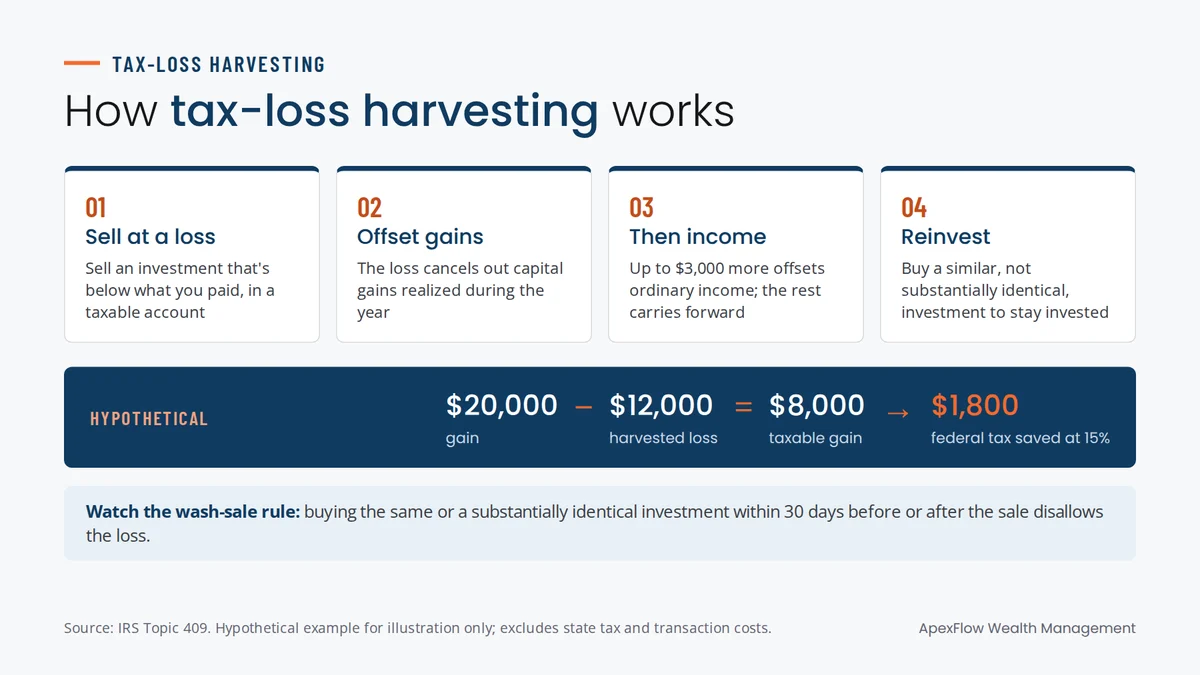
Tax-Loss Harvesting: How It Works and How to Avoid the Wash-Sale Rule
No one likes seeing an investment lose value. But in a taxable account, a loss can have a silver lining. Tax-loss harvesting means selling anRead more -
 October 7, 2026
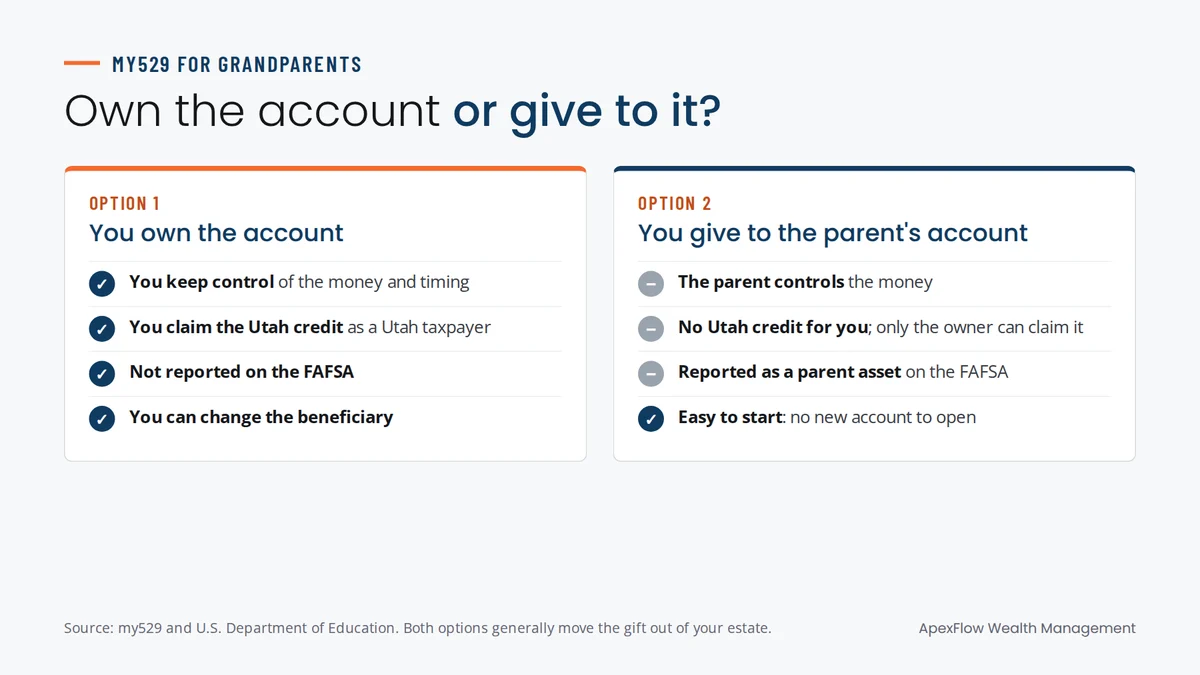
Using Utah’s my529 Plan as a Grandparent
Helping pay for a grandchild’s education is one of the most meaningful gifts a grandparent can give. It’s also one of the most tax-efficient. Utah’sRead more -
 October 7, 2026
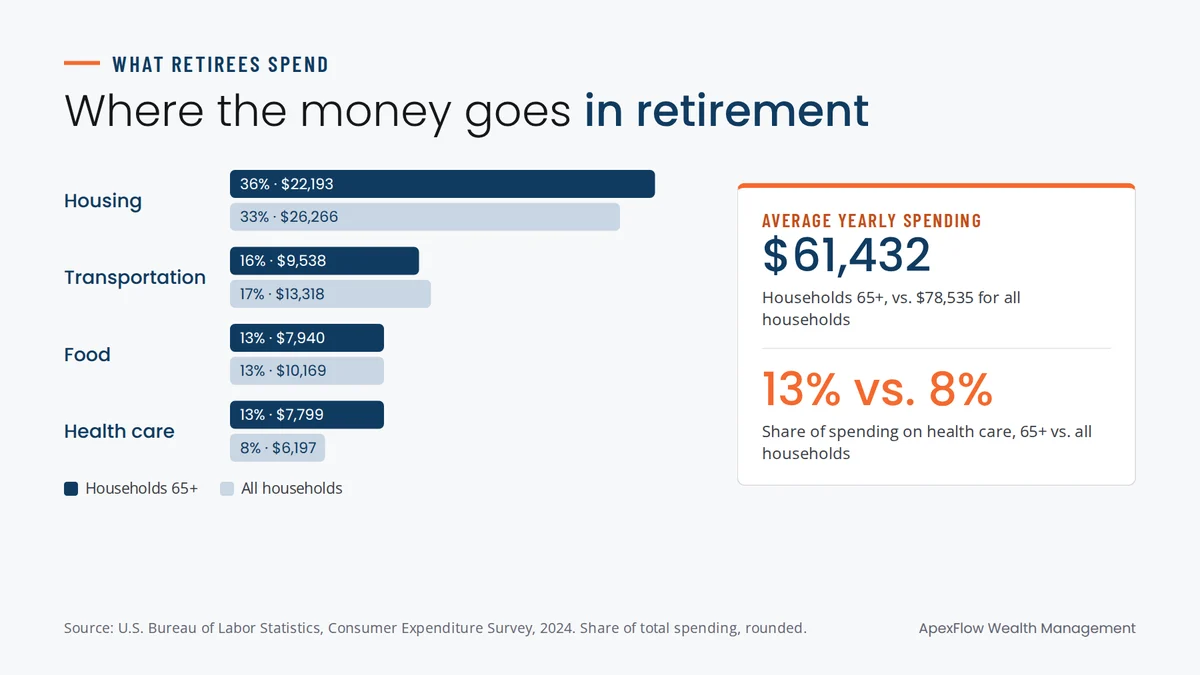
How to Build a Retirement Budget That Lasts
For decades, your budget had a built-in safety net: the next paycheck. Retirement changes that. Your income now comes from Social Security, maybe a pension,Read more