
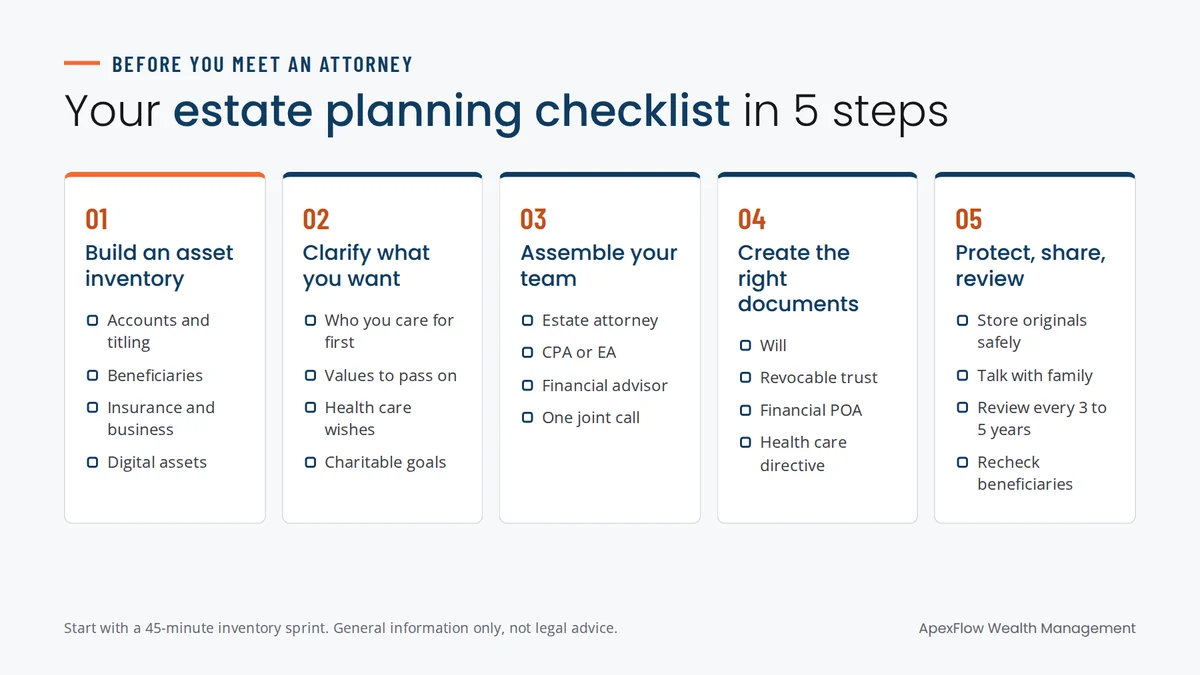
Estate planning isn’t only for the ultra-wealthy, and it isn’t something to file away for later. It’s a core part of a complete financial life. At its best, it reduces stress, honors your wishes and protects the people you care about. This estate planning checklist breaks the work into five steps you can start before your first attorney meeting, so the meeting is shorter, clearer and more productive.

At a glance
- Most of the hard work in estate planning happens before you sign anything: knowing what you own and deciding what you want.
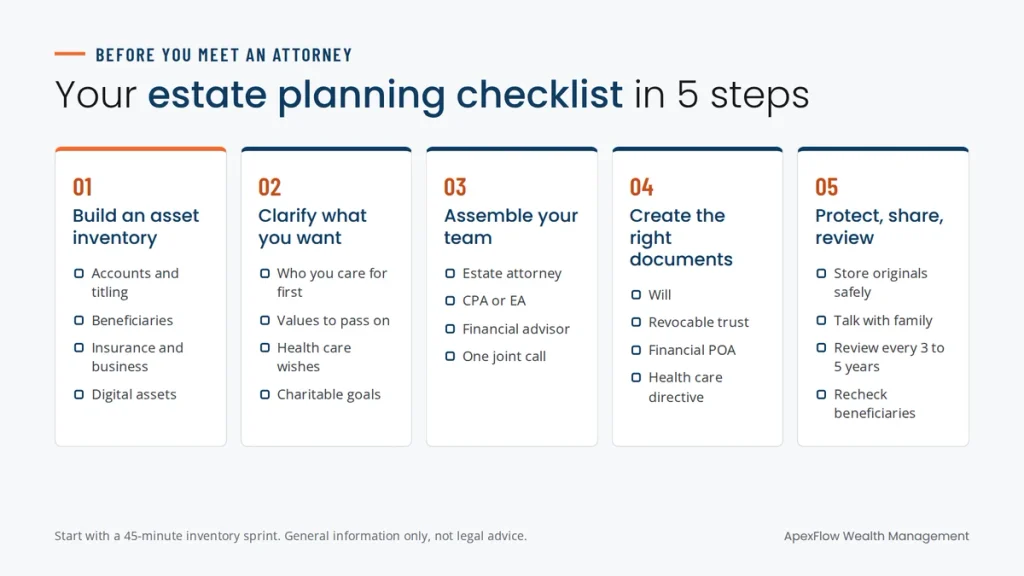
- Five steps: build an asset inventory, clarify your intent, assemble your team, create the right documents, then protect, share and keep the plan current.
- Small, scheduled steps beat one overwhelming project. Start with a 45-minute inventory sprint.
Why an estate planning checklist helps
The challenge is rarely a lack of intent. It’s the fog: complex forms, legal terms and too many choices at once. Behavioral finance teaches us that under stress we tend to default to inaction. We postpone and hope tomorrow will be clearer.
That may be why so many people never start. In Caring.com’s 2025 Wills and Estate Planning Study, only 24% of U.S. adults surveyed said they had a will. Our approach is different: break the work into simple steps, reduce the mental load and use small commitments that build momentum.
Step 1: Build a complete, simple asset inventory
Goal: Know what you own, where it lives and how it’s titled.
Why it clears the fog: The mind struggles with open loops. When assets are scattered, decision fatigue sets in. A single, living list reduces stress and speeds up every other step.
What to capture:
- Tangible assets: real estate, vehicles, jewelry and collectibles
- Financial accounts: bank, brokerage, 401(k), 403(b), IRA, HSA and 529 plans
- Insurance: life, disability, long-term care and annuities
- Business interests: private companies, equity awards, restricted stock and options
- Digital assets: email, social media, photo libraries, cloud storage, subscriptions, domains, crypto wallets and your password manager
- Titling and access: how each account is registered, its beneficiaries and where to find statements or logins
Quick checklist:
- One list with account names, the last four digits, titling and primary beneficiary
- One folder with statements and key policies
- A password manager with an emergency access contact set up
Behavioral nudge: Try a 45-minute inventory sprint. Don’t organize perfectly. Capture first, refine later. Perfection is the enemy of progress.

Step 2: Clarify your intent and outcomes
Goal: Decide what you want your wealth to do, for whom and when.
Why it clears the fog: Vague goals produce vague documents. Clear intent guides your team and reduces family conflict later.
Start with plain-language questions:
- Who do I want to care for first, and in what order?
- What support do minors or vulnerable family members need?
- Which values do I want to pass on, not only which dollars?
- Do I want to support a cause, a school or a community?
- If I faced a serious health event, what would I want my family and doctors to know?
Tools that help:
- If-then statements: “If I’m incapacitated for 60 days, then my agent should…”
- Decisions made in advance: Choose your defaults now for guardianship, health care and distributions.
- A letter of intent: A short, human note that explains the why behind your plan. Families read these during hard moments, and it helps.
Step 3: Assemble your estate planning team
Goal: Put the right professionals in the right seats, and have them talk to each other.
Why it clears the fog: Coordination reduces rework. A quick call between your financial advisor and your attorney can prevent one of the most common mistakes in estate planning: outdated beneficiary forms that override the will.
How we work at ApexFlow:
- We inventory accounts and beneficiaries first.
- We map how assets will move into wills and trusts before anything is signed.
- We run a beneficiary review at the end to confirm everything points where it should.
Behavioral nudge: Schedule a single 60-minute joint call. One calendar block beats five back-and-forth emails.
Do I need the full team?
You likely need an estate planning attorney if you:
- Own real estate, especially in more than one state
- Have minor children or plan to name guardians
- Own a business or have equity compensation
- Expect a taxable estate under federal or state rules
- Want to avoid probate, protect your privacy or control distributions over time
You likely need a tax professional (CPA or EA) if you:
- Have a high income or a complex tax picture
- Are considering gifting strategies
- Own a business or rental properties
- Want to understand the tax impact of leaving assets to heirs
- Are navigating a large transition or liquidity event
If you own a business, add a succession plan to the list. We explain why in Buy-Sell Agreement Basics.
Step 4: Create and sign the right documents
Goal: Turn your intent into enforceable, plain-language instructions.
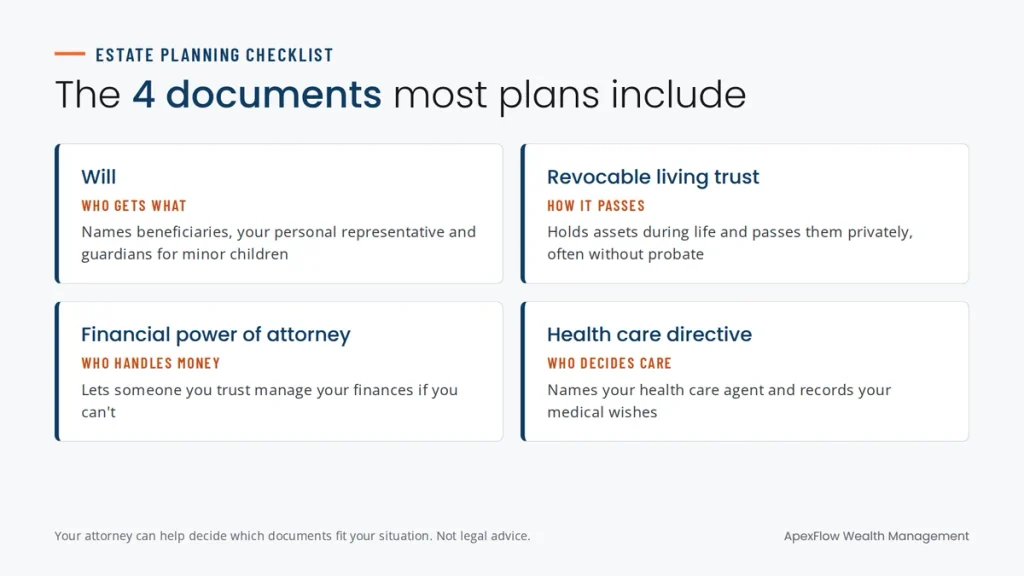
Estate planning documents are legal tools that communicate your wishes clearly. The exact language is created by an attorney, but most plans share a few familiar documents:
| Document | What it does |
|---|---|
| Last will and testament | Names who receives your assets, who carries out your wishes and who would raise minor children |
| Revocable living trust | Holds assets during your life and passes them privately, often without probate |
| Durable financial power of attorney | Lets someone you trust manage your finances if you can’t |
| Health care power of attorney and advance directive | Names who makes medical decisions for you and records your wishes |
Not sure whether you need a trust or just a will? We walk through six common situations in Do You Need a Trust? And if you’re wondering what happens without any of these documents, see What Happens If You Die Without a Will in Utah?
Hypothetical guardrails some families consider
Structure can reduce conflict, lower anxiety and make your intentions easier to follow. Here are a few hypothetical examples families sometimes consider. These aren’t recommendations, simply illustrations:
- Age-based access for younger beneficiaries
- Funds released after milestones, such as finishing school
- Money set aside for essential needs like housing or health care
- Independent oversight during stressful periods
Any formal planning choices should always be reviewed with your attorney.
Step 5: Protect, share and keep your plan current
Goal: Make sure your plan works when your family actually needs it.
Storage and access:
- Keep originals in a fire-resistant place at home or with your attorney.
- Save digital copies in a secure vault, and share access with your executor or successor trustee.
- Keep a short “Where Things Are” document that lists locations, key contacts and first steps.
Share the intent: Hold a family conversation. You don’t need to share numbers. Explain the purpose, the roles and how to find documents. We cover how in How to Talk to Your Adult Children About Inheritance.
Keep it current:
- Review every three to five years.
- Update after a marriage, divorce, birth or adoption, a significant change in wealth or a move across state lines. New to Utah? See Moved to Utah? Why Your Estate Plan Needs a Fresh Look.
- Recheck beneficiaries after job changes and rollovers.
Behavioral nudge: Put a recurring “Estate Plan Refresh” on your calendar for your birth month. Small, predictable prompts beat big, irregular projects.

Why families choose ApexFlow
Good financial guidance isn’t only about charts or documents. It’s about understanding what truly matters to you and helping you move forward without confusion or pressure. Our approach blends behavioral insight with practical structure, so your decisions feel lighter, not heavier.
We don’t draft legal documents. We coordinate with your estate attorney and CPA so your plan, your investments and your beneficiary designations work together. You can learn more on our estate planning page and in our planning process.
You bring your goals. We bring clarity, partnership and a process that keeps you moving.
Frequently asked questions
At a minimum: an inventory of your assets and how they’re titled, a list of beneficiaries, your goals for who you want to provide for, the professionals on your team and the core documents: a will, powers of attorney, a health care directive and, for many families, a revocable living trust.
Bring your asset inventory, recent account and insurance statements, current beneficiary designations, any existing estate documents, deeds and business agreements, and your list of who you’d like to name as executor, trustee, guardian and agents.
Most plans include a will, a durable financial power of attorney, a health care power of attorney with an advance directive and, often, a revocable living trust.
Every three to five years, and sooner after major life events like a marriage, divorce, birth, death in the family, move or big change in assets.
You don’t need one to create documents, but an advisor can help organize your inventory, coordinate with your attorney and CPA and make sure accounts and beneficiaries match your plan.
Talk it through with us
The heart of good planning is simple: clarity, organization and guidance, one step at a time. Not someday. Not eventually. Today. Book a 20-minute Fit Call. It’s virtual, no prep is needed and there’s no obligation.
With clarity and confidence,
Investing involves risk and you may incur a profit or loss regardless of strategy selected, including diversification and asset allocation. Raymond James and its advisors do not offer tax or legal advice. You should discuss any tax or legal matters with the appropriate professional.
Related Articles
Dig deeper into our resource library
-
 October 7, 2026
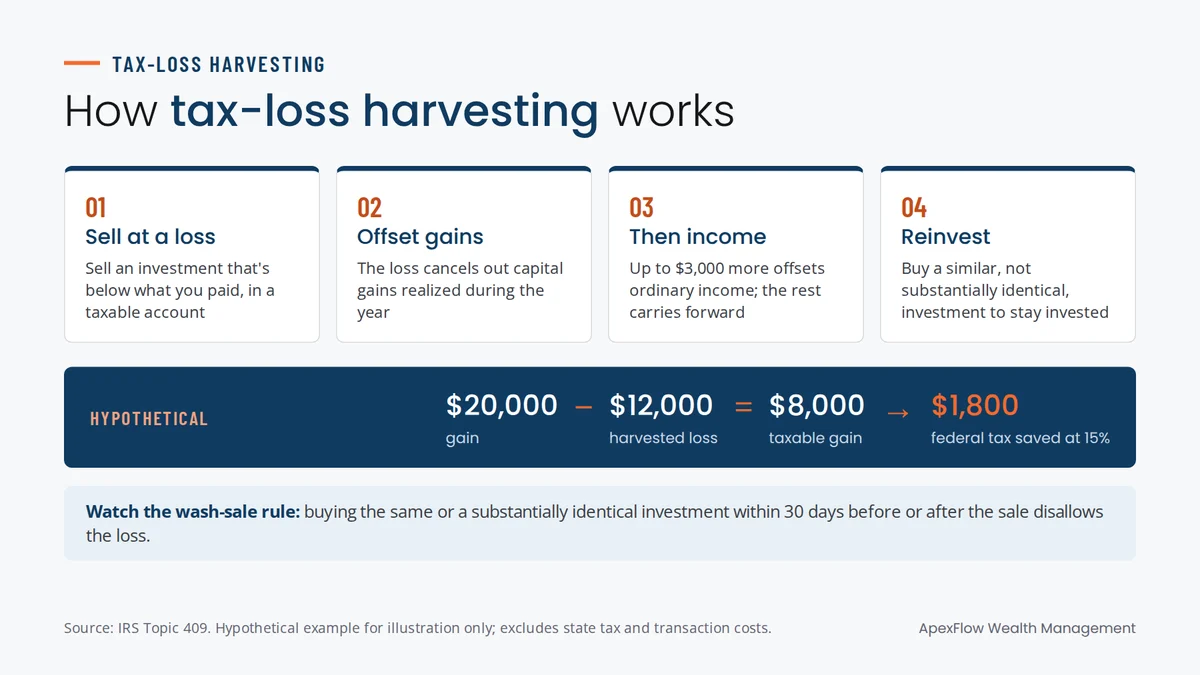
Tax-Loss Harvesting: How It Works and How to Avoid the Wash-Sale Rule
No one likes seeing an investment lose value. But in a taxable account, a loss can have a silver lining. Tax-loss harvesting means selling anRead more -
 October 7, 2026
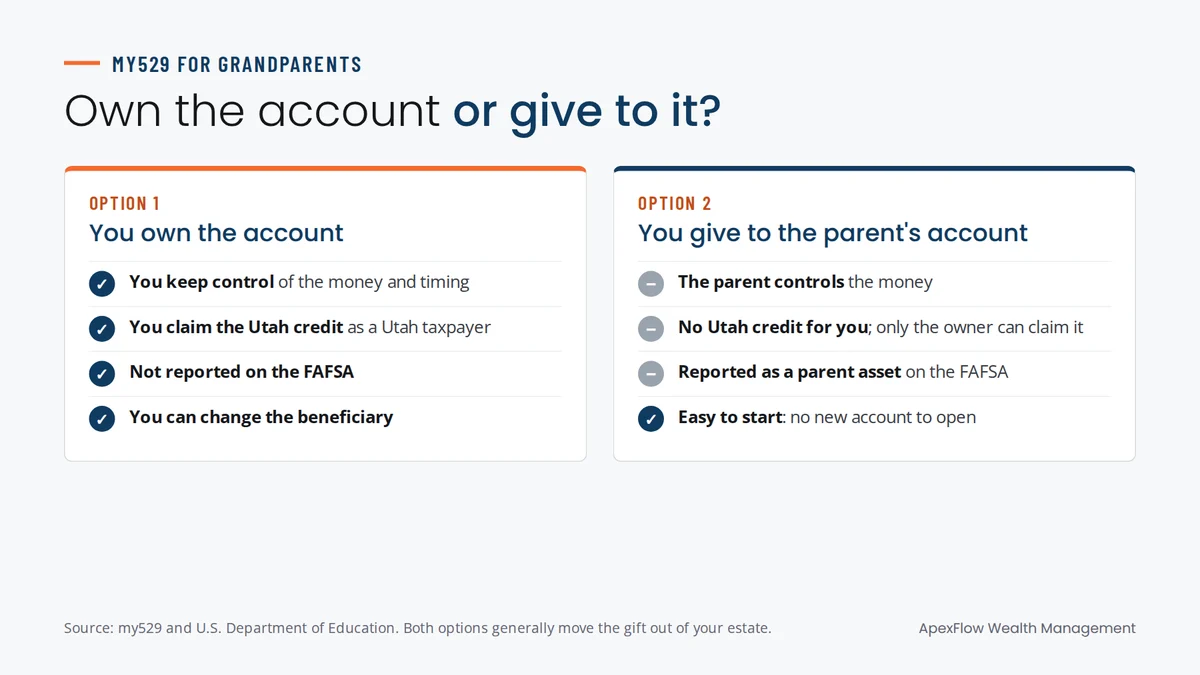
Using Utah’s my529 Plan as a Grandparent
Helping pay for a grandchild’s education is one of the most meaningful gifts a grandparent can give. It’s also one of the most tax-efficient. Utah’sRead more -
 October 7, 2026
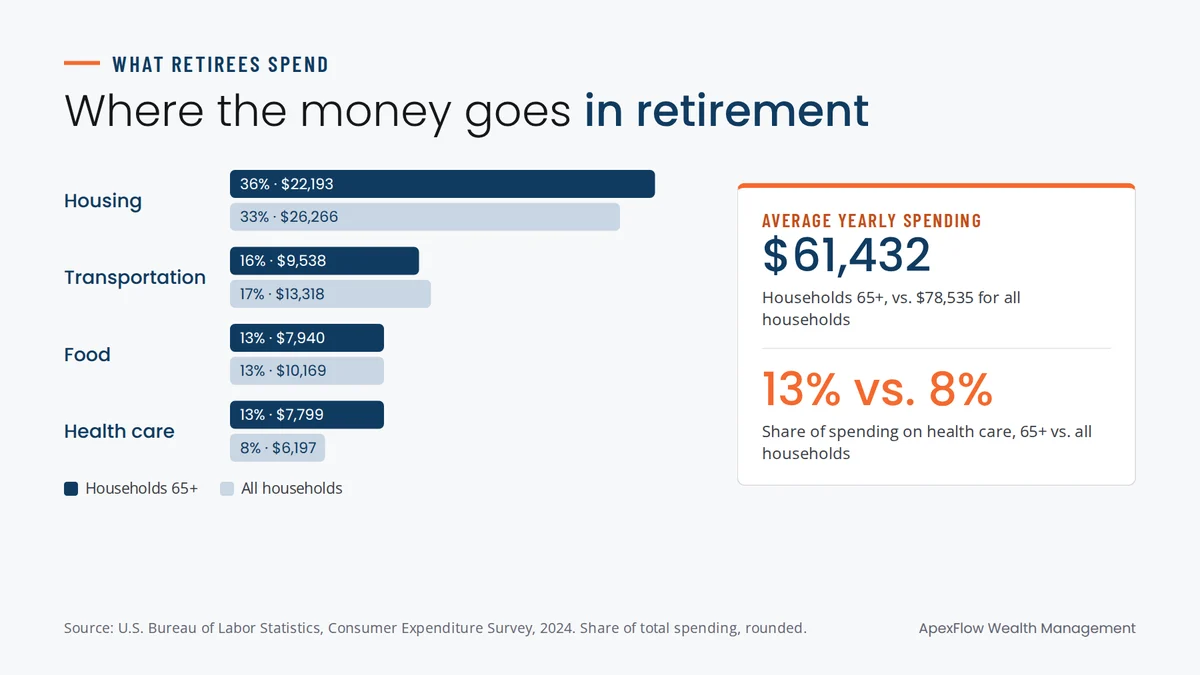
How to Build a Retirement Budget That Lasts
For decades, your budget had a built-in safety net: the next paycheck. Retirement changes that. Your income now comes from Social Security, maybe a pension,Read more