
Ask someone why they haven’t written a will, and you’ll rarely hear “I don’t think it matters.” You’ll hear “I haven’t gotten to it yet.” It sits on the same shelf as the gym membership and the garage cleanout, a task with no deadline, so it never quite becomes urgent enough to finish. But if you die without a will in Utah, it doesn’t mean nothing happens. It means someone else’s plan happens instead of yours. That someone is the Utah Legislature, and its plan was written for the average family, not yours.

At a glance
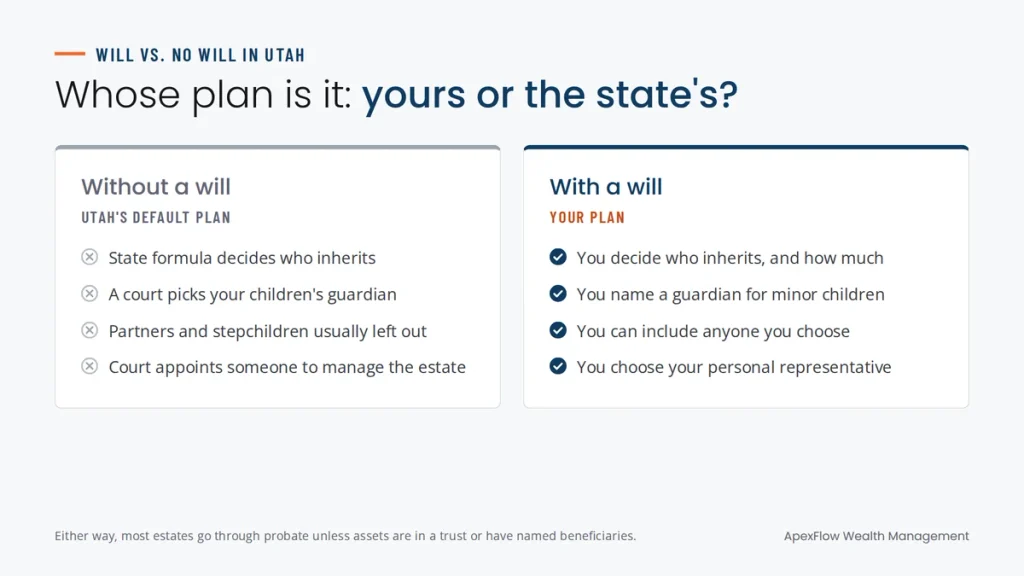
- Without a will, Utah’s intestate succession law decides who inherits, and a court decides who raises your minor children.
- Utah is more generous to spouses than many states, but blended families, unmarried partners and stepchildren can still be left out.
- A will, plus up-to-date beneficiary designations, replaces the state’s default formula with your own instructions.
Dying without a will has a name: intestate
When someone dies without a valid will, it’s called dying intestate. In that situation, state law, not your wishes, decides who inherits what. In Utah, those rules are part of the Utah Uniform Probate Code, Title 75 of the Utah Code. They’re essentially a default distribution formula that kicks in whether or not it reflects what you wanted.
You’re far from alone if you don’t have a will yet. In Caring.com’s 2025 Wills and Estate Planning Study, only 24% of U.S. adults surveyed said they had one.
Who inherits if you die without a will in Utah
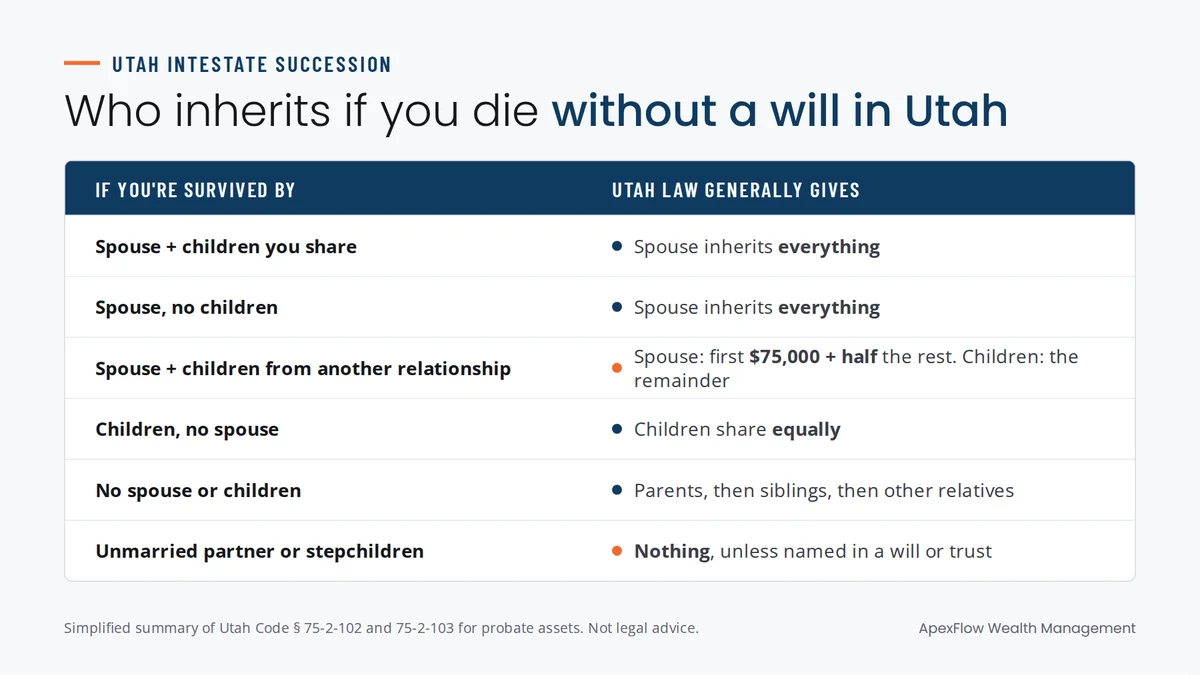
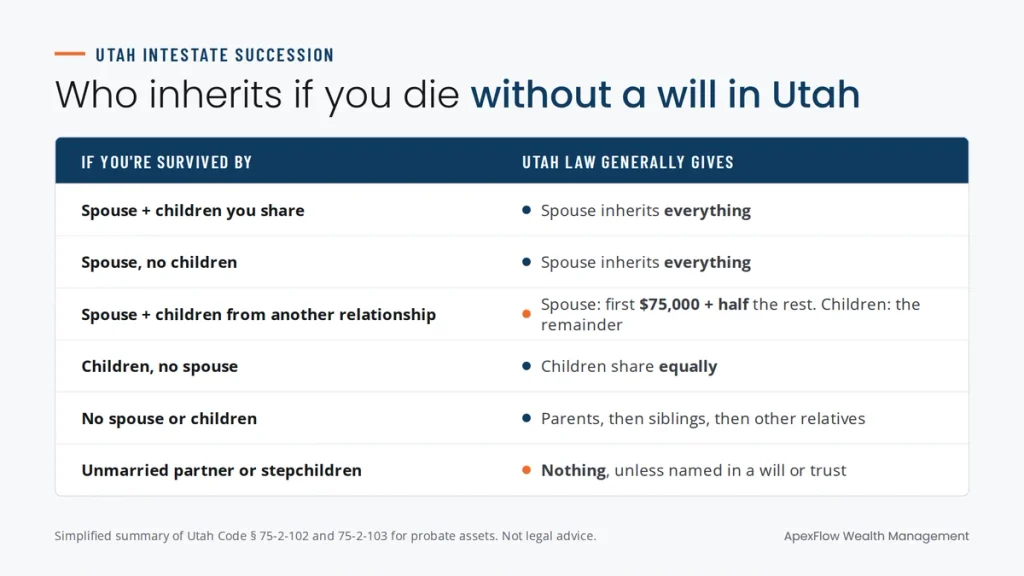
Utah’s intestate succession rules follow a set order. Here’s how the formula generally works for the property that passes through probate:
| Who survives you | Who inherits under Utah law |
|---|---|
| A spouse, and all your children are also your spouse’s children | Your spouse inherits everything |
| A spouse, and no children | Your spouse inherits everything |
| A spouse, and one or more children from another relationship | Your spouse receives the first $75,000 plus half of the rest; your children share the remainder |
| Children, but no spouse | Your children share everything equally |
| No spouse or children | Your parents, then your siblings and their children, then more distant relatives |
| No living relatives the law recognizes | Your property goes to the State of Utah |
Source: Utah Code § 75-2-102 and § 75-2-103. This is a simplified summary; an estate attorney can explain how the rules apply to your family.
These formulas are built around a fairly narrow assumption: a traditional family with a spouse and shared children. If your life looks like that, the default outcome in Utah might land close to what you’d have chosen anyway. If it doesn’t, the gap between the state’s plan and your actual intentions can be significant.
Where the surprises usually show up
A few scenarios where intestate succession catches people off guard, over and over.
Unmarried partners get nothing. No matter how long you’ve been together or how intertwined your finances are, a partner you never legally married has no inheritance rights under Utah’s intestate succession law. The law only recognizes legal relationships.
Blended families get complicated fast. If you have children from a prior relationship, your spouse doesn’t automatically inherit everything. Your spouse and those children end up sharing the estate, which can mean co-owning a home or splitting accounts with people who never planned to be financial partners.
Stepchildren are usually left out. Stepchildren you never legally adopted generally don’t inherit under the default rules, even if you raised them as your own.
Someone else decides who raises your kids. If you have minor children and no will naming a guardian, a court decides who raises them. Family members can end up in a dispute at the worst possible moment, one your family could have avoided with a single clause in a will.
The process takes longer and costs more. An estate without a will still goes through probate, but without your instructions, the court has to confirm who your heirs are and appoint someone to manage the estate. That typically means more time, more legal costs and more room for family disagreement.

What doesn’t go through intestate succession
Not everything you own follows the state’s formula. Some assets pass directly to a named person, whether or not you have a will:
- Retirement accounts and life insurance with a named beneficiary
- Bank and brokerage accounts with a payable-on-death or transfer-on-death designation
- Property owned jointly with right of survivorship
- Assets held in a living trust
That’s good news and a risk at the same time. If those designations are out of date, an ex-spouse or a parent who has passed away could still be listed. Reviewing them is as important as writing the will itself.
Utah probate without a will
When someone dies intestate in Utah, a family member usually asks the court to appoint a personal representative, the role an executor would fill under a will. That person gathers the assets, pays debts and taxes and distributes what’s left according to the state’s formula.
For smaller estates, Utah offers a shortcut. According to the Utah State Courts, heirs may be able to use a small estate affidavit if the estate is worth less than $100,000, includes no real estate, at least 30 days have passed since the death and no one has applied to be personal representative. If there’s a house involved, probate is usually still required.
What a will actually solves
A will is a legal document that names who receives your assets, who’s responsible for carrying out your wishes (your executor, called a personal representative in Utah) and who would raise your minor children if needed. It replaces the state’s default formula with your own instructions.
It’s also worth knowing that a will doesn’t avoid probate on its own. Assets that pass through a will still generally go through the probate process. If avoiding probate, keeping your affairs private or planning for incapacity matter to your family, that usually points toward pairing a will with a revocable living trust. We walk through when that makes sense in Do You Need a Trust?
Why this stays on the shelf
Nobody avoids writing a will because they don’t love their family. They avoid it because it forces a series of uncomfortable decisions: who gets what, who’s in charge, who raises the kids. Those are hard conversations, and it’s easier to assume there’s time later.
The reframe is this: a will isn’t really about you. It’s about removing the guesswork for the people you’d leave behind, at the exact moment they’d have the least capacity to handle more of it.

Where we fit in
We don’t draft wills ourselves. Estate documents are the work of a licensed estate attorney, and we work directly alongside yours to make sure the plan is coordinated with the rest of your financial picture: your investments, your beneficiary designations and your tax strategy, so nothing is working against itself. If you don’t already have an estate attorney in Utah, we can help point you toward the right fit.
Once your will is in place, a few next steps are worth knowing about. Our estate planning checklist walks through what to gather before you meet an attorney, and How to Talk to Your Adult Children About Inheritance covers explaining the plan to your family. You can also learn how we coordinate with your attorney on our estate planning page.
Frequently asked questions
Often, yes. If all of your children are also your spouse’s children, or you have no children, your spouse inherits your entire intestate estate. If you have children from another relationship, your spouse receives the first $75,000 plus half of the rest, and those children share the remainder.
Generally not, unless you legally adopted them. If you want stepchildren to inherit, you need to name them in a will, a trust or a beneficiary designation.
No. Utah’s intestate succession law doesn’t recognize unmarried partners, no matter how long you’ve been together. A will, a trust, a beneficiary designation or joint ownership are the main ways to leave them assets.
A Utah court decides, based on what it considers the children’s best interests. Naming a guardian in your will is the clearest way to make your choice known.
Usually, yes. Smaller estates worth less than $100,000 with no real estate may qualify for a small estate affidavit instead. Assets with a named beneficiary or held in a trust pass outside probate either way.
Talk it through with us
If it’s been a while since you’ve thought about what would happen if something happened to you tomorrow, that’s a conversation worth having, not because something is wrong, but because clarity now is a lot easier than untangling a default formula later. Book a 20-minute Fit Call. It’s virtual, no prep is needed and there’s no obligation.
With clarity and confidence,

Investing involves risk and you may incur a profit or loss regardless of strategy selected, including diversification and asset allocation. Raymond James and its advisors do not offer tax or legal advice. You should discuss any tax or legal matters with the appropriate professional.
Related Articles
Dig deeper into our resource library
-
 October 7, 2026
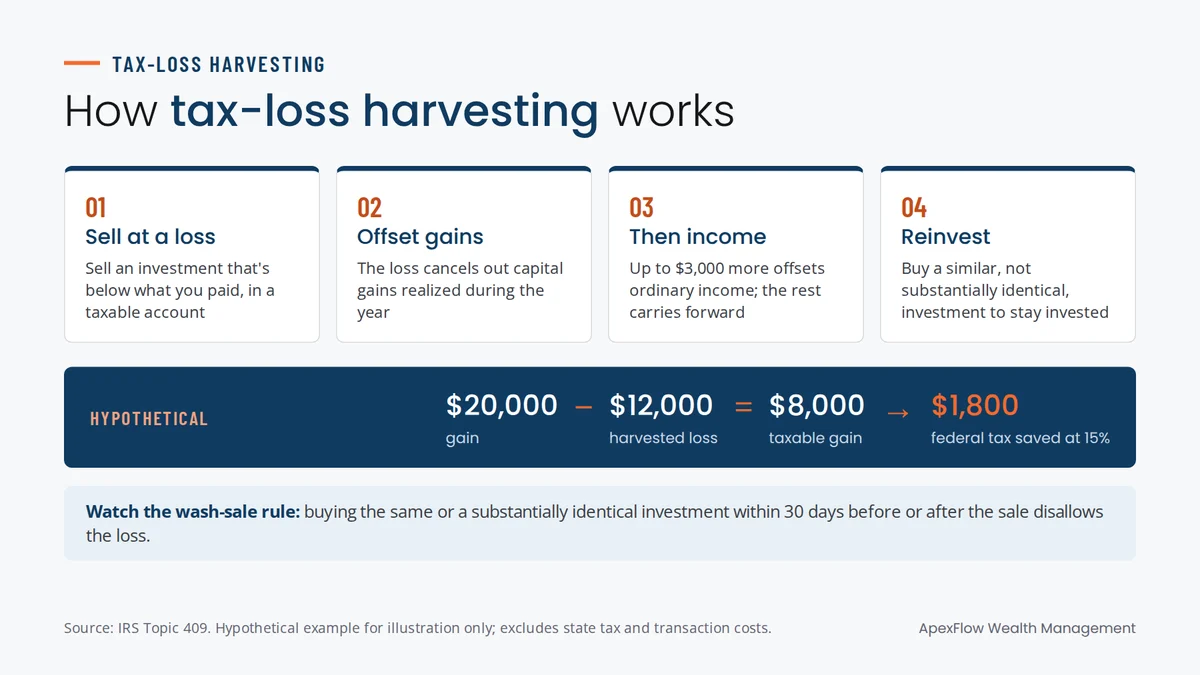
Tax-Loss Harvesting: How It Works and How to Avoid the Wash-Sale Rule
No one likes seeing an investment lose value. But in a taxable account, a loss can have a silver lining. Tax-loss harvesting means selling anRead more -
 October 7, 2026
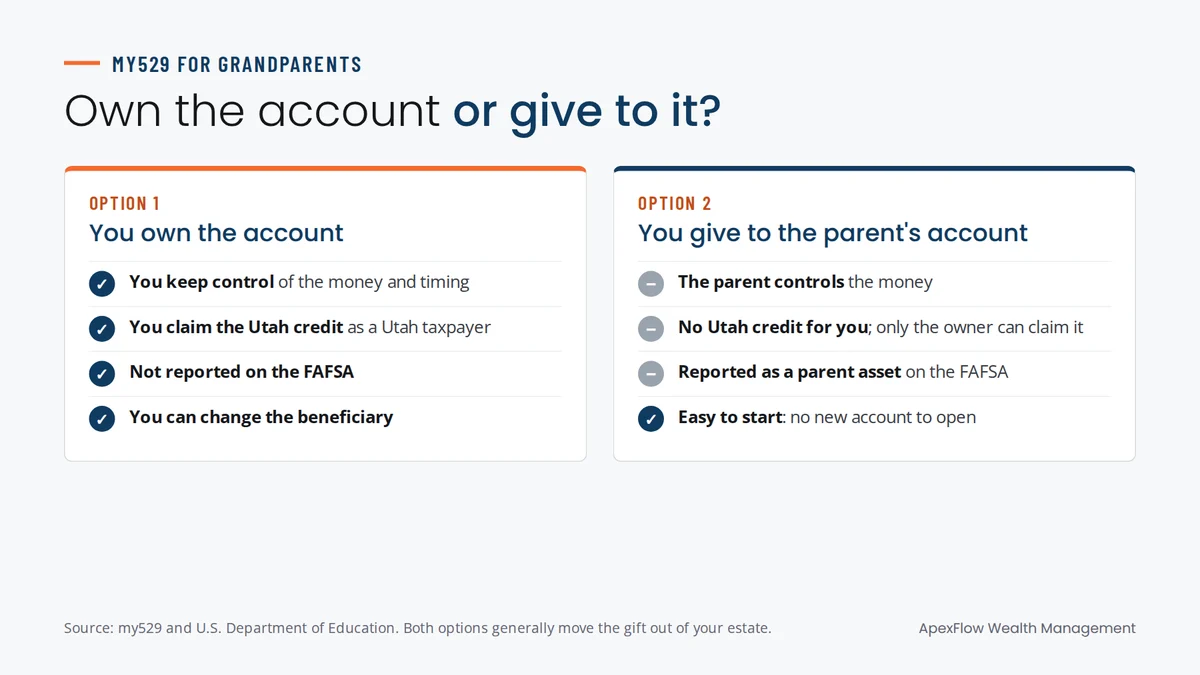
Using Utah’s my529 Plan as a Grandparent
Helping pay for a grandchild’s education is one of the most meaningful gifts a grandparent can give. It’s also one of the most tax-efficient. Utah’sRead more -
 October 7, 2026
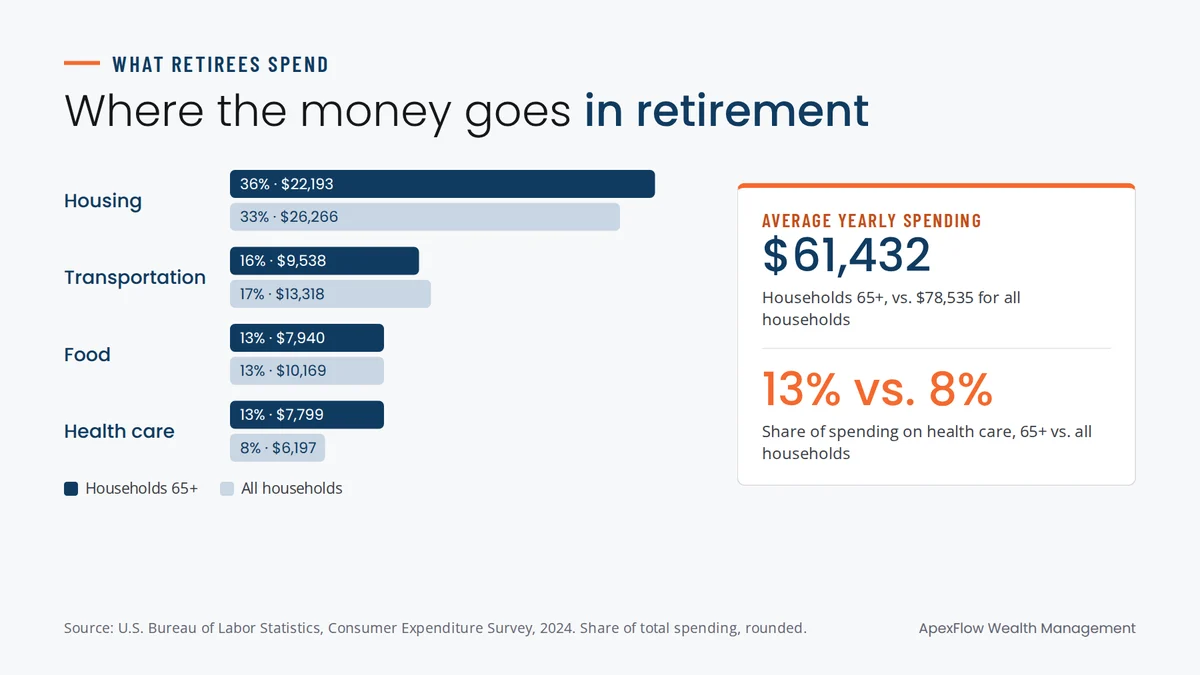
How to Build a Retirement Budget That Lasts
For decades, your budget had a built-in safety net: the next paycheck. Retirement changes that. Your income now comes from Social Security, maybe a pension,Read more