
At a glance
- URS pays a defined benefit based on your years of service, your final average salary and a multiplier that depends on your tier.
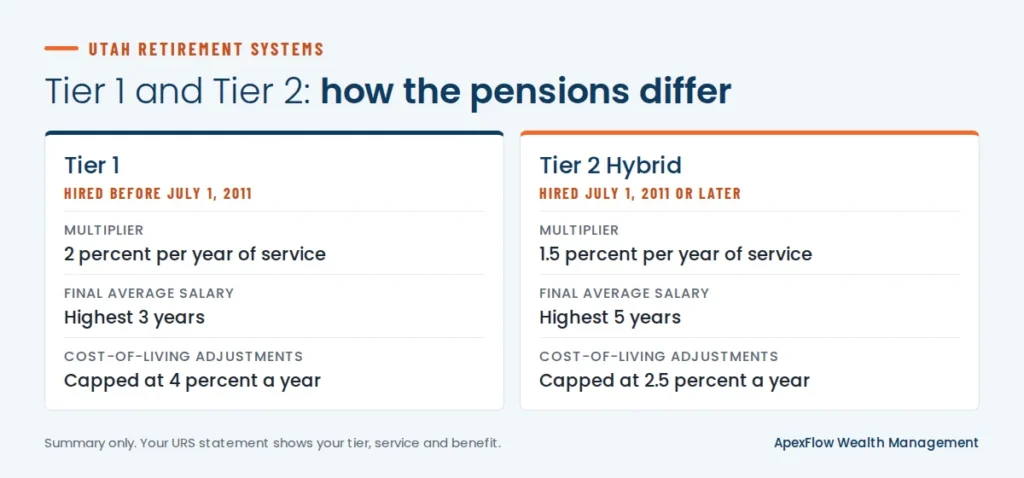
- Tier 1 (hired before July 1, 2011) uses 2 percent per year and your highest three years. Tier 2 Hybrid uses 1.5 percent and your highest five.
- Full, unreduced benefits start at 65 with four years of service, or at any age with 30 years (Tier 1) or 35 years (Tier 2).
- The payout option you choose at retirement decides what your spouse receives after you die. It cannot be changed later.
- Your URS 401(k) or 457, Social Security and Utah taxes all need to be planned around the pension, not after it.
Teachers, city and county staff, state employees and many others in Utah retire through Utah Retirement Systems. URS is a well-funded plan, and that is good news. It does not make the retirement decision simple. Clients come to us with the same questions: Am I better off working two more years? Which option protects my spouse? How does my 401(k) fit? Will Social Security be reduced? This guide covers the structure and the decisions. URS publishes the official details, and your own benefit estimate from URS is the starting point for any plan.
Two minutesHow much of your retirement is actually decided?Get my Clarity ScoreTier 1 or Tier 2
If you started public employment before July 1, 2011, you are in Tier 1. If you started on or after that date, you are in Tier 2, where you chose between the Hybrid plan (a smaller pension plus a 401(k)) and a defined contribution plan (401(k) only) in your first year.
For the Public Employees system, which covers most teachers and general employees, the main differences are:
- Multiplier. Tier 1 earns 2 percent of final average salary per year of service. Tier 2 Hybrid earns 1.5 percent.
- Final average salary. Tier 1 uses your highest three years. Tier 2 uses your highest five.
- Unreduced retirement. Both tiers allow full benefits at 65 with four years of service. Tier 1 also allows full benefits at any age with 30 years; Tier 2 requires 35.
- Cost-of-living adjustments. Tier 1 adjustments are capped at 4 percent per year; Tier 2 at 2.5 percent, tied to inflation.
- Employer 401(k) contribution. In Tier 2 the employer contributes a set percentage of pay toward your retirement. For the Hybrid plan, whatever is not needed to fund the pension goes to your 401(k). For the DC plan, the full amount goes to your 401(k).
Public safety and firefighter systems have their own multipliers and ages.
How the pension is calculated
The formula is simple: multiplier times years of service times final average salary. A hypothetical Tier 1 teacher retiring with 30 years and a final average salary of $80,000 would receive 2 percent times 30 times $80,000, or $48,000 a year before any option reduction. A Tier 2 Hybrid employee with the same numbers at 35 years would receive 1.5 percent times 35 times $80,000, or $42,000, plus whatever has accumulated in their 401(k).
Retiring before you qualify for an unreduced benefit means a permanent reduction for each year you are short. Working one more year does three things at once: it adds a year of service, often raises your final average salary, and shrinks or removes the early reduction. For people within a couple of years of a threshold, that math is worth running carefully.
The payout option decides your spouse’s future
At retirement you choose how the pension is paid. In broad terms, URS offers a single life option with the highest monthly amount and nothing to a survivor, joint options that pay a reduced amount for your life and then 100 percent or 50 percent to your spouse for theirs, and variations that restore the higher amount if your spouse dies first. The choice is permanent.
The single life option tempts people because the number is bigger. For a married retiree whose spouse depends on the income, it is usually the wrong choice unless there is enough life insurance or other assets to replace the pension. We model each option against the household’s other income, including the spouse’s own pension or Social Security, before anyone signs.
Hypothetical example: A Granite District teacher, 59, has 29 years of Tier 1 service. Retiring now means a reduced benefit. Working one more year reaches 30 years, removes the reduction and adds a year to her salary average. She and her husband compare the 100 percent joint option to the single life option paired with a term life policy, and find that for their situation the joint option costs less for the same protection. They also decide to delay her Social Security to 70, because her pension covers the early years. The example is illustrative only.
Your URS 401(k) and 457
Most URS members also have a 401(k), a 457, or both. These are yours to manage and they are the flexible part of your retirement. A few points:
- The 457 has no early withdrawal penalty once you separate from service, at any age, which makes it a useful bridge account for someone retiring in their 50s.
- The 401(k) allows penalty-free withdrawals after separation if you leave in or after the year you turn 55.
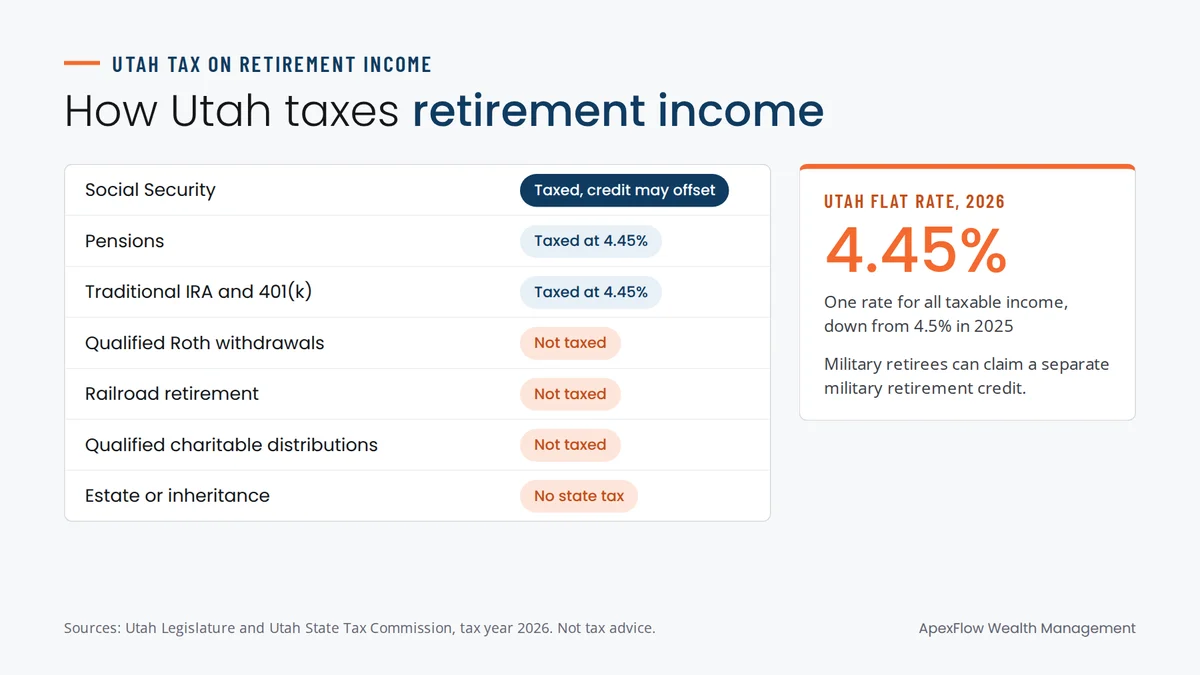
- Both are taxed as ordinary income when withdrawn, federally and by Utah at its flat rate (4.45 percent for 2026). Roth options exist in both.
- Leaving the money in URS plans is allowed and the costs are low. Rolling to an IRA is also allowed and gives more investment choice. Neither is automatically better; it depends on what you need the account to do.
Social Security and URS
Utah public employees pay into Social Security, so most URS members receive both a pension and Social Security without reduction. The Windfall Elimination Provision and Government Pension Offset, which cut benefits for workers in some other states, were repealed at the start of 2025. If you had years of work outside Utah public employment in a system that did not pay into Social Security, review your statement.
The planning question is timing. A URS pension starting at 60 can allow you to delay Social Security toward 70, which raises the lifetime inflation-protected income for you and your spouse. Our article on Social Security claiming strategies for married couples walks through the reasoning.
Utah taxes on a URS pension
Utah taxes pension income at its flat rate. There is a small retirement credit for people born before 1953 and a larger Social Security credit for retirees below an income threshold, but no general pension exclusion. If you are considering a move out of state in retirement, the destination’s treatment of pension income is worth checking. See our article on Utah’s tax on retirement income.
Returning to work after retirement
URS has rules about returning to work for a URS employer after you retire, including a required separation period before you can be re-employed without affecting your benefit. The rules have changed more than once. If you plan to substitute teach, consult or return part-time, confirm the current rules with URS before you retire.
Where we fit in
We do not replace URS, and we are not affiliated with it. What we do is put the pension in context: the payout option against your spouse’s needs, the 401(k) and 457 against your income gap, Social Security timing against the whole picture, and taxes across all of it. It is the same Purposeful Planning Process we use with every client, applied to a public pension.
If you or your spouse works for Intermountain Health, our guide to the Intermountain pension freeze covers what changes on December 31 and the decisions to make for 2027.
Frequently asked questions
Sometimes it works, usually for younger, healthy retirees whose spouse has substantial income of their own. Often the joint option is the cheaper way to buy the same protection. Compare real insurance quotes to the option reduction before deciding.
Tier 1 members with 30 years and Tier 2 members with 35 years can retire at any age without reduction. With fewer years, early retirement is possible from age 60 (or earlier with 25 years in Tier 1) with a permanent reduction.
Nothing automatic. You can leave it in place, take withdrawals, or roll it to an IRA. Check whether the age-55 rule or the 457’s no-penalty rule applies to you before moving money anywhere.
URS is one of the better-funded public pension systems in the country, and benefits are set by state statute. No one can promise the future, but the plan’s funding is strong relative to most peers.
Talk it through with us
Every situation is a little different. If you want to talk through yours, book a 20-Minute Fit Call with one of our advisors, by video or in person. No prep and no obligation. Want to see how we work first? Start with the Purposeful Planning Process or our services.

The information in this article is general in nature and is not a recommendation for any individual. Consider your own circumstances or speak with an advisor before acting on it. Any opinions are those of the author and not necessarily those of Raymond James.
ApexFlow Wealth Management does not provide tax or legal advice. Please consult your tax or legal professional before acting on any strategy mentioned here.
Examples labeled as hypothetical are for illustration only. They are not based on any actual client and do not represent actual or expected results.
Related Articles
Dig deeper into our resource library
-
 October 29, 2026
Long-Term Care Costs in Utah and How Families Pay for Them
What in-home care, assisted living and nursing homes cost in Utah, what Medicare and Utah Medicaid pay for, and the practical ways families fund care, from a dedicated reserve to insurance.Read more -
 October 29, 2026
Social Security Claiming Strategies for Married Couples
For a married couple, Social Security is two decisions that affect each other for the rest of both lives. Here is how the spousal and survivor rules work and how we help couples choose.Read more -
 November 5, 2026
Does Utah Tax Retirement Income? Social Security, Pensions and 401(k)s in 2026
If you’re planning to retire in Utah, or you already have, it’s worth knowing exactly how the state treats your income. The short answer: UtahRead more