

 »
Intermountain Health’s pension stops growing after December 31, 2026, for caregivers who are still earning benefits, and everything earned through that date is kept and protected by federal law. Starting in 2027, retirement saving moves to the 401(k), which adds a 2% automatic contribution alongside the employer match. Below are the reported facts, five decisions for 2027 and a checklist for the weeks before January. ApexFlow Wealth Management is not affiliated with Intermountain Health.
At a glance
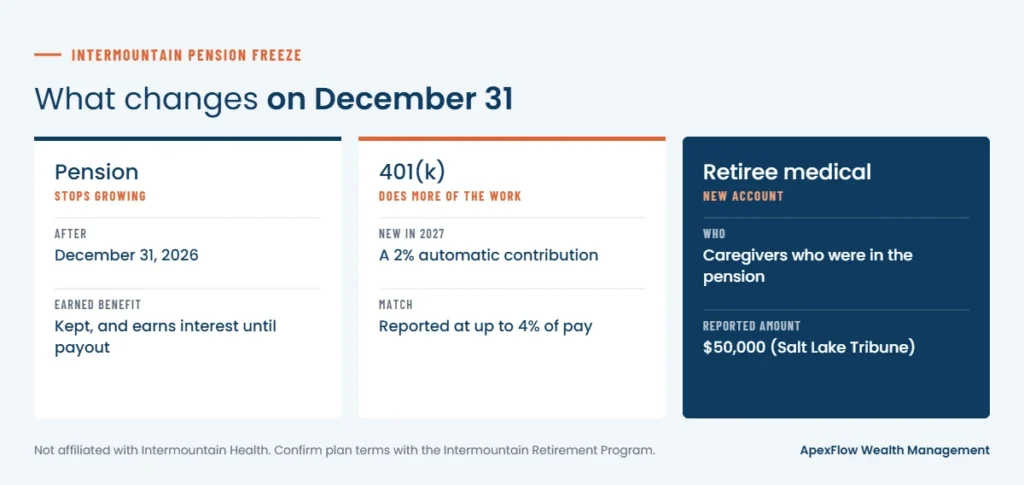
- Pension benefits stop growing after December 31, 2026, for currently employed caregivers who are still earning them.
- The benefit earned through that date is kept, earns interest until payout and is protected under federal law (ERISA), according to Intermountain.
- In 2027 the 401(k) adds a 2% automatic contribution for these caregivers, alongside an employer match reported at up to 4% of pay.
- Caregivers who were in the pension are being offered a new Retiree Medical Savings Account, which the Salt Lake Tribune reported at $50,000 for eligible workers.
What changes on December 31, and what doesn’t
The freeze applies to currently employed caregivers who are still earning pension benefits, according to a notice on Intermountain’s retirees page. The Salt Lake Tribune put that group at more than 22,000 caregivers, about a third of the system’s employees. Intermountain cited lower government payments, inflation and market volatility.
Retirees and former caregivers who already have a vested pension benefit, or who are receiving payments, are not affected. The pension has been closed to new hires since April 2020, and the Tribune reported earlier limits in 2007 and 2010 that capped contributions after 30 years of service. If you are past 30 years, ask how those limits apply to you.
The benefit you earned through December 31, 2026, stays yours. According to Intermountain, as reported by KSL, it is protected under the Employee Retirement Income Security Act (ERISA), held in a trust that can only pay pension benefits and will earn interest until payout. It is paid when you leave Intermountain or become eligible to retire under plan rules.
In 2027 the system moves entirely to the 401(k), administered through T. Rowe Price. Caregivers who were earning pension benefits now receive the 2% automatic contribution, which the 2024 plan summary did not give them. The match has been reported at up to 4% of pay, but the plan summary describes it as a discretionary percentage, so confirm the 2027 formula in your benefits materials.
Caregivers who previously participated in the pension are also being offered a new Retiree Medical Savings Account. The Tribune reported funding of $50,000 for eligible workers, and Intermountain sets who qualifies and what the account covers.
Five decisions for 2027
1. How much to put in to get the full match
The match depends on your own contributions. Under the 2024 plan summary, matching contributions are only made if you also made an elective contribution for the same period, and year-end true-ups are not guaranteed. That puts the focus on the rate in every paycheck, since a caregiver who reaches the IRS limit by fall could go months without a match.
For 2026 the IRS limit on employee contributions is $24,500, plus a catch-up of $8,000 at age 50 or older ($11,250 at ages 60 to 63). The IRS announces the next year’s limits in the fall. The 2% arrives automatically, so your decision is the rate that captures the full 2027 match, held steady through December.
Read more: How much to put in to get the full Intermountain 401(k) match
2. Whether your planned retirement age still works
After December 31 the pension no longer grows with more pay or service. Each year you work past 2026 builds the 401(k) instead, so retirement income leans more on contribution rates and investment returns.
Intermountain’s current application guide for active caregivers says reduced pension benefits are available before 65, with the full accrued benefit at 65. The 2021 guide adds that if you leave before 65 and wait until 65 to start, only a monthly annuity is available. Run the post-freeze benefit tool at more than one start age.
The month you leave matters too. Under the 2024 plan summary, the 2% is credited at year end to caregivers employed on the first day of the last December payroll period, or who leave because of a reduction in force, death, disability or after age 55. Hypothetical example for illustration only. Under those terms, a 54-year-old who retires in October would miss that year’s 2%, while a 56-year-old leaving the same week would receive it.
3. How the kept pension pays out
Intermountain’s 2021 pension application guide lists a single life annuity, a joint and survivor annuity paying 50%, 75% or 100% to a surviving spouse, ten-year certain versions of each, and a lump sum you can roll to an IRA or take in cash. Confirm the current options with the Retirement Program.
Treat the choice as permanent. The guide says a submitted application cannot be changed (you would cancel and start over), and payment elections are generally irrevocable once payments begin. A married caregiver who picks the single life annuity needs the spouse’s written consent.
Monthly payments provide income for life, while a lump sum hands you control of the money along with the investment risk. A lump sum paid to you rather than rolled over directly has 20% federal withholding, according to Intermountain’s guide and the IRS, and you have 60 days to complete a rollover. Ask for both figures for the same start date.
4. Roth or pre-tax in the 401(k)
The plan allows Roth contributions. Pre-tax contributions lower your taxable income now and are taxed when you withdraw them. Roth contributions are taxed now, and qualified withdrawals later, earnings included, are tax-free. Utah adds its own flat income tax, which is 4.45% for 2026 after S.B. 60.
A smaller pension means less fixed taxable income in retirement than you may have planned on, which changes whether paying tax now or later comes out ahead. Some households split contributions between the two, and your CPA should weigh in.
Higher earners have a new rule to plan around. Starting in 2026, if your prior-year wages from your employer were over $150,000, any catch-up contributions must go in as Roth. That can include physicians and senior administrators.
5. When to claim Social Security
With the pension frozen, Social Security may cover a larger share of retirement income. You can start benefits any time from 62 to 70, and Social Security sets full retirement age at 67 for anyone born in 1960 or later. Starting at 62 pays 70% of the full benefit, and waiting raises it until 70.
For married couples, the higher earner’s claiming age also shapes the survivor benefit, since Social Security notes that delaying results in higher survivor protection. Some households draw on the 401(k) or pension in the early years so the higher earner can claim later.
Utah taxes Social Security benefits but offers a credit. For tax years starting in 2025, the Utah State Tax Commission lists phase-out thresholds of $90,000 for married couples filing jointly and $54,000 for single filers. Taxable pension payments and 401(k) withdrawals count toward that income, so the order you draw from accounts can change the credit.
Read more: Social Security claiming strategies for married couples and Utah tax on retirement income
Start with Intermountain’s own resources
Intermountain is the source of record for your pension and 401(k), so begin there. These are the contacts and tools it lists or has described publicly.
- Intermountain Retirement Program. Use the contact details on the retirees page to ask about your benefit, payment forms and Retiree Medical Savings Account eligibility.
- Your 401(k). The “Log into your 401(k)” link on the retirees page goes to T. Rowe Price, which administers the plan.
- Your pension. The “Manage your pension” link on the same page is where you update your address, bank and tax withholding details.
- Post-freeze benefit tool. Intermountain said it is offering a tool to calculate benefits after the freeze (Deseret News).
- Webinars and one-on-one consultations. Intermountain said it is offering financial planning webinars and one-on-one retirement consultations, and the retirees page says caregivers can request a retirement consultant through AskHR.
Where an outside second opinion helps
Intermountain’s tools focus on Intermountain’s plans, meaning your pension benefit, your 401(k) and the choices inside each. A household plan adds what sits outside them, such as a spouse’s pension or 401(k), both Social Security records, Utah taxes, other savings and health coverage before Medicare.
ApexFlow can serve as that outside second opinion. We model the pension payout, 401(k) settings and claiming ages together and coordinate with your CPA on the tax side. You can see the steps in our planning process.
A short checklist before January
- Run Intermountain’s post-freeze benefit tool and save the result.
- Find the 2027 match formula in your benefits materials and set your T. Rowe Price contribution rate to meet it every pay period.
- Choose a Roth or pre-tax split for 2027, and if you are 50 or older and a higher earner, ask how the Roth catch-up rule applies to you.
- Ask the Intermountain Retirement Program whether you qualify for the Retiree Medical Savings Account.
- Request the current list of pension payment forms and talk through survivor options with your spouse.
- Check the beneficiary on your 401(k).
- Download your Social Security statement, and your spouse’s, from my Social Security at ssa.gov.
- Sign up for an Intermountain webinar or request a one-on-one consultation through AskHR.
Frequently asked questions
No. Intermountain says benefits earned through December 31, 2026, are preserved, protected under ERISA and held in a trust that can only pay pension benefits. They continue to earn interest until payout and are paid when you leave or become eligible to retire under plan rules.
Intermountain’s retirees page says it does not affect retirees or former caregivers who have a vested pension benefit or are receiving pension payments. The freeze applies only to currently employed caregivers who are still earning additional pension benefits.
As reported, yes. The 2% is an automatic contribution, and the Salt Lake Tribune reported it can be complemented by an additional match of up to 4%. Confirm the 2027 match formula in your benefits materials, since the plan summary treats the match as discretionary.
That depends on your health, your spouse’s needs, your other income and how comfortable you are managing investments. Monthly payments last for life, while a lump sum gives you control of the money and the investment risk. The choice is generally permanent, so compare both figures for the same start date and make the decision with your spouse.
Intermountain’s application guide for active caregivers says reduced pension benefits are available before 65, with the full accrued benefit at 65. Because the pension stops growing after 2026, the 401(k) and your Social Security timing carry more of the load. Run the post-freeze benefit tool at several start ages before you pick a date.
It is a new account Intermountain is offering to caregivers who previously participated in the pension, and the Salt Lake Tribune described it as a medical savings account that can be used during retirement. The Tribune reported Intermountain is offering to fund the accounts with $50,000 for eligible workers. Ask the Intermountain Retirement Program who qualifies, when the money is available and what it can pay for.
Confirm with the Intermountain Retirement Program, using the contact details on the retirees page. Intermountain operates in six Western states, and plan terms can differ by legacy plan and region. The Utah tax points on this page apply to Utah residents.
No. ApexFlow Wealth Management is a financial planning and wealth management team in Salt Lake City and is not affiliated with Intermountain Health. Questions about your Intermountain benefits belong with the Intermountain Retirement Program.
Bring your statements to a 20-Minute Fit Call
If you’d like a second look at your pension payout choice, 401(k) settings and Social Security timing before January, we’d be glad to help. Book a 20-Minute Fit Call. It can be virtual or in person at our Sugar House office, there’s no prep needed beyond the statements below, and there’s no obligation.
What to bring
- Your pension benefit estimate after the freeze
- Your latest T. Rowe Price 401(k) statement
- Your spouse’s retirement plan details
- Last year’s tax return
- Your Social Security statement (and your spouse’s)
Sources
KSL, Jan 31, 2026; Deseret News, Jan 29, 2026; Salt Lake Tribune, Feb 19, 2026; Intermountain Health retirees page (accessed Nov 4, 2026); Intermountain Health 401(k) Plan summary, 2024; Intermountain pension application guide, 2021; IRS 2026 limits; Utah State Tax Commission, Jan 15, 2026; Social Security Administration.

The information in this article is general in nature and is not a recommendation for any individual. Consider your own circumstances or speak with an advisor before acting on it. Any opinions are those of the author and not necessarily those of Raymond James.
ApexFlow Wealth Management does not provide tax or legal advice. Please consult your tax or legal professional before acting on any strategy mentioned here.
Investing involves risk, and you may incur a profit or loss regardless of the strategy selected, including diversification and asset allocation. Past performance does not guarantee future results.
Examples labeled as hypothetical are for illustration only. They are not based on any actual client and do not represent actual or expected results.
Related Articles
Dig deeper into our resource library
-
 November 4, 2026
How Much to Put in Your Intermountain 401(k) to Get the Full Match
Intermountain caregivers moving off the pension in 2027 get a new 2% automatic contribution and a match reported at up to 4%. What to contribute to capture the full match, and why maxing out early can cost you.Read more -
 October 29, 2026
Social Security Claiming Strategies for Married Couples
For a married couple, Social Security is two decisions that affect each other for the rest of both lives. Here is how the spousal and survivor rules work and how we help couples choose.Read more -
 November 5, 2026
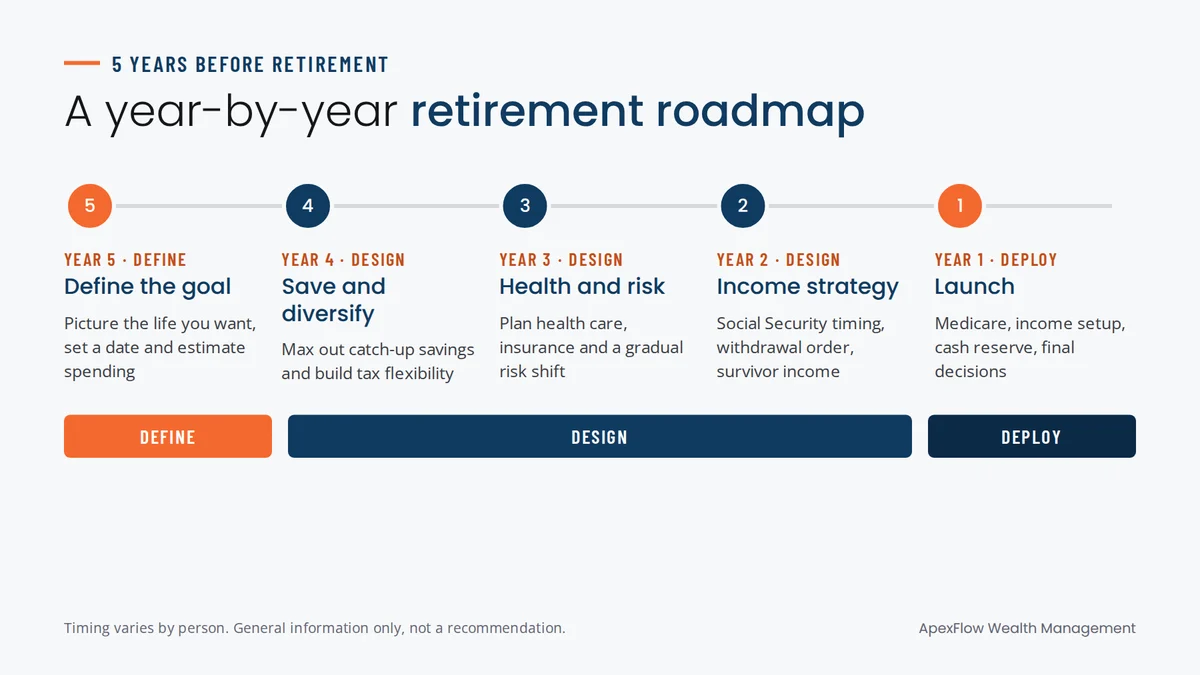
The 5 Years Before Retirement: A Year-by-Year Planning Roadmap
Ask most people what their retirement plan is, and you’ll get one of two answers. Either a number, some version of “I need two millionRead more