

At a glance
- Your benefit grows about 8 percent for every year you wait from full retirement age to 70, and shrinks for every year you claim early after 62.
- For couples, the higher earner’s benefit becomes the survivor’s benefit, so delaying it protects whichever of you lives longer.
- A spousal benefit tops out at half of the other spouse’s full retirement age benefit and does not grow past that spouse’s full retirement age.
- Working before full retirement age can temporarily reduce benefits under the earnings test; for 2026 the limit is $24,480.
- The best plan is often one spouse claiming earlier and the higher earner waiting to 70, but health, work and other income can change that.
Most Social Security advice is written for one person. Married couples face a different problem: two work records, two claiming dates, and a survivor rule that ties them together for life. The decision is worth getting right. For many couples the difference between a good strategy and a default one adds up to a meaningful amount over a long retirement, and it falls on the surviving spouse, who is usually the one with less margin.
Two minutesHow much of your retirement is actually decided?Get my Clarity ScoreThe basics, briefly
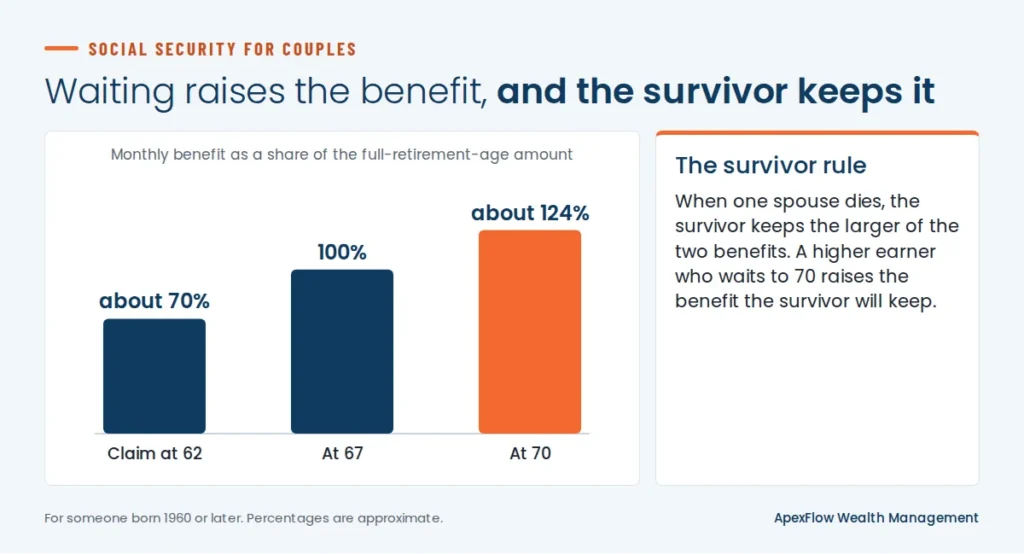
Your benefit is based on your highest 35 years of earnings. Claiming at your full retirement age, which is 67 for anyone born in 1960 or later, gets you 100 percent of that amount. Claiming at 62 cuts it by about 30 percent. Waiting past full retirement age adds roughly 8 percent per year until 70. The 2026 cost-of-living adjustment was 2.8 percent, and adjustments apply whether or not you have started benefits.
Those are the single-person rules. Couples add two more.
The spousal benefit
If you are married, you can receive the higher of your own benefit or a spousal benefit of up to 50 percent of your spouse’s full retirement age amount. You must be at least 62, and your spouse must have already filed. Claiming a spousal benefit before your own full retirement age reduces it. Waiting past your full retirement age does not increase it, so there is no reason to delay a pure spousal benefit beyond 67.
For couples where one spouse earned much less, this matters. It can mean the lower earner’s own record is nearly irrelevant to the household’s total.
The survivor benefit: the rule that drives most strategies
When one spouse dies, the survivor keeps the larger of the two benefits and loses the smaller one. That means the higher earner’s claiming decision is really a decision about how much income the survivor will have, potentially for decades.
If the higher earner delays to 70, the survivor inherits that larger benefit, including the delayed retirement credits. If the higher earner claims at 62, the survivor inherits the reduced one for life. This is why we usually encourage the higher earner in a couple to wait as long as the household can afford, even when their own life expectancy is average, because the benefit is really being purchased for whichever spouse lives longest.
The common pattern
For many couples the strategy looks like this: the lower earner claims somewhere between 62 and 67 to bring income into the household, and the higher earner delays to 70. Spending in the gap years comes from the lower earner’s benefit, from portfolio withdrawals, or from part-time work. The result is a larger inflation-adjusted income for life and for the survivor.
It is a pattern, not a rule. We change it when:
- One spouse has a serious health condition that shortens expected lifespan.
- The household cannot fund the gap years without selling investments at a bad time.
- One spouse is still working and would lose benefits to the earnings test.
- A pension with a survivor option changes what the survivor actually needs.
- Delaying would force large retirement account withdrawals that push the couple into higher brackets or raise Medicare premiums.
Hypothetical example: Dan and Marie live in Holladay. Dan’s full retirement age benefit is $3,400 a month, Marie’s is $1,400. Marie claims her own benefit at 64, slightly reduced. Dan waits to 70, where his benefit grows to about $4,200. From 67 to 70 they fund the gap with withdrawals from a taxable account. If Dan dies first, Marie’s income steps up to his $4,200 rather than the $3,400 she would have had if he claimed at 67, or less if he had claimed at 62. The figures are hypothetical and ignore cost-of-living adjustments and taxes.
Working and claiming
If you claim before full retirement age and keep working, benefits are reduced by $1 for every $2 you earn above $24,480 in 2026. In the year you reach full retirement age the limit rises to $65,160 and the reduction drops to $1 for every $3. The withheld benefits are credited back later, so it is not a permanent loss, but it usually means a working spouse should wait to claim.
Taxes on benefits
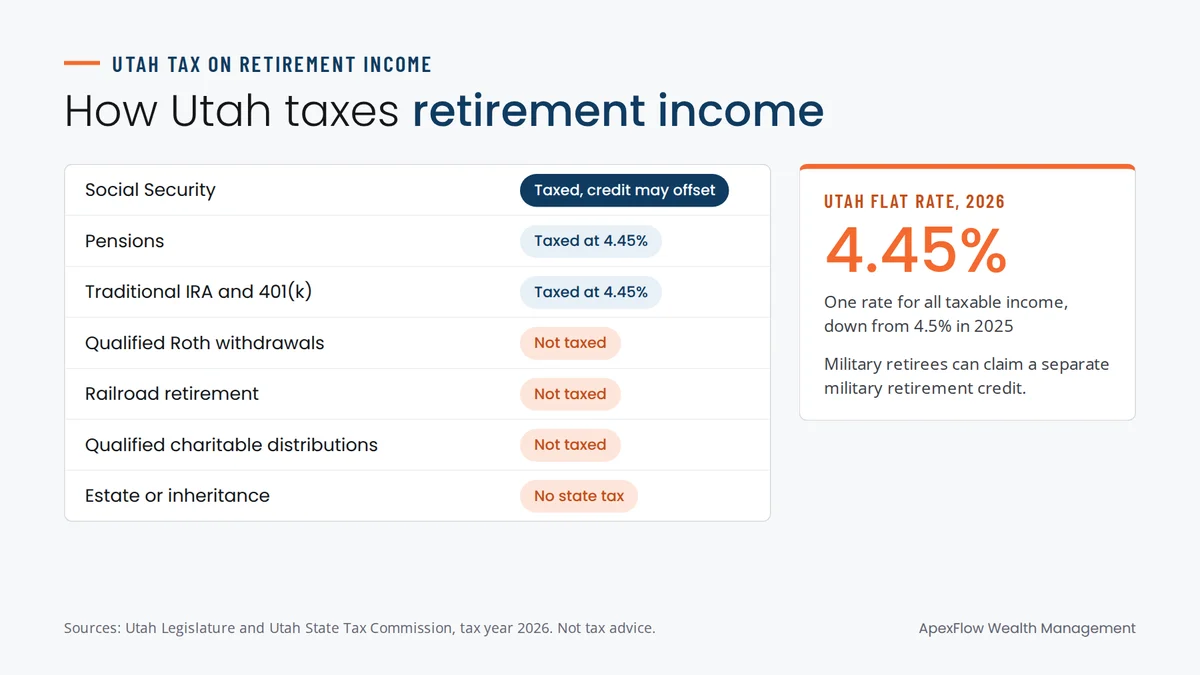
Up to 85 percent of Social Security can be included in federal taxable income depending on your other income. Utah taxes the same portion but offers a credit that eliminates the state tax for many retirees below an income threshold; for 2026 the joint-filer threshold is $90,000. Our article on how Utah taxes retirement income has the details, and they are worth confirming each year.
Where this fits in your plan
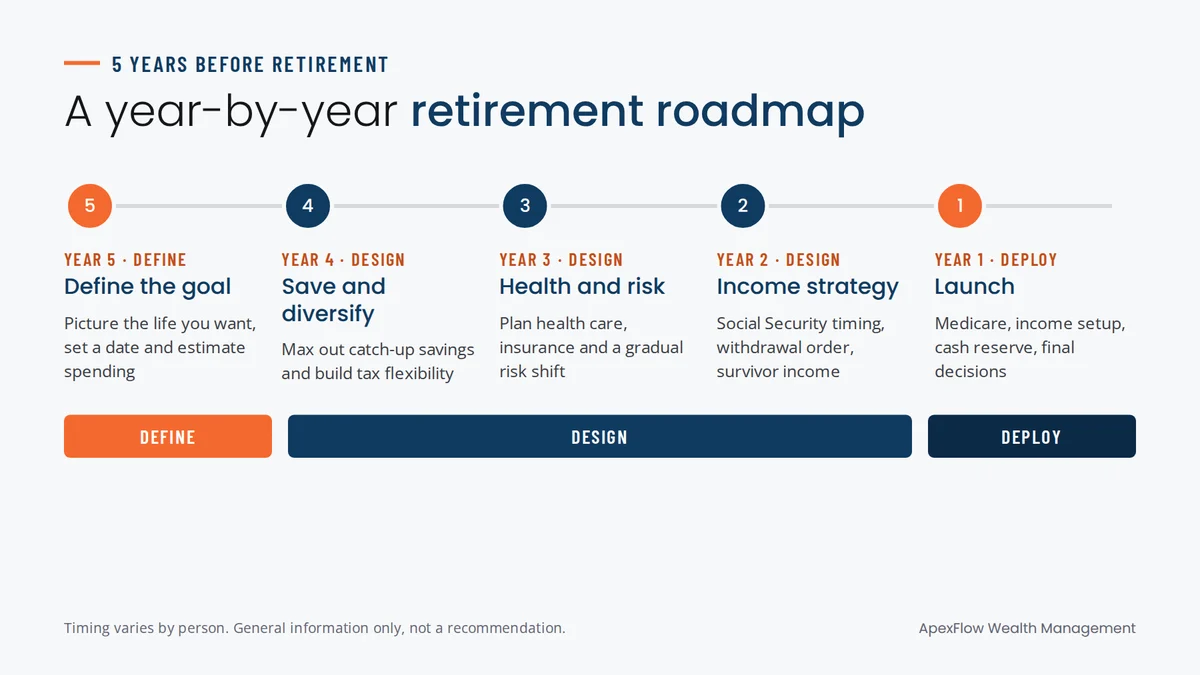
Social Security timing is one of the few retirement decisions that is close to irreversible, so we treat it as part of the whole income plan rather than a standalone choice. It interacts with when you stop working, how you draw from retirement accounts, whether Roth conversions make sense in the gap years, and what a survivor would need. We work through it in the Plan with Purpose step. If you are within five years of retirement, our article on the five years before retirement is a good companion.
Frequently asked questions
For most people born after January 1, 1954, no. When you file you are deemed to file for both, and you receive the higher. The old “file and suspend” and “restricted application” strategies are no longer available to most couples.
Yes. The working spouse must have filed for their own benefit before the other spouse can collect a spousal benefit on that record.
If the marriage lasted at least ten years and you have not remarried, you may be eligible for a spousal or survivor benefit on your former spouse’s record. Your former spouse does not need to have filed, as long as you have been divorced at least two years.
No. It usually wins for the higher earner in a healthy couple because of the survivor rule. It can lose when health is poor, when the gap years would require damaging withdrawals, or when both spouses have similar benefits and shorter life expectancies.
Talk it through with us
Every situation is a little different. If you want to talk through yours, book a 20-Minute Fit Call with one of our advisors, by video or in person. No prep and no obligation. Want to see how we work first? Start with the Purposeful Planning Process or our services.

The information in this article is general in nature and is not a recommendation for any individual. Consider your own circumstances or speak with an advisor before acting on it. Any opinions are those of the author and not necessarily those of Raymond James.
Examples labeled as hypothetical are for illustration only. They are not based on any actual client and do not represent actual or expected results.
Related Articles
Dig deeper into our resource library
-
 October 29, 2026
Long-Term Care Costs in Utah and How Families Pay for Them
What in-home care, assisted living and nursing homes cost in Utah, what Medicare and Utah Medicaid pay for, and the practical ways families fund care, from a dedicated reserve to insurance.Read more -
 November 5, 2026
Does Utah Tax Retirement Income? Social Security, Pensions and 401(k)s in 2026
If you’re planning to retire in Utah, or you already have, it’s worth knowing exactly how the state treats your income. The short answer: UtahRead more -
 November 5, 2026
The 5 Years Before Retirement: A Year-by-Year Planning Roadmap
Ask most people what their retirement plan is, and you’ll get one of two answers. Either a number, some version of “I need two millionRead more