
At a glance
- A nonqualified deferred compensation (NQDC) plan lets you postpone part of your salary or bonus and the tax on it until a later year.
- It works best when you expect to be in a lower bracket later, you already max out your 401(k), and your employer is financially strong.
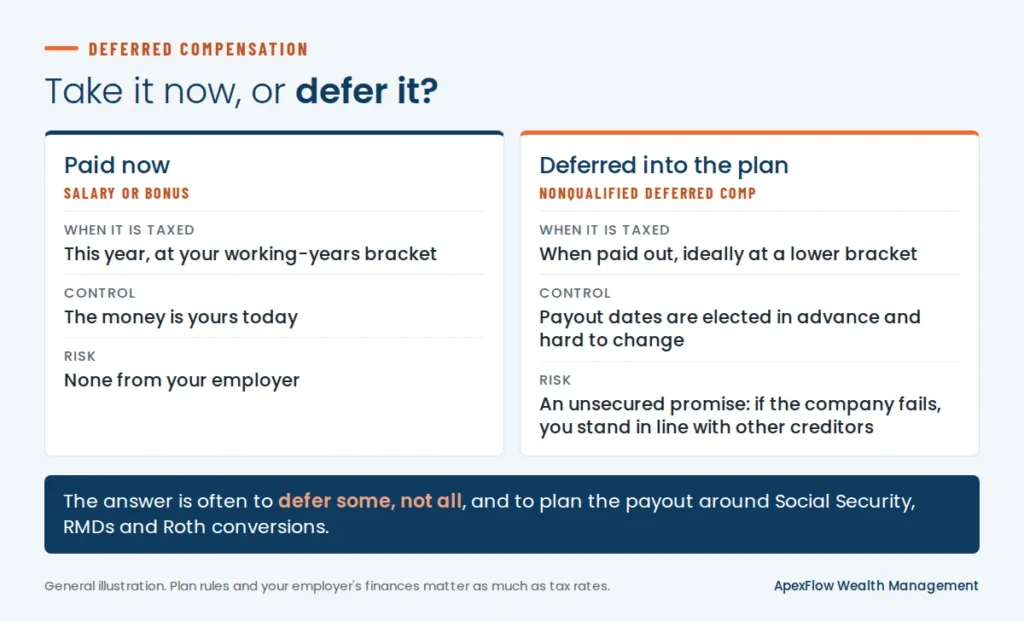
- Deferred money is an unsecured promise from your employer. If the company fails, you stand in line with other creditors.
- Distribution elections are made in advance and are hard to change. A bad election can stack deferred income on top of other income in retirement.
- The right answer is often to defer some, not all, and to coordinate the payout schedule with Social Security, RMDs and Roth conversions.
Each fall, executives at larger Utah employers get an enrollment email asking how much of next year’s salary and bonus they want to defer. It is a decision made in a short window, often with little guidance, and it shapes income for a decade or more.
Two minutesYou are planning money for 30 years and a body for how many?Check my WealthSpan GapWhat a deferred compensation plan is
A 401(k) is a qualified plan: contributions are limited, assets are held in a trust for your benefit, and the money is protected from your employer’s creditors. A nonqualified deferred compensation plan is the opposite on each point. There is usually no cap on how much you can defer. The money stays on your employer’s books. And if the company goes bankrupt, you are a general unsecured creditor.
In exchange, you get something a 401(k) cannot offer: the ability to move a large amount of income out of a high-tax year and into years you choose. Many plans also credit notional investment returns on the balance, often mirroring the 401(k) menu.
When deferring makes sense
Your bracket will be lower later. Deferring income taxed at the top federal rate today and receiving it in early retirement at a lower rate is a real saving. The spread matters more than any other factor.
You already fill your 401(k). The 401(k) comes first because it is protected and portable. For 2026 the employee limit is $24,500, plus catch-up contributions after 50. If you are not at that limit, start there.
Your employer is strong and likely to stay that way. You are extending credit for years. A large, diversified, investment-grade company is a different risk than a startup or a company in a cyclical industry.
You have a clear use for the payout. A deferral scheduled to pay out over the five years between retirement and Social Security can fund that gap at low tax rates and let your other accounts keep growing. That is a plan, not a guess.
When to say no, or to defer less
You might leave. Many plans pay out in a lump sum at separation. If you change jobs in three years, the entire balance can land in one tax year, which defeats the purpose.
Your employer’s credit is uncertain. No tax saving is worth a meaningful chance of losing the principal.
You have no liquidity. Deferring compensation reduces take-home pay. If you would be borrowing to fund your life while deferring, stop.
State tax is heading the wrong way. Deferred compensation is generally taxed by the state where you live when you receive it, with an exception for payments spread over ten or more years. Deferring in Utah at 4.45 percent and receiving it in a state with no income tax is a bonus. Deferring in a no-tax state and retiring to a high-tax one is the opposite. Utah’s flat rate keeps the state side predictable for most of our clients.
The distribution election is the real decision
When you defer, you choose when and how the money comes back: a lump sum or installments, at a fixed date or at separation. Changing the election later usually requires pushing the payout at least five years further out, and the change must be made well in advance. Most mistakes we see are election mistakes, not deferral mistakes.
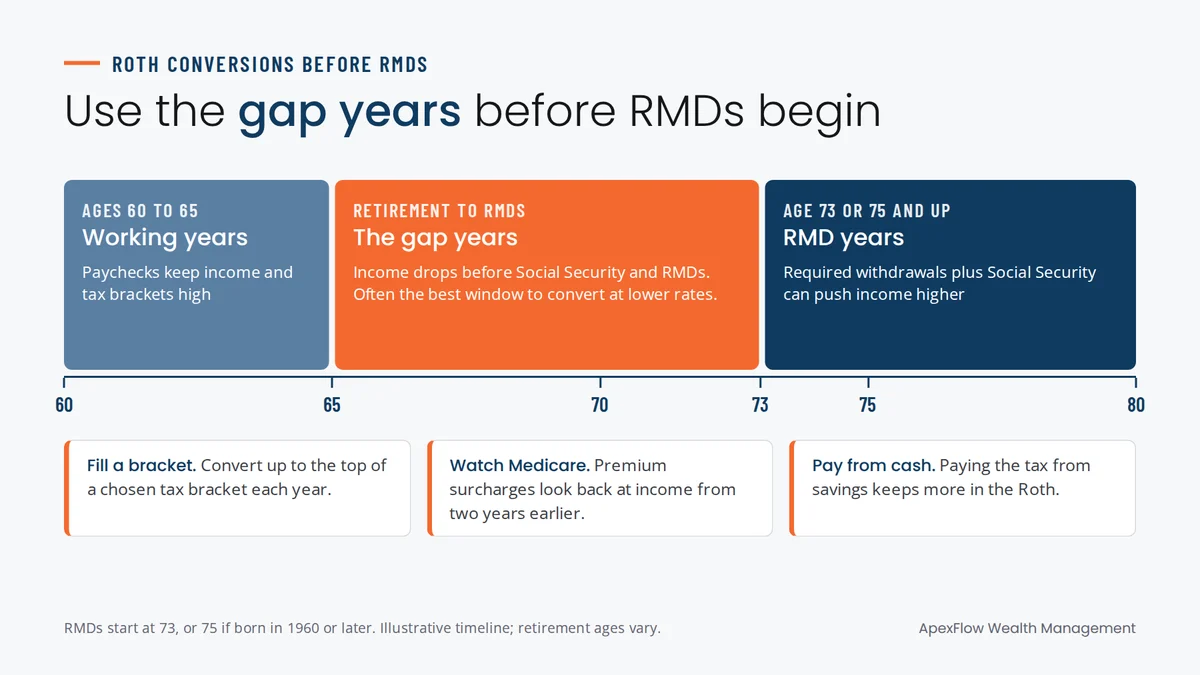
The common one: electing a lump sum at separation. An executive retires at 62, receives a seven-figure payout in one year, and pays more tax than if she had never deferred. The better choice for most people is installments over five to fifteen years, timed to fill the low-income years before Social Security and required minimum distributions begin at 73 or 75.
Hypothetical example: A division president in Salt Lake City, 55, earns $450,000 and plans to retire at 62. He defers 30 percent of salary and his full bonus for seven years into his company’s NQDC plan, electing ten annual installments starting at separation. The installments fund his spending from 62 to 72, which lets him delay Social Security to 70 and do modest Roth conversions in those years. He keeps the deferral below half of his comp so his family’s cash flow does not depend on the company surviving. The example is hypothetical and not a recommendation for any individual.
Coordinating the payout with everything else
Deferred compensation does not live in a vacuum. It arrives in the same years as pension payments, Social Security, RMDs and any Roth conversions you want to do. Stacking all of them in the same years pushes you into brackets you were trying to avoid. A good plan lays each income source on a timeline and shifts what can be shifted. Our article on Roth conversions before RMDs shows how the low-income window works.
This is why deferred comp sits inside our executive financial planning rather than being a standalone decision each November. During the Take Inventory step we gather every grant, plan and election you have, then in Plan with Purpose we build the payout schedule around your goals.
Frequently asked questions
No. A 401(k) is a qualified plan with contribution limits and creditor protection. A nonqualified deferred compensation plan has no statutory cap but the balance is an unsecured promise from your employer.
It depends on the plan and the deal. Some plans pay out on a change in control; others are assumed by the buyer. Read the plan document and ask HR before the deal closes, because the payout timing can create a large single-year tax bill.
Usually only by delaying the payout at least five more years, and the change must be made at least a year before the original payment date. Treat the first election as permanent and choose carefully.
Enough to use the tax spread you expect, and not so much that your household depends on the company’s solvency or your take-home pay feels squeezed. For many executives that lands somewhere between 10 and 40 percent of total compensation, but it should come from your own plan, not a rule of thumb.
Talk it through with us
Every situation is a little different. If you want to talk through yours, book a 20-Minute Fit Call with one of our advisors, by video or in person. No prep and no obligation. Want to see how we work first? Start with the Purposeful Planning Process or our services.

The information in this article is general in nature and is not a recommendation for any individual. Consider your own circumstances or speak with an advisor before acting on it. Any opinions are those of the author and not necessarily those of Raymond James.
ApexFlow Wealth Management does not provide tax or legal advice. Please consult your tax or legal professional before acting on any strategy mentioned here.
Investing involves risk, and you may incur a profit or loss regardless of the strategy selected, including diversification and asset allocation. Past performance does not guarantee future results.
Examples labeled as hypothetical are for illustration only. They are not based on any actual client and do not represent actual or expected results.
Related Articles
Dig deeper into our resource library
-
 October 29, 2026
Year-End Planning for Executives: A 2026 Checklist for Equity and Deferred Pay
Executive pay decisions run on their own calendar. A dated checklist for 2027 deferral elections, RSU withholding, ISO exercises under the 2026 AMT rules, 10b5-1 plans and 401(k) catch-ups.Read more -
 October 29, 2026
How to Avoid the Concentrated Stock Trap After an IPO or Acquisition
A liquidity event can turn years of equity into most of your net worth in one stock. Here is how to plan the months before and after an IPO or acquisition so you keep what you built.Read more -
 November 5, 2026
Roth Conversions Before RMDs: Making the Most of the Gap Years
For many retirees, the years between leaving work and starting required minimum distributions are the lowest-tax years they’ll ever have. The paycheck has stopped, SocialRead more