

At a glance
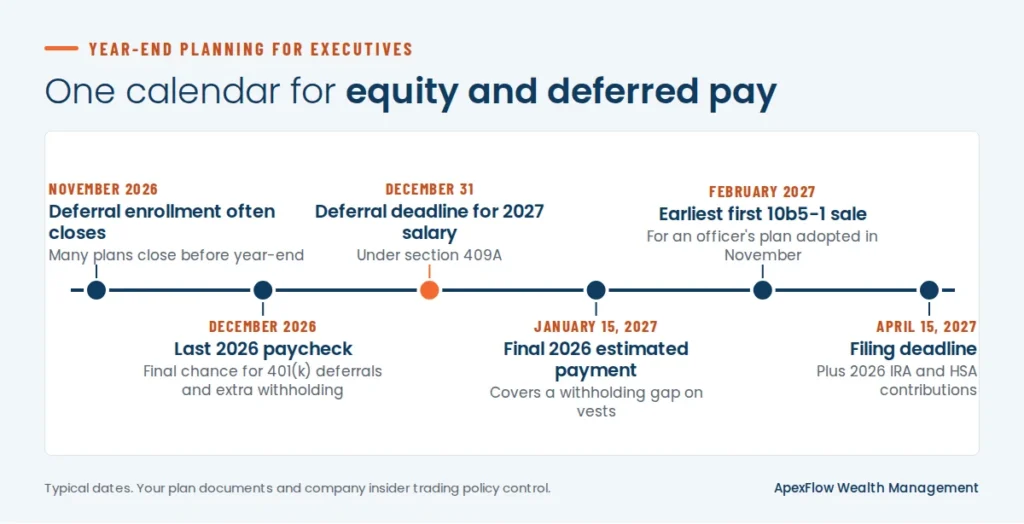
- Elections to defer 2027 salary into a nonqualified plan generally must be made by December 31, 2026, and many employers close enrollment earlier.
- The 22 percent supplemental withholding rate on RSU vests is often well below an executive’s actual bracket, and the 110 percent prior-year safe harbor applies when 2025 AGI exceeded $150,000.
- For 2026 the AMT exemption starts phasing out at $500,000 for single filers and $1,000,000 for joint filers, twice as fast as before, so ISO exercises reach AMT sooner than in 2025.
- Officers and directors who adopt a 10b5-1 plan face a cooling-off period of at least 90 days, so a plan adopted in November generally cannot trade before February.
- If your 2025 Social Security wages from your employer exceeded $150,000, any 401(k) catch-up contributions in 2026 must go in as Roth.
Year-end planning for executives runs on several calendars at once. Deferral elections for 2027 pay close before December 31, the last 2026 estimated tax payment is due January 15, and a trading plan adopted this fall may not place its first trade until spring. The mechanics are covered in our articles on RSUs and stock options and when deferring compensation makes sense. What changes each fall is the deadline attached to each decision, and for 2026 a few of the rules themselves. A CPA should review the tax side of these items before anything is final.
Two minutesYou are planning money for 30 years and a body for how many?Check my WealthSpan GapYear-end planning for executives starts with 2027 deferral elections
Under section 409A, an election to defer salary must generally be made by the end of the year before the work is performed. For 2027 salary, that means no later than December 31, 2026, and plans often set an earlier enrollment deadline in November or early December.
Bonus timing depends on how the plan defines the bonus. A bonus earned for 2027 service generally follows the same December 31, 2026 deadline. If it qualifies as performance-based pay with a performance period of at least 12 months, the plan may allow an election as late as six months before the period ends, which is June 30, 2027 for a calendar-year bonus, provided the amount is not yet readily ascertainable. Someone who becomes eligible for a plan for the first time generally has 30 days to elect, and the election covers only pay earned afterward.
The payout election usually travels with the deferral election. Changing it later requires an election made at least 12 months before the scheduled payment, a new payment date at least five years later, and a 12-month wait before the change takes effect. Executives a few years from retirement often check how the 2027 class stacks with earlier classes before choosing installments or a fixed date.
- Plan enrollment deadline and bonus election rules confirmed from the plan document.
- Payout election for the 2027 class compared with existing classes and the expected retirement year.
RSU vests, withholding and the safe harbor
Employers commonly withhold federal tax on RSU vests at the 22 percent supplemental rate, and they must use 37 percent on supplemental wages above $1 million in a calendar year. For 2026, joint filers reach the 32 percent bracket at $403,550 of taxable income, 35 percent at $512,450 and 37 percent at $768,700. A household in the 35 percent bracket with $200,000 of vests withheld at 22 percent is short about $26,000 of federal tax before Utah is counted.
The federal underpayment penalty is avoided when withholding and estimated payments cover at least 90 percent of 2026 tax or 100 percent of 2025 tax. That second test rises to 110 percent of 2025 tax if 2025 AGI was above $150,000. The final 2026 estimated payment is due January 15, 2027.
Withholding has one advantage over estimated payments. Unless you elect otherwise, it is treated as paid evenly through the year, so extra withholding from a December paycheck or year-end bonus can cover a shortfall from an earlier quarter. An estimated payment counts only from the date it is made.
ISO exercises and the 2026 AMT rules
The One Big Beautiful Bill Act changed how the AMT exemption phases out starting in 2026. The exemption is $90,100 for single filers and $140,200 for joint filers, but it now begins phasing out at $500,000 and $1,000,000 of alternative minimum taxable income, down from $626,350 and $1,252,700 for 2025. The exemption also shrinks by 50 cents per dollar instead of 25, so it is fully gone at $680,200 for single filers and $1,280,400 for joint filers.
For ISO holders, the spread at exercise is an AMT adjustment, and many high earners have less room to exercise without owing AMT in 2026 than they did in 2025. An exercise counts in the calendar year it happens, so a December exercise needs to be modeled before the broker’s year-end cutoff. If ISO shares are sold in the same calendar year as the exercise, no AMT adjustment applies, but the sale is a disqualifying disposition and the spread at exercise (or the actual gain, if smaller) is taxed as ordinary income. Long-term capital gain treatment requires holding until the later of two years from grant and one year from exercise.
ESPP enrollment and holding periods
Many employee stock purchase plans open enrollment for the next offering period in late fall. Shares bought through a qualified plan get the most favorable tax treatment only in a qualifying disposition, meaning a sale after the later of two years from the start of the offering and one year from the purchase. Ordinary income is then limited to the smaller of the actual gain or the discount measured at the start of the offering, and the rest is long-term capital gain.
Selling sooner is a disqualifying disposition. The difference between the purchase price and the market value on the purchase date is ordinary income, even if the shares have since fallen. Many executives sell at purchase anyway, accepting ordinary income in exchange for not adding to an already large company position. For lots close to the two-year mark, the year-end question is which shares to sell in 2026 and which to hold into 2027.
10b5-1 plans for 2027 sales
Under SEC rules adopted in 2022, a director or officer who adopts or modifies a 10b5-1 plan cannot trade under it until the later of 90 days after adoption or two business days after the company discloses financial results for the quarter in which the plan was adopted, capped at 120 days. Other employees face a 30-day cooling-off period. Directors and officers must also certify that they are not aware of material nonpublic information, overlapping plans are generally not allowed, and single-trade plans are limited to one in any 12-month period.
In practice, an officer who adopts a plan during a November 2026 trading window generally cannot see a first sale before February 2027, and possibly not until March. Company insider trading policies often add their own windows and pre-clearance rules. For executives working down a large position, the plan adopted this fall sets the pace for most of 2027. Our article on concentrated stock after an IPO or acquisition covers how to set a target.
401(k) limits, catch-ups and Roth options
Anyone not yet at the 2026 maximum has until the final paycheck of the year: $24,500 of elective deferrals, plus $8,000 more from age 50, or $11,250 more for those who reach 60 through 63 during the year.
New this year, catch-up contributions must be Roth for anyone whose 2025 FICA wages from the employer sponsoring the plan exceeded $150,000. The test uses Social Security wages (box 3 of the W-2) from that employer only. A plan without a Roth option can bar affected employees from catch-ups entirely. Final IRS regulations generally apply from 2027, and plans follow a good-faith reading of the law for 2026.
Mega backdoor Roth. Some plans accept after-tax contributions above the $24,500 limit, up to a combined $72,000 for 2026 counting your own deferrals and employer contributions, paired with in-plan Roth conversions or in-service withdrawals. Only payroll contributions count, so this window also closes with the final paycheck.
Backdoor Roth IRA. Direct Roth IRA contributions phase out between $242,000 and $252,000 of modified AGI for joint filers ($153,000 to $168,000 for single filers). The workaround is a nondeductible traditional IRA contribution converted to Roth. The trap is the pro-rata rule: the taxable share of a conversion is figured using the combined December 31 value of all your traditional IRAs, including SEP and other employer-sponsored IRAs. A large rollover IRA makes most of the conversion taxable unless it is moved into an employer plan that accepts roll-ins before year-end. Our article on Roth vs. traditional IRAs for high earners compares the options.
Benefits open enrollment
- Group long-term disability. Many plans replace a percentage of base salary up to a monthly cap and leave out bonus and equity, so an executive’s actual coverage can be a small share of total pay. If the employer pays the premium, benefits are generally taxable. Supplemental individual coverage can fill part of the gap.
- Supplemental life insurance. Group coverage is convenient but usually tied to the job. The cost of employer-provided group-term coverage above $50,000 is taxable wages.
- HSA. Choosing an HSA-eligible plan for 2027 opens a higher limit: the IRS has set 2027 HSA contributions at $4,500 for self-only coverage and $9,000 for family coverage, with $1,000 more from age 55. Money that goes in through payroll generally escapes Social Security and Medicare tax, which a contribution made directly to the HSA does not.
Giving company shares in a high-income year
A year with a large vest, bonus or exercise is often the year to fund several years of giving at once. Shares held more than one year can go to a donor-advised fund or charity for a deduction at market value, generally up to 30 percent of AGI, without realizing the gain. RSU shares start their holding period at vest, so lots that vested more than a year ago qualify for market-value treatment, while recent lots generally are limited to their cost basis. Shares from ISO or ESPP purchases that have not met their holding periods need a closer look before any gift.
The 2026 charitable rules apply here too: the 0.5 percent of AGI floor, and for taxable income above $768,700 on a joint return, a reduction that holds each deducted dollar to about 35 cents of tax savings. Our year-end tax planning checklist covers those rules. Officers should also check company policy, since gifts of company stock may require pre-clearance and reporting.
Hypothetical example: A married vice president at a Draper software company expects about $700,000 of 2026 wages, including $300,000 of RSU vests withheld at 22 percent. Her household’s top federal bracket is 35 percent, so the vests are underwithheld by roughly 13 points, or close to $40,000. Their 2025 AGI was above $150,000, so the safe harbor is 110 percent of their 2025 tax. She raises withholding on her December paychecks, which counts as paid evenly through the year, and gives $50,000 of company shares that vested in 2024 to a donor-advised fund. As an officer, she adopts a 10b5-1 plan during the November window, knowing the first sale cannot occur before February, and she elects to defer 20 percent of her 2027 salary before her plan’s December deadline. The figures are hypothetical and do not represent any client.
One calendar for the whole year
These decisions interact: a deferral election changes next year’s bracket, which changes how much ISO spread fits under the AMT, which changes the right size for a gift. Our executive financial planning work keeps them on one calendar, beginning with a full list of grants, plan documents and election dates assembled in the Take Inventory step.
Frequently asked questions
Under section 409A, salary deferral elections for 2027 generally must be made by December 31, 2026. Many plans close enrollment earlier, so the plan’s own deadline is the one that matters.
Generally yes. Withholding is treated as paid evenly through the year unless you elect to use the actual dates, so a larger December withholding can reduce an underpayment penalty from earlier quarters. Estimated payments count only when made.
The exemption of $90,100 (single) or $140,200 (joint) now starts phasing out at $500,000 and $1,000,000 of AMT income, down from $626,350 and $1,252,700 in 2025, and it phases out at 50 cents per dollar instead of 25. More high earners who exercise ISOs can owe AMT as a result.
Only if your 2025 Social Security wages from the employer sponsoring the plan exceeded $150,000. If that plan does not offer Roth contributions, it may not allow you to make catch-up contributions at all.
Talk it through with us
Every situation is a little different. If you want to talk through yours, book a 20-Minute Fit Call with one of our advisors, by video or in person. No prep and no obligation. Want to see how we work first? Start with the Purposeful Planning Process or our services.

The information in this article is general in nature and is not a recommendation for any individual. Consider your own circumstances or speak with an advisor before acting on it. Any opinions are those of the author and not necessarily those of Raymond James.
ApexFlow Wealth Management does not provide tax or legal advice. Please consult your tax or legal professional before acting on any strategy mentioned here.
Investing involves risk, and you may incur a profit or loss regardless of the strategy selected, including diversification and asset allocation. Past performance does not guarantee future results.
Examples labeled as hypothetical are for illustration only. They are not based on any actual client and do not represent actual or expected results.
Related Articles
Dig deeper into our resource library
-
 October 29, 2026
Deferred Compensation Plans: When Deferring Makes Sense and When It Doesn’t
Nonqualified deferred compensation can be one of the best tax tools an executive has, or an unsecured loan to an employer. Here is how to tell which one you are looking at.Read more -
 October 29, 2026
How to Avoid the Concentrated Stock Trap After an IPO or Acquisition
A liquidity event can turn years of equity into most of your net worth in one stock. Here is how to plan the months before and after an IPO or acquisition so you keep what you built.Read more -
 October 29, 2026
RSUs vs. Stock Options: What to Do When They Vest
RSUs and stock options are taxed differently, vest differently and call for different decisions. Here is a plain guide to what happens at vest and what to do about it.Read more