
At a glance
- Most beneficiaries other than a spouse who inherited after 2019 must empty an inherited IRA or 401(k) by December 31 of the tenth year after the year of death.
- If the original owner had reached their required beginning date, the beneficiary must also take an annual distribution in years one through nine, and the IRS has enforced that requirement since 2025.
- Surviving spouses, minor children of the owner, disabled or chronically ill beneficiaries and anyone not more than ten years younger than the owner can still stretch withdrawals over a lifetime, within limits.
- A beneficiary other than a spouse must move the money by trustee-to-trustee transfer into an inherited IRA titled in the owner’s name; a 60-day rollover is not allowed.
- Spreading withdrawals across the ten years, and timing them around your own income, can lower the total tax compared with one large withdrawal at the end.
A retirement account is often the largest single asset a parent leaves, and it comes with a deadline that many heirs learn about only when a custodian sends a letter. For deaths after 2019, the inherited IRA 10-year rule governs most beneficiaries who are not a surviving spouse, and the final IRS regulations issued in July 2024 added required annual withdrawals for many of them. The same framework applies to inherited 401(k)s, 403(b)s and 457(b)s, although an employer plan can offer fewer payout choices than the law allows.
Our 2026 RMD guide summarizes these rules in one paragraph. For an heir, the details decide how much must come out, when, and at what tax cost.
Two minutesHow much of your retirement is actually decided?Get my Clarity ScoreFirst, identify which kind of beneficiary you are
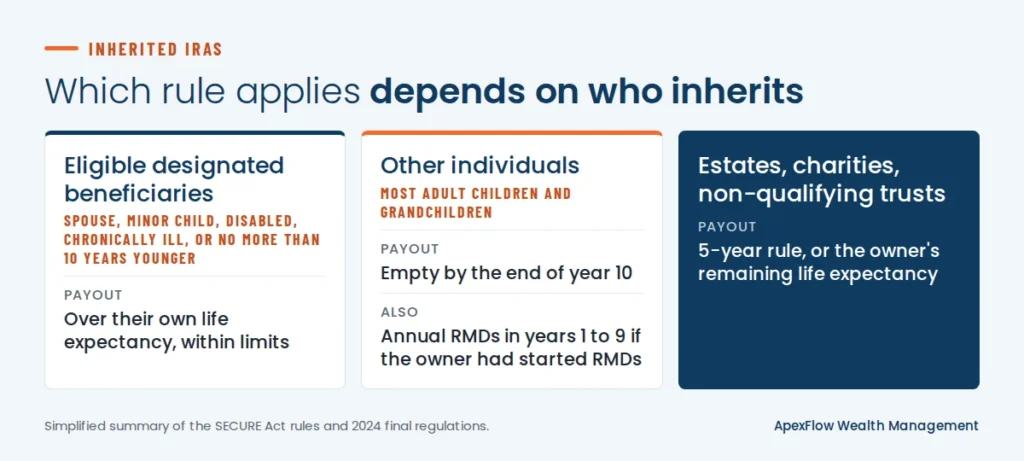
The SECURE Act sorts beneficiaries into three groups, and your status is fixed as of the date of death.
Eligible designated beneficiaries. Five kinds of people can still take withdrawals over their own life expectancy:
- The surviving spouse.
- A minor child of the account owner, until the child turns 21. Grandchildren and other minors do not qualify. At 21 the ten-year clock starts, so the account must be empty by the end of the year the child turns 31.
- A beneficiary who is disabled.
- A beneficiary who is chronically ill.
- Any individual not more than ten years younger than the owner, such as a sibling close in age.
When an eligible designated beneficiary dies, the person who inherits from them generally has ten years to finish emptying the account.
Designated beneficiaries. Any other individual named on the beneficiary form: most adult children, grandchildren, nieces, nephews and friends. They follow the ten-year rule.
Non-designated beneficiaries. An estate, a charity, or a trust that does not qualify as a see-through trust. These follow the rules that existed before 2020. If the owner died before their required beginning date, the account must be emptied by the end of the fifth year after death. If the owner died on or after that date, withdrawals can be spread over what would have been the owner’s remaining life expectancy.
How the inherited IRA 10-year rule works
The account must be fully distributed by December 31 of the tenth year after the year of death. For a death in 2026, that deadline is December 31, 2036.
The years in between depend on one fact: had the owner reached their required beginning date? That date is April 1 of the year after the owner reaches RMD age, which is 73 for those born 1951 through 1959 and 75 for those born in 1960 or later.
- Owner died before the required beginning date. No withdrawals are required in years one through nine. Any pattern works, as long as the account is empty by the end of year ten.
- Owner died on or after the required beginning date. The beneficiary must take a required minimum distribution every year from year one through year nine, generally based on their own life expectancy from the IRS single life table, and then withdraw the rest in year ten.
The annual requirement surprised beneficiaries when it was proposed in 2022, and the IRS waived the penalty for missed annual distributions in 2021 through 2024 (Notices 2022-53, 2023-54 and 2024-35). The final regulations apply from 2025, so 2026 is the second year of enforcement. The waiver did not move the ten-year deadline. A missed distribution now carries a 25 percent excise tax on the shortfall, reduced to 10 percent if corrected within two years.
The year-of-death distribution. If the owner died on or after their required beginning date without taking that year’s full RMD, the beneficiary must take whatever remains, figured as if the owner had lived the whole year. Ask the custodian how much the owner had already withdrawn. If that amount is missed, the IRS generally waives the penalty when the beneficiary takes it promptly, by their tax filing deadline for that year, so it pays to ask early.
Options for a surviving spouse
A spouse who is the sole beneficiary has the most flexibility.
- Treat the IRA as your own, or roll it into your own IRA. Future RMDs follow your age and the Uniform Lifetime Table, and you name your own beneficiaries. The trade-off: withdrawals before 59½ lose the death exception and can face the 10 percent additional tax.
- Remain a beneficiary with an inherited IRA. Withdrawals at any age avoid the 10 percent additional tax, and if your spouse died before their required beginning date, distributions can wait until the year your spouse would have reached RMD age. A spouse under 59½ can keep the inherited IRA for access and roll it into their own IRA later.
- For 401(k)s and other employer plans, elect to be treated as the deceased employee. SECURE 2.0 added this election starting in 2024. Distributions can wait until your spouse would have reached RMD age and are then figured on the Uniform Lifetime Table at your own age. The IRS has proposed but not finalized detailed rules, so confirm how your plan handles it.
If you have recently lost a spouse, our financial checklist after losing a spouse covers the rest of the first year.
Inherited Roth IRAs
Roth IRA owners never have lifetime RMDs, so the IRS treats every Roth owner as having died before the required beginning date. A beneficiary under the ten-year rule therefore has no annual withdrawals, only the year-ten deadline. Withdrawals are tax-free once the five-year holding period is met, counted from January 1 of the year the original owner first funded any Roth IRA. Contributions always come out tax-free; earnings withdrawn before the five years are up can be taxable. With qualified withdrawals tax-free, there is no tax reason to take them early.
Moving the money: titling and transfers
A beneficiary other than a spouse cannot roll an inherited IRA into their own IRA or use a 60-day rollover. If the custodian pays the money to you, it is a taxable distribution and cannot go back into any IRA. The move must be a trustee-to-trustee transfer into an inherited IRA titled in the deceased owner’s name for your benefit, for example “Robert Jensen, deceased, IRA FBO Emily Jensen, beneficiary.” From a 401(k), the equivalent is a direct rollover to an inherited IRA.
When several siblings share one account, splitting it into separate inherited IRAs lets each set their own withdrawal pace and investments. Name your own beneficiary on the inherited account too.
When a trust is the beneficiary
A trust is not an individual, but if it qualifies as a see-through trust (broadly, valid under state law, irrevocable at death and with identifiable beneficiaries, plus some paperwork rules), the IRS looks through it to the people it benefits.
Conduit trusts pass each withdrawal out to the beneficiary. They are easy to administer, but under the ten-year rule the entire account reaches the beneficiary within ten years, so the protection a parent intended may end sooner than expected.
Accumulation trusts let the trustee keep withdrawals inside the trust, which can protect a young beneficiary, one with special needs, or one facing creditors or divorce. The cost is tax: for 2026, income kept in a trust reaches the top 37 percent federal bracket above $16,000 of taxable income.
Many trusts drafted before 2020 assumed a lifetime stretch that no longer exists for most heirs, and they are worth reviewing with the drafting attorney.
Planning the tax over ten years
Every dollar withdrawn from an inherited traditional IRA is ordinary income in the year you take it. Utah taxes it at the flat 4.45 percent rate for 2026, and state tax follows where the beneficiary lives, not where the owner lived. There is no 10 percent early-withdrawal penalty for a beneficiary at any age. Your CPA should confirm how these rules apply to your return.
Spread the income and fill brackets. Waiting until year ten can push most of a large account into the top brackets in one year. For 2026, the 22 percent federal bracket ends at $211,400 of taxable income for joint filers and $105,700 for single filers, and a beneficiary can check each year how much room remains before the next bracket.
Coordinate with your own income. A year with a sabbatical, a business loss, early retirement or a gap between jobs is a natural year for a larger withdrawal. A year with a large bonus or stock vesting is not.
Mind the Medicare lookback. Inherited withdrawals taken at 63 or older can raise Medicare Part B and D costs two years later. For 2026, the surcharge starts above $109,000 of modified adjusted gross income on a single return and $218,000 on a joint one, and the 2027 figures are usually announced in November.
Give through QCDs at 70½ or older. A beneficiary who has reached 70½ can make qualified charitable distributions from an inherited IRA, counting toward the inherited RMD, within the same $111,000 per-person limit for 2026 that covers their own IRAs. Our article on qualified charitable distributions covers the mechanics.
Hypothetical example: Megan, 54, a nurse in Sandy, inherits a $600,000 traditional IRA from her father in St. George, who died in 2025 at 81. Because he had passed his required beginning date, she must take an annual RMD starting in 2026 and empty the account by the end of 2035. Her salary already fills most of the 22 percent bracket, so while she works she takes the required minimum plus a modest extra amount each year. When she retires at 60, she plans larger withdrawals that keep each year’s total income below the top of the 24 percent bracket, so the account is close to empty before 2035 and there is no single large final year. The figures are hypothetical and do not represent any client.
For IRA owners: choosing beneficiaries with these rules in mind
- Name primary and contingent beneficiaries on every account. An estate as beneficiary means probate and the older five-year or life expectancy rules.
- Consider which heir receives which kind of money. Traditional IRA dollars cost a high-earning child more in tax than a retired sibling or a charity, while Roth accounts pass tax-free.
- Roth conversions in your own lower-income years shift tax to you at your rates. Our article on Roth conversions before RMDs explains the window.
- If a trust is the beneficiary, make sure it was drafted with the ten-year rule in mind.
- Tell your heirs where the accounts are and that a ten-year clock comes with them. Our guide to talking with adult children about inheritance offers a format.
Beneficiary forms override a will, so review them after a marriage, divorce, death or move. When a client inherits an account, we lay out a ten-year withdrawal schedule against their own income and coordinate it with their CPA. For owners, beneficiary choices are part of the work on our estate planning page, revisited in the Adjust with Intention step as families change.
Frequently asked questions
It depends on the owner. If the owner had reached their required beginning date, most beneficiaries under the ten-year rule must take an RMD in years one through nine. If the owner died before that date, or the account is a Roth IRA, no annual withdrawals are required, but the account must still be empty by the end of year ten.
Only a surviving spouse can. Other beneficiaries must keep the money in an inherited IRA, moved by trustee-to-trustee transfer, and a check made out to you cannot be redeposited.
No. Distributions to a beneficiary after the owner’s death are exempt at any age. A spouse who treats the account as their own gives up that exception for withdrawals before 59½.
If the first beneficiary was an eligible designated beneficiary using life expectancy payments, you generally have ten years from their death to empty it. If the first beneficiary was already under the ten-year rule, the original deadline generally still applies.
Free one-page checklist
Required minimum distributions: a planning checklist for 2026. Start dates, deadlines and the ways to reduce the tax, on one printable page.
Talk it through with us
Every situation is a little different. If you want to talk through yours, book a 20-Minute Fit Call with one of our advisors, by video or in person. No prep and no obligation. Want to see how we work first? Start with the Purposeful Planning Process or our services.

The information in this article is general in nature and is not a recommendation for any individual. Consider your own circumstances or speak with an advisor before acting on it. Any opinions are those of the author and not necessarily those of Raymond James.
ApexFlow Wealth Management does not provide tax or legal advice. Please consult your tax or legal professional before acting on any strategy mentioned here.
Investing involves risk, and you may incur a profit or loss regardless of the strategy selected, including diversification and asset allocation. Past performance does not guarantee future results.
Examples labeled as hypothetical are for illustration only. They are not based on any actual client and do not represent actual or expected results.
Related Articles
Dig deeper into our resource library
-
 October 29, 2026
A Financial Checklist After Losing a Spouse: The First Year, Step by Step
After a spouse dies, only a few financial tasks are urgent and most can wait. A calm, time-ordered checklist for the first two weeks, the first 90 days and the first year, with Utah specifics.Read more -
 October 29, 2026
Charitable Giving From an IRA: Qualified Charitable Distributions Explained
If you are over 70½, give to charity and have an IRA, a qualified charitable distribution is usually the cheapest way to give. Here is how it works, the 2026 limits and the mistakes to avoid.Read more -
 October 29, 2026
Required Minimum Distributions: The 2026 Rules and How to Reduce Them
RMDs start at 73 for most retirees today and 75 for younger ones. Here are the 2026 rules, the penalties, and the five ways to shrink the tax bill they create.Read more