
If August felt like a lot to keep up with, you weren’t imagining it. Trade tensions with Canada turned into new tariffs, the bond market wrestled with a gap between fiscal policy and the Federal Reserve, and pressure built again around Iran. Beneath the noise, earnings kept growing and Treasury yields moved lower. In this August 2026 market update, we look at the shift in market leadership and why fundamentals are still winning.

Key takeaways
- Growth stocks tied to the AI buildout consolidated, while health care, materials and energy took the lead.
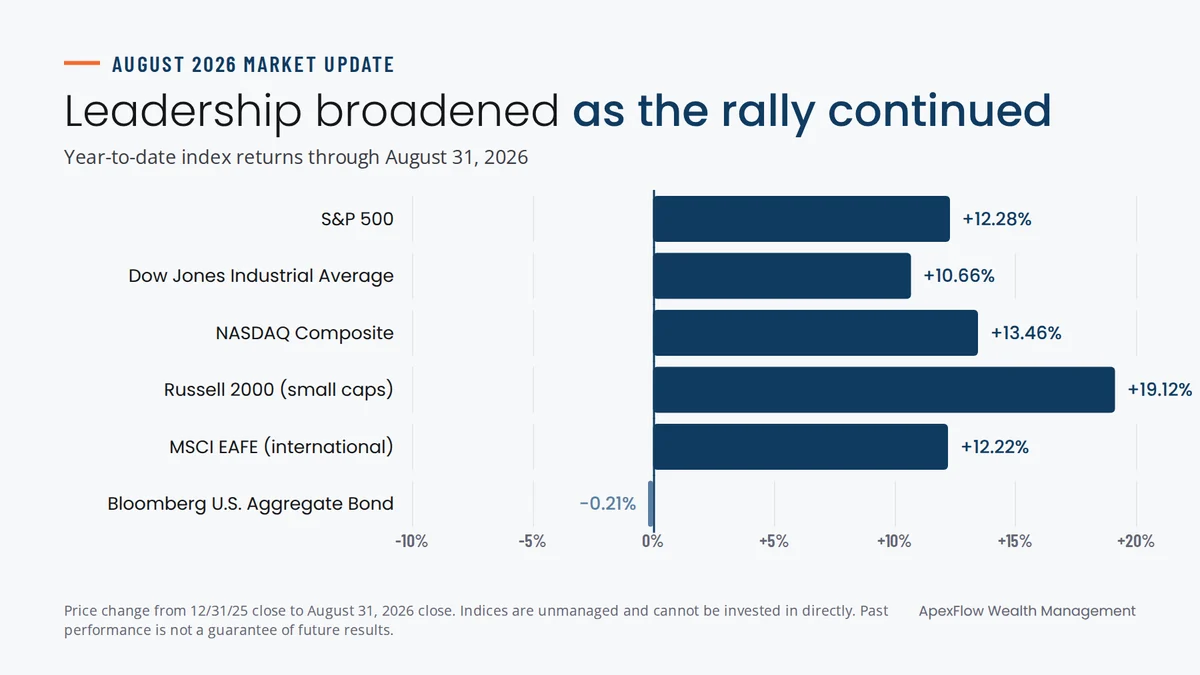
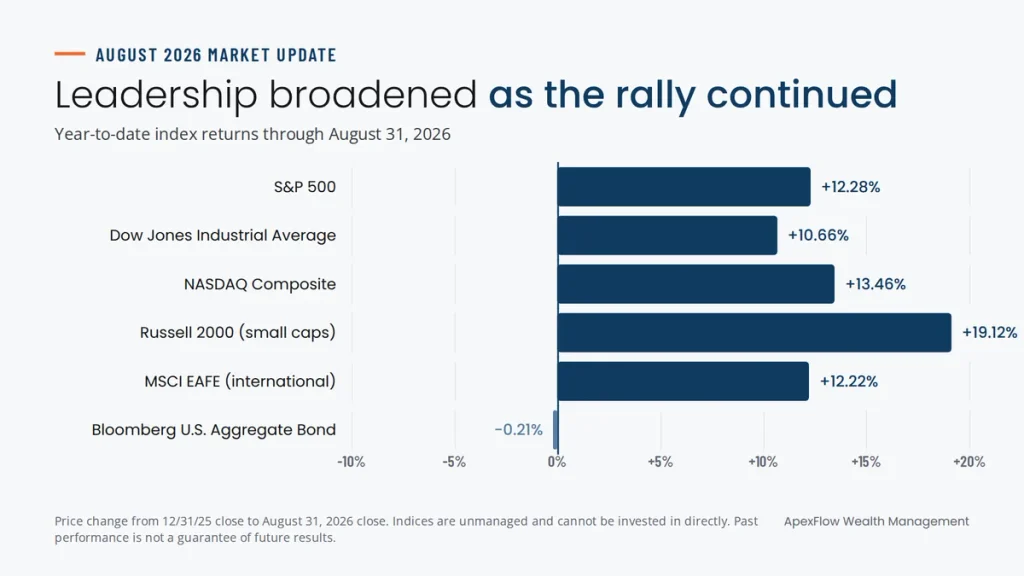
- Earnings kept growing at a double-digit pace, and the S&P 500 was up 12.28% for the year through August.
- Treasury yields moved lower, led by longer-term bonds.
- The labor market lost jobs for the first time since February, and a new 50% tariff hit $20 billion of Canadian goods.
Equities push past the noise
After a long run at the front of the pack, growth-oriented stocks, many tied to AI, began to consolidate as investors grew more selective about valuations and spending. Value-oriented sectors like health care, materials and energy stepped forward.
That broadening has been building all year. Small-cap stocks led the way, with the Russell 2000 up 19.12% year to date, and international stocks in the MSCI EAFE were up 12.22%. When gains come from more places than a handful of familiar names, that’s usually a healthier sign, not a warning.
Year-to-date index returns
| Index | 12/31/25 close | 8/31/26 close | Year-to-date change |
|---|---|---|---|
| Dow Jones Industrial Average | 48,063.29 | 53,185.90 | 10.66% |
| NASDAQ Composite | 23,241.99 | 26,370.89 | 13.46% |
| S&P 500 | 6,845.50 | 7,686.14 | 12.28% |
| MSCI EAFE | 2,892.71 | 3,246.34 | 12.22% |
| Russell 2000 | 2,481.91 | 2,956.45 | 19.12% |
| Bloomberg U.S. Aggregate Bond | 2,348.85 | 2,343.86 | -0.21% |
Performance reflects index values as of market close on August 31, 2026.
The headlines behind the numbers
A new trade fight with Canada. Talks between the U.S. and Canada collapsed, prompting a new 50% tariff on $20 billion of Canadian goods, including alcohol, lumber, dairy and textiles. Canada announced retaliatory tariffs of its own.
Bond buybacks and yields. The administration’s plan to double buybacks of long-term bonds hints at bringing long rates down, even as the clash between fiscal and monetary policy adds another source of volatility. More than three years into an elevated rate environment, bonds continue to provide income and diversification.
Pressure returns on Iran. Military action remains part of the backdrop, but the U.S. is leaning more on economic pressure. Iran has proven resilient to that approach before.
AI booms abroad. Economies tied to semiconductors and electronics remain big beneficiaries of the AI buildout. Korea and Taiwan grew, while Malaysia and Vietnam grew even faster.

The tug of war: fiscal policy vs. the Fed
On one side, plenty of noise: a new trade dispute, renewed pressure on Iran and a widening gap between fiscal policy and the Fed. On the other, fundamentals held their ground. Earnings kept growing, consumers stayed resilient and the economy kept expanding at a sustainable pace, even as job growth cooled and consumer sentiment softened. For now, the fundamentals are winning.
What it means for your plan
We heard from a number of you this month, and the questions were fair ones: should we be doing something differently? Should we wait this out? Months like August are exactly why we don’t build plans around predicting headlines. Trade disputes, Fed policy and geopolitics can move markets in the short term, but they rarely change the trajectory of a well-built plan. If you felt a flicker of worry, you’re not alone, and it doesn’t mean anything is wrong with your plan. We explain why losses and scary headlines feel so heavy in Loss Aversion: Why Market Downturns Feel Worse Than They Are.

Talk it through with us
If any of this has been on your mind, even as a passing thought while scrolling the news, we’d love to hear from you. Book a 20-minute Fit Call. It’s virtual, no prep is needed and there’s no obligation.
With clarity and confidence,
Any opinions are those of ApexFlow Wealth Management and not necessarily those of Raymond James. Expressions of opinion are as of this date and are subject to change without notice. Raymond James and its advisors do not offer tax or legal advice. You should discuss any tax or legal matters with the appropriate professional. Investing involves risk and you may incur a profit or loss regardless of strategy selected, including diversification and asset allocation. Prior to making an investment decision, please consult with your financial advisor about your individual situation. The indices shown are unmanaged and cannot be invested in directly. Index returns do not reflect fees or expenses. Past performance is not a guarantee of future results.