
July showed that loud headlines and steady fundamentals can show up in the same month. Tensions between the U.S. and Iran pushed energy prices higher, tariffs grabbed attention and the tech stocks that carried the market for over a year finally cooled. Beneath the noise, earnings kept growing and other sectors stepped up. In this July 2026 market update, we look at what changed and what didn’t.

Key takeaways
- The Nasdaq fell 3.2% in July and the Russell 2000 slipped 3.1%, while the S&P 500 dipped just 0.1% and the Dow gained 0.3%.
- Health care, industrials and financials strengthened as tech took a breather.
- Earnings kept growing at a double-digit pace, and inflation eased slightly.
- New tariffs and rising oil pushed Treasury yields 16 to 20 basis points higher.
Tech takes a breather
After leading gains since March, AI-driven technology stocks cooled as investors grew more cautious about steep valuations and heavy capital spending. Not every corner of the market moved the same way. Health care, industrials and financials all picked up strength, helping keep the broader market on solid footing.
As Raymond James Chief Investment Officer Larry Adam put it, “While macro events can drive short-term sentiment, growth, earnings and fundamentals ultimately drive long-term returns. The encouraging news is that earnings continue to grow at a double-digit pace, extending a remarkable streak of corporate profit growth, while the US economy remains resilient.”
A slower month for tech doesn’t mean a slower month for the market. When gains come from more places than a handful of mega-cap names, that’s usually a healthier sign, not a warning.
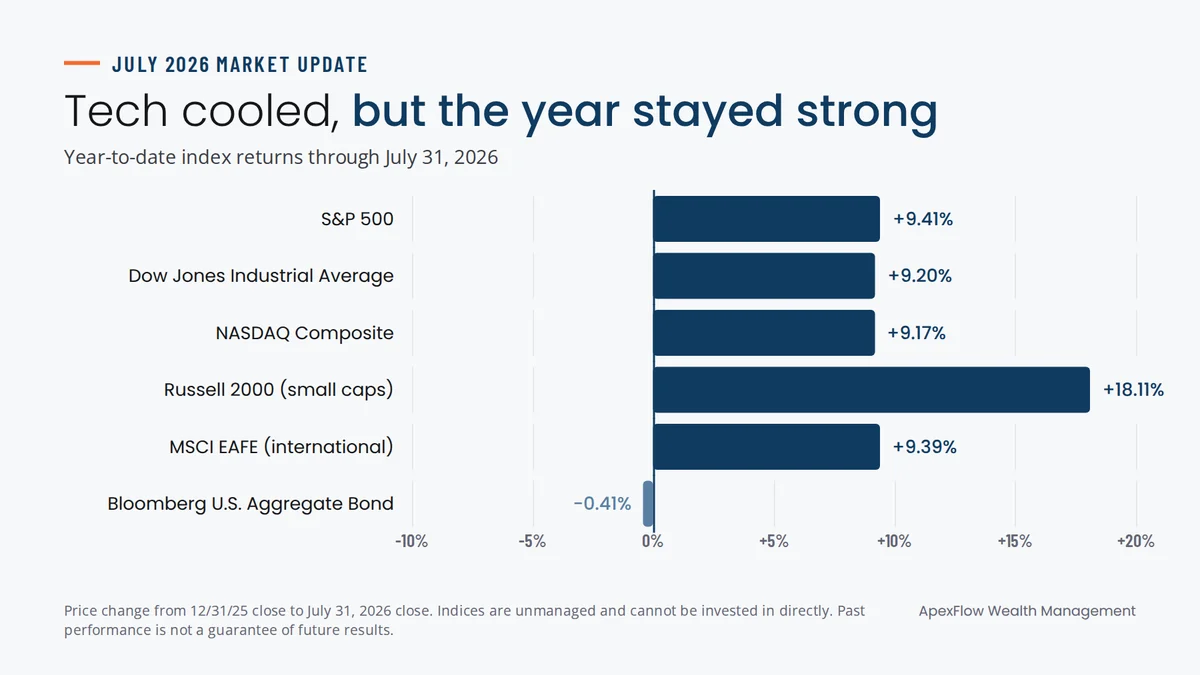
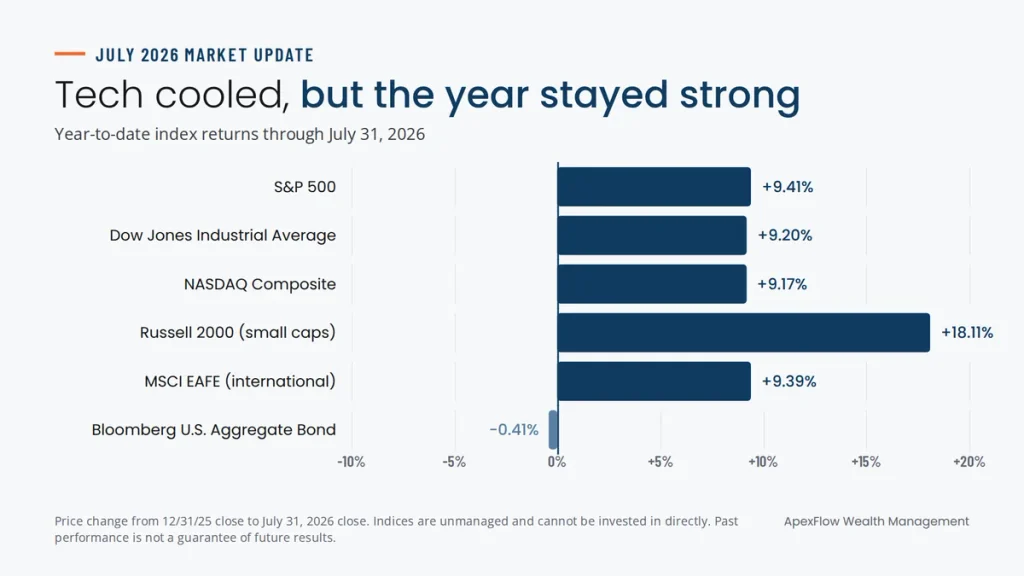
Year-to-date index returns
| Index | 12/31/25 close | 7/31/26 close | Year-to-date change |
|---|---|---|---|
| Dow Jones Industrial Average | 48,063.29 | 52,485.03 | 9.20% |
| NASDAQ Composite | 23,241.99 | 25,373.85 | 9.17% |
| S&P 500 | 6,845.50 | 7,489.72 | 9.41% |
| MSCI EAFE | 2,892.71 | 3,164.43 | 9.39% |
| Russell 2000 | 2,481.91 | 2,931.30 | 18.11% |
| Bloomberg U.S. Aggregate Bond | 2,348.85 | 2,339.24 | -0.41% |
Performance reflects index values as of market close on July 31, 2026.
Trade policy and rising yields
The administration announced new 50% tariffs on a targeted list of Canadian goods, tied to disputes over autos, dairy and alcohol. Separately, new labor-related tariffs took effect on imports from about 60 countries, replacing an earlier tariff structure the Supreme Court had struck down.
Treasury yields rose alongside these developments, following oil prices higher as Middle East tensions intensified. Yields across most of the curve ended July 16 to 20 basis points above where the month began.

Commodities and sentiment under pressure
Russia’s war with Ukraine is now in its fifth year, and Ukrainian drone strikes on Russian energy infrastructure and cargo ships are disrupting Russia’s refining capacity. That’s straining fuel, agricultural and fertilizer supplies, with risks for food supplies in parts of the Middle East and Africa. Consumer sentiment came in a little better than expected but stayed close to record lows.
Noise vs. fundamentals
July pulled investors in two directions. On one side: geopolitical tension, new tariffs and a Fed that held rates steady while three members pushed for a hike, with Chair Kevin Warsh not ruling much out. On the other: steady unemployment, slightly lower inflation, resilient consumer spending, modest improvement in housing and double-digit earnings growth. For now, the fundamentals are winning.
What it means for your plan
Geopolitical events and Fed decisions can move markets in the short term, but they rarely change the trajectory of a well-built plan. Tariffs, energy and Fed communication deserve attention where they touch specific parts of a portfolio. Reacting to every headline is usually where good decisions go sideways. If the pullback in tech stocks hit close to home, How to Diversify a Concentrated Stock Position is a good next read.

Talk it through with us
If the headlines have you second-guessing your plan, that’s exactly the kind of conversation we’re here for. Book a 20-minute Fit Call. It’s virtual, no prep is needed and there’s no obligation.
With clarity and confidence,

Any opinions are those of ApexFlow Wealth Management and not necessarily those of Raymond James. Expressions of opinion are as of this date and are subject to change without notice. Raymond James and its advisors do not offer tax or legal advice. You should discuss any tax or legal matters with the appropriate professional. Investing involves risk and you may incur a profit or loss regardless of strategy selected, including diversification and asset allocation. Prior to making an investment decision, please consult with your financial advisor about your individual situation. The indices shown are unmanaged and cannot be invested in directly. Index returns do not reflect fees or expenses. Past performance is not a guarantee of future results.