
At a glance
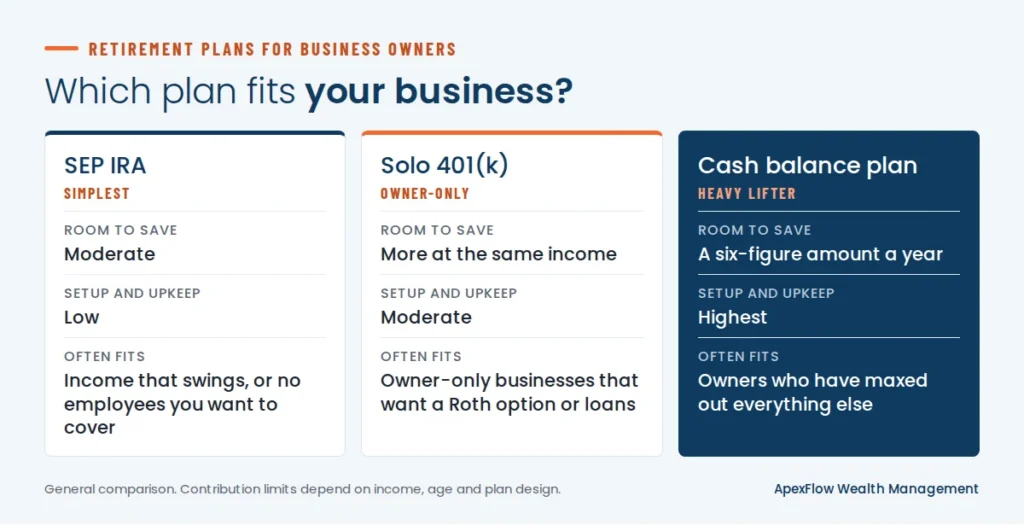
- A SEP IRA is the simplest plan and works well when your income swings or you have no employees you want to cover.
- A Solo 401(k) lets an owner-only business put away more at the same income, and adds a Roth option and loans.
- A cash balance plan is for owners who have maxed out everything else and want to shelter a six-figure amount per year for several years.
- The right plan depends on your age, your profit, whether you have employees and how steady your cash flow is.
- You can change plans as your business grows. The mistake is waiting.
Most Utah business owners we meet are saving for retirement in one of two ways: a SEP IRA their CPA set up years ago, or nothing at all because the business is the retirement plan. Both can work. Both can also leave a lot of tax savings on the table. Three plans do most of the work for owners, and choosing between them comes down to profit, payroll and patience.
Two scoresIs the business ready to be sold? Are you ready to leave it?Check my exit readinessThe SEP IRA: simple, flexible, limited
A Simplified Employee Pension lets the business contribute up to 25 percent of compensation for each eligible employee, including you, up to an annual cap. For 2026 that cap is $72,000, and the compensation that counts is capped at $360,000. There is no employee deferral; every dollar is an employer contribution.
What owners like about it: setup takes an afternoon, there is no annual filing, and you decide each year whether to contribute at all. A slow year can be a zero year.
What catches owners off guard: the percentage you give yourself must be the same percentage you give every eligible employee. If you have three staff and want to put 20 percent of your own pay away, you are putting 20 percent of their pay away too. For a solo consultant that is irrelevant. For a shop with a payroll it changes the math quickly.
The Solo 401(k): more room at the same income
A Solo 401(k), sometimes called an individual 401(k), is for a business with no employees other than the owner and a spouse. It lets you contribute two ways. As the employee, you can defer up to $24,500 for 2026, plus a catch-up of $8,000 if you are 50 or older (a higher catch-up applies at ages 60 through 63). As the employer, the business can add up to 25 percent of compensation. The combined total is capped at $72,000 for 2026 before catch-ups.
Because of the employee deferral, a Solo 401(k) nearly always beats a SEP at the same income level. A hypothetical owner paying herself $100,000 could put roughly $25,000 into a SEP. In a Solo 401(k) she could defer $24,500 as the employee and add about $25,000 as the employer, close to double.
Other advantages: a Roth option for the deferral portion, the ability to borrow from the plan, and a way to add a spouse who works in the business. The trade-offs are a little more paperwork and an annual Form 5500-EZ once the plan passes $250,000 in assets. Hire a full-time employee and the plan has to open to them, which is when many owners move to a standard 401(k).
The cash balance plan: the heavy lifter
A cash balance plan is a type of defined benefit plan. Instead of a contribution limit, it has a benefit target, and an actuary calculates how much the business must contribute each year to fund it. For owners in their 50s and 60s with strong, steady profits, the required contribution can run well into six figures per year, on top of a 401(k).
For a high-income owner a decade from exit, that means moving a large share of profit out of this year’s tax bill and into a retirement account. We often see it paired with a 401(k) so the owner gets both.
The costs are real. Contributions are required each year, not optional, so you need predictable cash flow. You will pay for an actuary and annual administration. Employees must generally be included, and the plan has to pass nondiscrimination testing. It is a commitment of several years, not a one-off.
Hypothetical example: An orthodontist in Sandy, age 56, nets about $600,000 a year from her practice and has three staff. She already funds a 401(k) with a safe harbor match. Adding a cash balance plan lets her business contribute an additional six-figure amount for her benefit each year for the next eight years, with required contributions for staff that are modest by comparison. Her CPA models the federal and Utah tax savings against the plan’s administration cost before she commits. The figures are illustrative only and will differ for every business.
How we help a client choose
The choice usually comes down to four questions, and they are the same questions we ask in step two of our process, Take Inventory.
- How much profit is reliably available after you pay yourself what you need?
- Do you have employees, and do you want to cover them as a retention tool or keep it owner-only?
- How many years until you plan to sell or step back? A cash balance plan wants a runway.
- How much do you value flexibility? A SEP can be skipped in a bad year. A cash balance plan cannot.
A common path looks like this: SEP in the early years, Solo 401(k) once income is steady, a standard 401(k) when the first employee arrives, and a cash balance plan layered on top in the final high-earning decade. Nobody has to start at the end.
Deadlines matter
A Solo 401(k) must generally be established by the end of the tax year to make employee deferrals for that year, though recent law changes allow a sole proprietor some extra time for the first year. A SEP can be opened and funded up to your tax filing deadline, including extensions. A cash balance plan needs to be adopted before year-end and funded by the time the return is filed. If you are reading this in the fourth quarter, call your CPA and your advisor now, not in March.
One piece of a bigger plan
A retirement plan is one piece of the business owner planning we do. It sits alongside the buy-sell agreement, the cash reserve, the exit plan and the question of what you will actually do with your time when the business is no longer yours. Our article on retirement savings for business owners covers the habits that make any of these plans work.
Frequently asked questions
You can, but the combined employer contributions share the same annual limit, so there is rarely a reason to. Most owners pick one. Switching from a SEP to a Solo 401(k) for the next year is common and easy to do.
No. It is designed for a business with no employees other than the owner and a spouse. If you later hire a full-time employee who meets the eligibility rules, the plan must cover them, which usually means converting to a standard 401(k).
No. It fits any owner with steady profit and a desire to put away far more than a 401(k) allows, including contractors, consultants, dealership owners and farm operations with strong years. The key is predictable cash flow, because contributions are required.
Contributions to any of these plans reduce the income Utah taxes at its flat rate, which is 4.45 percent for 2026. The federal savings are usually larger, but the state savings are not trivial on a six-figure contribution. Your CPA can model both.
Free one-page checklist
Business owner continuity checklist. Agreements, authority, risk and your own plan, on one printable page.
Talk it through with us
Every situation is a little different. If you want to talk through yours, book a 20-Minute Fit Call with one of our advisors, by video or in person. No prep and no obligation. Want to see how we work first? Start with the Purposeful Planning Process or our services.

The information in this article is general in nature and is not a recommendation for any individual. Consider your own circumstances or speak with an advisor before acting on it. Any opinions are those of the author and not necessarily those of Raymond James.
ApexFlow Wealth Management does not provide tax or legal advice. Please consult your tax or legal professional before acting on any strategy mentioned here.
Examples labeled as hypothetical are for illustration only. They are not based on any actual client and do not represent actual or expected results.
Related Articles
Dig deeper into our resource library
-
 October 29, 2026
Selling a Business in Utah: What to Do Two or Three Years Before the Sale
The years before a sale decide how much of the price you keep. What Utah owners can do two or three years out on value, deal structure, taxes, QSBS, and family and charitable gifts.Read more -
 October 29, 2026
Farm and Ranch Succession Planning in Utah
Passing a Utah farm or ranch to the next generation is a land problem, a tax problem and a family problem at once. Here is how to work through all three without splitting the ground.Read more -
 November 5, 2026
Retirement Savings by Age: Why Business Owners Need a Different Yardstick
One of the most common questions people quietly carry is simple: “Am I on track for retirement?” For business owners, the usual answers rarely fit.Read more