
At a glance
- Most Utah farm and ranch wealth sits in land, which is hard to divide and harder to sell without ending the operation.
- “Fair” and “equal” are different goals. Deciding which one you mean is the first real step.
- Separating the land from the operating business, then treating each differently, solves more problems than any single tax trick.
- Water rights, greenbelt assessment and federal estate tax rules each have Utah-specific details worth checking.
- The conversation with your kids is the hardest part and the one that saves the family.
Utah agriculture is overwhelmingly family-owned, and the average operator is well into their 60s. That means a large share of the state’s farm and ranch land will change hands over the next fifteen years, much of it without a written plan. We work with families in the Salt Lake Valley, the Wasatch Back and central Utah on exactly this, and the pattern is consistent: the land is worth far more than the operation earns, one child wants to farm, the others do not, and nobody has said any of this out loud.
Two scoresIs the business ready to be sold? Are you ready to leave it?Check my exit readinessStart with the two questions that decide everything
First: do you want the operation to continue as a working farm or ranch? Some families do. Others are ready for the next generation to inherit value rather than chores. Neither answer is wrong, but the plan is completely different.
Second: do you want to treat your children equally or fairly? Equal means each child gets the same dollar value. Fair acknowledges that the child who has worked the place for twenty years at below-market wages has already contributed, and that handing a working ranch to four siblings in equal shares usually ends with the ranch being sold. Most families land on fair, with a clear explanation. That explanation is what keeps Thanksgiving intact.
Separate the land from the business
The most useful structural move we see is splitting the operation into two pieces.
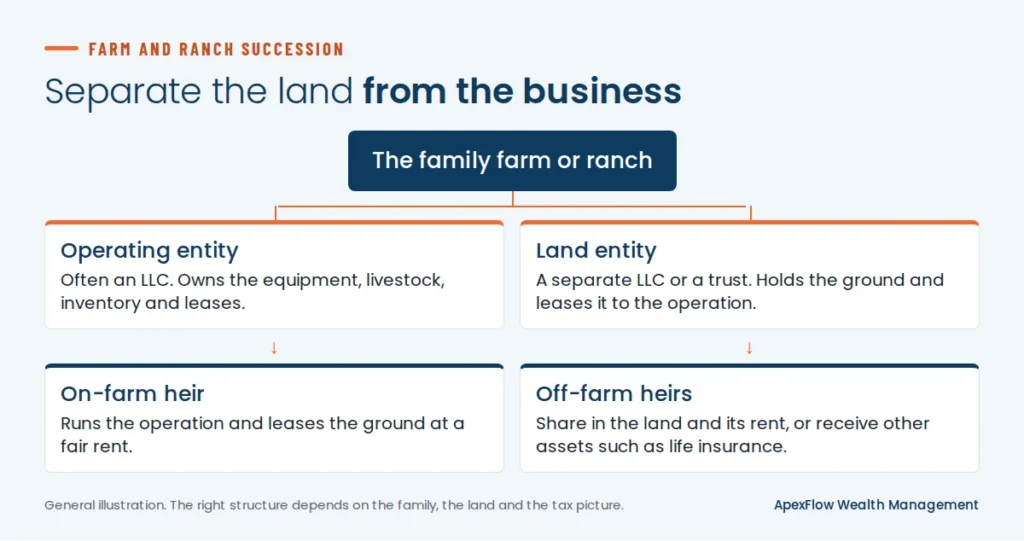
The operating entity, often an LLC, owns the equipment, livestock, inventory and leases. It is what the on-farm heir will run. It can transfer gradually through gifts or a sale over time, and it can be valued on earnings rather than land prices.
The land entity, a separate LLC or a trust, holds the ground and leases it to the operation at a fair rent. Off-farm heirs can inherit shares of the land entity and receive rent without any say in daily operations. A right of first refusal and a buyout formula in the operating agreement keep the land available to the farmer and give siblings a path to cash if they want out.
This structure also lets you give the on-farm heir control without giving them all the value, which is often the compromise that makes a plan feel fair to everyone.
Hypothetical example: A Sanpete County cattle operation is owned by parents in their late 60s. One son runs it; two daughters live along the Wasatch Front. The parents move the land into a family LLC, leave a majority of the LLC to the daughters and a minority plus the full operating company to the son, and sign a 25-year lease between the two. The son’s operating company holds a right of first refusal on the land. A life insurance policy on the parents, owned by a trust, gives the daughters liquidity so the son is not pressured to buy them out at the worst time. The details are illustrative only and every family’s numbers differ.
Utah-specific details worth checking
Greenbelt assessment. Utah’s Farmland Assessment Act taxes qualifying agricultural land on its productive value, not its market value. A change in ownership or use can trigger a rollback tax covering up to five prior years. Transfers to a family entity usually preserve greenbelt if the land stays in production, but the paperwork with the county assessor has to be done.
Water rights. In Utah, water rights are property that can be separated from the land. Make sure the deed, the water right records at the Division of Water Rights and your entity documents all agree on who owns what. Families have lost water through an oversight in a transfer.
Federal estate tax. With the exemption at $15 million per person for 2026, most Utah farm families will not owe federal estate tax, but land values along the Wasatch Front and Back have pushed some over the line. Special-use valuation under Section 2032A and the installment payment rules under Section 6166 exist for exactly this situation. Utah has no state estate tax.
Step-up in basis. Land inherited at death gets a new cost basis equal to its value at that date. Land gifted during life carries the parents’ old basis. For ground bought decades ago, that difference is enormous if it is ever sold, which argues for holding appreciated land until death and gifting other assets or operating interests during life. This is a decision to make with your CPA.
Conservation easements and development pressure
For families near growing communities, a conservation easement can lower the taxable value of land, generate a charitable deduction and permanently keep the ground in agriculture. It is also permanent, and it reduces what your heirs could sell for. We treat it as a values decision first and a tax decision second.
The conversation
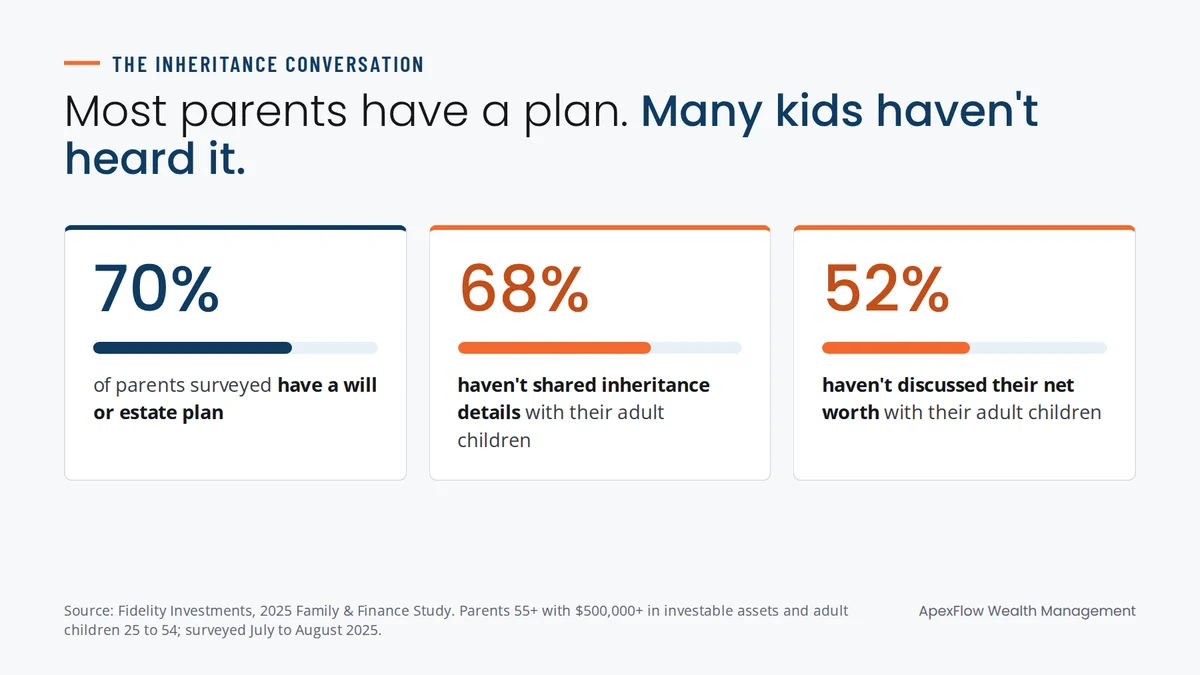
Every tool above fails if the family hears about the plan for the first time at a funeral. We encourage parents to hold a family meeting, often with us or the attorney in the room, where the plan and the reasoning are explained. The on-farm heir learns what they are getting and what they owe. The off-farm heirs learn why fair is not equal and what their path to liquidity is. Our article on talking to adult children about inheritance has a format that works.
In our Purposeful Planning Process this is the first step, Define Your Why, and for farm families it is often the longest conversation. Farms are rarely just assets. Knowing what the land means to you tells us what the plan has to protect.
How we work with farm and ranch families
We coordinate with your estate attorney, CPA and often your lender. We help you take inventory of land, water, equipment, debt and insurance, build a cash flow picture for the operation and the retiring generation, and design the structure above. Our business planning page describes the process.
Frequently asked questions
A revocable trust avoids probate and is a good start, but it does not by itself solve fair-versus-equal, operating control or liquidity for off-farm heirs. Most farm plans pair a trust with an LLC structure and a lease.
Separate the land from the operation, give the on-farm child the operation and a path to buy or lease the land, and use life insurance or other assets to balance the inheritance for siblings. Then explain it to all of them while you are alive.
Usually not if the land remains in qualifying agricultural use and the assessor is notified properly. Confirm with your county assessor and attorney before any deed is recorded.
A buy-sell agreement and transfer restrictions in the entity documents can keep ownership within the bloodline through divorce or death of an heir. It is an uncomfortable topic and one of the most common reasons family land leaves the family.
Free one-page checklist
Business owner continuity checklist. Agreements, authority, risk and your own plan, on one printable page.
Talk it through with us
Every situation is a little different. If you want to talk through yours, book a 20-Minute Fit Call with one of our advisors, by video or in person. No prep and no obligation. Want to see how we work first? Start with the Purposeful Planning Process or our services.

The information in this article is general in nature and is not a recommendation for any individual. Consider your own circumstances or speak with an advisor before acting on it. Any opinions are those of the author and not necessarily those of Raymond James.
ApexFlow Wealth Management does not provide tax or legal advice. Please consult your tax or legal professional before acting on any strategy mentioned here.
Examples labeled as hypothetical are for illustration only. They are not based on any actual client and do not represent actual or expected results.
Related Articles
Dig deeper into our resource library
-
 October 29, 2026
Selling a Business in Utah: What to Do Two or Three Years Before the Sale
The years before a sale decide how much of the price you keep. What Utah owners can do two or three years out on value, deal structure, taxes, QSBS, and family and charitable gifts.Read more -
 October 29, 2026
What Happens to Your Business If You Die Without a Succession Plan (Utah Rules)
If a Utah business owner dies without a succession plan, state law and the operating agreement decide who owns the company next. Here is what actually happens, step by step, and how to prevent it.Read more -
 November 5, 2026
How to Talk to Your Adult Children About Inheritance
There’s a particular kind of silence that shows up around estate planning. Parents don’t want to talk about it because it means talking about theirRead more