
At a glance
- Without a plan, your ownership interest passes by your will, or by Utah’s intestacy statute if you have no will, and that process runs through probate.
- Your spouse may inherit the whole company, or share it with children from an earlier relationship, depending on family structure.
- In the weeks after a death, the real problem is usually authority: who can sign payroll, renew the line of credit and talk to customers.
- An LLC operating agreement or a corporate buy-sell agreement overrides most of this, which is why they matter more than the will.
- The fix is a short list: a signed agreement, a funded way to pay for it, powers of attorney and a one-page continuity memo.
Nearly every owner we meet has a succession plan in their head. Very few have one on paper. What actually happens in Utah when an owner dies without one is usually what finally gets people to act.
In practice, your business becomes an asset in your estate, and your estate is handled by whoever has legal authority, which may be nobody for a while. The company keeps needing decisions in the meantime.
Two scoresIs the business ready to be sold? Are you ready to leave it?Check my exit readinessStep one: your ownership interest becomes estate property
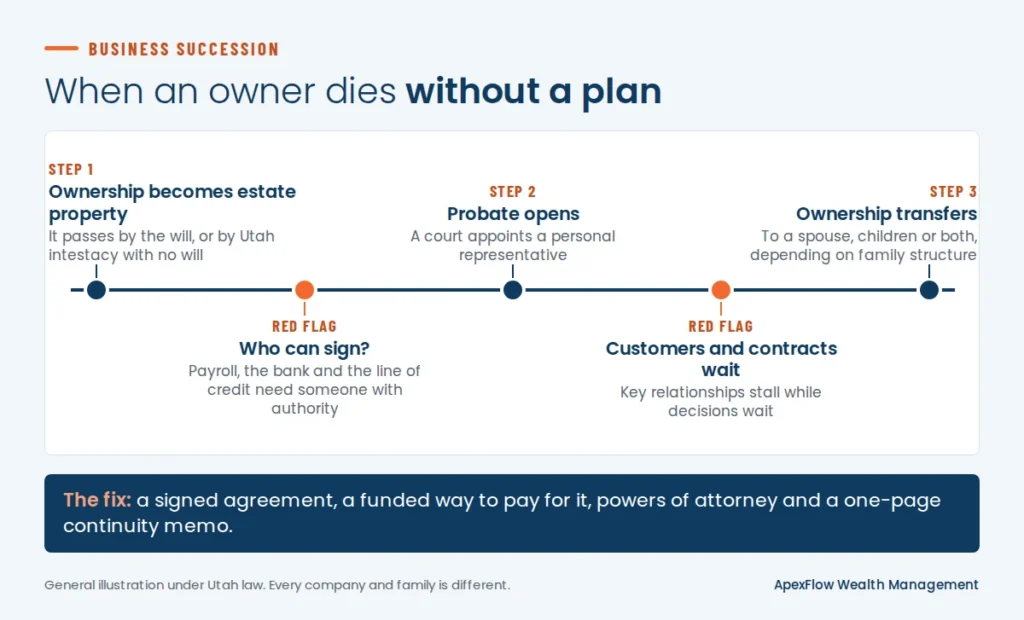
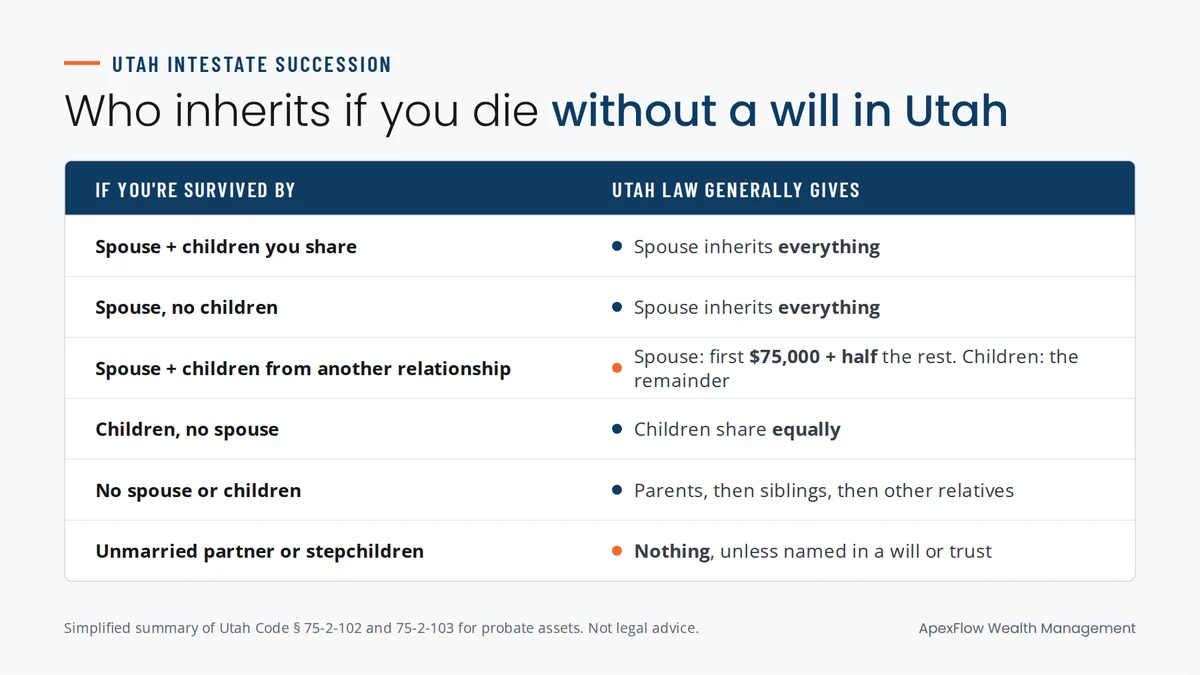
Whether you own shares in a corporation or a membership interest in an LLC, that interest is personal property. When you die, it passes the way your other property does. If you have a will, it goes to the person your will names. If you do not, Utah’s intestate succession rules decide.
Under Utah law, a surviving spouse inherits everything if you have no children, or if all of your children are also your spouse’s children. If you have children from another relationship, your spouse receives the first $75,000 of the probate estate plus half of the rest, and your other children split the remainder. That means a blended family can wake up with a business owned jointly by a stepparent and stepchildren who never planned to be partners. We wrote more about this in what happens if you die without a will in Utah.
Step two: probate, and the gap before it
Transferring a business interest through a will or intestacy requires probate in Utah unless the interest was held in a trust or passes by contract. Utah’s small estate affidavit can move assets under $100,000 without court involvement, but most operating businesses are worth more than that, and the affidavit cannot be used for real estate.
Probate itself is not the disaster people imagine. Utah’s informal probate is comparatively quick and inexpensive. The problem is the gap. Until the court appoints a personal representative, nobody has clear legal authority over your interest. Banks know this. So do landlords, key vendors and the state agencies that renew licenses.
Step three: the company keeps running, or does not
These are the things that tend to break in the first sixty days.
- The bank freezes or declines to renew a line of credit guaranteed by the owner personally.
- Payroll stalls if the owner was the only authorized signer.
- Customer contracts with a “key person” or change-of-control clause can be terminated.
- Professional licenses held in the owner’s name cannot be used by anyone else.
- Employees start looking, because nobody can tell them who is in charge.
None of these are legal defaults. They are the practical results of a company that depended on one signature.
What overrides all of this: the agreements you already control
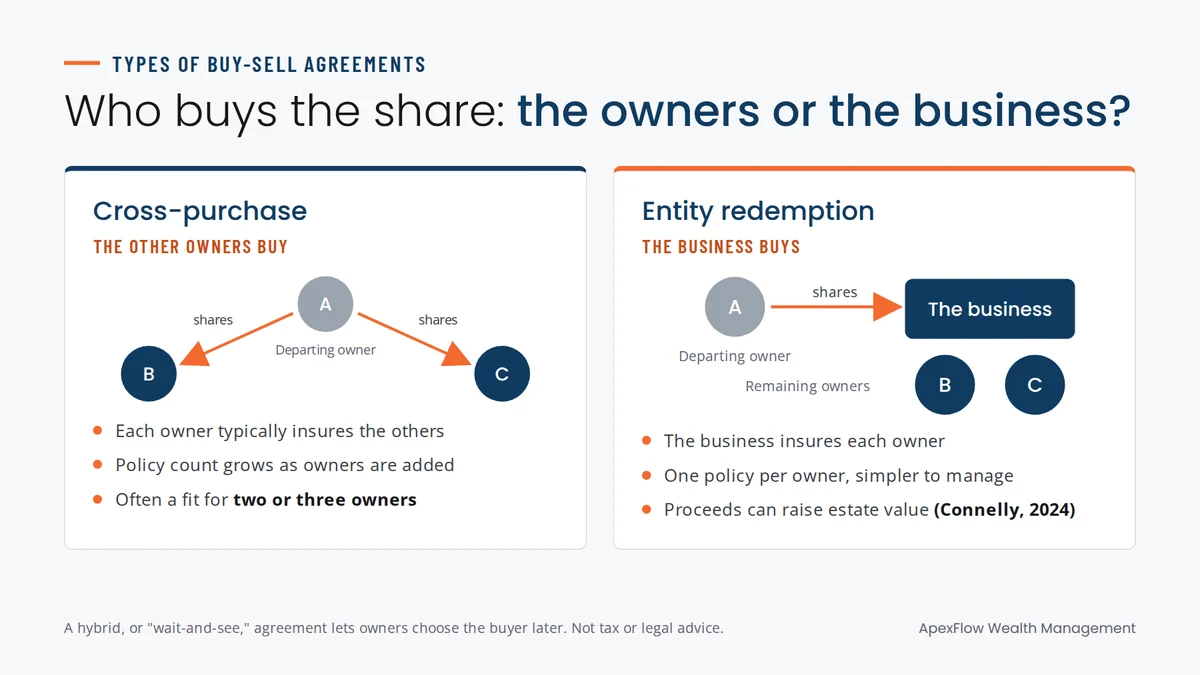
A well-drafted LLC operating agreement or shareholder buy-sell agreement controls what happens to your interest at death, and it beats the will. It can require the company or the other owners to buy your interest at an agreed price or formula, give your family cash instead of a company they cannot run, and name who manages the business in the meantime. Life insurance owned by the company or the partners is the usual way to fund the purchase. We cover the mechanics in our article on buy-sell agreements.
For a single-owner business, the equivalent tools are a revocable trust that holds the ownership interest, a durable power of attorney that names someone to act if you are incapacitated rather than deceased, and a written continuity plan that says who runs the company for the first ninety days.
Hypothetical example: A Murray HVAC contractor, 58, owns 100 percent of his S corporation and employs eleven people. His wife has never worked in the business. If he dies without a plan, she inherits the shares through probate, but for several weeks no one can sign payroll or the fuel card renewal. With a plan, his shares sit in a revocable trust with a successor trustee, his operations manager holds a written authority to run day-to-day for ninety days, a key-person life policy covers payroll and debt, and a standing offer from a competitor is documented so his wife has a buyer and a price. The outcome is illustrative only.
Estate taxes are rarely the issue; liquidity is
Utah has no estate or inheritance tax. The federal estate tax exemption is $15 million per person for 2026, so most Utah owners will not owe federal estate tax either. What families do run short of is cash: to keep the business running, to pay a buyout, or to equalize an inheritance between a child who works in the company and siblings who do not. That is a planning problem, and it has planning solutions.
The owner checklist
This is a condensed version of what we cover in the Take Inventory step with business owners.
- A signed operating agreement or buy-sell agreement that addresses death, disability and divorce.
- An agreed valuation method, reviewed every two or three years.
- Funding for the buyout, usually life insurance, owned the right way.
- A revocable trust holding your interest if you are a sole owner.
- Durable powers of attorney and a continuity memo naming interim authority.
- A second authorized signer on every business account.
- Beneficiary and ownership reviews on company-owned policies and retirement plans.
We coordinate this work with your attorney and CPA, and our business planning page describes how.
Frequently asked questions
In most cases yes, if you have no agreement saying otherwise. Whether that is a gift or a burden depends on whether there is a plan for someone to run or buy the company. A buy-sell agreement turns the business into cash for your spouse.
Not by itself. Your membership interest is still your personal property. Holding that interest in a revocable trust, or having an operating agreement with a transfer-on-death provision, is what keeps it out of probate.
Informal probate can appoint a personal representative within a few weeks of filing, and the whole process often takes several months to a year. The first few weeks, before anyone is appointed, are the dangerous stretch for an operating company.
Then your family becomes your partner’s partner, unless your agreement says otherwise. Most partners prefer a buyout, and most families prefer cash. A funded buy-sell agreement gives both sides what they want.
Free one-page checklist
Business owner continuity checklist. Agreements, authority, risk and your own plan, on one printable page.
Talk it through with us
Every situation is a little different. If you want to talk through yours, book a 20-Minute Fit Call with one of our advisors, by video or in person. No prep and no obligation. Want to see how we work first? Start with the Purposeful Planning Process or our services.

The information in this article is general in nature and is not a recommendation for any individual. Consider your own circumstances or speak with an advisor before acting on it. Any opinions are those of the author and not necessarily those of Raymond James.
ApexFlow Wealth Management does not provide tax or legal advice. Please consult your tax or legal professional before acting on any strategy mentioned here.
Examples labeled as hypothetical are for illustration only. They are not based on any actual client and do not represent actual or expected results.
Related Articles
Dig deeper into our resource library
-
 October 29, 2026
Selling a Business in Utah: What to Do Two or Three Years Before the Sale
The years before a sale decide how much of the price you keep. What Utah owners can do two or three years out on value, deal structure, taxes, QSBS, and family and charitable gifts.Read more -
 November 5, 2026
Buy-Sell Agreement Basics: Who Gets Your Business If You Can’t Run It?
Most business owners have a will. Far fewer have answered the question that matters most for what they’ve built: what happens to the business itselfRead more -
 November 5, 2026
What Happens If You Die Without a Will in Utah?
Ask someone why they haven’t written a will, and you’ll rarely hear “I don’t think it matters.” You’ll hear “I haven’t gotten to it yet.”Read more