

At a glance
- Lehi sits at the Point of the Mountain between Salt Lake and Utah counties, surrounded by the employers, campuses and new neighborhoods that make up Silicon Slopes.
- Housing ranges from new construction in Traverse Mountain and the west side to older homes near downtown Lehi, with Saratoga Springs and Eagle Mountain as lower-cost alternatives.
- Utah taxes income, including equity compensation, at a flat 4.45 percent for 2026, with no local income tax.
- Equity compensation is the planning issue for many arrivals: RSU vests, option exercises and a home purchase often land in the same two years.
- The plan should set a target for how much company stock to hold, a vest-by-vest decision rule and an estimated tax schedule before the first vest.
Twenty years ago Lehi was a farm town with a roller mill. Today it is the center of Utah’s tech economy, with corporate campuses along Interstate 15, Thanksgiving Point, and new neighborhoods climbing Traverse Mountain and spreading west toward Utah Lake. The people moving here are often arriving for a job offer that includes equity, which means the financial plan has two moving parts at once: a new home and a new kind of compensation. Both deserve a plan.
Two minutesHow much of your retirement is actually decided?Get my Clarity ScoreHousing around Silicon Slopes
Lehi’s housing is mostly new. Traverse Mountain offers views and quick access to Interstate 15 at a premium. Central and west Lehi have newer subdivisions and townhomes at more accessible prices. Saratoga Springs, Eagle Mountain and American Fork draw buyers who want more house for the money and accept a longer drive. Prices across the area rose sharply through the tech boom and remain above Provo and Orem, though below Salt Lake City’s east side.
Utah property tax favors primary residences, taxing them on 55 percent of market value, and Utah County rates are moderate. In new developments, read the HOA documents and check for special assessment areas or improvement district taxes attached to the parcel; these are common where infrastructure was built recently. Utilities are inexpensive, and groceries carry a reduced state sales tax rate.
Utah taxes for a tech worker
Utah taxes wages, bonuses, RSU income and option gains at a single flat rate, 4.45 percent for 2026, with no local or city income tax. For someone arriving from California, that is a large reduction. From Washington or Texas, it is a new cost to plan for.
Two timing details matter for equity. First, if you move mid-year, income is generally sourced to where you worked when it was earned, and RSU vests can be partly taxable to your old state even after you move, based on the portion of the vesting period you worked there. Second, Utah’s flat rate means there is no bracket management to do at the state level; the work is all federal.
Commuting
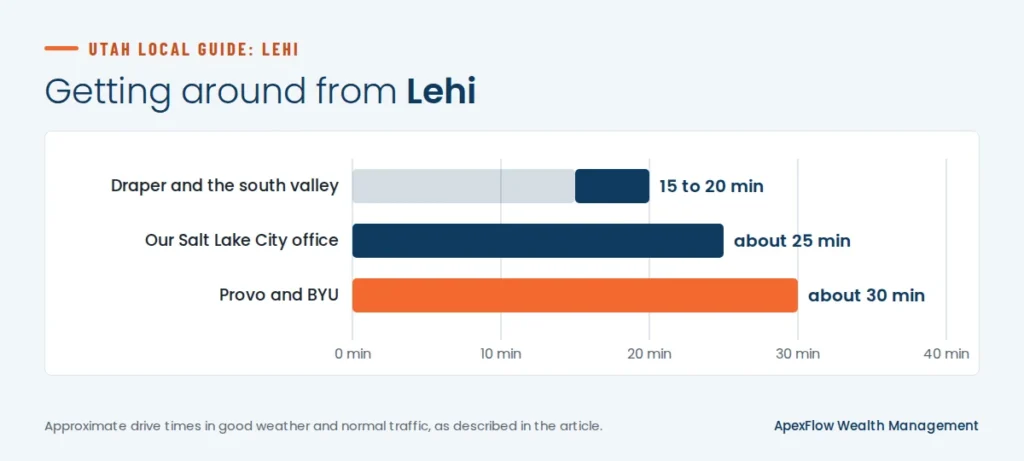
Many Lehi residents work in Lehi. For those commuting to Salt Lake City, Interstate 15 through the Point of the Mountain is congested at peak hours, and FrontRunner commuter rail from Lehi Station is a practical alternative. Draper and the south valley are fifteen to twenty minutes. Provo and BYU are about half an hour south.
Equity compensation: the real planning issue
Most offers in Silicon Slopes include restricted stock units, stock options or both. We see the same three mistakes repeatedly: holding every vested share by default, underpaying taxes because withholding was too low, and making the first big decision in the week a vest or a trading window arrives. The fix is to make the decisions before the calendar forces them.
Set a target for company stock. Decide what share of your net worth you are willing to keep in your employer. For many people it is 10 to 20 percent or less, given that your salary already depends on the company. Our article on the concentrated stock trap after an IPO or acquisition covers the reasoning.
Write a vest rule. For example: sell all RSUs at vest and invest the proceeds according to the plan, or sell everything above the target. Holding vested RSUs is the same decision as buying company stock with that paycheck. See RSUs vs. stock options: what to do when they vest.
Handle options deliberately. Incentive stock options can trigger alternative minimum tax at exercise; non-qualified options are taxed as wages. Exercise schedules should be modeled against your tax picture, not done all at once.
Pay the tax on time. Employer withholding on RSU income is often below your real marginal rate. Estimated payments avoid an April surprise and a penalty.
Coordinate with the house. A down payment is a near-term cash need. Vested shares that will fund it should be sold and held in cash well ahead of closing, not left in the stock hoping for a better price. Lenders also treat RSU income differently from salary; ask early.
Hypothetical example: An engineer, 31, relocates from Austin for a role at a Lehi software company with a grant of RSUs vesting over four years. Before the first vest, she and her advisor set a company stock target of 10 percent of net worth, a rule to sell each vest and invest the proceeds, and a quarterly estimated tax schedule that includes Utah’s 4.45 percent. The first two vests fund the down payment on a townhome in west Lehi, held in cash for three months before closing. Her 401(k) match and an HSA are funded first each year, and an emergency fund covers five months at the new budget. The example is illustrative only.
The move checklist
- Define the why and the time horizon: a two-year stint and a ten-year plan call for different housing decisions.
- Take inventory of the new budget with Utah taxes, housing, commuting and any special assessments.
- Protect the household with term life and disability coverage, and sign Utah estate documents. See updating your estate plan after moving to Utah.
- Set the equity rules above before the first vest or trading window.
- Build the portfolio from the plan, with near-term cash needs out of the market. See portfolio management.
Working with us from Lehi
Our Salt Lake office is twenty-five minutes north of Lehi, and many Silicon Slopes clients meet us by video between meetings. Equity compensation planning is a core part of our executive financial planning work, and a move is the natural time to put the whole plan in place through our Purposeful Planning Process.
Frequently asked questions
Prices rose sharply with the tech boom and remain above Provo and Orem, with Traverse Mountain at the top of the range. Saratoga Springs, Eagle Mountain and American Fork offer lower entry points nearby.
As ordinary income at the flat 4.45 percent rate for 2026, the same as wages. If you moved mid-vesting period, part of a vest may be taxable to your prior state based on where you worked while it was earning.
Selling at vest is a sensible default because holding is equivalent to buying company stock with that paycheck. The amount of company stock to keep should come from a written target, not from the vest schedule.
Yes, but sell the shares and hold cash well before closing rather than relying on a future stock price, and ask your lender early how they treat RSU income in qualifying for the mortgage.
Free one-page checklist
Moving to Utah: your financial checklist. Every step from before the move through your first year, on one printable page.
Talk it through with us
Every situation is a little different. If you want to talk through yours, book a 20-Minute Fit Call with one of our advisors, by video or in person. No prep and no obligation. Want to see how we work first? Start with the Purposeful Planning Process or our services.

The information in this article is general in nature and is not a recommendation for any individual. Consider your own circumstances or speak with an advisor before acting on it. Any opinions are those of the author and not necessarily those of Raymond James.
ApexFlow Wealth Management does not provide tax or legal advice. Please consult your tax or legal professional before acting on any strategy mentioned here.
Investing involves risk, and you may incur a profit or loss regardless of the strategy selected, including diversification and asset allocation. Past performance does not guarantee future results.
Examples labeled as hypothetical are for illustration only. They are not based on any actual client and do not represent actual or expected results.
Related Articles
Dig deeper into our resource library
-
 October 29, 2026
How to Avoid the Concentrated Stock Trap After an IPO or Acquisition
A liquidity event can turn years of equity into most of your net worth in one stock. Here is how to plan the months before and after an IPO or acquisition so you keep what you built.Read more -
 October 29, 2026
RSUs vs. Stock Options: What to Do When They Vest
RSUs and stock options are taxed differently, vest differently and call for different decisions. Here is a plain guide to what happens at vest and what to do about it.Read more -
 November 5, 2026
Moved to Utah? Why Your Estate Plan Needs a Fresh Look
There’s a comforting myth about estate planning: that it’s a project with an end date. You meet with an attorney, sign the documents and checkRead more