

At a glance
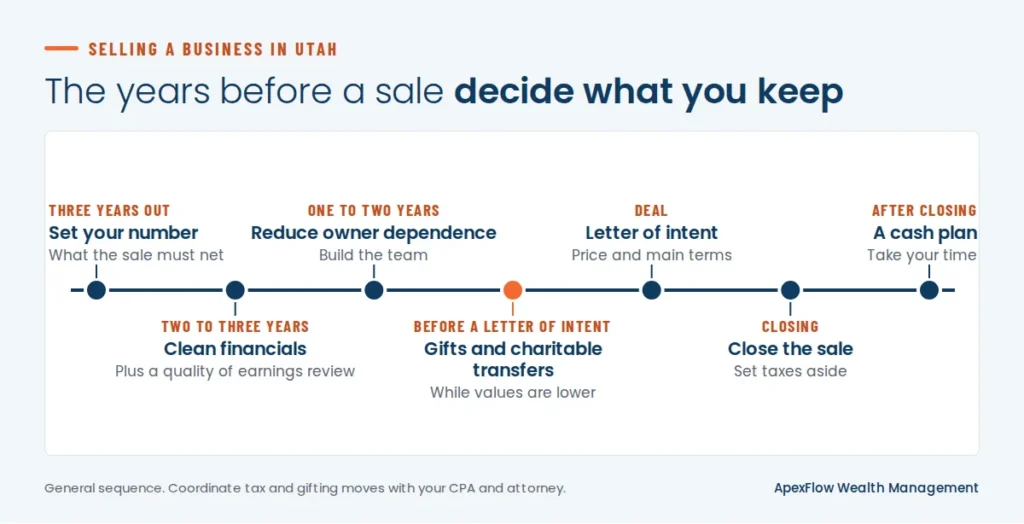
- Your number, the after-tax amount the sale must produce to fund the rest of your life, should be set before you talk to any buyer.
- Clean financial statements, recurring revenue, a management team and less dependence on the owner tend to raise value, and each takes a year or more to show.
- Deal structure, including asset or stock sale, depreciation recapture, earnouts, seller notes and rollover equity, can change after-tax proceeds as much as the price does.
- Utah taxes the gain at its flat rate, 4.45 percent for 2026, and the state’s elective pass-through entity tax can preserve a federal deduction that the SALT cap would otherwise limit.
- Gifts of shares to family or charity generally need to happen before a sale is practically certain, which usually means well before a letter of intent.
Most owners start thinking about selling a business in Utah when a buyer calls. By then, several decisions that shape what they keep are hard to change. The two or three years before a sale are when value can still be built, the deal can still be shaped around taxes, and gifts to family or charity can still happen at lower values. A sale plan does not cover an unexpected death before closing, which our article on an owner dying without a succession plan addresses.
Two scoresIs the business ready to be sold? Are you ready to leave it?Check my exit readinessKnow your number before you talk to buyers
Your number is what the sale has to net, after taxes, debt payoff and fees, to fund the rest of your life. It comes from your spending, other savings, Social Security and how long the money must last. A broker’s estimate tells you what the market might pay. It does not tell you what you need.
Without a number, owners tend to hold out for a price they do not need, or accept one that leaves too little cash at closing because much of it is deferred or contingent. With one, each offer can be judged by what it puts in your pocket and when. We start this in the first step of our process, Define Your Why. The last years before a sale are often an owner’s highest-income years, and a cash balance plan can move part of that income into tax-deferred savings.
Who might buy your company
- Strategic buyers in your industry may pay more because they can cut overlapping costs or sell to your customers.
- Private equity firms want steady earnings and a management team that stays. They often ask the owner to keep a minority stake.
- Employees can buy through a management buyout or an employee stock ownership plan (ESOP). A C corporation owner who sells to an ESOP that ends up owning at least 30 percent may be able to defer gain under section 1042 if other conditions are met.
- Family members rarely pay full value in cash, so family transfers usually combine gifts, a seller note and the estate plan.
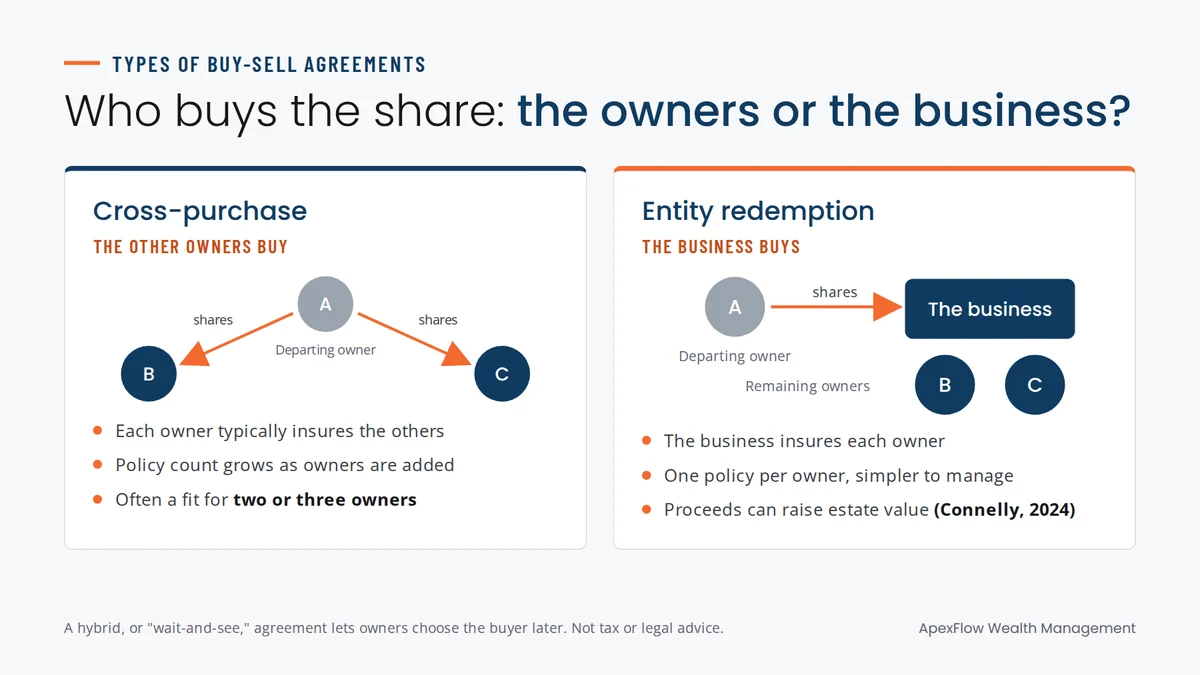
- A partner may already hold a right to buy you out. The price formula or right of first refusal in your buy-sell agreement can shape or block a sale to anyone else.
What raises value in the years before a sale
Buyers price a company on the earnings they expect to continue after you leave, and on how much they trust those earnings.
- Clean financial statements, reviewed or audited and prepared consistently for at least three years, with personal expenses removed or documented.
- A quality of earnings review done before going to market, so problems surface in time to fix them.
- Recurring revenue from service contracts and multi-year agreements, which usually earns a higher multiple than one-time project work.
- Less dependence on you. If customers, lenders and key staff deal mainly with the owner, a buyer is purchasing a risk.
- A management team with retention incentives tied to a sale.
- Lower customer concentration. When one customer is a large share of revenue, buyers tend to cut the price or push more of it into an earnout.
- Documented processes for operations, pricing, safety and hiring.
How deal structure changes what you keep
Two offers with the same headline price can produce very different after-tax results.
Asset sale or stock sale. Buyers usually prefer assets, which give them a fresh tax basis and leave old liabilities behind. Sellers usually prefer to sell stock, because gain on shares held more than a year is generally long-term capital gain. In an asset sale the price is allocated among asset classes, and inventory produces ordinary income while goodwill generally produces capital gain.
Depreciation recapture. Gain on equipment, up to the depreciation already taken, is ordinary income. Gain tied to depreciation on buildings can be taxed at up to 25 percent federally.
Installment sales and seller notes. When part of the price arrives over time, gain is generally reported as payments come in, except recapture, which is reported in the year of sale even if no cash has arrived. A seller note also makes you a lender to the new owner.
Earnouts. These pay part of the price only if the company hits targets after closing, which depends on results you no longer control.
Rollover equity. Private equity buyers often ask the seller to reinvest part of the proceeds. The rolled portion can be tax-deferred if structured properly, but it keeps wealth in one illiquid company, much like concentrated stock after an acquisition.
Non-compete and consulting payments. These are generally ordinary income to the seller, and consulting pay can carry payroll or self-employment tax.
Taxes on selling a business in Utah
Utah taxes nearly all income at one flat rate, 4.45 percent for 2026, with no separate capital gains rate. On an $8 million gain, the Utah tax is roughly $356,000. Federally, long-term capital gain is taxed at up to 20 percent, and the 3.8 percent net investment income tax can apply depending on your role in the business.
The federal deduction for state and local taxes is capped at $40,400 for 2026 and phases down toward $10,000 once modified adjusted gross income passes $505,000. Most sellers pass that range in a sale year, leaving the Utah tax on the gain largely nondeductible.
Utah’s elective pass-through entity tax. Since 2022, a partnership, an LLC taxed as a partnership or an S corporation can elect to pay Utah income tax at the entity level, at the individual rate, for all its individual owners. Federal guidance lets the entity deduct that tax, and the owners claim a nonrefundable Utah credit for it. The election is made each year on Form TC-75 with payment by the last day of the entity’s tax year, and it cannot be revoked once paid. It matters most when the entity itself recognizes the gain, as in an asset sale.
Hypothetical example: A couple in Spanish Fork, both 59, own an S corporation that services commercial HVAC systems. A broker thinks it could sell for about $10 million in three years, and they estimate they need about $6 million after taxes, debt payoff and fees. Over the next two years they promote their operations manager, commission a quality of earnings review and bring their largest customer from about a third of revenue to under 20 percent. When offers arrive, they compare an all-cash asset purchase with a private equity offer that includes an earnout, and their CPA models the Utah pass-through entity election for the year of sale. The figures are hypothetical and do not represent any client.
Qualified small business stock for C corporations
Section 1202 can exclude a large share of the federal gain on qualified small business stock (QSBS): C corporation stock acquired at original issuance, held long enough, in a company that meets the business and size tests. S corporation shares and LLC interests taxed as a partnership do not qualify, and many service fields, such as health, law, accounting and consulting, are excluded.
The One Big Beautiful Bill Act, signed July 4, 2025, changed the rules for stock acquired after that date:
- The exclusion is 50 percent of the gain after three years, 75 percent after four and 100 percent after five.
- The per-company cap rose from $10 million to $15 million per taxpayer, indexed for inflation after 2026, or ten times your basis if higher.
- The ceiling on the company’s gross assets rose from $50 million to $75 million.
Stock acquired on or before July 4, 2025 keeps the earlier rules: generally more than five years of holding and, for stock acquired after September 27, 2010, a 100 percent exclusion up to $10 million or ten times basis. New-rule stock cannot reach three years until July 2028, so most owners selling soon fall under the older rules. Utah starts from federal adjusted gross income, so gain excluded federally generally stays off the Utah return as well. Qualification is technical and worth confirming early.
Moves that must come before a letter of intent
Once a letter of intent sets the price and main terms, the window for some planning narrows or closes.
Gifts to family or trusts. Shares given before a deal is in sight are valued at today’s price, sometimes with discounts for a minority interest, and later growth happens outside your estate. For 2026 the federal estate and gift tax exemption is $15 million per person and the annual gift exclusion is $19,000 per recipient. Utah has no estate or inheritance tax. Gifted shares keep your original basis.
Charitable planning. Giving appreciated shares to a donor-advised fund or a charitable remainder trust before a sale can keep the gain on those shares off your return, and a charitable remainder trust can also pay you an income stream. S corporation shares raise extra issues for both, and from 2026 itemized charitable deductions count only above 0.5 percent of adjusted gross income.
The assignment-of-income doctrine. If shares are given away after a sale is practically certain, the IRS and the courts can treat the gain as the donor’s anyway. Courts look at all the facts, not only the date of a letter of intent, and the later the gift, the greater the risk. This planning belongs with your CPA and attorney well before negotiations turn serious.
After the sale: cash, taxes and what comes next
A cash plan. Before closing, decide where the proceeds will land, how much stays in cash or short-term Treasuries for the next year or two, and when escrows or holdbacks should pay out.
Taxes set aside. Moving the expected federal and Utah tax to a separate account at closing keeps it from being spent or invested by accident.
No rushed investment decisions. Holding proceeds short term while a plan is built costs little.
Replacing what the business gave you. The company supplied a schedule, a title, friendships and a sense of usefulness along with income, and replacing those takes more thought than the money does.
Where we fit
We help owners set their number, test offers against it and coordinate the tax, estate and investment work with their CPA, attorney and broker or banker. Our business planning page describes how that work runs before and after a sale.
Frequently asked questions
Two to three years gives time to clean up financial statements, reduce owner dependence, and complete gifts or charitable transfers before a buyer is involved.
No. Utah taxes capital gains at the same flat rate as other income, 4.45 percent for 2026.
No. Section 1202 applies only to stock of a C corporation that meets the other requirements. Utah’s elective pass-through entity tax may still help an S corporation owner in the year of sale.
Sellers usually prefer a stock sale because more of the gain is capital gain, while buyers usually prefer assets. The better choice depends on the price and the tax numbers on both sides.
Free one-page checklist
Business owner continuity checklist. Agreements, authority, risk and your own plan, on one printable page.
Talk it through with us
Every situation is a little different. If you want to talk through yours, book a 20-Minute Fit Call with one of our advisors, by video or in person. No prep and no obligation. Want to see how we work first? Start with the Purposeful Planning Process or our services.

The information in this article is general in nature and is not a recommendation for any individual. Consider your own circumstances or speak with an advisor before acting on it. Any opinions are those of the author and not necessarily those of Raymond James.
ApexFlow Wealth Management does not provide tax or legal advice. Please consult your tax or legal professional before acting on any strategy mentioned here.
Investing involves risk, and you may incur a profit or loss regardless of the strategy selected, including diversification and asset allocation. Past performance does not guarantee future results.
Examples labeled as hypothetical are for illustration only. They are not based on any actual client and do not represent actual or expected results.
Related Articles
Dig deeper into our resource library
-
 October 29, 2026
What Happens to Your Business If You Die Without a Succession Plan (Utah Rules)
If a Utah business owner dies without a succession plan, state law and the operating agreement decide who owns the company next. Here is what actually happens, step by step, and how to prevent it.Read more -
 October 29, 2026
SEP IRA vs. Solo 401(k) vs. Cash Balance Plan: Which Retirement Plan Fits Your Business
Three retirement plans do most of the work for Utah business owners. Here is how a SEP IRA, a Solo 401(k) and a cash balance plan differ, and how to tell which one fits your business this year.Read more -
 November 5, 2026
Buy-Sell Agreement Basics: Who Gets Your Business If You Can’t Run It?
Most business owners have a will. Far fewer have answered the question that matters most for what they’ve built: what happens to the business itselfRead more