
At a glance
- The FERS annuity is 1 percent of your high-3 salary per year of service, or 1.1 percent if you retire at 62 or later with at least 20 years.
- Retiring at your minimum retirement age with 30 years, or at 60 with 20, brings an unreduced annuity and a supplement that runs until 62, subject to an earnings test.
- The survivor election, the five-year rule for FEHB and the FEGLI reduction choice are made at retirement and are hard or impossible to change later.
- For 2026 the TSP deferral limit is $24,500 plus catch-ups, and Roth TSP balances no longer carry required distributions for the owner.
- Utah taxes the FERS annuity and traditional TSP withdrawals at 4.45 percent for 2026, while a state credit effectively removes Utah tax on military retired pay.
Hill Air Force Base sits between Layton, Clearfield, Roy, Riverdale and South Weber, near the line between Davis and Weber counties. Many of the people who keep it running are civilians in the Ogden Air Logistics Complex and other units, and most of them retire under the Federal Employees Retirement System (FERS). Retiring from Hill Air Force Base comes down to a handful of decisions that are permanent or close to it: the date, the survivor election, health and life insurance, and the Thrift Savings Plan.
Many retirees stay in Davis County. Others move closer to children and grandchildren, which can change the tax picture. If you or a spouse also worked for a Utah school district or state agency, our guide to retiring from URS covers that pension.
Two minutesHow much of your retirement is actually decided?Get my Clarity ScoreHow the FERS annuity is calculated
The basic FERS annuity is 1 percent of your high-3 average salary for each year of creditable service. If you are 62 or older at separation with at least 20 years, the multiplier rises to 1.1 percent. Your high-3 is your highest average basic pay over any three consecutive years, usually the last three. It includes pay subject to retirement deductions, such as locality pay, but not overtime or bonuses.
Unused sick leave is added to your service for the computation, at 100 percent for separations since 2014. It cannot be used to reach eligibility or to raise the high-3, but OPM has confirmed it can carry someone 62 or older across the 20-year line for the 1.1 percent multiplier.
When you can retire, and what age 62 is worth
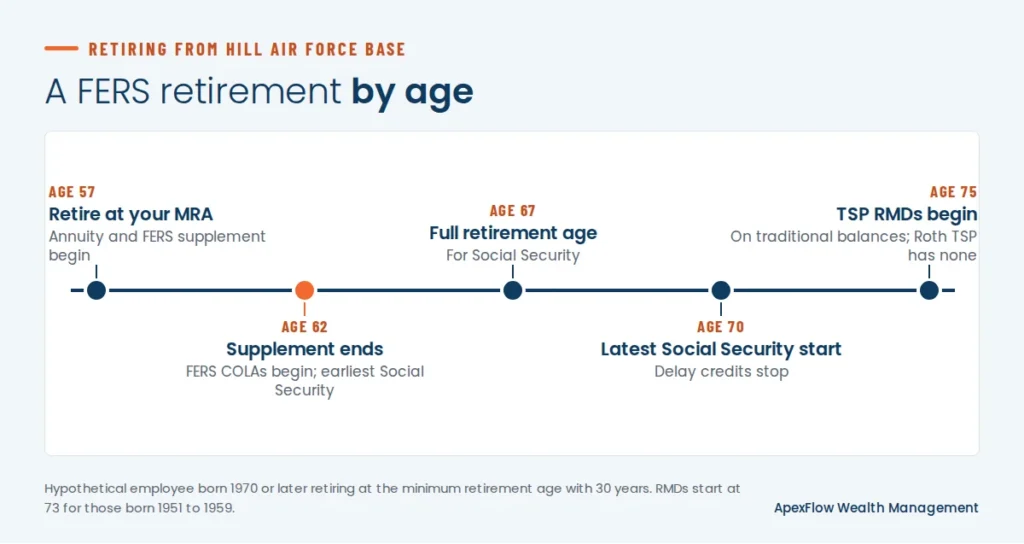
FERS pays an immediate, unreduced annuity at your minimum retirement age (MRA) with 30 years of service, at 60 with 20 years, or at 62 with five. Your MRA is 56 if you were born from 1953 through 1964, rises two months for each later birth year, and reaches 57 for anyone born in 1970 or later.
With 10 to 29 years, you can leave at your MRA under the MRA+10 provision, but the annuity is permanently reduced by 5 percent for each year you are under 62, unless you have 20 years and the annuity starts at 60 or later. Postponing the start date shrinks the reduction, though FEHB and FEGLI stop at separation and resume only when the annuity begins.
The move from 1 percent to 1.1 percent is a 10 percent raise on the same service, for life. Working to 62 can add service, raise the high-3 and switch on the higher multiplier at once.
Hypothetical example: A Layton engineer born in 1966 has 30 years of service at 60 and a high-3 of $110,000. Retiring at 60 produces an unreduced annuity of $33,000 a year, plus the FERS supplement until 62. Working to 62 could lift her high-3 to $115,000, and at the 1.1 percent multiplier with 32 years her annuity would be about $40,500, roughly 23 percent more for life before any survivor reduction. She and her husband weigh that against two fewer years of retirement and decide from their spending plan. The figures are hypothetical and do not represent any client.
The supplement, Social Security and COLAs
If you retire on an immediate, unreduced annuity before 62, you generally receive the FERS annuity supplement, which approximates the Social Security benefit earned during your FERS service and ends with the month you turn 62. MRA+10 and deferred retirees do not receive it, and those leaving through early retirement offers wait until their MRA.
The supplement is reduced by $1 for every $2 of earned income above the Social Security exempt amount, which is $24,480 for 2026 and $25,560 for 2027. Wages and self-employment income count; the annuity, TSP withdrawals and investment income do not.
The Social Security Fairness Act, signed January 5, 2025, ended the Windfall Elimination Provision and Government Pension Offset for benefits payable from January 2024 onward. Those rules mainly affected CSRS retirees and their spouses, since FERS service was covered by Social Security. For claiming decisions, see Social Security claiming strategies for married couples.
Regular FERS retirees receive no cost-of-living adjustments until 62. After that, FERS COLAs pay the full inflation increase when it is 2 percent or less, 2 percent when inflation falls between 2 and 3 percent, and inflation minus one point above 3 percent. For January 2027, Social Security and CSRS benefits rise 3.6 percent and eligible FERS annuities 2.6 percent.
Survivor benefits: an election that is hard to undo
At retirement, a married FERS employee chooses how much of the annuity continues to a spouse.
- Full survivor annuity: your spouse receives 50 percent of your unreduced annuity, and your annuity is reduced by 10 percent.
- Partial survivor annuity: your spouse receives 25 percent, and your annuity is reduced by 5 percent.
- No survivor annuity: no reduction, and nothing continues to your spouse.
Anything less than the full survivor annuity requires your spouse’s written consent. The election also controls health coverage: a surviving spouse can keep FEHB only if a survivor annuity is payable and they were covered under your family or self plus one enrollment. Even the partial option preserves that right, which is one reason some couples choose it.
Your TSP in retirement
For 2026 the TSP elective deferral limit is $24,500 and the age-50 catch-up is $8,000, or up to $11,250 for participants turning 60 through 63 this year. Catch-ups for employees whose 2025 wages exceeded $150,000 must go to Roth. The core funds are the G Fund (government securities with no risk of loss of principal), the F Fund (bonds), the C Fund (the S&P 500), the S Fund (U.S. stocks outside the S&P 500), the I Fund (international stocks) and the L Funds, which blend the five by target date.
After you separate, you can take partial withdrawals of $1,000 or more, set up monthly, quarterly or annual installments, buy a life annuity, or combine these, and you can draw from traditional money, Roth money or both pro rata. If you separate in or after the year you turn 55, TSP withdrawals generally avoid the 10 percent early withdrawal penalty.
Since 2024, Roth TSP balances are not subject to required minimum distributions during your lifetime. Since January 2026, the TSP allows Roth in-plan conversions, including for separated participants, with the tax paid from outside money. Traditional balances still face RMDs at 73 or 75, as our 2026 RMD guide explains.
Leaving money in the TSP keeps costs low and the menu familiar. Rolling some to an IRA brings a wider range of investments and one place to manage several accounts.
Health and life insurance: FEHB, Medicare and FEGLI
FEHB. To carry health coverage into retirement, you generally must be enrolled when you retire and have been continuously covered by FEHB (or TRICARE) for the five years immediately before retirement, or since your first opportunity to enroll if that is shorter.
Medicare Part B. FEHB does not require Medicare. At 65, retirees with FEHB decide whether to add Part B, whose standard premium is $202.90 a month for 2026, with 2027 figures expected later this fall. With Part B, Medicare generally pays first, and many FEHB plans waive deductibles and copays for Part B services or reimburse part of the premium. Enrolling later carries a penalty of 10 percent of the premium for each full 12-month period without Part B, for as long as you have it.
FEGLI. Basic life insurance can continue if you were covered for the five years before retiring. You elect a 75 percent reduction, which becomes free once reductions begin, a 50 percent reduction or no reduction; the last two carry ongoing premiums. If you file no election, you default to the 75 percent reduction.
If you also draw military retired pay
Military service and FERS. While you receive military retired pay, you generally cannot count military service toward your FERS annuity, except in limited cases such as a combat-related disability retirement or a reserve retirement. Otherwise, crediting the service means waiving retired pay and completing a deposit, generally 3 percent of military basic pay for FERS, before you separate.
Utah’s military retirement credit. Utah offers a nonrefundable credit equal to the state tax rate times the military retirement pay in your income, which effectively removes Utah tax on that pay, including pay received by a survivor. It cannot be claimed in the same year as Utah’s retirement credit for older taxpayers.
TRICARE For Life. Military retirees must enroll in Medicare Part A and Part B to keep TRICARE For Life at 65, which settles the Part B decision for anyone who also holds FEHB.
Utah taxes when retiring from Hill Air Force Base
Utah taxes the FERS annuity, the supplement and traditional TSP withdrawals at its flat rate, 4.45 percent for 2026, with no exclusion for federal civilian pensions. Qualified Roth TSP withdrawals are tax-free federally and in Utah.
Social Security is included in Utah income to the extent it is federally taxable, and a nonrefundable credit removes that tax for retirees under the income thresholds. For 2026 the credit begins to phase out above $90,000 of modified adjusted gross income for joint filers and $54,000 for single filers. Our article on Utah income tax for retirees moving from other states compares Utah with its neighbors.
Timing the paperwork
A retirement application passes through your agency, payroll and OPM. Air Force civilians start with the Benefits and Entitlements Service Team. OPM’s quick guide suggests meeting with your benefits office at least 60 days before separation and outlines roughly three to five months to a finished case. For September 2026, OPM reported average processing of 66 days for immediate retirements, with digital claims at 56 days and paper claims at 149.
While the case is open, OPM pays interim payments, which its guide puts at roughly 60 to 80 percent of the estimated net annuity, so a cash reserve for the first few months helps.
We fit your FERS benefits into one plan: the retirement date against the 1.1 percent and supplement rules, the survivor election against your spouse’s needs, and TSP withdrawals and Roth conversions against federal and Utah taxes. Our financial planning page and the Purposeful Planning Process describe how that work is organized.
If your spouse works for Intermountain Health, our Intermountain pension freeze guide explains what changes after December 31, 2026, and the 2027 decisions to make together.
Frequently asked questions
Yes. An immediate, unreduced annuity at your MRA with 30 years generally includes the FERS supplement until 62, subject to the earnings test. Your MRA is 56 to 57, depending on birth year.
You do not have to. The TSP allows partial withdrawals, installments and Roth in-plan conversions after separation at low cost, while an IRA offers broader investment choices.
FEHB does not require it, but enrolling late brings a 10 percent premium penalty for each 12-month period without it, for life. Military retirees need Part B to keep TRICARE For Life.
Yes. The annuity, the supplement and traditional TSP withdrawals are taxed at Utah’s flat rate, 4.45 percent for 2026. Military retired pay is effectively exempt through a state credit.
Talk it through with us
Every situation is a little different. If you want to talk through yours, book a 20-Minute Fit Call with one of our advisors, by video or in person. No prep and no obligation. Want to see how we work first? Start with the Purposeful Planning Process or our services.

The information in this article is general in nature and is not a recommendation for any individual. Consider your own circumstances or speak with an advisor before acting on it. Any opinions are those of the author and not necessarily those of Raymond James.
ApexFlow Wealth Management does not provide tax or legal advice. Please consult your tax or legal professional before acting on any strategy mentioned here.
Investing involves risk, and you may incur a profit or loss regardless of the strategy selected, including diversification and asset allocation. Past performance does not guarantee future results.
Examples labeled as hypothetical are for illustration only. They are not based on any actual client and do not represent actual or expected results.
Related Articles
Dig deeper into our resource library
-
 October 29, 2026
Required Minimum Distributions: The 2026 Rules and How to Reduce Them
RMDs start at 73 for most retirees today and 75 for younger ones. Here are the 2026 rules, the penalties, and the five ways to shrink the tax bill they create.Read more -
 November 5, 2026
Retiring From URS: A Guide for Utah Public Employees and Teachers
Utah Retirement Systems is a strong pension, and the decisions around it are still yours to make: when to retire, which payout option to take, and how the 401(k), Social Security and taxes fit around it.Read more -
 October 29, 2026
Social Security Claiming Strategies for Married Couples
For a married couple, Social Security is two decisions that affect each other for the rest of both lives. Here is how the spousal and survivor rules work and how we help couples choose.Read more