
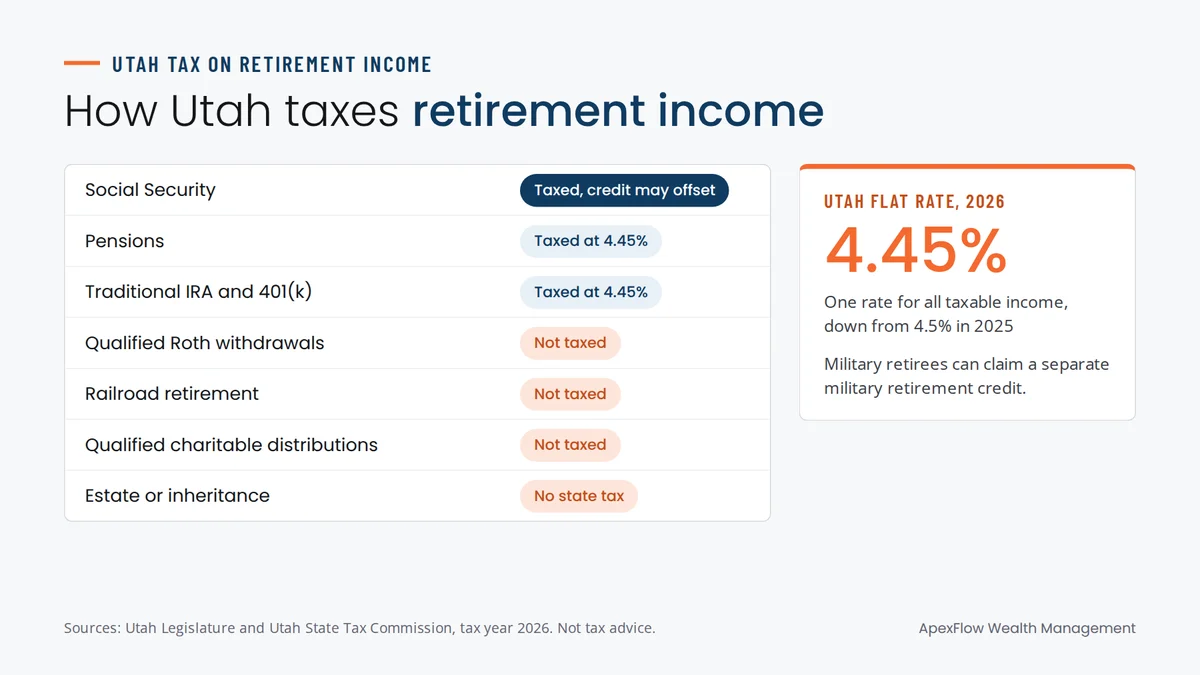
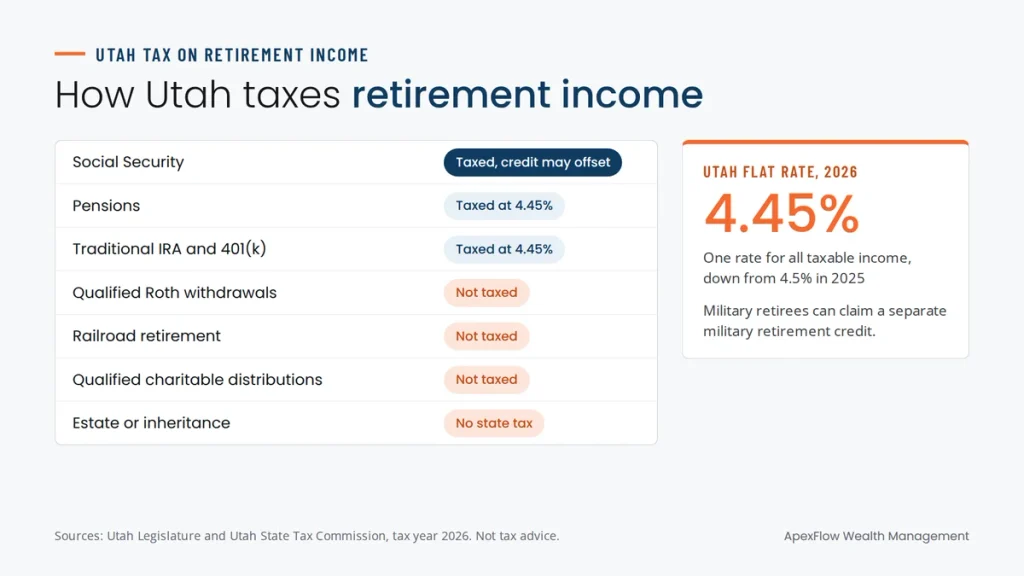
If you’re planning to retire in Utah, or you already have, it’s worth knowing exactly how the state treats your income. The short answer: Utah taxes most retirement income, including Social Security, at a single flat rate. The longer answer is better news. Credits can wipe out the state tax on Social Security for many retirees, and Utah has no estate or inheritance tax. Here’s how Utah tax on retirement income works in 2026, and where planning can make a difference.

At a glance
- Utah taxes income at a flat 4.45% for 2026, and that includes pensions, IRA and 401(k) withdrawals and Social Security.
- A Social Security credit can offset the tax on benefits entirely for many retirees, but it phases out as income rises.
- Utah has no estate or inheritance tax, and qualified Roth withdrawals aren’t taxed.
Utah’s flat income tax
Utah uses one flat income tax rate for everyone. The Legislature lowered it to 4.5% for 2025 and to 4.45% for 2026 under SB 60. Utah starts with your federal adjusted gross income, so in general, income that’s taxable on your federal return is taxable in Utah too.
That flat rate is simple, but it also means Utah offers no lower bracket for smaller amounts of income. Credits do most of the work instead.
How Utah taxes each type of retirement income
| Income type | How Utah treats it in 2026 |
|---|---|
| Social Security | Taxed at 4.45%, but the Social Security credit can offset it fully or partly |
| Pensions | Taxed at 4.45% |
| Traditional IRA and 401(k) withdrawals | Taxed at 4.45% |
| Roth IRA and Roth 401(k) withdrawals | Not taxed if qualified |
| Military retirement pay | Taxed, with a separate military retirement credit available |
| Railroad retirement | Not taxed (deducted from income) |
| Qualified charitable distributions | Not taxed, because they’re excluded from federal income |
| Estate or inheritance | No Utah estate or inheritance tax |
Does Utah tax Social Security?
Yes. Utah is one of nine states that tax Social Security benefits, according to a Utah Legislature research brief. The portion of your benefits that’s taxable on your federal return is taxable in Utah too.
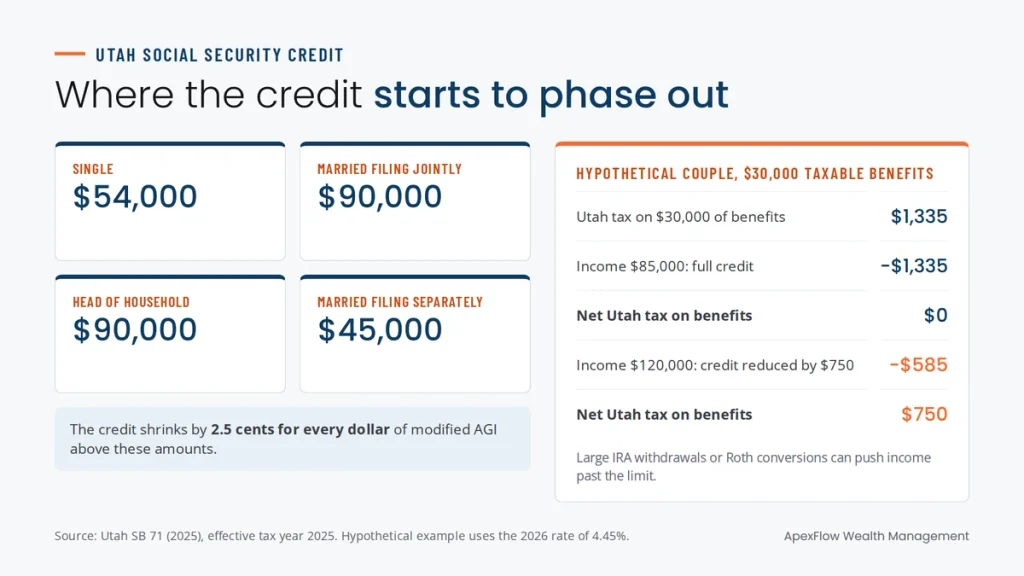
The good news is the Social Security benefits credit, which equals the state tax rate times your taxable benefits. For many retirees, that cancels out the Utah tax on Social Security completely. The credit phases out by 2.5 cents for every dollar of modified adjusted gross income above these limits, which SB 71 raised starting in tax year 2025:
| Filing status | Credit starts phasing out above |
|---|---|
| Single | $54,000 |
| Married filing jointly | $90,000 |
| Head of household | $90,000 |
| Married filing separately | $45,000 |
A hypothetical example. A married couple filing jointly has $30,000 of Social Security that’s taxable on their federal return and modified adjusted gross income of $85,000. Their Social Security credit is $1,335 (4.45% of $30,000). Because their income is under $90,000, they keep the full credit, and Utah effectively doesn’t tax their benefits.
Now suppose a large IRA withdrawal brings their income to $120,000. That’s $30,000 over the limit, which reduces the credit by $750 (2.5% of $30,000). Their credit drops to $585, and about $750 of Utah tax on their benefits comes back.
This example is hypothetical and for illustration only, uses 2026 figures and does not represent any specific client.
Other Utah credits retirees should know
- Retirement credit. If you were born on or before December 31, 1952, you may qualify for a credit of up to $450 per person, which phases out above $25,000 of income for single filers and $32,000 for joint filers, according to the Utah State Tax Commission. You can’t claim it in the same year as the Social Security or military retirement credit, so tax software or your preparer should pick the larger one.
- Military retirement credit. Military retirees can claim a credit for their retirement pay. It can’t be combined with the Social Security or retirement credit.
- Taxpayer tax credit. Every Utah filer gets a credit based on deductions and exemptions, which phases out as income rises.
Property taxes and sales taxes in retirement
Income tax is only part of the picture. Utah offers property tax help for older homeowners and renters with lower incomes, according to the Tax Commission’s Publication 36:
- Circuit breaker relief: homeowners 67 or older and renters 66 or older with 2025 household income under $44,221 may qualify for help of up to $1,412.
- Property tax deferral: homeowners 75 or older with 2025 household income up to $88,442 may be able to defer property taxes.
- Groceries: food bought for home is taxed at a reduced combined rate of 3%.
Rules and limits change each year, so check with your county or the Tax Commission before applying.
Utah has no estate or inheritance tax
Utah’s inheritance tax was tied to a federal credit that ended after 2004, so the state hasn’t collected it since, according to the Utah State Tax Commission, and there’s no separate state estate tax. For most families, that means estate planning here centers on federal rules, probate and making sure assets pass smoothly. We cover the basics in Do You Need a Trust?
Ways to manage Utah tax on retirement income
Because Utah’s rate is flat, saving state tax usually comes from managing the amount of taxable income and keeping credits intact:
- Watch the Social Security credit thresholds. Spreading large IRA withdrawals or Roth conversions across several years can help keep income under the phase-out limits.
- Use Roth accounts. Qualified Roth withdrawals don’t count as income in Utah. We explain how to build Roth savings in the years before RMDs in Roth Conversions Before RMDs.
- Give from your IRA. If you’re 70½ or older, qualified charitable distributions of up to $111,000 in 2026 count toward your RMD and stay out of both federal and Utah income.
- Harvest losses in taxable accounts. Utah follows federal capital gains rules, so losses that reduce your federal tax reduce your Utah tax too. See Tax-Loss Harvesting: How It Works.
- Budget for state tax. Taxes are a real retirement expense. Our guide to building a retirement budget shows where they fit.
Where we fit in
State taxes are one piece of a retirement income plan. At ApexFlow, we look at where your income comes from each year, federal and Utah, and coordinate withdrawals, Roth conversions and charitable giving with your tax professional. It all comes together in the Design stage of our planning process.
Frequently asked questions
Yes, but the Social Security benefits credit can offset the tax fully for married couples with modified adjusted gross income up to $90,000 and single filers up to $54,000. Above those amounts, the credit phases out.
Utah has a flat rate of 4.45% for 2026, down from 4.5% for 2025. The same rate applies to wages, pensions, IRA withdrawals and other taxable income.
Yes. Pension income and withdrawals from traditional IRAs and 401(k)s are taxed at the flat rate. Qualified Roth withdrawals aren’t taxed.
No. Utah hasn’t collected an inheritance tax since 2004 and has no separate estate tax. Federal estate tax rules still apply to larger estates.
It depends on your income. Retirees with moderate incomes often pay little or no Utah tax on Social Security because of the credit. Retirees with larger IRA withdrawals or pensions pay the flat rate on that income and may lose part of the credit.
Talk it through with us
If you’d like to see how much of your retirement income Utah will tax, and whether you can keep more of it, we’d be glad to help. Book a 20-minute Fit Call. It’s virtual, no prep is needed and there’s no obligation.
With clarity and confidence,

This material is for informational purposes only. Tax rates, credits and thresholds are for 2026 and change frequently; confirm current figures with the Utah State Tax Commission. Examples are hypothetical and for illustration only. Withdrawals from tax-deferred accounts are subject to income tax and may be subject to a 10% penalty if taken before age 59½. Raymond James and its advisors do not offer tax or legal advice. You should discuss any tax or legal matters with the appropriate professional.
Related Articles
Dig deeper into our resource library
-
 October 7, 2026
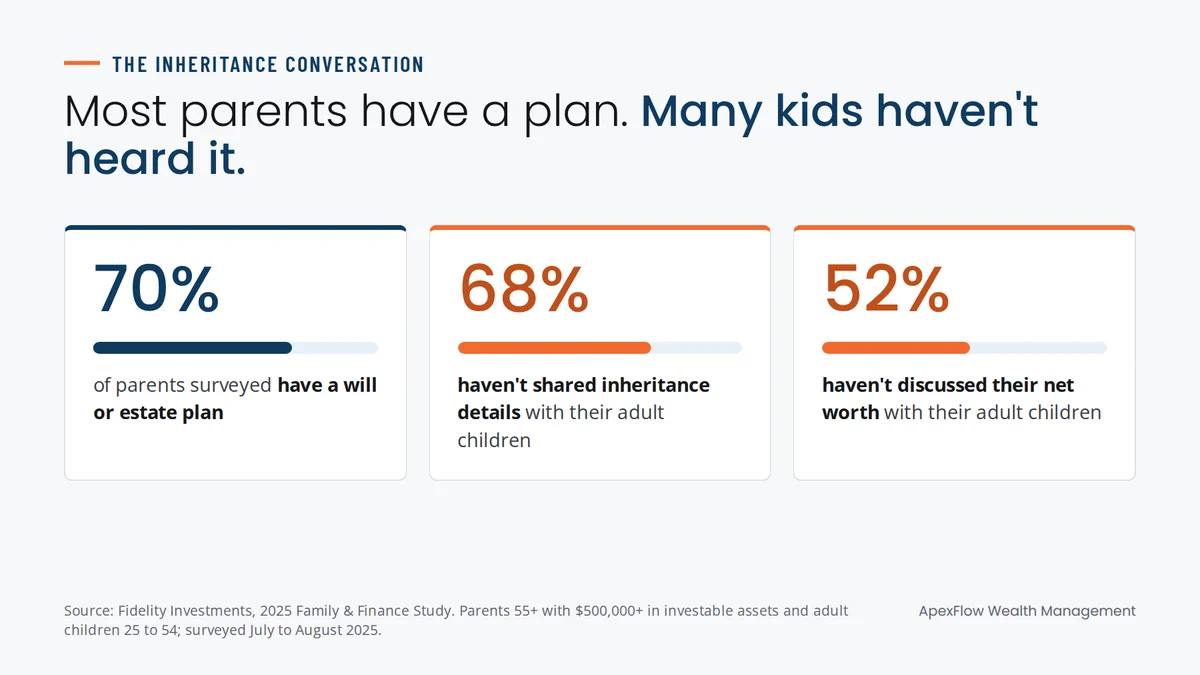
How to Talk to Your Adult Children About Inheritance
There’s a particular kind of silence that shows up around estate planning. Parents don’t want to talk about it because it means talking about theirRead more -
 October 7, 2026
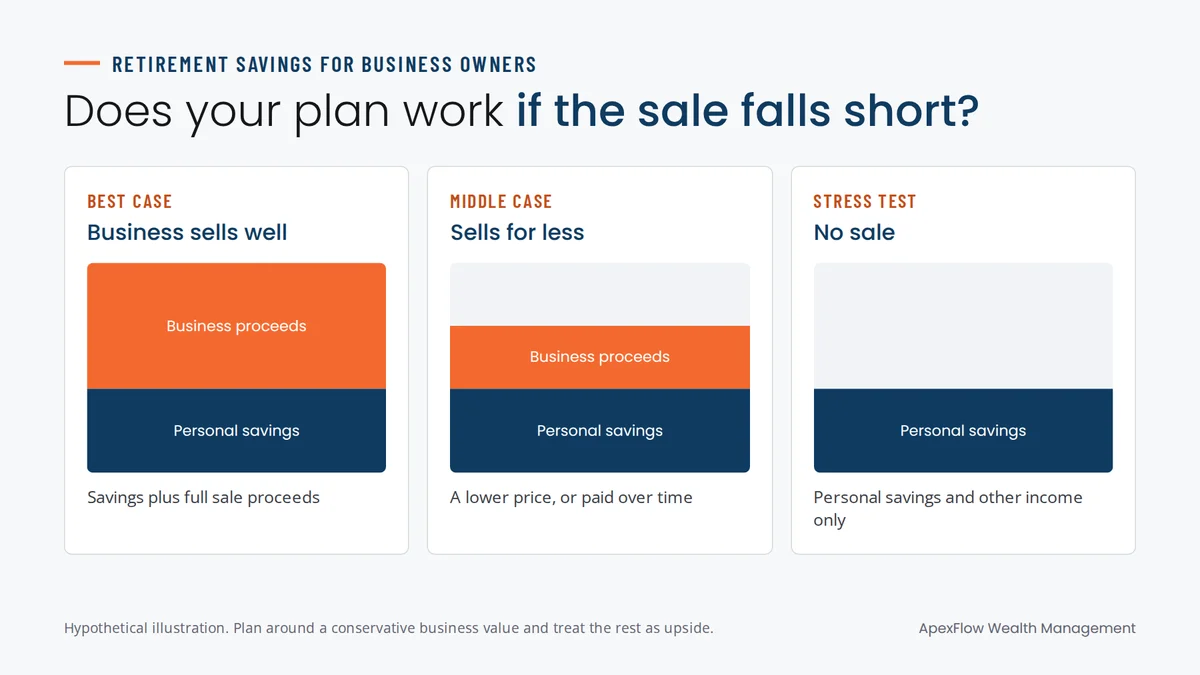
Retirement Savings by Age: Why Business Owners Need a Different Yardstick
One of the most common questions people quietly carry is simple: “Am I on track for retirement?” For business owners, the usual answers rarely fit.Read more -
 October 7, 2026
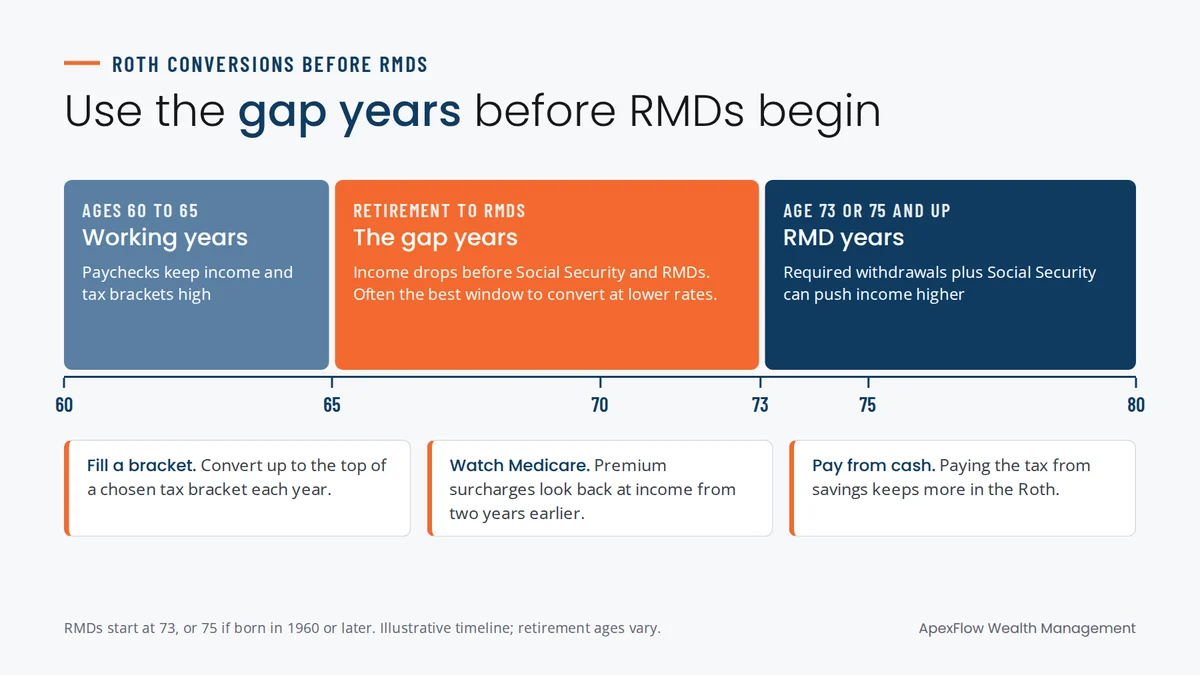
Roth Conversions Before RMDs: Making the Most of the Gap Years
For many retirees, the years between leaving work and starting required minimum distributions are the lowest-tax years they’ll ever have. The paycheck has stopped, SocialRead more