

At a glance
- The concentrated stock trap is simple: most of your wealth in one company, and no plan for reducing it.
- The best time to decide how much to sell is before the IPO or deal closes, when emotions are lower.
- Lockups, trading windows and tax lots all shape the schedule. A 10b5-1 plan turns the schedule into automatic sales.
- Qualified small business stock (QSBS), charitable gifts of shares and exchange funds can reduce the tax cost of diversifying.
- Set a target for what share of your net worth should stay in company stock, then work toward it.
An IPO or an acquisition is the moment years of equity turn into something you can actually spend. It is also the moment many executives make their most expensive mistake: they treat the stock as untouchable and let it sit as 60, 70 or 80 percent of their net worth. Sometimes it works out. Often it does not, and the people it happens to are not careless. They are loyal, optimistic and busy. The fix is a plan written before the deal, so loyalty is not what decides your retirement.
Two minutesYou are planning money for 30 years and a body for how many?Check my WealthSpan GapWhy concentration is a trap
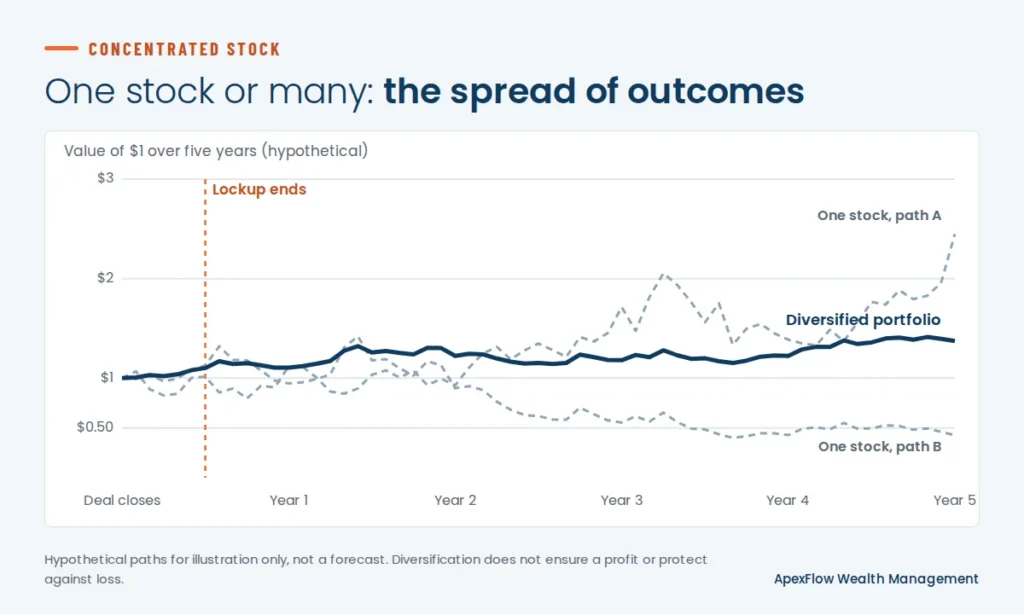
A single company can fail, be disrupted, miss a quarter or simply drift for a decade. A broad portfolio cannot do any of those things in the same way. Over long periods, a large share of individual stocks underperform the market, and a meaningful number lose most of their value. The problem is that the people holding a concentrated position almost always have good reasons to believe their company is the exception. Some are right. You cannot know in advance whether you are one of them, which is why we treat concentration as a risk to be managed, not a bet to be made. Our earlier article on concentrated stock positions covers the behavioral side.
Decide the target before the event
The single most useful thing you can do before an IPO closes is write down a number: the percentage of your net worth you are willing to keep in company stock once you are able to sell. For most clients it lands somewhere between 5 and 20 percent, depending on their other assets, their age and how much of their income already depends on the company. Then write down the schedule for getting there.
Making this decision before the stock has a public price matters. After the IPO, every sale will feel either too early or too late, and the stock’s daily movement will argue with your plan. A number written down in a calm month is easier to follow in a loud one.
Know the mechanics that control your timing
Lockups. After an IPO, insiders are usually barred from selling for about six months. Some companies release a portion early if the stock trades above a threshold. The lockup expiration is often a volatile day because many people sell at once.
Trading windows. As an insider, you may only trade during open windows after earnings. A 10b5-1 plan, adopted during an open window when you have no material nonpublic information, lets you set a schedule of sales that continues through closed windows. It is the standard tool for executives who want to diversify methodically. Rule changes in recent years added a cooling-off period before the first trade, so the plan has to be set up ahead of time.
Acquisitions. If your company is acquired for cash, the decision is made for you and the issue becomes taxes. If it is acquired for stock in the buyer, you have simply exchanged one concentration for another, and the plan still applies. Earnouts and retention packages add their own schedules.
Keeping the tax bill down
Diversifying a large position usually means realizing gains, and the tax bill can make people freeze. A few tools reduce the cost.
- Tax lot selection. Sell the highest-basis lots first and hold the lowest-basis lots longest. Shares from recent RSU vests often have little gain.
- Spreading across tax years. Selling across two or three calendar years keeps more of the gain in lower brackets and can soften net investment income tax.
- Qualified small business stock. If your company was a qualifying C corporation and you held the shares long enough, Section 1202 can exclude a large amount of gain from federal tax. Recent law changes expanded the benefit for stock issued after mid-2025. Founders and early employees should have their shares evaluated before selling anything.
- Charitable gifts of appreciated shares. Giving shares directly to a donor-advised fund or charity avoids the capital gain and produces a deduction. For people who give anyway, this is often the cheapest way to reduce a position.
- Exchange funds. These pool concentrated positions from many investors into a diversified fund without an immediate taxable sale. They have long lockups, costs and eligibility rules, and are only right for some situations.
Utah taxes capital gains as ordinary income at its flat rate, 4.45 percent for 2026, so the state cost is easy to estimate.
Hypothetical example: A product leader at a Utah company that went public holds shares worth $3 million, about 75 percent of her net worth, with a low cost basis. Before the lockup ends she and her advisor set a target of 15 percent in company stock within three years. They adopt a 10b5-1 plan that sells a fixed number of shares each quarter, gift the lowest-basis shares to a donor-advised fund to cover her planned giving for several years, and model the federal and Utah tax each year so estimated payments are made on time. Proceeds fund a diversified portfolio built from her plan. The example is hypothetical and does not represent any actual client.
The question underneath the stock
Underneath all of it is a simpler question: what is the money for? A written plan that says what the proceeds will fund, a home, a child’s education, financial independence by a certain age, makes it much easier to sell a share of a company you love. It is why our executive financial planning work starts with goals before tax lots, and why the portfolio that results is built the way we describe on our portfolio management page.
Frequently asked questions
There is no single number, but many planners get uncomfortable above 10 to 20 percent of net worth, and the figure should be lower if your salary and bonus also depend on the company. The right target is personal and should be written down before a liquidity event.
Scheduled sales through a 10b5-1 plan are common and expected for executives. Many companies encourage them because they reduce the appearance of trading on inside information.
Not paying estimated taxes on large sales or vests, and selling the lowest-basis shares first without a reason. A second common one is failing to check whether shares qualify for the small business stock exclusion before selling.
No. You still own one company, just a different one. The same target and schedule apply, with the added wrinkle of the buyer’s own trading windows and lockups.
Talk it through with us
Every situation is a little different. If you want to talk through yours, book a 20-Minute Fit Call with one of our advisors, by video or in person. No prep and no obligation. Want to see how we work first? Start with the Purposeful Planning Process or our services.

The information in this article is general in nature and is not a recommendation for any individual. Consider your own circumstances or speak with an advisor before acting on it. Any opinions are those of the author and not necessarily those of Raymond James.
ApexFlow Wealth Management does not provide tax or legal advice. Please consult your tax or legal professional before acting on any strategy mentioned here.
Investing involves risk, and you may incur a profit or loss regardless of the strategy selected, including diversification and asset allocation. Past performance does not guarantee future results.
Examples labeled as hypothetical are for illustration only. They are not based on any actual client and do not represent actual or expected results.
Related Articles
Dig deeper into our resource library
-
 October 29, 2026
Year-End Planning for Executives: A 2026 Checklist for Equity and Deferred Pay
Executive pay decisions run on their own calendar. A dated checklist for 2027 deferral elections, RSU withholding, ISO exercises under the 2026 AMT rules, 10b5-1 plans and 401(k) catch-ups.Read more -
 October 29, 2026
Deferred Compensation Plans: When Deferring Makes Sense and When It Doesn’t
Nonqualified deferred compensation can be one of the best tax tools an executive has, or an unsecured loan to an employer. Here is how to tell which one you are looking at.Read more -
 November 5, 2026
Too Much Company Stock? How to Diversify a Concentrated Stock Position
“Don’t put all your eggs in one basket” is advice everyone nods along to and almost nobody applies correctly. The people most likely to breakRead more