


By Trevor Hanson, Wealth Advisor, RJFS
Last reviewed November 9, 2026
Trevor’s key points
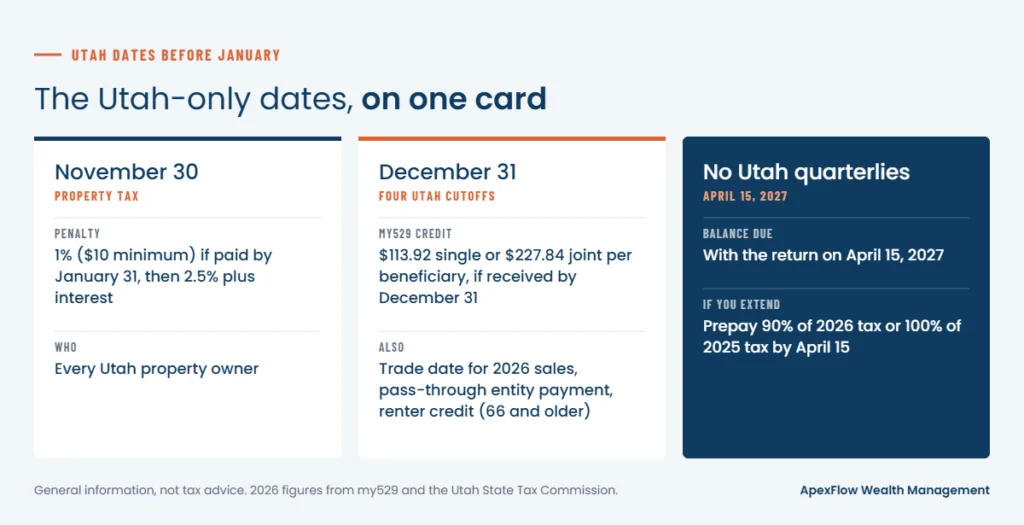
- November 30: property tax is due to your county. The penalty is 1% ($10 minimum) if paid by January 31, then 2.5% plus interest.
- December 31: my529 contributions must be received to count for 2026. The 4.45% credit covers up to $2,560 per beneficiary for single filers and $5,120 for joint filers.
- December 31: the trade date, not the settlement date, decides which year a sale belongs to, for both the federal return and Utah’s.
- Utah does not require quarterly estimated payments from individuals. Any balance is due April 15, 2027, and prepaying by then matters only if you file an extension.
Book a 20-Minute Fit Call or call 385-606-0358.
Most year-end checklists stop at the federal dates: the December 31 trade date, required minimum distributions, 401(k) deferrals. Utah adds a short list of its own, and several carry real money for families on the Wasatch Front. Property tax is due November 30. A my529 contribution received by December 31 earns a Utah credit of $113.92 per beneficiary for single filers and $227.84 for joint filers. A December Roth conversion or IRA withdrawal can push a retiree past the income line where the Social Security credit starts to shrink. Below are the Utah-specific dates, what each is worth and who should care, in the order they arrive. For the federal list, see our 2026 year-end tax planning checklist.
Trevor works with people who want their retirement income and investments in one plan. We take new clients in Salt Lake City and by video. Book a 20-Minute Fit Call or call 385-606-0358.
November 30: property tax
Property tax goes to the county, and the state sets the date: November 30, or the next business day when that falls on a weekend (Utah Code 59-2-1331). In 2026 that is a Monday. Pay late and the penalty is 1% of the tax, or $10 if more, as long as you settle up by January 31, 2027; after that it is 2.5% and interest runs from January 1. If your lender pays from escrow, confirm it happened. We cover the exemption, the senior relief programs and the deduction in Utah property taxes are due November 30.
December 31: the my529 contribution credit
Utah’s 529 plan comes with a state income tax credit for Utah taxpayers. For 2026, my529 lists the credit at 4.45% of contributions up to $2,560 per beneficiary for single filers, a credit of $113.92, and up to $5,120 per beneficiary for joint filers, a credit of $227.84. It is per beneficiary, so a couple with three grandchildren’s accounts can earn three credits.
Timing is the catch. A contribution counts for the year my529 receives it. For 2026, my529 lists two cutoffs on Thursday, December 31: online contributions must be received before 11:59 p.m. Mountain Time, and contributions made through its manual process before 5:00 p.m. A check mailed in the last week of the year can miss the window. If a grandparent is funding the account, our guide to my529 for grandparents covers who should own it and why that affects the credit.
December 31: the trade date rule
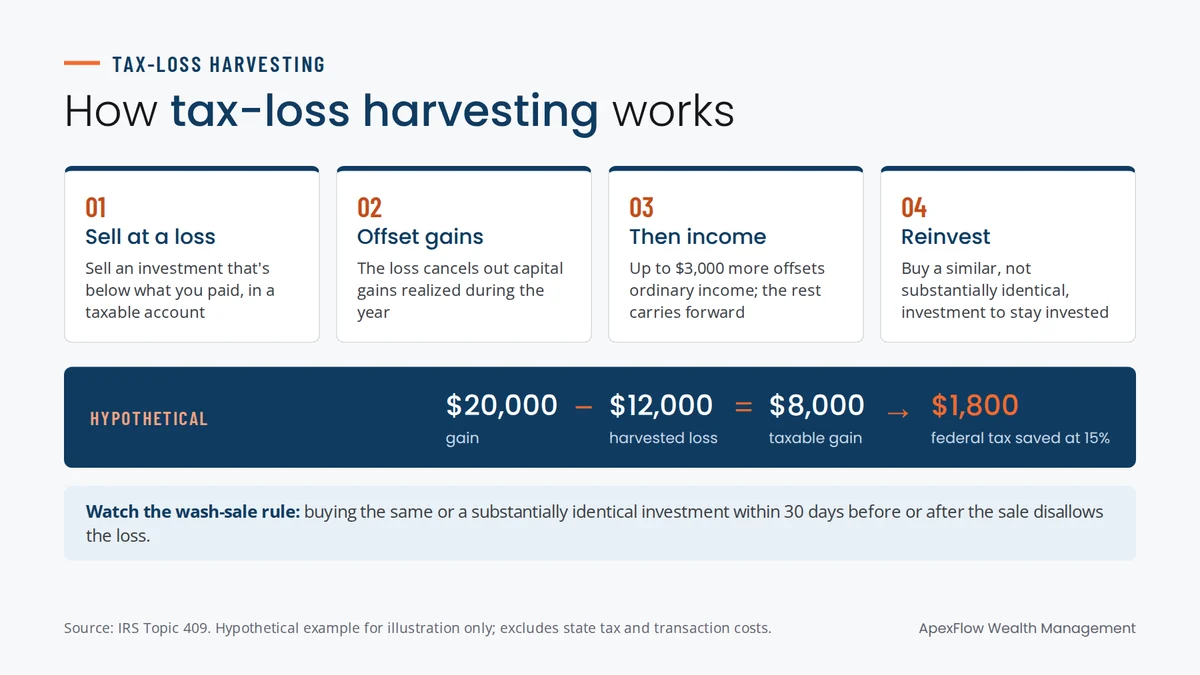
If you plan to sell an investment at a loss to offset gains, the sale has to have a 2026 trade date, and markets are open Thursday, December 31. Settlement a day or two later does not move it into 2027. The same rule applies to selling a winner you meant to realize this year. Utah’s return starts from federal adjusted gross income, so whatever the sale does to your federal income carries straight into the 4.45% Utah tax. The mechanics and the wash-sale trap are in tax-loss harvesting and the wash-sale rule.
How much of your retirement is actually decided? Get my Clarity Score (two minutes).
December 31: the Social Security credit income line
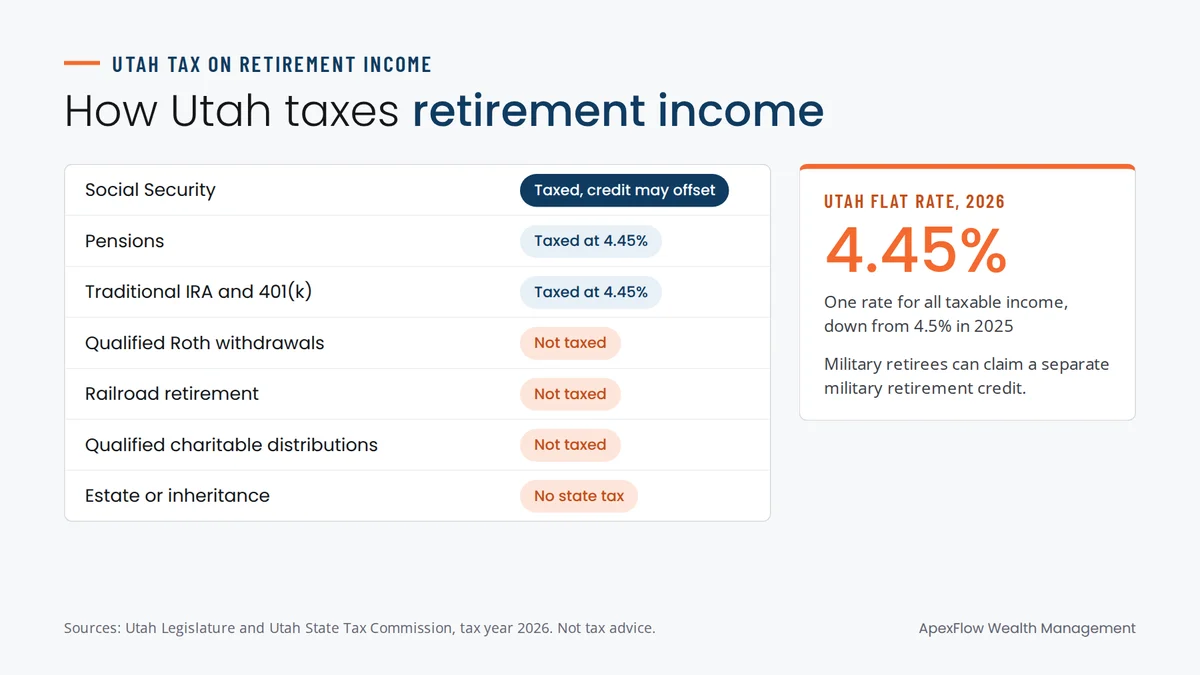
This one catches retirees who make December moves. Utah taxes Social Security at 4.45%, but a credit equal to the tax on your taxable benefits can cancel it. The credit phases out by 2.5 cents for every dollar of modified adjusted gross income above $54,000 for single filers and $90,000 for joint filers, as explained in how Utah taxes retirement income.
A Roth conversion, a large IRA withdrawal or a realized gain in December all raise that income. For a couple sitting just under $90,000, a $20,000 conversion costs more than the 4.45% on the conversion itself: it also removes $500 of the Social Security credit (2.5 cents times $20,000). That does not make the conversion wrong, but it belongs in the math. If you are weighing one, read Roth conversions before RMDs with the Utah credit in view.
Hypothetical example for illustration only. Dan and Lori, both 68, file jointly in Sandy with $84,000 of modified adjusted gross income, including $32,000 of taxable Social Security. Their Utah Social Security credit is $1,424 (4.45% of $32,000), and because they are under $90,000 they keep all of it. They are considering a $30,000 Roth conversion in December. It would raise their income to $114,000, which is $24,000 over the line, and shrink the credit by $600 (2.5 cents times $24,000) to $824. The conversion would also add $1,335 of Utah tax (4.45% of $30,000) and the federal tax on $30,000. Splitting the conversion across December 2026 and January 2027 keeps each year under or near the line.
Math: $32,000 x 4.45% = $1,424. $84,000 + $30,000 = $114,000; $114,000 minus $90,000 = $24,000; $24,000 x 2.5% = $600; $1,424 minus $600 = $824. $30,000 x 4.45% = $1,335.
December 31: the pass-through entity payment
Business owners who elected Utah’s pass-through entity tax for 2026 pay it at the business level, and the payment is due by the last day of the business’s tax year, December 31 for a calendar-year company. The election is irrevocable for the year and payments are not refunded, so this is a payment to confirm with your CPA now rather than discover in March. Details in Utah’s pass-through entity tax election.
December 31: the renter credit for people 66 and older
A Utah renter who is 66 or older, or an unmarried surviving spouse, with 2025 household income under $44,221 can claim a renter credit of up to $1,412 from the Utah State Tax Commission by December 31, online at tap.utah.gov or on form TC-90CB (Publication 36). This is the one property tax relief program that is still open this year; the homeowner programs closed September 1.
January 15: a federal date, not a Utah one
The IRS fourth-quarter estimated payment for 2026 is due January 15, 2027. Utah has no equivalent. The Utah State Tax Commission does not require quarterly prepayments from individuals; your Utah balance is due with the return on April 15, 2027. The prepayment rule only matters if you plan to file late: Utah grants an automatic six-month extension to file, but to avoid a penalty you must have paid 90% of your 2026 Utah tax, or 100% of your 2025 Utah tax, by April 15. Withholding, a prior-year refund applied forward and payments on form TC-546 all count. If you had a large capital gain or conversion this year and no withholding on it, that April 15 payment is the Utah date to plan for.
The dates on one page
| Date | What | Who it affects | Where |
|---|---|---|---|
| Mon Nov 30, 2026 | Property tax due; 1% penalty if paid by Jan 31, then 2.5% plus interest | Every property owner | County treasurer |
| Thu Dec 31, 2026 | my529 contribution received for the 2026 credit ($113.92 single, $227.84 joint, per beneficiary) | Parents, grandparents | my529.org |
| Thu Dec 31, 2026 | Trade date for 2026 gains and losses | Taxable account investors | Your custodian |
| Thu Dec 31, 2026 | Income line for the Social Security credit ($54,000 single, $90,000 joint) | Retirees weighing conversions or withdrawals | Your advisor and CPA |
| Thu Dec 31, 2026 | Pass-through entity tax payment for calendar-year businesses | Owners who elected for 2026 | Business, with CPA |
| Thu Dec 31, 2026 | Renter credit application (66 and older) | Renters under the income limit | tap.utah.gov or TC-90CB |
| Fri Jan 15, 2027 | Federal Q4 estimated payment; no Utah equivalent | Anyone making federal estimates | IRS |
| Thu Apr 15, 2027 | Utah balance due; 90% or 100% prepayment test if extending | Everyone | Utah Tax Commission |
Where we fit in
Most of these dates are easy once someone is watching them. We keep them on each client’s calendar, run the Social Security credit math before any December conversion or withdrawal, and coordinate the my529 and pass-through items with your CPA so nothing lands in the wrong year. It is part of the Design stage of our planning process.
What happens on a 20-Minute Fit Call
- You tell us a little. Four quick fields on the booking page. We reply within one business day to set a time that works for you.
- We talk for 20 minutes. You share where you are and what you want to figure out. We ask a few questions and tell you whether we can help.
- You decide. If it feels right, we outline your first meeting. If not, you still walk away with a useful next step and no follow-up pressure.
Or call 385-606-0358.
Frequently asked questions
Contributions have to be received by my529 by December 31 to count for that tax year. For 2026 the credit is 4.45% of up to $2,560 per beneficiary for single filers and $5,120 for joint filers, a maximum of $113.92 or $227.84 per beneficiary.
No. Individuals pay any Utah balance with the return by April 15. Prepaying 90% of the current year’s tax or 100% of last year’s by April 15 matters only if you file on extension and want to avoid a penalty.
November 30, or the next business day if that is a weekend or holiday. In 2026 it is Monday, November 30.
It can. The credit phases out at 2.5 cents per dollar of modified adjusted gross income above $54,000 for single filers and $90,000 for joint filers, and a conversion raises that income in the year it is done.
Yes. The trade date decides the tax year for both the federal and Utah returns.
Talk it through with us
If December moves, a Roth conversion or a grandchild’s my529 are on your list this year, we’d be glad to run the Utah numbers with you before the dates pass. Book a 20-Minute Fit Call. It’s virtual, no prep is needed and there’s no obligation.

The information in this article is general in nature and is not a recommendation for any individual. Consider your own circumstances or speak with an advisor before acting on it. Any opinions are those of the author and not necessarily those of Raymond James.
ApexFlow Wealth Management does not provide tax or legal advice. Please consult your tax or legal professional before acting on any strategy mentioned here.
Investing involves risk, and you may incur a profit or loss regardless of the strategy selected, including diversification and asset allocation. Past performance does not guarantee future results.
Examples labeled as hypothetical are for illustration only. They are not based on any actual client and do not represent actual or expected results.
Related Articles
Dig deeper into our resource library
-
 November 23, 2026
Year-End Tax Planning 2026: What Must Happen by December 31 and What Can Wait
Some 2026 tax moves must be finished by December 31 and others can wait until April 15, 2027. A dated checklist, plus how the new charitable, senior and SALT rules change the math this year.Read more -
 November 20, 2026
Tax-Loss Harvesting: How It Works and How to Avoid the Wash-Sale Rule
By Samuel Preine, Wealth Advisor, RJFSOctober 7, 2026Tax-loss harvesting means selling an investment in a taxable account for less than you paid, using that lossRead more -
 November 23, 2026
Does Utah Tax Retirement Income? Social Security, Pensions and 401(k)s in 2026
By Trevor Hanson, Wealth Advisor, RJFSAugust 1, 2026If you’re planning to retire in Utah, or you already have, it’s worth knowing exactly how the stateRead more