


By Trevor Hanson, Wealth Advisor, RJFS
Last reviewed November 2, 2026
Trevor’s key points
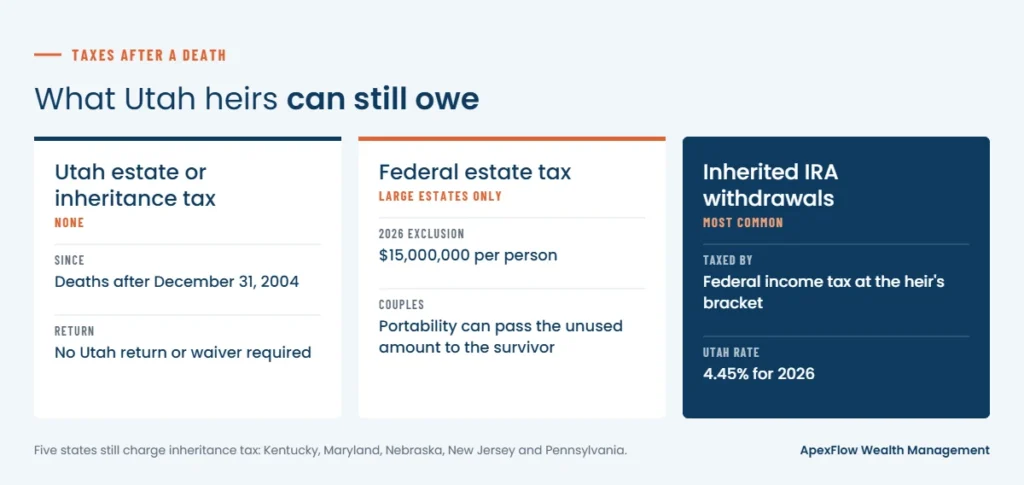
- Utah’s former “pick up” estate tax ended for deaths after December 31, 2004, and Utah no longer requires an inheritance tax return or waiver.
- The federal estate tax only applies above $15,000,000 per person for 2026, and a surviving spouse can keep the unused amount through a portability election.
- Withdrawals from an inherited traditional IRA or 401(k) are taxable income, federally and at Utah’s 2026 flat rate of 4.45%.
- Five states still charge inheritance tax (Kentucky, Maryland, Nebraska, New Jersey and Pennsylvania), and it can reach a Utah heir when the person who died lived or owned property there.
Book a 20-Minute Fit Call or call 385-606-0358.
No. Utah has no estate tax and no inheritance tax, and Utah heirs do not file a state inheritance tax return. That does not mean an inheritance is tax free. Depending on what you inherit and where the person lived, federal estate tax, income tax on retirement accounts or another state’s inheritance tax can still apply. Below we cover what Utah does not tax, the taxes that can still show up, and the planning steps that matter most for Utah families.
Trevor works with people who want their retirement income and investments in one plan. We take new clients in Salt Lake City and by video. Book a 20-Minute Fit Call or call 385-606-0358.
Why Utah has no estate or inheritance tax
Utah’s old estate tax was a “pick up” tax. It collected a share of the federal estate tax through a credit the federal government allowed for state death taxes. When Congress phased out that federal credit, Utah’s tax went with it. The Utah State Tax Commission says there is no longer a basis for the Utah inheritance tax for deaths after December 31, 2004, that Utah inheritance tax returns do not need to be filed, and that Utah does not require an inheritance tax waiver.
An estate tax and an inheritance tax are different. An estate tax is charged to the estate before anything is distributed. An inheritance tax is charged to the person who receives the money, and the rate often depends on how closely related they were to the person who died. Utah has neither.
The federal estate tax: the line that matters
For Utah families with very large estates, the federal estate tax is the one to plan around. For people who die in 2026, the federal basic exclusion amount is $15,000,000 per person, set by the 2025 federal tax law and confirmed in IRS Revenue Procedure 2025-32. Amounts above the exclusion are taxed, and the exclusion is scheduled to adjust for inflation in later years.
Married couples can effectively double it. When the first spouse dies, the executor can elect “portability,” which passes that spouse’s unused exclusion to the survivor. The election is made on a timely filed federal estate tax return (Form 706), even when no tax is owed. If the estate was not otherwise required to file, the IRS allows a simplified late election up to five years after the date of death under Revenue Procedure 2022-32. Skipping this filing is a common and costly mistake for families whose combined wealth could grow toward the limit.
Gifts during life count against the same exclusion, with one exception. For 2026 you can give up to $19,000 per recipient without using any of it or filing a gift tax return, according to the IRS.
How much of your retirement is actually decided? Get my Clarity Score (two minutes).
What Utah heirs do pay: income tax on inherited retirement accounts
This is the tax most Utah families meet. Traditional IRAs, 401(k)s and similar accounts were funded with pre-tax money, so every withdrawal an heir takes is taxable income. Federal income tax applies at the heir’s own bracket, and Utah taxes it at the 2026 flat rate of 4.45% (lowered from 4.5% by the 2026 Legislature, SB 60).
Most adult children who inherit an IRA must empty it within ten years, and some must also take yearly withdrawals along the way. When and how much to withdraw each year can make a real difference to the total tax, especially for heirs in their peak earning years. We explain the rules in The inherited IRA 10-year rule.
Inherited Roth IRAs work differently. Qualified withdrawals are generally tax free, which is one reason some retirees convert part of their traditional IRA to Roth during their lifetime.
The step-up in basis
Inherited stocks, funds and real estate usually receive a new cost basis equal to their value on the date of death, as the IRS explains in Publication 559. Hypothetical example for illustration only: if a parent bought shares for $50,000 and they were worth $300,000 at death, the heir’s basis is generally $300,000. Selling soon after for about that amount produces little or no taxable gain.
This is why giving appreciated assets away during life, or adding a child to the title of a house, can backfire. A gift carries the giver’s original basis, so the child could owe tax on decades of growth that would have been wiped out at death. Talk it through with your advisor and attorney before retitling property.
When another state’s inheritance tax applies to a Utah heir
Living in Utah does not protect you from another state’s inheritance tax. These taxes generally follow where the person who died lived, and for real estate, where the property sits. Five states charge an inheritance tax: Kentucky, Maryland, Nebraska, New Jersey and Pennsylvania. Iowa repealed its tax effective January 1, 2025.
Close relatives are often exempt or taxed at low rates in these states, while siblings, nieces, nephews and friends can pay more. If a parent lives in one of these states, or you expect to inherit a property there, it is worth looking at the rules now. Several states also have their own estate tax with much lower exemptions than the federal one, which matters if a family member owns property in one of them.
Moving to Utah from a community property state
Utah is not a community property state. Couples who moved here from states such as California, Arizona or Nevada may still own property that kept its community property character. Utah’s Uniform Disposition of Community Property Rights at Death Act addresses how that property passes at death. It can also affect the step-up in basis, so it belongs on the list when you update your estate plan after moving to Utah.
Where we fit in
For most Utah families, the real tax planning happens in how retirement accounts, appreciated investments and the house pass to the next generation. We map who inherits what, check beneficiary designations, model the income tax heirs would pay, and coordinate with your estate planning attorney and CPA. It is part of the Design stage of our planning process.
What happens on a 20-Minute Fit Call
- You tell us a little. Four quick fields on the booking page. We reply within one business day to set a time that works for you.
- We talk for 20 minutes. You share where you are and what you want to figure out. We ask a few questions and tell you whether we can help.
- You decide. If it feels right, we outline your first meeting. If not, you still walk away with a useful next step and no follow-up pressure.
Or call 385-606-0358.
Frequently asked questions
No. Utah’s inheritance tax ended for deaths after December 31, 2004, when the federal credit it depended on was phased out. Utah does not require an inheritance tax return or waiver.
A cash inheritance is not income for Utah or federal purposes. Withdrawals from an inherited traditional IRA or 401(k) are taxable income, and Utah taxes them at its 2026 flat rate of 4.45%.
The federal estate tax applies to the estate, not the heir, and only above $15,000,000 per person for 2026. A married couple can shelter up to twice that if the surviving spouse elects portability.
Possibly. Pennsylvania’s inheritance tax is based on the person who died, not the heir’s state, so a Utah heir can owe it. Rates depend on the relationship, and children are taxed at a lower rate than more distant relatives.
Often it is better not to. A gift during life passes your original cost basis to your child, while property inherited at death usually gets a step-up in basis. A transfer on death deed or a revocable trust can avoid probate without giving up that benefit.
Talk it through with us
If you’d like to see what your heirs would owe, and how to pass assets to them more efficiently, we’d be glad to help. Book a 20-Minute Fit Call. It’s virtual, no prep is needed and there’s no obligation.

The information in this article is general in nature and is not a recommendation for any individual. Consider your own circumstances or speak with an advisor before acting on it. Any opinions are those of the author and not necessarily those of Raymond James.
ApexFlow Wealth Management does not provide tax or legal advice. Please consult your tax or legal professional before acting on any strategy mentioned here.
Investing involves risk, and you may incur a profit or loss regardless of the strategy selected, including diversification and asset allocation. Past performance does not guarantee future results.
Examples labeled as hypothetical are for illustration only. They are not based on any actual client and do not represent actual or expected results.
Related Articles
Dig deeper into our resource library
-
 November 23, 2026
The Inherited IRA 10-Year Rule: What to Do When You Inherit an IRA or 401(k)
Most people who inherit an IRA or 401(k) now have ten years to empty it, and many must also withdraw something every year. How the rules sort beneficiaries, what spouses can do, and how to spread the tax.Read more -
 November 23, 2026
How to Leave a Home to Your Kids Without Creating a Fight
The family home is the asset most likely to divide siblings after a death. Here is how to pass it on in a way that is clear, tax-smart and fair, with Utah-specific tools.Read more -
 November 20, 2026
Moved to Utah? Why Your Estate Plan Needs a Fresh Look
By Samuel Preine, Wealth Advisor, RJFSSeptember 3, 2026There’s a comforting myth about estate planning: that it’s a project with an end date. You meet withRead more