


By Trevor Hanson, Wealth Advisor, RJFS
Last reviewed November 4, 2026
Trevor’s key points
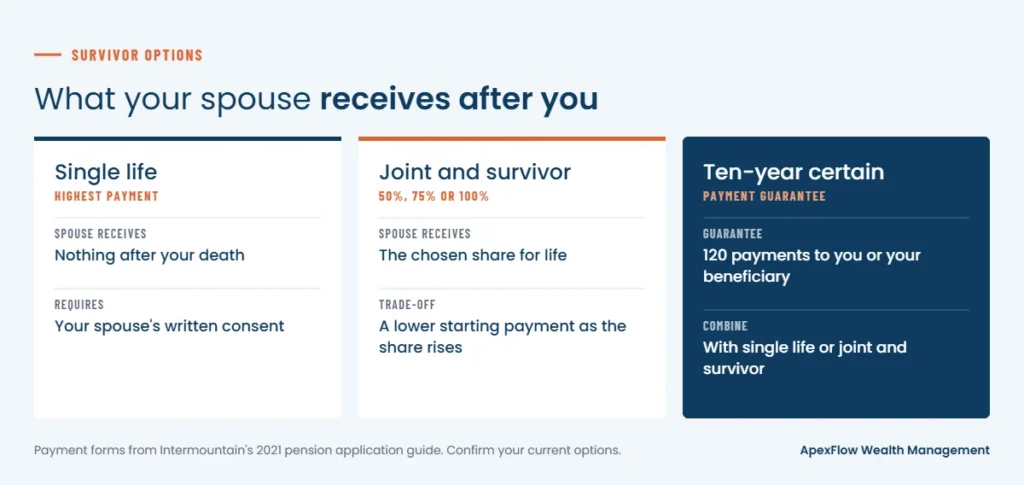
- Intermountain’s 2021 pension application guide lists a single life annuity, a joint and survivor annuity paying 50%, 75% or 100% to a surviving spouse, ten-year certain versions of both, and a lump sum.
- Under federal law, a married participant’s pension is paid with a spousal survivor benefit unless both spouses agree in writing to another form, and the spouse’s signature must be witnessed by a notary or plan representative.
- When one spouse dies, Social Security pays the survivor the higher of the two benefits, not both.
- Once pension payments begin, the form of payment is generally permanent.
Book a 20-Minute Fit Call or call 385-606-0358.
Married Intermountain caregivers who take the pension as monthly payments have to decide how much of that check continues to a spouse after they die. A joint and survivor option at 50%, 75% or 100% protects the spouse but lowers the payment you start with, while the single life option pays more and requires your spouse’s written consent. Below we cover the payment forms, the federal consent rules, the factors that usually decide the choice and how it fits with Social Security. For the wider picture, start with our Intermountain pension freeze guide.
ApexFlow Wealth Management is not affiliated with Intermountain Health. For your exact figures, start with Intermountain’s retirees page (“Manage your pension”), where the Intermountain Retirement Program lists its contact details. Intermountain has said it is offering one-on-one retirement consultations and a tool to calculate benefits after the freeze (KSL), and AskHR can assign you a Retirement Consultant.
Trevor works with people who want their retirement income and investments in one plan. We take new clients in Salt Lake City and by video. Book a 20-Minute Fit Call or call 385-606-0358.
What survivor options does the Intermountain pension offer?
Intermountain’s 2021 pension application guide lists five ways to receive the pension, and the undated guide for active caregivers on the retirees page lists the same five. Plan terms can change, so confirm the current options before you apply.
| Payment form | What it pays | Who it tends to suit (general, not advice) |
|---|---|---|
| Single life annuity | Monthly payments for your life only. Nothing is paid after your death. | Unmarried caregivers, or couples where the spouse has ample income of their own. |
| Joint and survivor, 50% | A reduced payment for your life, then half of it to your surviving spouse for life. | Couples who want some protection and a higher starting check. |
| Joint and survivor, 75% | The same, with three quarters continuing to your spouse. | Couples looking for a middle ground. |
| Joint and survivor, 100% | The same, with the full payment continuing to your spouse. | Couples where the spouse would rely heavily on this pension. |
| Ten-year certain versions | Either form above, with 120 monthly payments guaranteed. If you (and your spouse, under the joint version) die sooner, your beneficiary receives the rest. | People who want something left for heirs if death comes early. |
| Lump sum | One payment, rolled to an IRA or taken in cash. | Covered in lump sum or monthly payments. |
Why does a bigger survivor benefit mean a smaller check?
A joint and survivor payment may run for two lifetimes instead of one, so the plan starts it lower than the single life amount. Intermountain’s current guide calls it a “reduced monthly amount.” Three things set the size of the reduction: the survivor percentage, your age and your spouse’s age. A higher percentage costs more each month, and a much younger spouse generally means a larger reduction because the plan expects to pay for more years.
Hypothetical example for illustration only. These figures are assumptions, not Intermountain’s conversion factors. Say a caregiver’s single life annuity would be $3,000 a month. Assume the 50% joint and survivor option pays $2,700 and the 100% option pays $2,400. Under the 50% option the survivor would receive $1,350 a month, and under the 100% option the full $2,400. Giving up an extra $300 a month while you are alive buys an extra $1,050 a month for the survivor.
Since no one knows who will outlive whom, a practical starting point is the income your spouse would need without you.
Can you take the single life option if you’re married?
Only with your spouse’s agreement. Under Internal Revenue Code sections 401(a)(11) and 417, a pension must pay a married participant a qualified joint and survivor annuity unless the participant and spouse consent in writing to another form, and a plan representative or notary must witness the spouse’s consent, according to the IRS. The survivor’s share must be no less than 50% and no more than 100%.
Intermountain’s guide names this requirement for the single life annuity and lists a spousal waiver form. If you are weighing a ten-year certain option or a beneficiary other than your spouse, ask whether that choice needs a waiver too.
What should you weigh before choosing?
- Age gap. A younger spouse is more likely to outlive you and also raises the cost of survivor coverage.
- Health. A spouse in poor health may need less survivor income, while a healthy spouse from a long-lived family may need more.
- Your spouse’s own income. A spouse with their own pension, a 401(k) or a larger Social Security benefit may need less from yours.
- If your spouse dies first. Intermountain’s guide does not describe a “pop-up” feature, which in some pensions raises your payment back to the single life amount if your spouse dies first. Without one, the reduced payment generally continues unchanged, so ask Intermountain how its plan handles this.
- Other savings. From 2027, new retirement savings at Intermountain go to the 401(k), and that balance can pass to a spouse. Capturing the full 401(k) match helps build that second source of survivor income.
Is life insurance a better way to protect your spouse?
Some couples take the single life option for the higher check and buy life insurance to replace the survivor income. If your spouse dies first, you keep the larger payment and can drop the policy. The approach only holds up if the numbers work and the policy lasts as long as you do.
- Compare the premium with the monthly amount a survivor option would cost you.
- Coverage and price depend on underwriting, and a diagnosis can make a policy expensive or unavailable.
- Term coverage can end before you die, leaving your spouse with neither the policy nor a pension.
- Your spouse would need a plan to turn a lump-sum death benefit into lifetime income.
- The single life option still requires your spouse’s witnessed consent.
How does the pension choice fit with Social Security survivor benefits?
When one spouse dies, the household goes from two Social Security checks to one. A survivor eligible for both their own benefit and a survivor benefit receives one payment, and “the payments won’t be added together,” according to the Social Security Administration. A survivor at full retirement age can receive up to 100% of the deceased spouse’s benefit. At the first death, the household loses the smaller Social Security check plus whatever part of the pension stops.
The two decisions work together. If the higher earner delays Social Security, the survivor inherits the delayed retirement credits, which can make a lower pension survivor percentage easier to live with. We cover claiming in Social Security strategies for married couples, and our financial checklist after losing a spouse covers what a survivor faces.
What about divorce or a former spouse?
A divorce can reach your pension through a qualified domestic relations order (QDRO), and “a QDRO may assign survivor benefits to a former spouse,” according to the Department of Labor. Federal rules generally tie the survivor annuity to the person you are married to when payments begin, unless a QDRO changes it. If you have been divorced or expect to remarry, talk with a family law attorney and Intermountain before you elect.
Can you change your survivor option later?
Once payments begin, the choice is generally permanent. Intermountain’s guide says a submitted application cannot be changed, so you would cancel the request and start over. Federal rules allow an election to be revoked before the annuity starting date, so confirm Intermountain’s cutoff before you apply.
The decision may come sooner than some caregivers expect. Intermountain’s April 2026 summary of plan changes says participants not already receiving payments may start their pension while still working at 65 beginning January 1, 2027, or at 59½ beginning March 1, 2027. The survivor choice is made whenever payments start.
Which of the 2027 decisions have you made? Check my 2027 decisions (one minute).
Where we fit in
Intermountain’s tool and consultants can give you the exact figure for each form. As an outside second opinion, we set those figures beside your spouse’s benefits, Social Security timing, Utah taxes and savings, test how your spouse would live under each option and coordinate with your attorney or CPA. It builds on our Intermountain pension freeze guide and is part of our planning process.
What happens on a 20-Minute Fit Call
- You tell us a little. Four quick fields on the booking page. We reply within one business day to set a time that works for you.
- We talk for 20 minutes. You share where you are and what you want to figure out. We ask a few questions and tell you whether we can help.
- You decide. If it feels right, we outline your first meeting. If not, you still walk away with a useful next step and no follow-up pressure.
Or call 385-606-0358.
Frequently asked questions
It is a monthly pension paid for your life that continues, at a percentage you choose, to your surviving spouse for the rest of their life. Intermountain’s 2021 guide offers 50%, 75% or 100%. Because payments may last two lifetimes, the starting check is lower than a single life annuity.
Yes. Federal law requires a married participant’s spouse to consent in writing to give up the joint and survivor form, with the signature witnessed by a notary or plan representative. Intermountain’s guide states this requirement for the single life annuity.
Among the joint and survivor options, the 50% version starts with the highest payment and the 100% version with the lowest. The single life annuity pays more than any of them but leaves nothing for a spouse. Exact amounts depend on both of your ages, so get your figures from Intermountain.
Federal law requires traditional pension plans to provide a qualified pre-retirement survivor annuity to married participants unless both spouses waive it in writing, according to the IRS. Ask Intermountain how its plan calculates that benefit for your spouse.
Generally not. Intermountain’s guide says a submitted application cannot be changed without cancelling and starting over, and federal rules allow an election to be revoked before the annuity starting date. Confirm the deadline with Intermountain before you apply.
Talk it through with us
If you’d like a second opinion on which survivor option fits your household, using the figures Intermountain gives you, we’d be glad to help. Book a 20-Minute Fit Call. It’s virtual, no prep is needed and there’s no obligation.

The information in this article is general in nature and is not a recommendation for any individual. Consider your own circumstances or speak with an advisor before acting on it. Any opinions are those of the author and not necessarily those of Raymond James.
ApexFlow Wealth Management does not provide tax or legal advice. Please consult your tax or legal professional before acting on any strategy mentioned here.
Investing involves risk, and you may incur a profit or loss regardless of the strategy selected, including diversification and asset allocation. Past performance does not guarantee future results.
Examples labeled as hypothetical are for illustration only. They are not based on any actual client and do not represent actual or expected results.
Related Articles
Dig deeper into our resource library
-
 November 12, 2026
Your Intermountain Pension After the Freeze: Lump Sum or Monthly Payments?
The Intermountain pension freeze stops new benefits, but the pension you earned still has to be paid out. We compare monthly payments with a lump sum, the age 65 rule, rollover taxes and spousal consent.Read more -
 November 18, 2026
How Much to Put in Your Intermountain 401(k) to Get the Full Match
Intermountain caregivers moving off the pension in 2027 get a new 2% automatic contribution and a match reported at up to 4%. What to contribute to capture the full match, and why maxing out early can cost you.Read more -
 November 23, 2026
Social Security Claiming Strategies for Married Couples
For a married couple, Social Security is two decisions that affect each other for the rest of both lives. Here is how the spousal and survivor rules work and how we help couples choose.Read more