
Somewhere along the way, “trust” became a word people associate with wealth they don’t think they have. Trusts are for other people, the thinking goes: people with more complicated lives, more real estate, more zeros. Most of the time, that’s not really true. So, do you need a trust? The better question isn’t whether you’re wealthy enough for one. It’s whether your family’s situation is complex enough to benefit from what a trust does that a will doesn’t.

At a glance
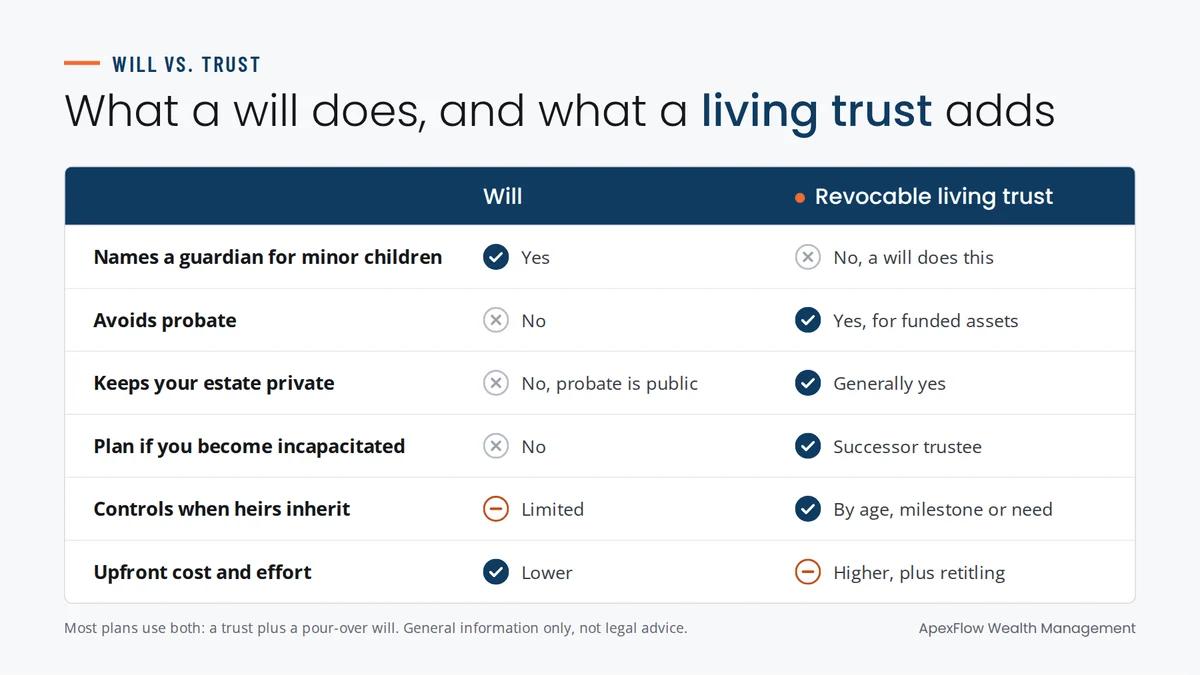
- A will says who gets what and names a guardian for minor children, but it usually goes through probate and does nothing if you become incapacitated.
- A revocable living trust can avoid probate, keep your affairs private and give you a built-in plan for incapacity, but it costs more to set up and only works if you fund it.
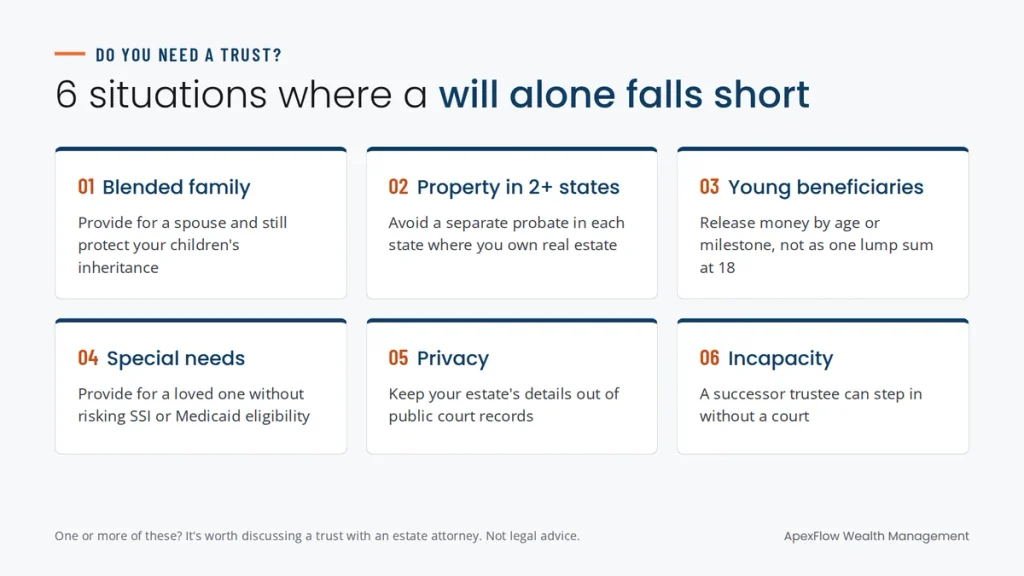
- Six situations tend to tip the scale toward a trust: a blended family, property in more than one state, young beneficiaries, a beneficiary with special needs, a desire for privacy and a plan for incapacity.
Will vs. trust: what each one does
Many families haven’t started either one. In Caring.com’s 2025 Wills and Estate Planning Study, only 24% of U.S. adults surveyed said they had a will, and 13% reported having a living trust. So if you’re weighing the two, you’re already ahead of most people.
What a will does
A will is your instructions, in writing, for who receives your assets and who’s in charge of carrying that out. It also lets you name a guardian for minor children, which a trust can’t do. It’s foundational. Nearly everyone should have one, regardless of net worth.
What a will doesn’t do is avoid probate. Assets passing through a will generally still go through the court-supervised probate process, which validates the will, settles debts and distributes what’s left. Probate is also public record, so the contents of your will and the value of your estate can become part of a public court filing.
A will also only takes effect after death. It offers no structure for what happens if you become incapacitated while you’re still alive.
What a trust does
A revocable living trust is a legal arrangement that holds your assets during your lifetime and directs how they’re managed and distributed, both while you’re alive and after you’re gone. You typically act as your own trustee, stay in control of the assets and can change the trust as life changes. That’s where “revocable” comes from.
The practical difference: assets properly titled in a trust generally avoid probate, passing to beneficiaries more privately and often more efficiently than assets passing through a will alone. A trust also provides a built-in plan for incapacity, since a successor trustee can step in and manage things right away if you can’t, without a court getting involved.
| Will | Revocable living trust | |
|---|---|---|
| Names a guardian for minor children | Yes | No (you still need a will for this) |
| Avoids probate | No | Yes, for assets titled in the trust |
| Stays private | No, probate is public | Generally yes |
| Plan for incapacity | No | Yes, through a successor trustee |
| Controls timing of an inheritance | Limited | Yes, by age, milestone or need |
| Upfront cost and effort | Lower | Higher, plus retitling assets |
When a will alone is often enough
Not every family needs a trust, and building one you don’t need just adds cost and complexity without real benefit. A will, paired with up-to-date beneficiary designations, is often sufficient when:
- Your estate is relatively simple, without real estate in multiple states, a closely held business or a beneficiary who needs long-term oversight.
- Your family structure is uncomplicated, without the blended-family or special-needs considerations below.
- Privacy and probate timing aren’t major concerns for your family.
Keep in mind that many assets already skip probate on their own. Retirement accounts, life insurance and accounts with a payable-on-death or transfer-on-death designation go directly to the people you’ve named. That’s why reviewing those designations matters as much as the will itself.
Do you need a trust? 6 situations where one usually earns its cost
A trust tends to make more sense once your situation has more moving parts. Here are the six we see most often. If one or more describes your family, you likely need a trust, or at least a conversation with an estate attorney about one.
1. You have a blended family
If you want to provide for your current spouse while still preserving an inheritance for children from a previous relationship, a trust can do that in a way a will generally can’t. For example, a trust can provide income to your spouse for life, then pass what remains to your children, with the timing and conditions spelled out in advance. A trust for a blended family can head off one of the most painful kinds of family conflict.
2. You own real estate in more than one state
Property owned in several states can trigger a separate probate in each one, called ancillary probate. A cabin in Idaho or a rental in Arizona can mean hiring a second attorney and waiting on a second court. A trust is built to avoid exactly that kind of cost and delay.
3. Your beneficiaries are minors or young adults
A trust can control how and when an inheritance is paid out, for example, releasing funds at certain ages or milestones, or paying for education and a first home along the way. The alternative is often a lump sum the moment a child becomes a legal adult (Another Option is a 529 Plan for your Grandchildren).
4. A beneficiary has special needs
A properly structured special needs trust can provide for a loved one without disqualifying them from important government benefits, like Supplemental Security Income and Medicaid. A direct inheritance through a will could put those benefits at risk.
5. Privacy matters to your family
If you’d rather the details of your estate not become public court record, a trust is the tool built for that.
6. You want a plan for incapacity, not just death
If something happened tomorrow that left you unable to manage your own affairs, a trust already has a successor trustee ready to step in. A will offers nothing until after death. (A durable power of attorney helps here too, and most plans include one either way.)
What a revocable trust doesn’t do
A few common misconceptions are worth clearing up:
- It doesn’t reduce estate taxes on its own. Assets in a revocable trust still count as part of your estate. For 2026, the IRS basic exclusion amount is $15 million per person, so most families won’t owe federal estate tax either way. Larger estates may use other kinds of trusts for tax planning.
- It doesn’t protect assets from your own creditors. Because you can change or revoke it, the assets are still treated as yours.
- It doesn’t work if it’s empty. A trust only controls the assets that are actually titled in its name.
Funding the trust: where good plans fall short
A trust that isn’t properly funded, meaning assets were never actually retitled into it, doesn’t do the job it was built for. Funding usually means:
- Recording a new deed to move your home into the trust
- Retitling bank and brokerage accounts in the trust’s name
- Assigning personal property and business interests, when appropriate
- Reviewing beneficiary designations on retirement accounts and life insurance, which usually pass outside the trust and need to be coordinated with it
This step happens after the attorney meeting, which is exactly why it gets missed. It’s also where a lot of otherwise well-intentioned estate plans quietly fall short.

Will vs. trust isn’t either-or
Most well-built estate plans use both. A trust handles the assets you fund into it, and what’s called a pour-over will acts as a safety net, directing anything left outside the trust into it after death. The pour-over will is also where you name guardians for minor children. The two tools are designed to work together, not compete.

Where we fit in
We don’t draft these documents ourselves. That’s the work of a licensed estate attorney. What we do is help you think through which structure fits your family before you sit down with one, and make sure whatever gets built stays coordinated with your investments, your beneficiary designations and the rest of your financial plan. That includes following up to make sure the trust is funded.
If you own a business, the same coordination applies to your succession plan. We explain why in Buy-Sell Agreement Basics. And once your plan is in place, the next step is often explaining it to the people it affects, which we cover in The Estate Planning Conversation Most Families Avoid.
You can learn more about how we work alongside your attorney on our estate planning page and in our planning process.
Frequently asked questions
Not always. A will is enough for many families with simple estates. A trust usually makes sense if you have a blended family, property in more than one state, young or special-needs beneficiaries, a strong preference for privacy or want a plan for incapacity.
Neither is better in every case. They do different jobs, and many families use both: a revocable living trust to hold most assets and a pour-over will to catch anything left out and name guardians for children.
There’s no net worth cutoff. The reasons to use a trust are mostly about family structure, property and privacy, not the size of the estate. A modest estate with a special-needs beneficiary may benefit more than a larger, simpler one.
Not on its own. Assets in a revocable trust are still part of your taxable estate. In 2026, the federal estate tax applies only to estates above the $15 million per-person exclusion, though other trusts can help larger estates plan for taxes.
Any asset not titled in the trust, and without a beneficiary designation, will generally pass through your pour-over will and go through probate, which is what the trust was meant to avoid.
Talk it through with us
If you’re not sure which side of this you fall on, that’s exactly the kind of question worth working through together before you build anything. Book a 20-minute Fit Call. It’s virtual, no prep is needed and there’s no obligation.

Investing involves risk and you may incur a profit or loss regardless of strategy selected, including diversification and asset allocation. Raymond James and its advisors do not offer tax or legal advice. You should discuss any tax or legal matters with the appropriate professional.
Related Articles
Dig deeper into our resource library
-
 October 7, 2026
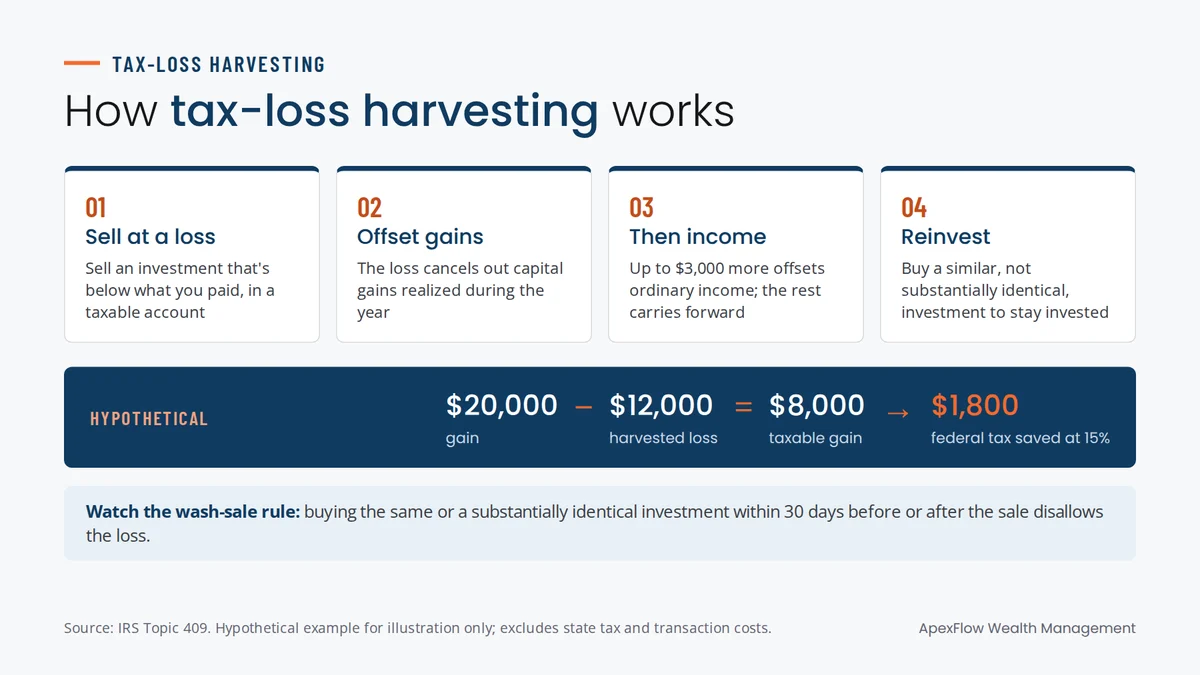
Tax-Loss Harvesting: How It Works and How to Avoid the Wash-Sale Rule
No one likes seeing an investment lose value. But in a taxable account, a loss can have a silver lining. Tax-loss harvesting means selling anRead more -
 October 7, 2026
Using Utah’s my529 Plan as a Grandparent
Helping pay for a grandchild’s education is one of the most meaningful gifts a grandparent can give. It’s also one of the most tax-efficient. Utah’sRead more -
 October 7, 2026
How to Build a Retirement Budget That Lasts
For decades, your budget had a built-in safety net: the next paycheck. Retirement changes that. Your income now comes from Social Security, maybe a pension,Read more