
There’s a moment many investors recognize. A sector is surging. A fund is outperforming. An investment seems to be winning everywhere you look. The urge to invest feels obvious. It feels less like speculation and more like catching up. That’s often recency bias in investing, and it can become one of the most expensive behavioral mistakes investors make.

At a glance
- Recency bias is the tendency to give recent events more weight than long-term history, so today’s winners look like tomorrow’s.
- It works in both directions: it pulls investors into hot investments after big gains and out of the market after sharp declines.
- A diversified plan, scheduled rebalancing and one simple question can help keep it from driving your decisions.
What is recency bias in investing?
Recency bias is the tendency to give more weight to recent events than to long-term history. In investing, it shows up when investors assume today’s top performer will keep outperforming tomorrow.
The instinct feels logical. We naturally look for patterns and expect them to continue. Markets don’t always work that way. Investment performance is often cyclical. Yesterday’s leader can become tomorrow’s laggard, while neglected areas of the market can unexpectedly rebound. When investors chase recent winners, they’re often buying after much of the gain has already happened.
It’s a bit like driving while staring into the rearview mirror. What’s behind you is clear and vivid. What’s ahead is what actually matters.
Recency bias works both ways
Most people think of recency bias as chasing what’s hot. It also shows up after a bad stretch:
- After a strong run, investors pile into the winning fund, sector or stock and assume the gains will continue.
- After a sharp decline, investors assume the losses will continue and sell, often near the bottom. We explore why losses feel so heavy in Loss Aversion: Why Market Downturns Feel Worse Than They Are.
- We also explore ways to maximize on these losses in Tax-Loss Harvesting: How It Works and How to Avoid the Wash-Sale Rule
- In planning, a few great years can make a 10% annual return feel normal, while a few poor years can make retirement feel out of reach. Neither may be a realistic long-term assumption.
Why performance chasing can be costly
The pattern is common:
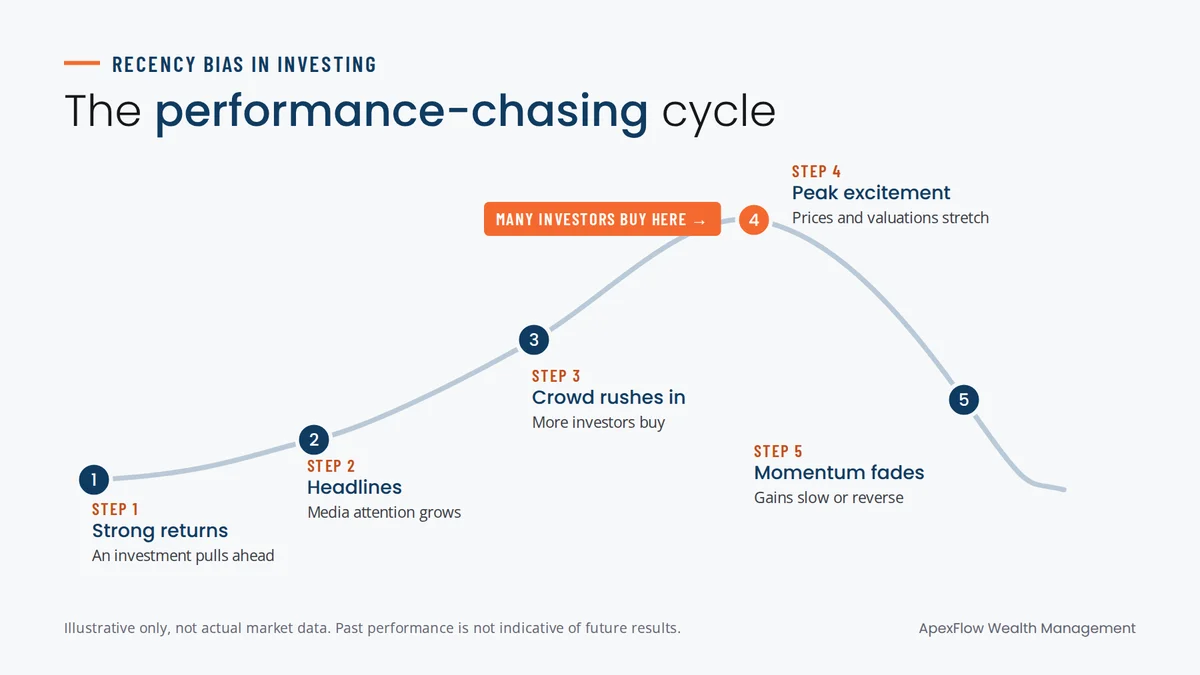
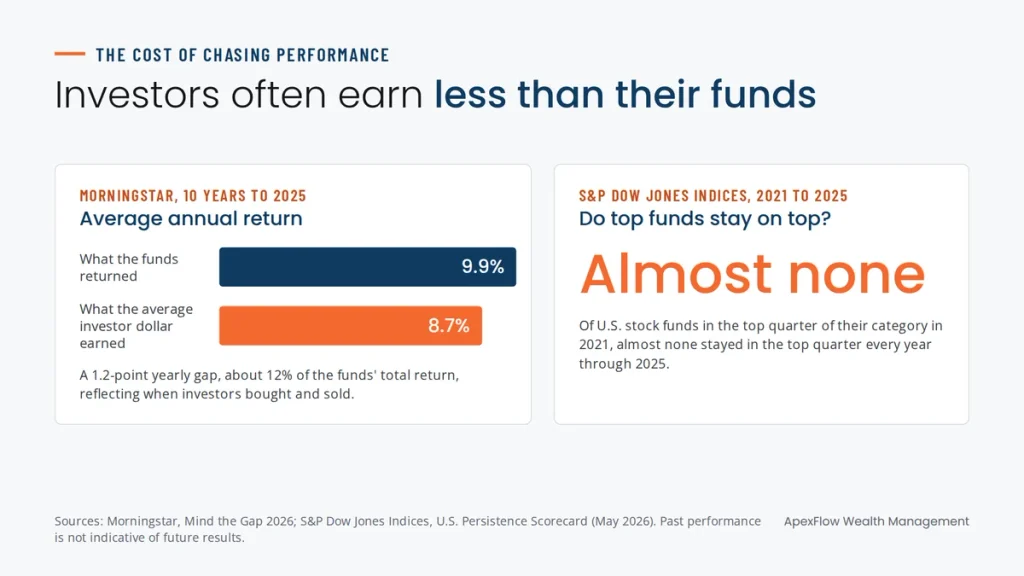
- An investment produces strong returns.
- Media attention increases.
- More investors rush in.
- Prices and valuations rise.
- Momentum slows or reverses.
Many investors enter near the peak of excitement, which is why “past performance is not indicative of future results” matters. Strong recent returns tell us very little about what happens next.
What the research shows
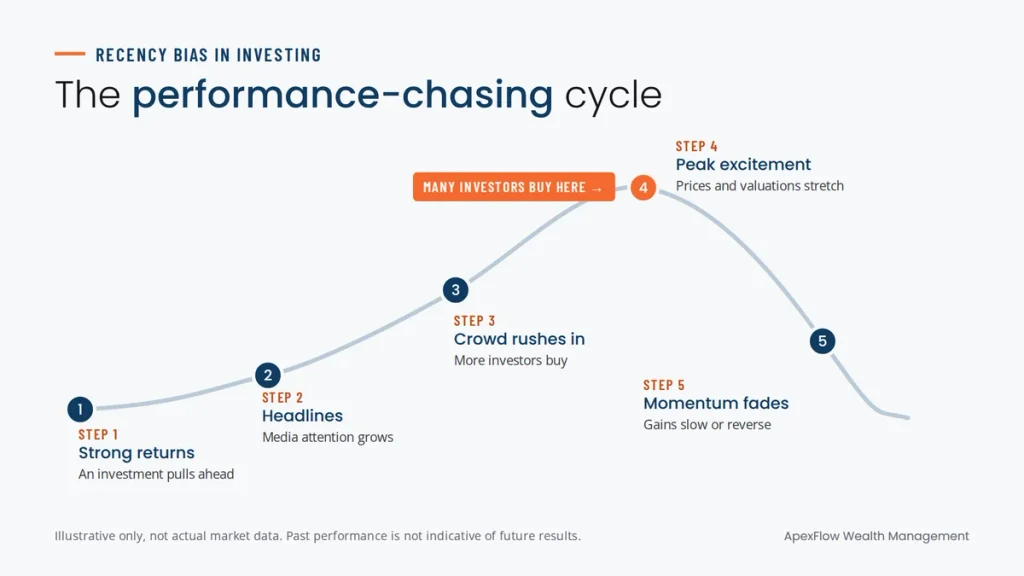
Two long-running studies put numbers on the cost of chasing.
Investors earn less than their funds. Morningstar’s Mind the Gap 2026 study found that over the 10 years ended December 31, 2025, the average dollar invested in U.S. mutual funds and ETFs earned 8.7% per year, while the funds themselves returned 9.9%. That 1.2-percentage-point annual gap, about 12% of the funds’ total return, reflects the timing of when investors bought and sold.
Yesterday’s top funds rarely stay on top. S&P Dow Jones Indices tracks how often winning funds keep winning. Its U.S. Persistence Scorecard found that of the domestic stock funds ranked in the top quarter of their category in 2021, almost none stayed in the top quarter every year through 2025.
Recent performance alone is rarely a solid investment thesis.
How to avoid recency bias: a better approach than chasing returns
The solution isn’t finding the next hot trend. It’s staying committed to a diversified investment strategy built around your goals, risk tolerance and time horizon. That means:
- Maintaining a diversified portfolio, so no single trend makes or breaks your plan. If one stock already dominates your portfolio, see How to Diversify a Concentrated Stock Position.
- Rebalancing on a schedule or set ranges, which naturally trims what has run up and adds to what has lagged, the opposite of chasing.
- Writing down your investment rules while markets are calm, so you’re not deciding under pressure.
- Focusing on long-term objectives, not last quarter’s leaderboard.
It’s not exciting, but it removes the need to predict which trend will continue and which will reverse.
Questions to ask before you act
Before making a change, ask yourself:
- Would I still want this investment if it hadn’t recently gone up?
- Would I still sell this if it hadn’t recently gone down?
- Does this change fit my plan, or am I reacting to headlines?
- How much of my portfolio would this affect, and could I live with being wrong?
If the answer to the first question is no, recency bias may be influencing the decision.
Why recency bias is so difficult to avoid
Recency bias affects nearly everyone. Watching a particular investment soar while your portfolio grows more steadily can be frustrating, and the fear of missing out is real.
The goal isn’t to ignore performance. It’s to avoid letting a few strong months override a long-term plan designed to last decades. Successful investing often takes patience when excitement is highest, and discipline when fear is highest. Our post Should You Move to Cash Before Retirement? shows what missing just a few of the market’s best days can cost.

How a financial advisor can help
One of the most valuable roles of a financial advisor is helping investors recognize recency bias before acting on it. When a sector, fund or investment has had a strong run, it’s worth stepping back and asking whether the opportunity fits your overall financial plan.
That doesn’t mean dismissing new opportunities. It means making sure decisions are driven by strategy, not by what performed best last quarter. At ApexFlow, that strategy comes from the Design stage of our planning process, where your portfolio is built around your goals and how much risk your plan can actually absorb. We explain that difference in Risk Tolerance vs. Risk Capacity in Retirement.
Frequently asked questions
Buying a fund because it was last year’s top performer, expecting the streak to continue. Selling everything after a sharp market drop because you expect the decline to keep going is another.
Stick to a diversified plan built around your goals, rebalance on a set schedule or range and ask whether you’d still want an investment if it hadn’t recently gone up.
They’re closely related. Recency bias is the mental shortcut of overweighting recent events. The fear of missing out is the emotion that often makes investors act on it.
Not reliably. S&P Dow Jones Indices research shows that very few top-performing funds stay at the top over several years.
Not just because of recent performance. Ask whether the reason you owned it has changed and whether it still fits your plan. Rebalancing may even mean adding to areas that have lagged.
Talk it through with us
If you’re considering an investment because of its recent performance, or thinking about selling because of a recent drop, it’s worth evaluating it through the lens of your long-term goals first. Book a 20-minute Fit Call. It’s virtual, no prep is needed and there’s no obligation.
With clarity and confidence,

Investing involves risk and you may incur a profit or loss regardless of strategy selected, including diversification and asset allocation. Raymond James and its advisors do not offer tax or legal advice. You should discuss any tax or legal matters with the appropriate professional.
Related Articles
Dig deeper into our resource library
-
 October 7, 2026
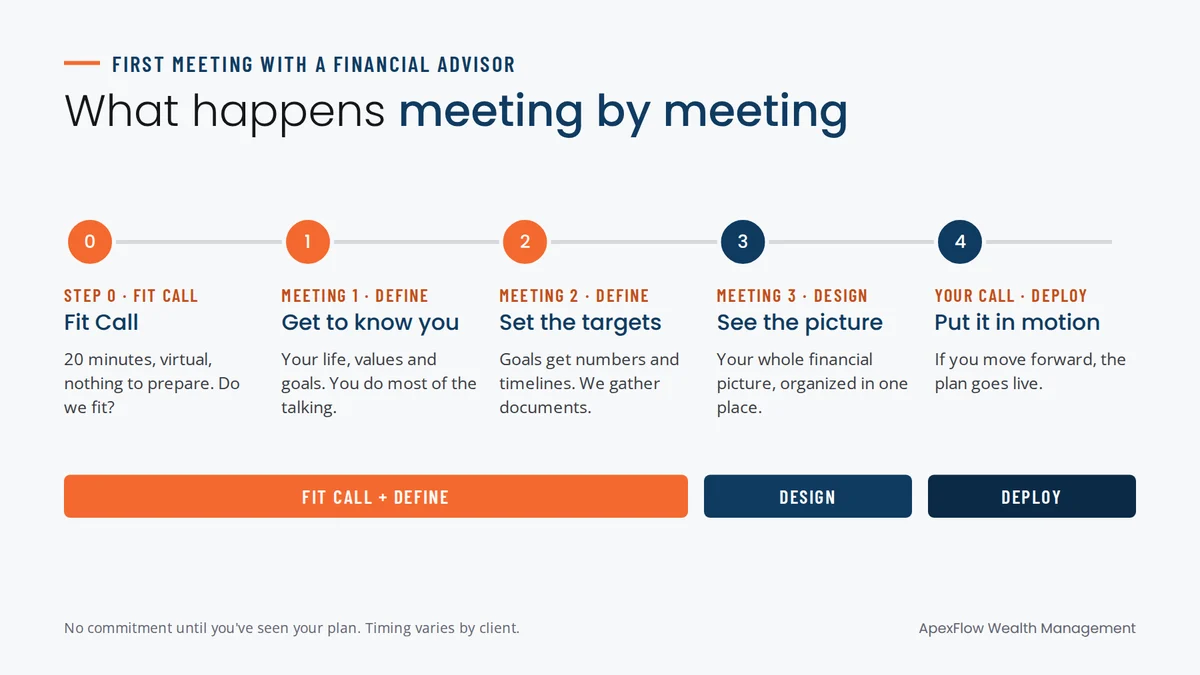
What to Expect in Your First Meetings With a Financial Advisor
Most people put off calling a financial advisor for the same reason they put off calling a doctor. It’s not that they don’t care. It’sRead more -
 October 7, 2026
The 5 Years Before Retirement: A Year-by-Year Planning Roadmap
Ask most people what their retirement plan is, and you’ll get one of two answers. Either a number, some version of “I need two millionRead more -
 October 7, 2026
Loss Aversion Investing: Why Market Downturns Feel Worse Than They Are
A market drops 3% in a week and it feels like the beginning of something bad. A market climbs 3% in a week and itRead more