

At a glance
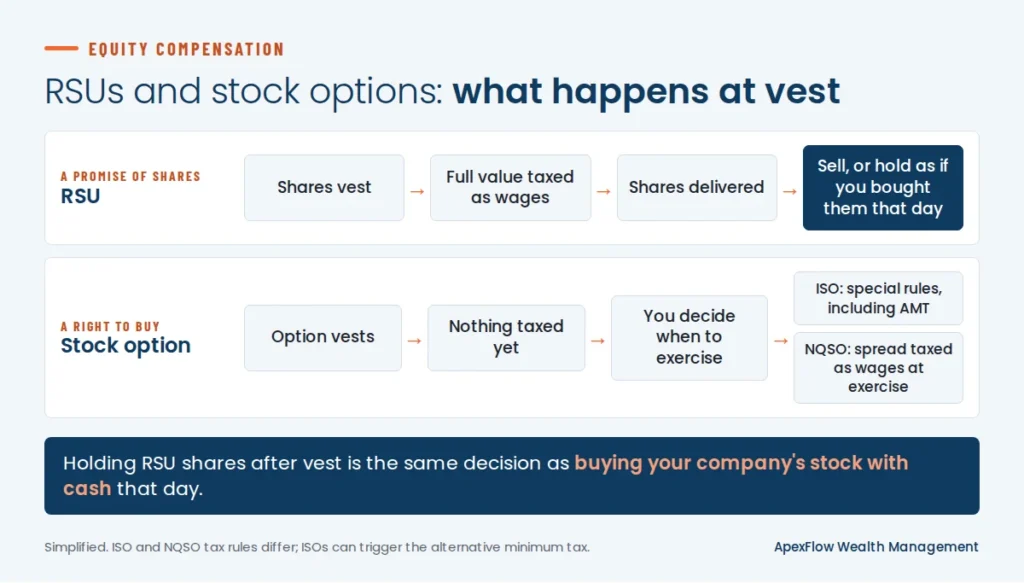
- An RSU is a promise of shares. At vest, the full value is taxed as wages whether or not you sell.
- A stock option is a right to buy shares at a set price. Nothing is taxed at vest; the decision happens when you exercise.
- Holding RSU shares after vest is the same decision as buying your company’s stock with cash that day.
- Incentive stock options (ISOs) and non-qualified options (NQSOs) follow different tax rules, and the ISO rules include the alternative minimum tax.
- Default withholding on RSUs is often too low for a Utah executive, which produces a surprise in April.
Equity compensation is the main reason many Utah executives build real wealth, and it is also the area where we see the most avoidable mistakes. The two most common forms, restricted stock units and stock options, look similar on an offer letter and behave very differently in your tax return and your portfolio.
Two minutesYou are planning money for 30 years and a body for how many?Check my WealthSpan GapRSUs: vest is a taxable paycheck in shares
A restricted stock unit is your employer’s promise to deliver shares on a schedule, usually over three or four years. You do not own anything until a vest date arrives. On that date, the shares are yours, and the fair market value of every share that vested is reported as ordinary wages on your W-2. That is true even if you never sell.
Your employer will typically withhold taxes by keeping some of the shares, often at the flat federal supplemental rate. For a Utah executive in a higher bracket, that flat rate is frequently lower than your actual marginal rate, so the withholding falls short. Add Utah’s flat 4.45 percent for 2026 and the gap can be meaningful on a large vest. We help clients estimate the shortfall and make estimated payments so April is not a surprise.
After vest, your cost basis is the value on the vest date. If you sell right away, there is almost no additional gain or loss. If you hold, any further change is a capital gain or loss, short-term for the first year and long-term after that.
Hold or sell?
Holding vested RSU shares is equivalent to receiving your bonus in cash and immediately buying company stock with all of it. Most people would never do that deliberately. They hold because selling feels like a vote against the company or because they expect the stock to go up.
Our default guidance is to sell at vest and put the proceeds to work according to your plan, then make a separate, deliberate decision about how much company stock you want to own. For many executives the answer is some, but far less than accumulates by default. Our article on concentrated stock positions explains why.
If your company restricts when you can trade, a 10b5-1 plan lets you schedule sales in advance so vests can be sold even during closed windows.
Stock options: vesting gives you a choice
A stock option gives you the right to buy a set number of shares at a fixed exercise price. Vesting means you are now allowed to exercise. It is not a taxable event. If the stock trades below your exercise price, the option is underwater and you simply wait.
What happens when you exercise depends on the type of option.
Non-qualified stock options (NQSOs). The spread between the stock price and your exercise price at the moment of exercise is ordinary wage income, withheld and reported like an RSU vest. After that, the shares behave like any other stock you bought.
Incentive stock options (ISOs). No regular income tax at exercise. If you hold the shares at least one year after exercise and two years after grant, the entire gain from exercise price to sale price is a long-term capital gain. The catch is the alternative minimum tax: the spread at exercise counts as income for AMT purposes, and a large ISO exercise can trigger a substantial AMT bill in a year with no cash from a sale. Selling ISO shares before the holding period ends, called a disqualifying disposition, turns the gain back into ordinary income but avoids the AMT problem.
How we think about exercising
Options have time value. An option with five years left is worth more unexercised than exercised, because you have not yet put your own money at risk. So our starting point is not to exercise early just because you can. The reasons to exercise include an approaching expiration date, a departure from the company that starts a short exercise clock, a deliberate plan to start the ISO holding period while the spread is small, or a year when your other income is unusually low.
Hypothetical example: An engineer at a Lehi software company has 10,000 ISOs with a $12 exercise price and the stock at $40. Exercising all of them creates a $280,000 AMT preference item in one year. Instead, she and her advisor model exercising a portion each year, keeping the AMT impact near the point where it stops costing extra, and selling older NQSO shares to fund the exercises. The figures are illustrative and not a recommendation.
The calendar is the plan
Vest dates, trading windows, option expirations and estimated tax deadlines all fall on a calendar. Executives who make each decision the week it comes due tend to hold too much company stock and underpay their taxes. Executives who put the whole year on one page, tied to their goals and tax brackets, make better decisions with less stress. Putting the year on one page is most of what our executive financial planning work does.
Frequently asked questions
Selling at vest is a sensible default because holding is the same as buying company stock with that day’s bonus. The right amount of company stock to keep is a separate decision based on your whole plan, not on the vest schedule.
Employers usually withhold at a flat supplemental rate that is lower than many executives’ real marginal rate, and state withholding may also be light. The difference is due with your return. Estimated payments during the year close the gap.
NQSOs are taxed as wages on the spread when you exercise; ISOs are not taxed at exercise for regular tax purposes but count toward the alternative minimum tax, and can qualify for long-term capital gains if you meet the holding periods.
Unvested RSUs and options are usually forfeited. Vested options typically must be exercised within a short window after departure, often 90 days, or they expire. Check your plan documents before you resign.
Talk it through with us
Every situation is a little different. If you want to talk through yours, book a 20-Minute Fit Call with one of our advisors, by video or in person. No prep and no obligation. Want to see how we work first? Start with the Purposeful Planning Process or our services.

The information in this article is general in nature and is not a recommendation for any individual. Consider your own circumstances or speak with an advisor before acting on it. Any opinions are those of the author and not necessarily those of Raymond James.
ApexFlow Wealth Management does not provide tax or legal advice. Please consult your tax or legal professional before acting on any strategy mentioned here.
Investing involves risk, and you may incur a profit or loss regardless of the strategy selected, including diversification and asset allocation. Past performance does not guarantee future results.
Examples labeled as hypothetical are for illustration only. They are not based on any actual client and do not represent actual or expected results.
Related Articles
Dig deeper into our resource library
-
 October 29, 2026
Year-End Planning for Executives: A 2026 Checklist for Equity and Deferred Pay
Executive pay decisions run on their own calendar. A dated checklist for 2027 deferral elections, RSU withholding, ISO exercises under the 2026 AMT rules, 10b5-1 plans and 401(k) catch-ups.Read more -
 October 29, 2026
Deferred Compensation Plans: When Deferring Makes Sense and When It Doesn’t
Nonqualified deferred compensation can be one of the best tax tools an executive has, or an unsecured loan to an employer. Here is how to tell which one you are looking at.Read more -
 November 5, 2026
Too Much Company Stock? How to Diversify a Concentrated Stock Position
“Don’t put all your eggs in one basket” is advice everyone nods along to and almost nobody applies correctly. The people most likely to breakRead more