

At a glance
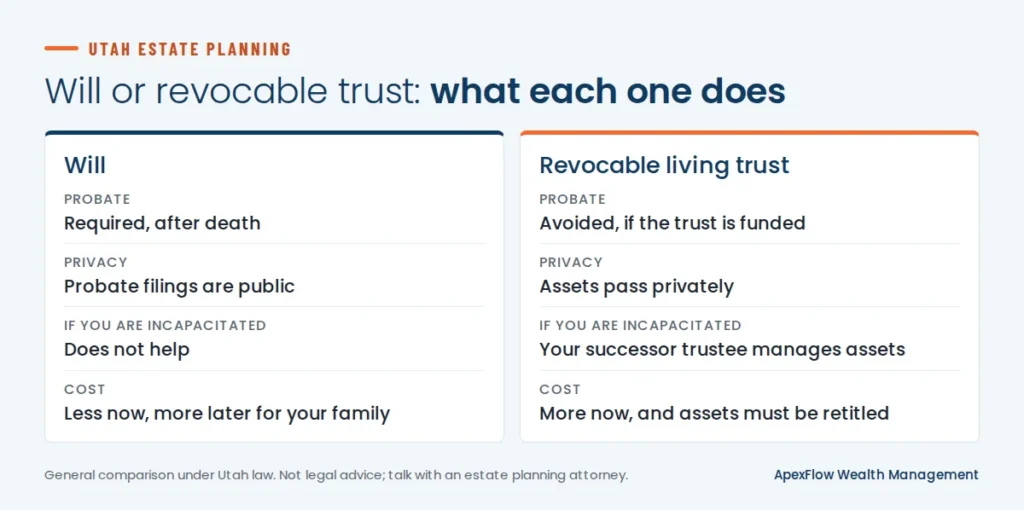
- A will names who gets what and who raises minor children, but it only works through probate and only after death.
- A revocable living trust holds your assets during life, manages them if you become incapacitated and passes them privately at death without probate, if it is funded.
- Utah probate is simpler and cheaper than in many states, which changes the math compared with what you may have read online.
- A trust costs more to set up and requires retitling assets. A will costs less now and more later, paid by your family in time and fees.
- Most Utah homeowners with children, blended families or property in more than one state end up better served by a trust. Many single people with simple estates do fine with a will.
“Do I need a trust or is a will enough?” is the most common estate planning question we hear, and the real answer is that it depends on what you own, who you love and how much work you want to leave behind. The internet is full of articles written for California and New York, where probate is slow and expensive. Utah is different, and the decision should be made on Utah facts. We are not attorneys, and the documents themselves must be drafted by one; our role is to help you decide what you need and make sure the plan lines up with your accounts and beneficiaries.
Two minutesHow much of your retirement is actually decided?Get my Clarity ScoreWhat a will does
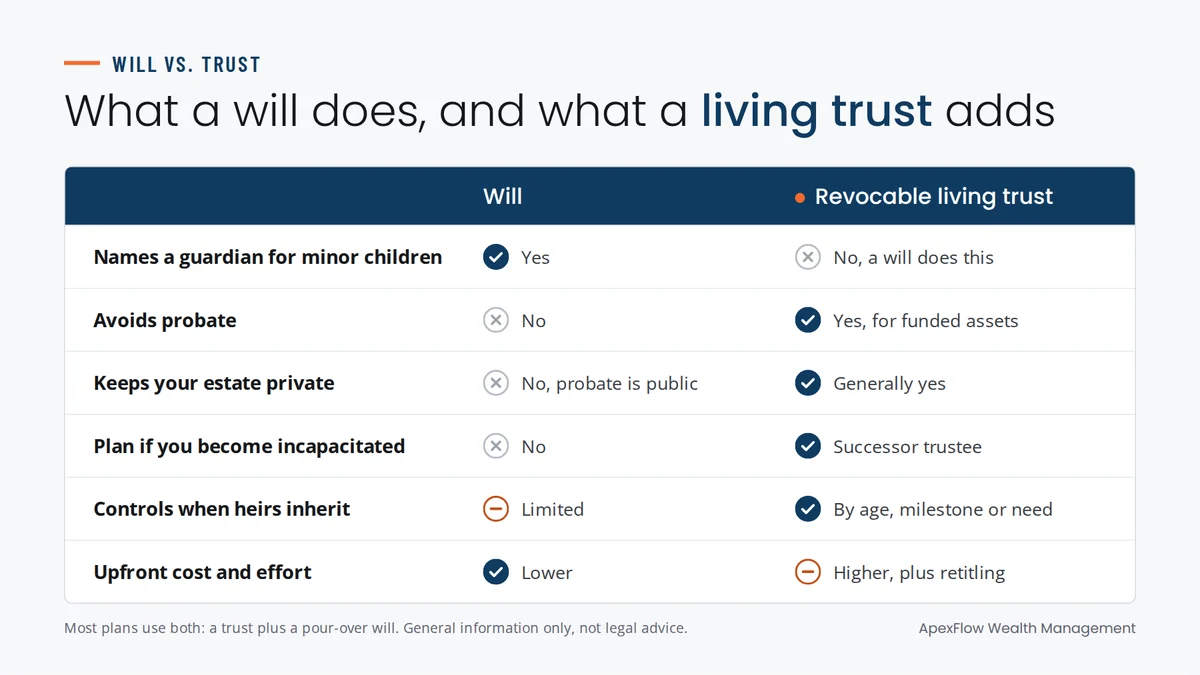
A will is a set of instructions that takes effect at death. It names an executor (Utah calls this a personal representative), says who receives your probate property, and names a guardian for minor children. That last job is one only a will can do.
What a will does not do: it does not avoid probate. It is the document the probate court uses. It does nothing while you are alive, so it provides no help if you become incapacitated. And it controls only assets in your own name without a beneficiary designation. Retirement accounts, life insurance and jointly owned property pass outside the will regardless of what it says.
What a revocable living trust does
A revocable trust is a legal container you create and control. You move your assets into it (retitling your home, your taxable accounts, your business interest) and name yourself trustee. Nothing changes day to day. You name a successor trustee who steps in if you become incapacitated or die, and the trust document says how assets are managed and distributed.
Because the trust, not you, owns the assets, there is nothing for the probate court to transfer at death. The successor trustee follows the instructions privately. The same person can manage your affairs during a long illness without a court-appointed guardianship.
The catch is funding. A trust that is signed but never funded, with the house still deeded in your name and the brokerage account never retitled, avoids nothing. A “pour-over will” catches the stragglers, but those stragglers go through probate. In our experience, unfunded or partly funded trusts are the most common estate planning failure in Utah.
What Utah probate actually involves
Utah uses the Uniform Probate Code, and most estates qualify for informal probate. The personal representative files an application, is appointed by the court clerk within days or weeks, and administers the estate with limited court involvement. Estates under $100,000 with no real property can skip court entirely with a small estate affidavit. Attorney fees are typically hourly rather than a percentage of the estate, and a straightforward informal probate often costs a few thousand dollars and takes several months to a year.
That is a far cry from the horror stories. But probate still has costs that are easy to underrate: it is public, so anyone can see what you owned and who got it; it takes time during which accounts are frozen; it requires an attorney for most families; and if you own property in another state, a second probate is usually needed there. For a cabin in Idaho or a condo in Arizona, that alone can justify a trust.
What each costs
Prices vary by attorney and complexity, so treat these as ranges. A simple will package in Utah, with powers of attorney and a health care directive, typically costs several hundred to a couple thousand dollars. A revocable trust package, including the trust, pour-over will, powers of attorney, directive and deeds to fund the trust, typically runs from a few thousand dollars to more for complex estates.
The comparison people miss is timing. The will is cheaper today and leaves probate costs, attorney time and months of administration to your family. The trust is more expensive today and leaves a successor trustee with a private, faster job and usually a lower bill. For an estate that includes a home, the lifetime cost is often similar. The difference is who pays and when, and how much friction your family absorbs.
Who tends to need a trust in Utah
- Homeowners who want their children to avoid court entirely.
- Blended families, where a trust can provide for a spouse during life and still pass assets to children from a prior marriage.
- Parents of a child with special needs or a child who is not ready to manage a large sum.
- Owners of property in more than one state.
- Business owners, where a trust can hold the ownership interest and keep the company running without a probate gap.
- Anyone who wants a plan for incapacity that does not involve a court.
Who may do fine with a will
- A single person with a modest estate held mostly in accounts with beneficiary designations.
- A married couple whose assets are all jointly titled or have beneficiaries, who understand the survivor will need a plan.
- Someone whose primary concern is naming a guardian for minor children and who accepts probate later.
Hypothetical example: A couple in Sandy, both 48, own a home, two retirement accounts, a taxable account and life insurance, and have three children. A will-based plan would route the house and the taxable account through probate at the second death, with the retirement accounts and insurance passing by beneficiary. A trust-based plan holds the house and taxable account in the trust, names the trust as contingent beneficiary of the insurance, and leaves the retirement accounts to each other and then the children directly. The second plan costs more to set up and requires two new deeds and a retitled account. The children would not need to open a probate. The example is illustrative; the right design depends on the family’s details.
Either way, these matter more than the label
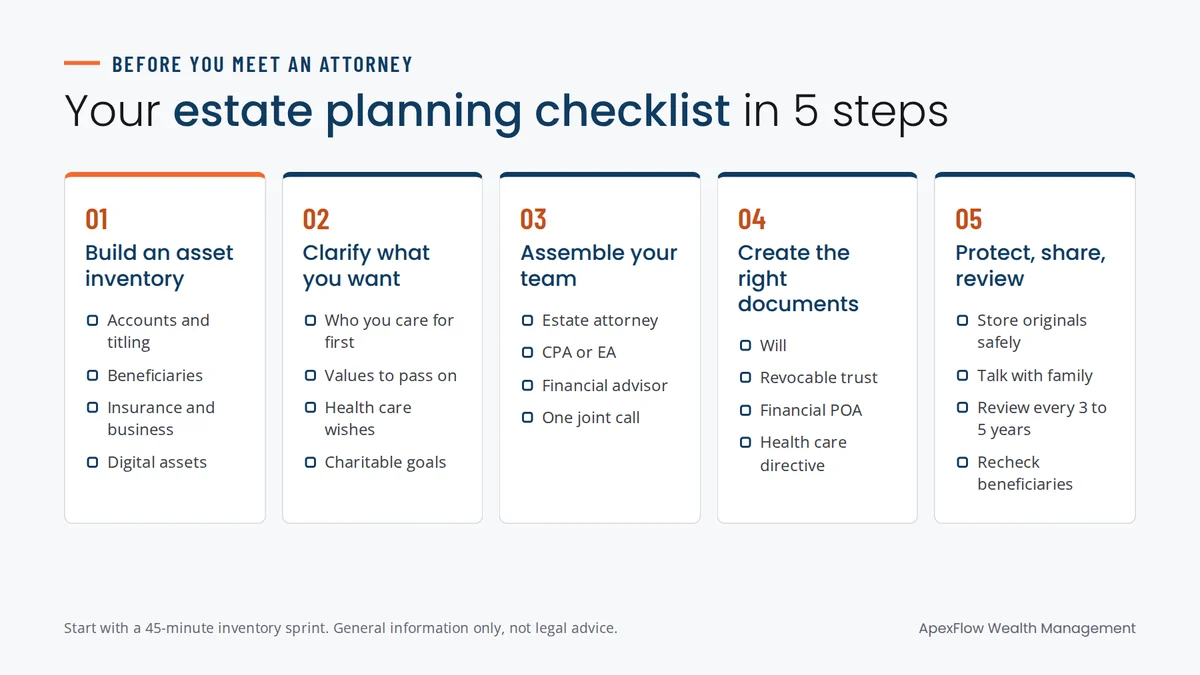
Whichever document you choose, three things decide whether the plan works. Beneficiary designations on retirement accounts and insurance must match the plan, because they override both wills and trusts. Powers of attorney and a health care directive must be in place for incapacity. And the plan must be reviewed every few years and after a move, a marriage, a divorce or a death. Our article on whether you need a trust goes deeper on the decision, and our estate planning checklist is a good tool for the review.
How we fit in
We help you take inventory of what you own and how each asset is titled, think through who should receive it and when, and coordinate with your estate attorney so the documents and the accounts agree. Then we keep the plan current as life changes, which is step four of the Purposeful Planning Process, Adjust with Intention. Our estate planning page describes the work in more detail.
Frequently asked questions
A revocable trust does not reduce income or estate taxes. Utah has no estate tax, and the federal exemption is $15 million per person for 2026, so most Utah families owe none. Trusts can be designed for tax reasons at very high net worth, but that is a different kind of trust.
Yes. A pour-over will catches anything left outside the trust and is the only document that can name a guardian for minor children.
Utah recognizes handwritten wills and there are online forms, but errors in signing, witnessing or funding are common and discovered only when it is too late to fix. For anything involving a home, children or a business, an attorney is worth the cost.
Review it every three to five years and after any major life event: marriage, divorce, birth, death, a move to or from Utah, a business sale or a large inheritance.
Talk it through with us
Every situation is a little different. If you want to talk through yours, book a 20-Minute Fit Call with one of our advisors, by video or in person. No prep and no obligation. Want to see how we work first? Start with the Purposeful Planning Process or our services.

The information in this article is general in nature and is not a recommendation for any individual. Consider your own circumstances or speak with an advisor before acting on it. Any opinions are those of the author and not necessarily those of Raymond James.
ApexFlow Wealth Management does not provide tax or legal advice. Please consult your tax or legal professional before acting on any strategy mentioned here.
Examples labeled as hypothetical are for illustration only. They are not based on any actual client and do not represent actual or expected results.
Related Articles
Dig deeper into our resource library
-
 October 29, 2026
A Financial Checklist After Losing a Spouse: The First Year, Step by Step
After a spouse dies, only a few financial tasks are urgent and most can wait. A calm, time-ordered checklist for the first two weeks, the first 90 days and the first year, with Utah specifics.Read more -
 November 5, 2026
Do You Need a Trust? 6 Family Situations Where a Will Falls Short
Not everyone needs a trust. A will is the foundation of nearly every estate plan, and for a simple estate, a will plus up-to-date beneficiaryRead more -
 November 5, 2026
Utah Estate Planning Checklist: 5 Steps Before You Meet an Attorney
A Utah estate planning checklist comes down to the same five steps families everywhere use. List what you own, where it’s held and how it’sRead more