


By Trevor Hanson, Wealth Advisor, RJFS
Last reviewed November 2, 2026
Trevor’s key points
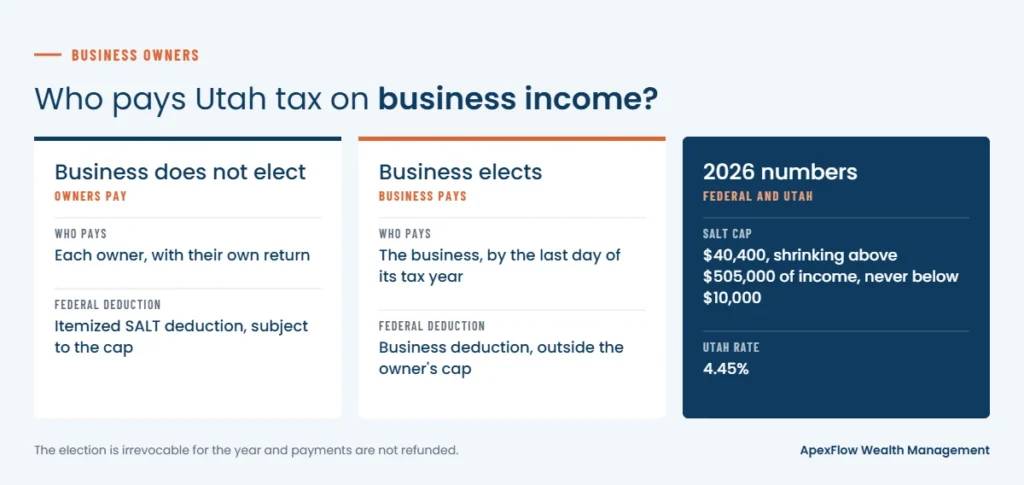
- Utah’s elective pass-through entity tax is figured at the individual income tax rate, 4.45% for 2026, and must be paid by the last day of the business’s tax year.
- The business deducts the payment federally, and IRS Notice 2020-75 says it does not count against the owners’ SALT deduction cap.
- For 2026 the individual SALT cap is $40,400, but it shrinks once modified adjusted gross income passes $505,000 and can fall to $10,000.
- The election is irrevocable for the year, payments are not refunded and individual owners cannot opt out.
Book a 20-Minute Fit Call or call 385-606-0358.
Utah lets partnerships, S corporations and LLCs taxed as either pay Utah income tax on their owners’ share of business income at the business level. The business deducts that payment on its federal return, outside the cap on the individual state and local tax (SALT) deduction, and each owner claims a Utah credit for the tax paid on their behalf. For calendar-year businesses, the 2026 election is made by paying the tax by December 31, 2026. Below we cover how it works, who tends to benefit now that the federal cap is higher, the trade-offs and the steps to take before year end.
Trevor works with people who want their retirement income and investments in one plan. We take new clients in Salt Lake City and by video. Book a 20-Minute Fit Call or call 385-606-0358.
How Utah’s elective tax works
The rules are in Utah Code 59-10-1403.2, which the 2026 Legislature extended through HB 77 for tax years beginning in 2026. A pass-through entity with Utah income can elect to pay tax on the income it passes to owners who are taxed as individuals. Disregarded entities cannot elect.
There is no separate form to sign. Under the Tax Commission’s guidance, the business makes the election by paying the tax and filing a SALT Report electronically through Taxpayer Access Point (TAP) on or before the last day of its tax year. A payment made after that date does not count. The tax equals the owners’ share of income times the individual rate for the year, which the Legislature set at 4.45% for 2026 (SB 60).
Each owner then receives a nonrefundable Utah credit equal to the tax paid for them. Any unused credit can be carried forward for up to ten years.
What the 2025 federal tax law changed
Before 2025, individuals could deduct no more than $10,000 of state and local taxes. The 2025 federal law raised that cap. For 2026, the IRS sets it at $40,400, reduced when modified adjusted gross income exceeds $505,000 but never below $10,000. The reduction is 30% of the income above the threshold, per the Schedule A instructions, so a joint filer’s cap reaches the $10,000 floor at roughly $606,000 of income.
The business level deduction survived the new law. IRS Notice 2020-75 says a partnership or S corporation deducts these payments in the year it makes them, and the payments are not taken into account in applying the SALT cap to its owners.
Who tends to look at the election
The election usually matters most in three situations.
- Owners with high incomes. Above about $606,000 of modified adjusted gross income, the cap is back to $10,000, and property taxes alone can use it up. Utah tax paid personally on business income then brings no federal deduction at all.
- Owners who take the standard deduction. The standard deduction leaves the Utah tax you pay personally with no federal benefit. When the business pays it instead, it lowers business income, and you can still take the standard deduction.
- Owners whose other state and local taxes already fill the cap. A large property tax bill, or tax on other income, can leave no room for the tax on business income.
Hypothetical example for illustration only. A married couple owns an S corporation that passes $700,000 of Utah income to them. At that income their SALT cap is $10,000, and their property taxes already use it up. Utah tax on the business income at 4.45% is $31,150, and paid personally, it brings no federal deduction. If the business pays the $31,150 by December 31, the couple’s share of business income falls by that amount. If that income would otherwise be taxed at a 35% federal rate, that is about $10,900 less federal tax, before any effect on other deductions.
Trade-offs to weigh
The election is not right for every business. Points to cover with your CPA:
- It cannot be undone. Once paid, the election is irrevocable for the year, and the business cannot reduce it or get a refund. If income comes in lower than expected, owners carry the extra credit forward.
- It covers every individual owner. Owners taxed as individuals cannot opt out, and the election does not apply to owners that are businesses themselves. It also cannot be made for income that passes through another pass-through entity first.
- Cash leaves sooner. The tax is due by December 31 instead of with the owners’ returns in the spring. Plan for it alongside your cash reserves.
- Other numbers can shift. Lower business income can change your qualified business income deduction and other income-based calculations. Ask your CPA to run both versions.
- Owners outside Utah. The payment reduces the business’s withholding for nonresident owners, but how their home state treats Utah’s tax depends on that state’s rules.
| Business does not elect | Business elects | |
|---|---|---|
| Who pays Utah tax on business income | Each owner, with their own return | The business, by the last day of its tax year |
| Federal deduction | Part of the owner’s itemized SALT deduction, subject to the cap | Business deduction, outside the owner’s cap |
| Owner’s Utah return | Pays tax at 4.45% | Claims a nonrefundable credit for tax paid on their behalf |
| Can it be changed later | Not applicable | No. Irrevocable for the year, no refunds |
Steps to take before December 31
- Ask your CPA in November whether electing for 2026 helps each owner, using projected full-year income.
- Estimate each individual owner’s share of 2026 Utah income and the tax at 4.45%.
- Pay through TAP and file the SALT Report by the last day of the tax year. A TAP login is not required for this process.
- Notify owners, and give each one a Utah Schedule K-1 showing the tax paid for them. The Tax Commission can charge up to $100 for each required K-1 not provided.
- Owners report the amount on form TC-40A, adding it to income with code 67 and claiming the credit with code AP.
The same year end review is a good time to look at retirement plan contributions, which we compare in SEP IRA vs solo 401(k) vs cash balance plan.
Is the business ready to be sold? Are you ready to leave it? Check my exit readiness (two scores).
Where we fit in
The election is a tax decision your CPA makes with you, but it touches cash flow, retirement contributions and personal tax planning. We bring the business numbers and your household plan together, help time the payment around your cash needs and coordinate with your CPA so the decision fits the full picture. It is part of the Design stage of our planning process.
What happens on a 20-Minute Fit Call
- You tell us a little. Four quick fields on the booking page. We reply within one business day to set a time that works for you.
- We talk for 20 minutes. You share where you are and what you want to figure out. We ask a few questions and tell you whether we can help.
- You decide. If it feels right, we outline your first meeting. If not, you still walk away with a useful next step and no follow-up pressure.
Or call 385-606-0358.
Frequently asked questions
The business must pay the tax and file the SALT Report through TAP on or before the last day of its tax year. For a calendar-year business, that is December 31, 2026. Payments made after that date do not count as an election.
Not if it is a disregarded entity for tax purposes, which is the default for a single-member LLC. A single-member LLC taxed as an S corporation is not disregarded and can elect.
Owners add the tax paid for them on form TC-40A using code 67 and claim the credit using code AP. The credit is nonrefundable, and any unused part carries forward for up to ten years.
For some owners, less than before. It still tends to help owners above the phase-down range, owners who take the standard deduction and owners whose property taxes already fill the cap. Your CPA can compare both versions using your projected income.
IRS Notice 2020-75 says these payments are deductible by the business and are not counted against the owners’ SALT cap. The Utah Tax Commission notes that it does not control federal treatment, so confirm the details with your CPA.
Talk it through with us
If you’d like to see how the election fits your business and household plan before December 31, we’d be glad to help. Book a 20-Minute Fit Call. It’s virtual, no prep is needed and there’s no obligation.

The information in this article is general in nature and is not a recommendation for any individual. Consider your own circumstances or speak with an advisor before acting on it. Any opinions are those of the author and not necessarily those of Raymond James.
ApexFlow Wealth Management does not provide tax or legal advice. Please consult your tax or legal professional before acting on any strategy mentioned here.
Investing involves risk, and you may incur a profit or loss regardless of the strategy selected, including diversification and asset allocation. Past performance does not guarantee future results.
Examples labeled as hypothetical are for illustration only. They are not based on any actual client and do not represent actual or expected results.
Related Articles
Dig deeper into our resource library
-
 November 23, 2026
Selling a Business in Utah: What to Do Two or Three Years Before the Sale
The years before a sale decide how much of the price you keep. What Utah owners can do two or three years out on value, deal structure, taxes, QSBS, and family and charitable gifts.Read more -
 November 23, 2026
SEP IRA vs. Solo 401(k) vs. Cash Balance Plan: Which Retirement Plan Fits Your Business
Three retirement plans do most of the work for Utah business owners. Here is how a SEP IRA, a Solo 401(k) and a cash balance plan differ, and how to tell which one fits your business this year.Read more -
 November 9, 2026
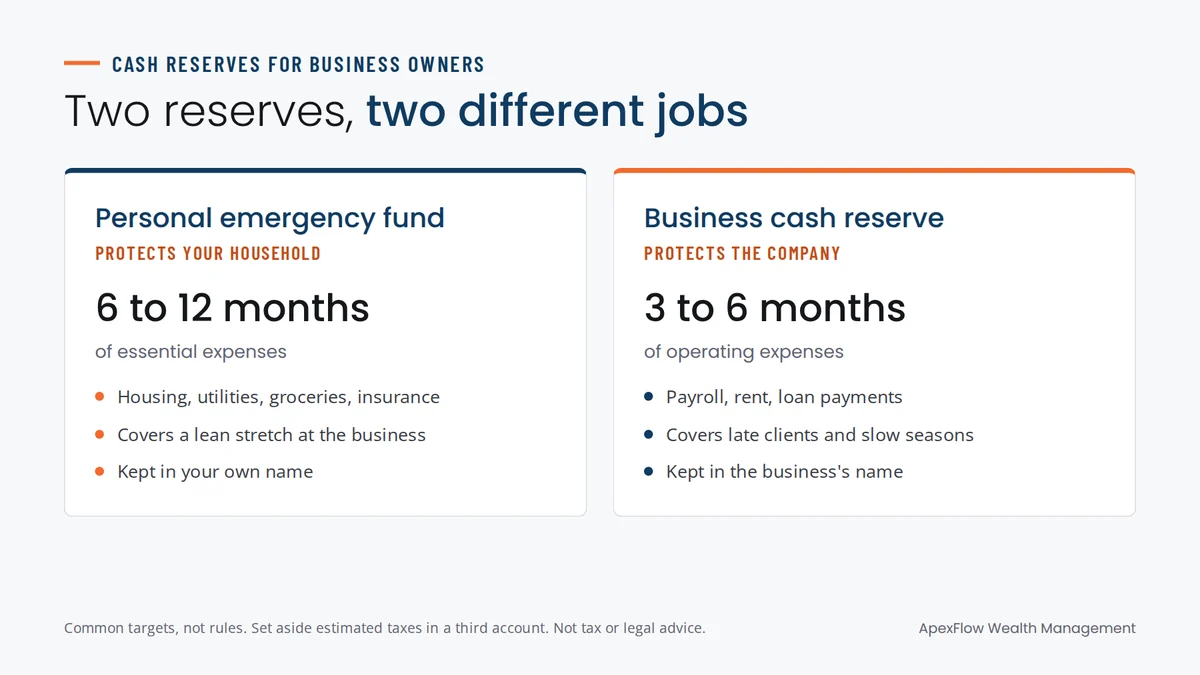
Cash Reserves for Business Owners: Personal vs. Business Emergency Funds
By Trevor Hanson, Wealth Advisor, RJFSJune 30, 2026How much cash should a business owner keep? Two separate reserves. A personal emergency fund, which for ownersRead more