
Health care planning is one of the few areas of life where unpredictability isn’t the exception but the expectation. Costs shift, coverage evolves and important decisions often arrive during already stressful moments. Health Savings Accounts are usually introduced in pieces, through a benefits meeting or a passing recommendation, so many people treat them as a medical checking account and spend the balance every year. Used differently, an HSA for retirement can be one of the most tax-efficient accounts you own, as long as you know the rules as you approach 65.

At a glance
- An HSA can offer a triple tax advantage: money can go in pre-tax, grow tax-deferred and come out tax-free for qualified medical expenses.
- If you can pay today’s medical bills from other savings, investing your HSA and letting it grow turns it into a dedicated health care fund for retirement.
- Once you enroll in any part of Medicare, you can no longer contribute. Because Part A can be backdated up to six months, timing matters.
What is a Health Savings Account?
A Health Savings Account is available to people enrolled in an HSA-eligible health plan, usually a high-deductible health plan. It lets you set aside money for qualified medical expenses now and in the future. Contributions can come from you, your employer or both, and the money can be held in cash or invested, depending on the provider.
Unlike a flexible spending account, there’s no “use it or lose it.” Balances roll forward year after year, and the account belongs to you, even if you change jobs or retire.
For 2026, the IRS limits are:
| 2026 HSA contribution limits | Amount |
|---|---|
| Self-only coverage | $4,400 |
| Family coverage | $8,750 |
| Extra catch-up contribution, age 55 and older | $1,000 |
The rules also widened in 2026. Under the One Big Beautiful Bill Act, bronze and catastrophic plans bought through an exchange now count as HSA-compatible, and people in certain direct primary care arrangements can now contribute too.
The HSA triple tax advantage
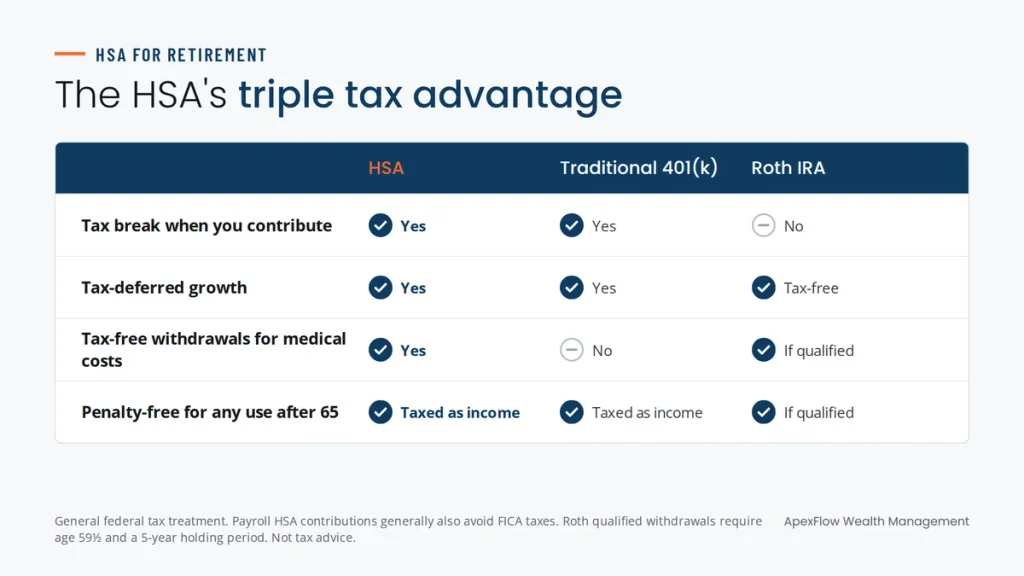
An HSA is one of the only accounts in the tax code that can be tax-favored on the way in, while it grows and on the way out:
- Contributions may reduce your taxable income. Contributions made through payroll at work generally also avoid Social Security and Medicare taxes.
- Investments can grow tax-deferred.
- Withdrawals for qualified medical expenses are tax-free.
How to use your HSA for retirement
The strategy is simple, though it isn’t right for everyone: treat your HSA as a long-term account rather than a spending account.
- Invest the balance. Many providers let you invest once your cash balance passes a set amount. Money left in cash for decades has little chance to grow.
- Pay today’s medical bills from other savings, if you can. That leaves the HSA invested and growing.
- Keep your receipts. You can generally reimburse yourself tax-free later for qualified expenses you paid after the HSA was opened, as long as you keep records. Some people let years of receipts build up, then reimburse themselves in retirement.
- Know the age 65 rule. Before 65, money taken out for non-medical expenses is taxed and hit with an extra 20% penalty. After 65, the penalty goes away. Non-medical withdrawals are taxed as ordinary income, much like a traditional IRA, while medical withdrawals stay tax-free.
That last point is why an HSA works as a backup retirement account, too. If you end up healthier than expected, the money isn’t trapped.
What your HSA can pay for in retirement
Retirees often have more qualified expenses than they expect. According to IRS Publication 969, your HSA can generally cover:
| Generally qualified | Generally not qualified |
|---|---|
| Medicare Part A, Part B and Part D premiums | Medigap (Medicare supplement) premiums |
| Medicare Advantage (Part C) premiums | Non-medical expenses (taxable, though no penalty after 65) |
| Deductibles, copays and coinsurance | |
| Dental, vision and hearing costs | |
| A portion of qualified long-term care insurance premiums, up to IRS limits |
The Medicare rule to know before you turn 65
This is where well-built HSA strategies most often go wrong.
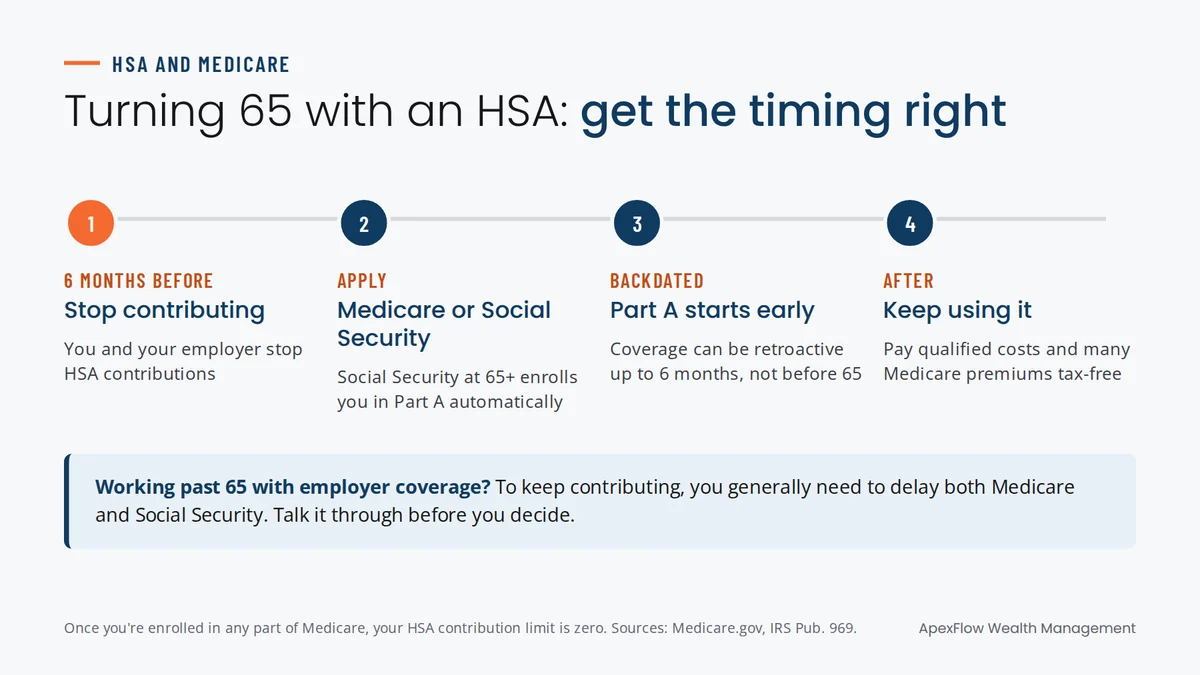
Once you’re enrolled in any part of Medicare, you can’t contribute to an HSA. Your contribution limit drops to zero beginning with the first month you’re covered.
Part A can be backdated. If you sign up for Medicare after 65, Part A coverage is generally retroactive for up to six months, though not earlier than the month you turned 65. Any HSA contributions made during those backdated months become excess contributions.
Social Security can enroll you automatically. If you start Social Security retirement benefits at 65 or later, you’re automatically enrolled in Part A.
That’s why Medicare.gov says you and your employer should stop contributing to your HSA six months before you retire or apply for Social Security. If you’re still working past 65 with employer coverage and want to keep contributing, you’ll need to delay both Medicare and Social Security, and that decision is worth running past an advisor.
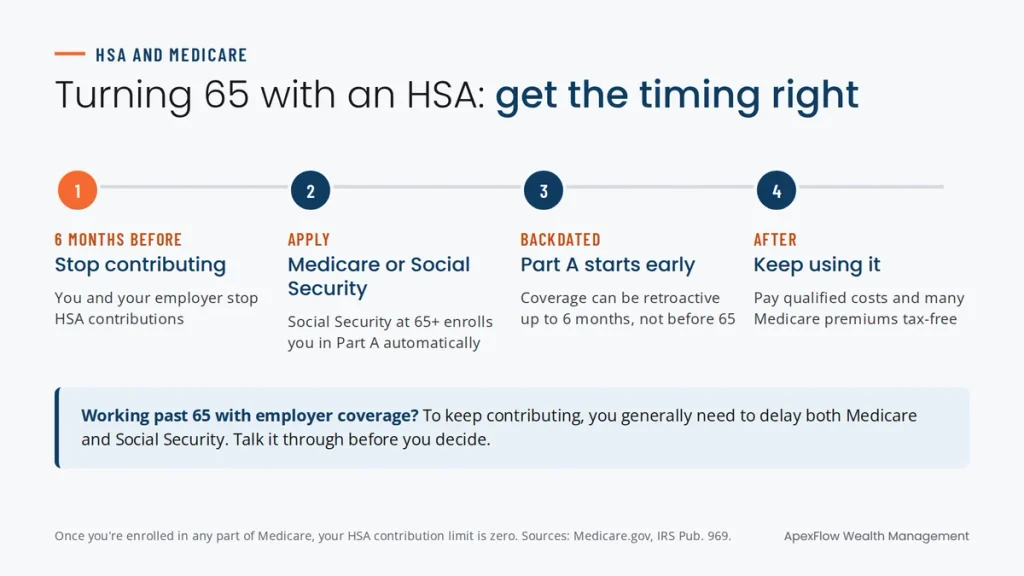
The good news: enrolling in Medicare doesn’t touch the money you’ve already saved. You can keep using your HSA for qualified expenses, including many Medicare premiums, for the rest of your life.
How much will health care cost in retirement?
Health care costs tend to build gradually, then accelerate later in life as care needs become more frequent and complex. Fidelity’s 2026 Retiree Health Care Cost Estimate found that a 65-year-old retiring in 2026 can expect to spend an average of $185,500 on health care and medical expenses in retirement. That figure doesn’t include long-term care.
An HSA won’t cover all of that, and it doesn’t eliminate uncertainty. But used intentionally, it can create structure in an area where structure is often missing.

A far too common story
A business owner in his early sixties had spent decades building a successful company. His financial plan appeared strong, but health care had always been deferred.
When a sudden medical event occurred, he faced coverage gaps, rising costs and uncertainty all at once. Without a dedicated reserve, he was forced to draw from long-term investments at an already difficult time.
The issue wasn’t a lack of resources, but a lack of preparation. With a consistently built HSA, much of that pressure could have been reduced, allowing decisions to feel more measured instead of reactive.
This is a hypothetical story and is not indicative of any specific situation or client. It is presented only as an example and is not intended as investment advice. Investing involves risk, and there is no assurance that any investment strategy will be successful.
Advantages and trade-offs
HSAs offer meaningful advantages, particularly around tax efficiency and long-term saving for health care. Their ability to roll forward and stay with you creates continuity that many health care accounts don’t provide.
At the same time, they aren’t universally ideal. Eligibility requires specific health plans, which may not fit every situation. Higher deductibles can create short-term cash-flow pressure, so many people pair an HSA with a solid emergency fund. And using HSA money for non-medical expenses before 65 gives up much of the benefit.
Different generations also tend to use HSAs differently. People closer to retirement often value stability and see an HSA as a practical way to prepare for future health care costs. Younger savers may value flexibility, using it as both a near-term resource and a long-term planning tool. And many families are doing both at once, supporting aging parents while preparing for their own future.
Where we fit in
HSAs are often undervalued not because people misunderstand the rules, but because they’re rarely viewed as part of a broader strategy. Financial tools are only as effective as the role they play in a larger plan.
Our role is to help you step back from isolated decisions and see how each piece connects: how your HSA is invested in our portfolio management work, when to stop contributing before Medicare, and how health care costs fit into your retirement income plan. For high earners, it’s a natural part of executive financial planning. And it’s built into the Design stage of our planning process.
Frequently asked questions
Yes. You can use it tax-free for qualified medical expenses at any age, and after 65 you can withdraw money for any reason without a penalty, though non-medical withdrawals are taxed as income.
No. Once you’re enrolled in any part of Medicare, your contribution limit is zero. Because Part A can be backdated up to six months, many people stop contributing six months before applying for Medicare or Social Security.
Yes, for Part A, Part B, Part D and Medicare Advantage premiums. Medigap (Medicare supplement) premiums don’t qualify.
If you expect to use the money soon, cash may make sense. If you can pay current medical costs from other savings and want to use your HSA for retirement, investing it gives it a chance to grow. Investing involves risk, including the loss of principal.
If your spouse is the beneficiary, it generally becomes their HSA. If someone else inherits it, the account usually ends and the balance becomes taxable income to them, so beneficiary choices matter.
Talk it through with us
If you have an HSA and aren’t sure whether you’re using it to its full potential, or you’re approaching 65 and want to get the Medicare timing right, that’s worth a conversation. Book a 20-minute Fit Call. It’s virtual, no prep is needed and there’s no obligation.
With clarity and confidence,

Investing involves risk and you may incur a profit or loss regardless of strategy selected, including diversification and asset allocation. Raymond James and its advisors do not offer tax or legal advice. You should discuss any tax or legal matters with the appropriate professional.
Related Articles
Dig deeper into our resource library
-
 October 7, 2026
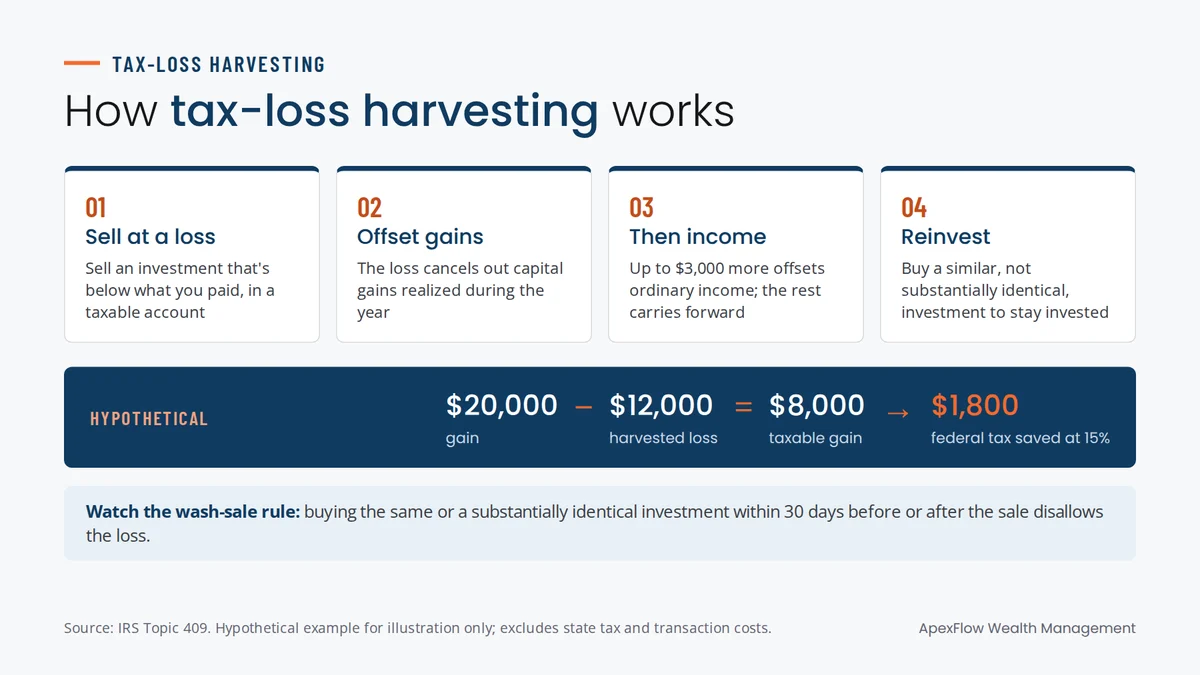
Tax-Loss Harvesting: How It Works and How to Avoid the Wash-Sale Rule
No one likes seeing an investment lose value. But in a taxable account, a loss can have a silver lining. Tax-loss harvesting means selling anRead more -
 October 7, 2026
Using Utah’s my529 Plan as a Grandparent
Helping pay for a grandchild’s education is one of the most meaningful gifts a grandparent can give. It’s also one of the most tax-efficient. Utah’sRead more -
 October 7, 2026
How to Build a Retirement Budget That Lasts
For decades, your budget had a built-in safety net: the next paycheck. Retirement changes that. Your income now comes from Social Security, maybe a pension,Read more