
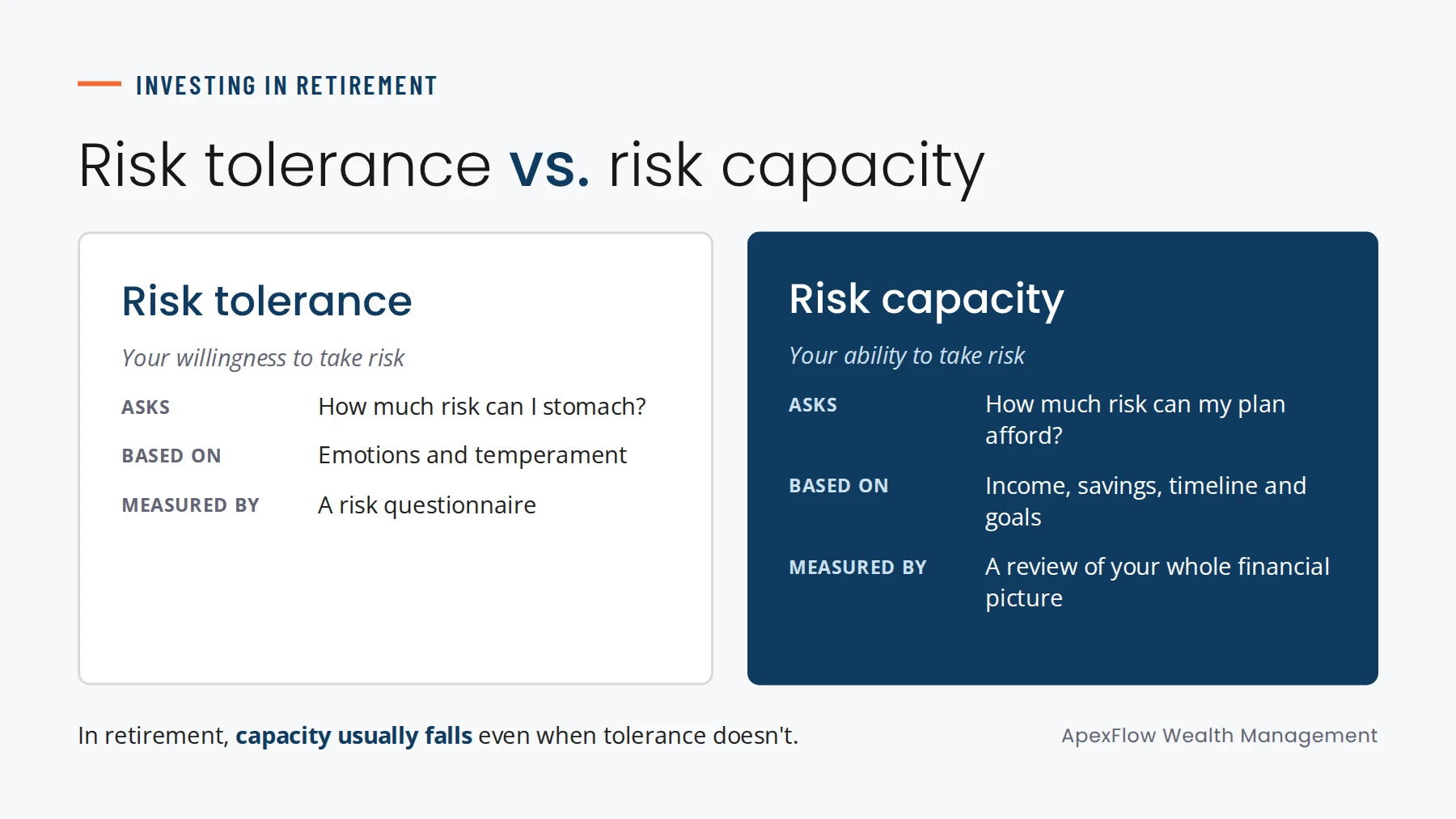
Ask most people about their investment risk and you’ll get an answer about how they feel. “I don’t like watching my account drop.” “I can handle some ups and downs.” That’s a real and useful answer, but it’s only half the picture. Risk tolerance is how you feel about losses. Risk capacity is how much loss your plan can actually absorb. Some advisors call them your willingness and your ability to take risk. The difference between them rarely matters more than in the years just before and after you retire.

At a glance
- Retirement usually lowers your capacity, even if your tolerance stays the same. A good plan respects both.
- Risk tolerance is emotional: your comfort with market swings.
- Risk capacity is financial: what your income, savings and timeline can withstand.
What is risk tolerance?
Risk tolerance, sometimes called risk appetite, is psychological. It’s your comfort level watching your investments fluctuate, your instinct when the market drops and your ability to stay steady instead of reacting. Some people can shrug off a 20% decline. Others feel real distress at half that.
Neither is right or wrong. It’s a description of temperament. But a portfolio that ignores it, even one that’s mathematically sound, can lead to an emotional, poorly timed decision during a downturn. That decision often does more damage than the downturn itself. (We cover why losses feel so heavy in Why Market Downturns Feel Worse Than They Actually Are.)
What is risk capacity?
Risk capacity, also called your capacity for loss, is about facts, not feelings. It’s how much of a loss you could take without derailing your goals, and it depends on:
- Your time horizon: how long until you need the money
- Your income: how stable it is, and how much of your spending it covers
- Your reserves: cash and other assets you can live on during a downturn
- Your obligations: upcoming expenses you can’t easily move or cut
Someone in their thirties with a steady paycheck has far more risk capacity than someone retiring next year, no matter how either of them feels about risk.
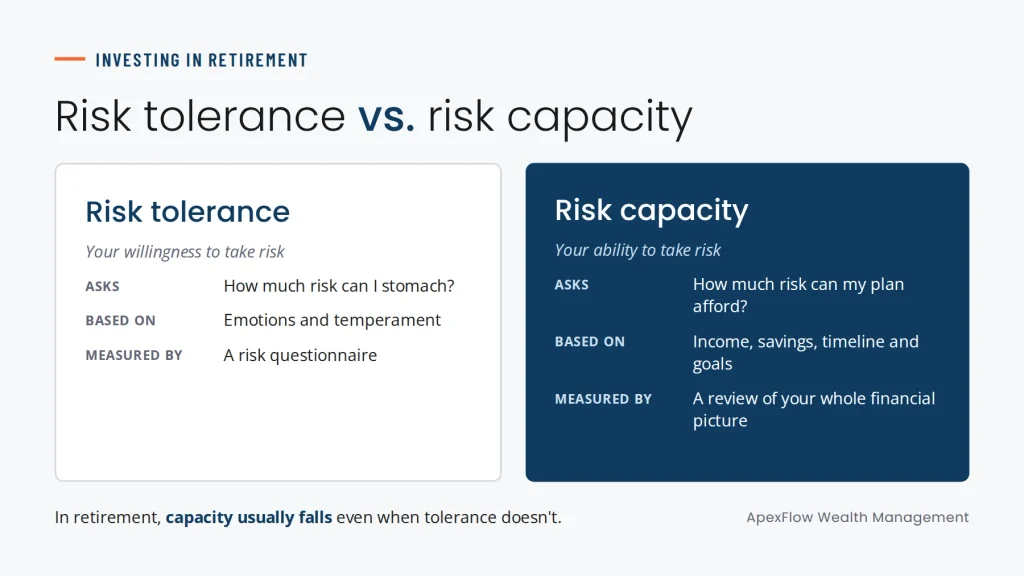
Risk tolerance vs. risk capacity: the key differences
Why your risk capacity changes when you retire
For most people, capacity drops at retirement even if their tolerance doesn’t move. Three things change at once:
- The paycheck stops. While you’re working, new savings go in during a downturn and buy investments at lower prices. In retirement, money flows the other way, out of your retirement portfolio.
- You start withdrawing. Selling investments to cover living expenses while they’re down locks in losses. Those dollars aren’t there for the recovery.
- The order of returns starts to matter. A bad market in the first few years of retirement does more lasting harm than the same decline ten years later. Planners call this sequence-of-returns risk.
That’s why many retirees find their comfort with risk and their plan’s ability to handle it pointing in different directions for the first time.
A hypothetical example: same feelings, different capacity
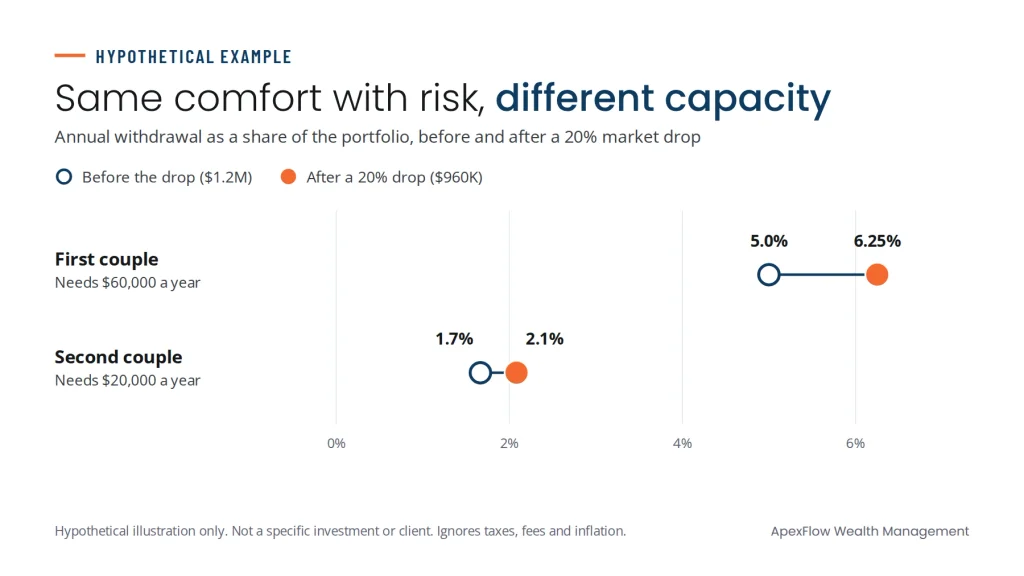
Picture two retired couples. Each has a $1.2 million portfolio and each says they’re comfortable with market swings. Their appetite for risk is the same.
- The first couple needs $60,000 a year from the portfolio because Social Security covers only part of their spending. That’s a 5% withdrawal rate.
- The second couple has a pension that covers most of their spending. They need just $20,000 a year from the portfolio, a withdrawal rate under 2%.
Now suppose the market drops 20% and both portfolios fall to $960,000. The first couple’s $60,000 withdrawal is now 6.25% of what’s left, a pace that can be hard to sustain. The second couple’s $20,000 is about 2%, which leaves plenty of room to wait for a recovery.
When tolerance and capacity disagree
High tolerance, low capacity. A retiree who isn’t bothered by volatility but now draws income from the portfolio may have far less room to absorb a downturn than their confidence suggests. Confidence isn’t the same as cushion.
Low tolerance, high capacity. Someone with a large pension and modest spending may be able to afford more growth, but if every dip keeps them up at night, that matters too. A plan they abandon in a panic isn’t a plan.
Build around only one of the two, and the plan tends to fail in a predictable way. Ignore capacity, and the portfolio may feel fine right up until a downturn forces a change in lifestyle. Ignore tolerance, and you get a portfolio that works on paper but that you can’t stick with when it counts.
The third question: how much risk do you need?
There’s one more piece most articles skip. Beyond how much risk you can stomach and how much you can afford, there’s how much you actually need to take to reach your goals. Advisors sometimes call this “risk required.”
If your income sources and savings already cover the life you want, you may not need to take much risk at all, even if you could. If there’s a gap, the plan has to decide how to close it: more growth, a later retirement date, a different spending plan or some combination. The right answer comes from your goals, not from a market forecast.

Ways to increase your risk capacity in retirement
You can’t change how you feel about losses overnight, but you can often strengthen what your plan can absorb:
- Hold a cash reserve for near-term spending, so you aren’t forced to sell investments in a downturn. See How Much Should You Keep in Cash Reserves?
- Use bonds and other steadier assets to fund the next several years of withdrawals. Our post on the role of bonds in a financial plan explains how.
- Strengthen guaranteed income, for example by carefully timing when you claim Social Security, so less of your spending depends on the market.
- Build flexibility into spending, separating essential expenses from ones you could trim for a year or two if markets are rough.
None of these is right for everyone. Each one has trade-offs, and the right mix depends on your whole financial picture.
Why this is a conversation, not a questionnaire
Many standard risk questionnaires and risk-profile quizzes only measure tolerance: a handful of questions about how you’d feel in a hypothetical downturn. That’s useful, but incomplete. Understanding capacity means looking at your income sources, time horizon, other assets, upcoming obligations and how much flexibility you have if things don’t go as planned.
That’s why we don’t build a portfolio from a questionnaire alone. In the Define stage of our planning process, we learn what you want your money to do and how you feel about risk. In Design, we measure what your situation can support. Then we build a portfolio that respects both.
It’s also one of the clearest examples of what we mean by high-challenge, high-support leadership. Sometimes it means telling a client that their comfort level and their actual capacity don’t match, and working through that honestly instead of defaulting to whichever answer is easier to hear.
Frequently asked questions
Both matter, but capacity sets the limit. You can choose to take less risk than your capacity allows, but taking more than it allows puts your goals in danger, however comfortable you feel.
Usually, yes. Once your paycheck stops and you start withdrawing from your savings, a large loss is harder to recover from. How much it drops depends on how much of your spending comes from guaranteed income like Social Security or a pension.
Yes. Tolerance often shifts after living through a major downturn, after a big life change or simply with age. It’s worth revisiting at your regular reviews.
Start with how much of your spending your guaranteed income covers, how many years of withdrawals you could fund without selling stocks and how flexible your spending is. A financial advisor can stress-test these together against different market scenarios.
There’s no single answer. Rules of thumb based on age can be a starting point, but the right mix depends on your income sources, spending, timeline and how you’ll feel if markets fall. That’s exactly the gap between tolerance and capacity this article describes.
Talk it through with us
If no one has ever walked through both sides of this with you, it’s worth doing before your next major investment decision, not after. Book a 20-minute Fit Call. It’s virtual, no prep is needed and there’s no obligation.

Investing involves risk and you may incur a profit or loss regardless of strategy selected, including diversification and asset allocation. Raymond James and its advisors do not offer tax or legal advice. You should discuss any tax or legal matters with the appropriate professional.
Related Articles
Dig deeper into our resource library
-
 October 7, 2026
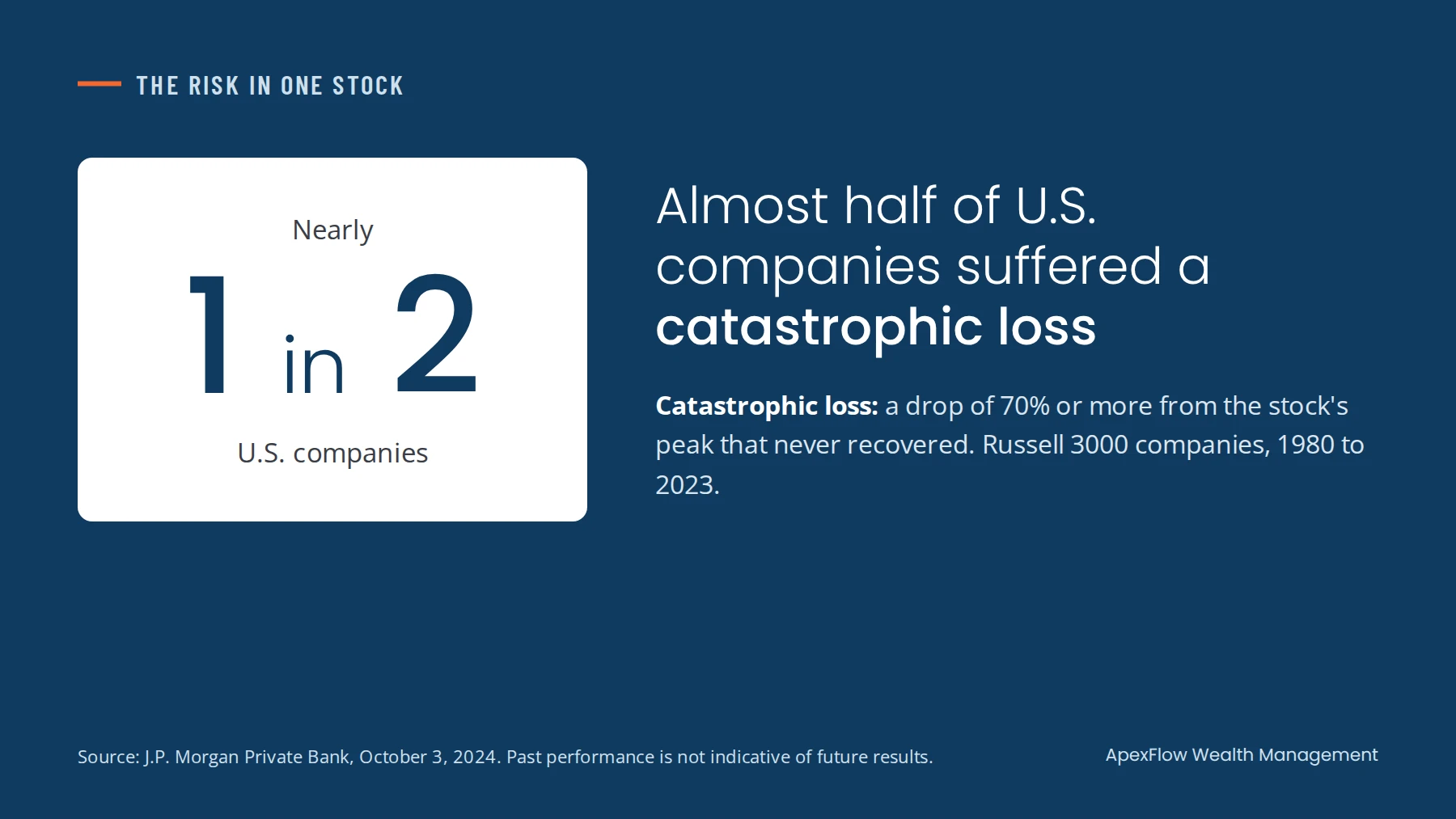
Too Much Company Stock? How to Diversify a Concentrated Stock Position
“Don’t put all your eggs in one basket” is advice everyone nods along to and almost nobody applies correctly. The people most likely to breakRead more -
 October 7, 2026
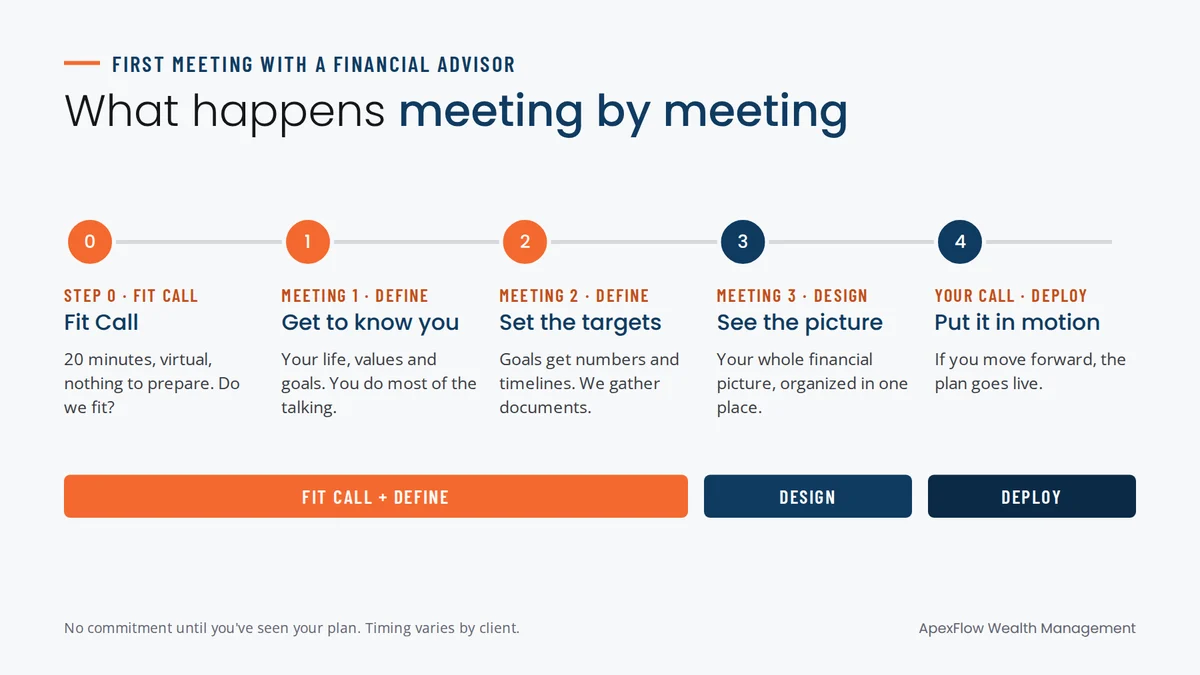
What to Expect in Your First Meetings With a Financial Advisor
Most people put off calling a financial advisor for the same reason they put off calling a doctor. It’s not that they don’t care. It’sRead more -
 October 7, 2026
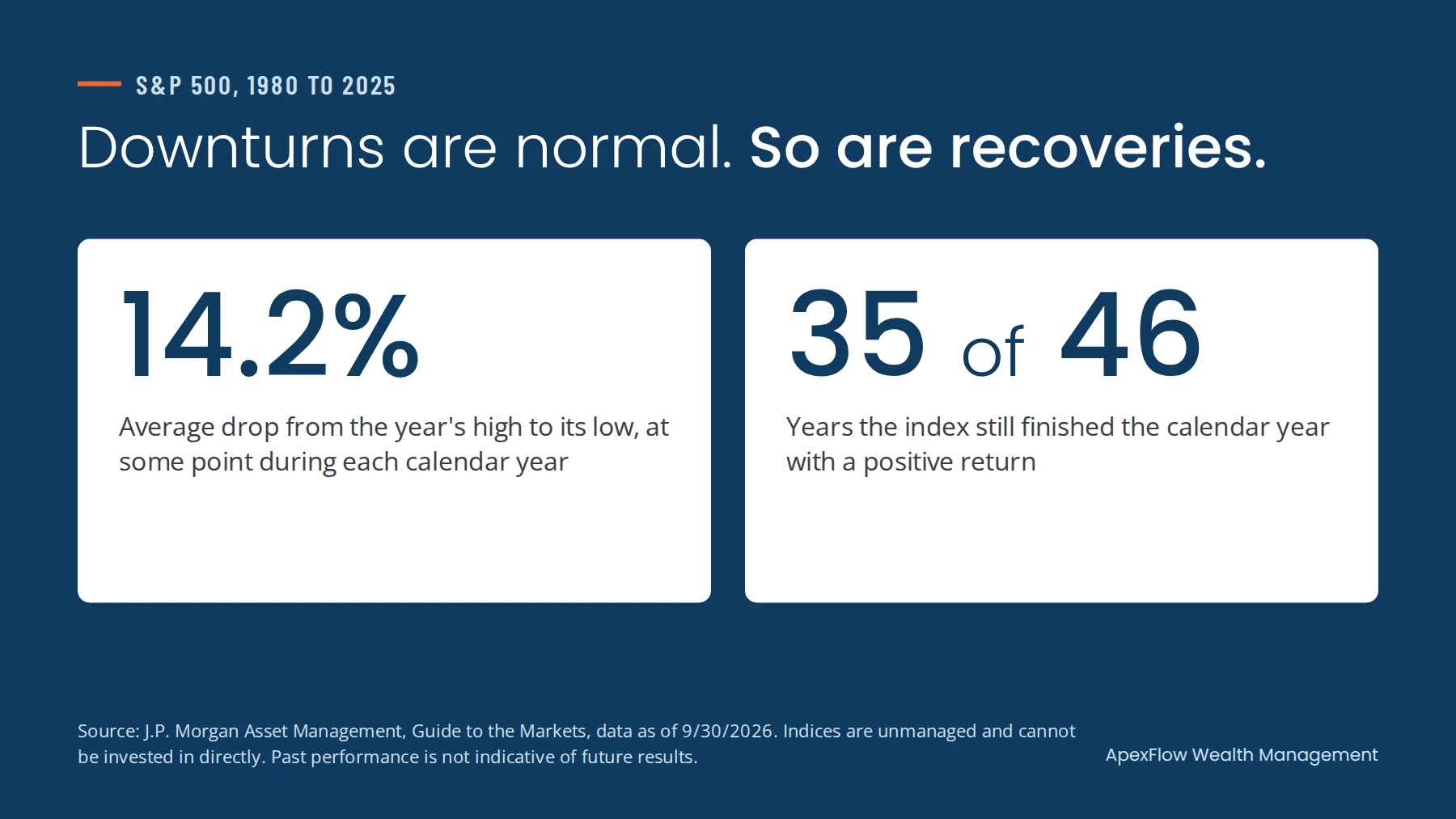
Loss Aversion Investing: Why Market Downturns Feel Worse Than They Are
A market drops 3% in a week and it feels like the beginning of something bad. A market climbs 3% in a week and itRead more