
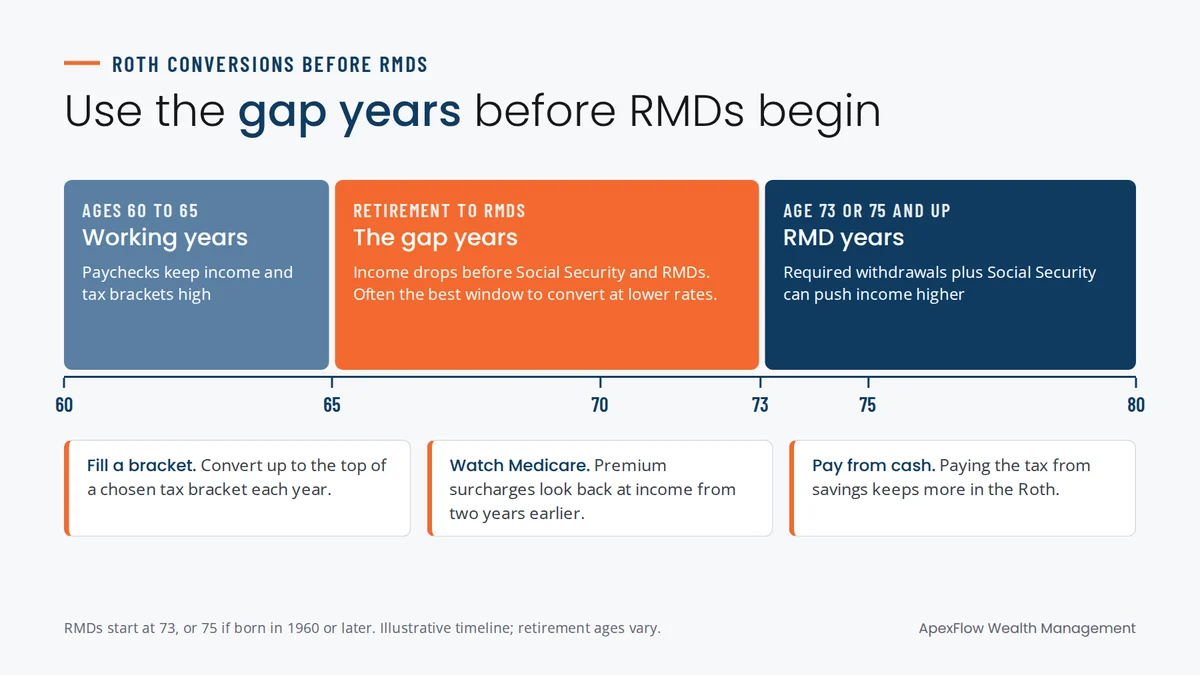
For many retirees, the years between leaving work and starting required minimum distributions are the lowest-tax years they’ll ever have. The paycheck has stopped, Social Security may not have started and the IRS hasn’t yet required withdrawals from traditional IRAs and 401(k)s. A Roth conversion before RMDs uses that window to move money into tax-free accounts on purpose, at tax rates you choose, instead of waiting for the IRS to force withdrawals later.

At a glance
- A Roth conversion moves money from a traditional IRA or 401(k) into a Roth IRA. You pay income tax now, and qualified withdrawals later are tax-free.
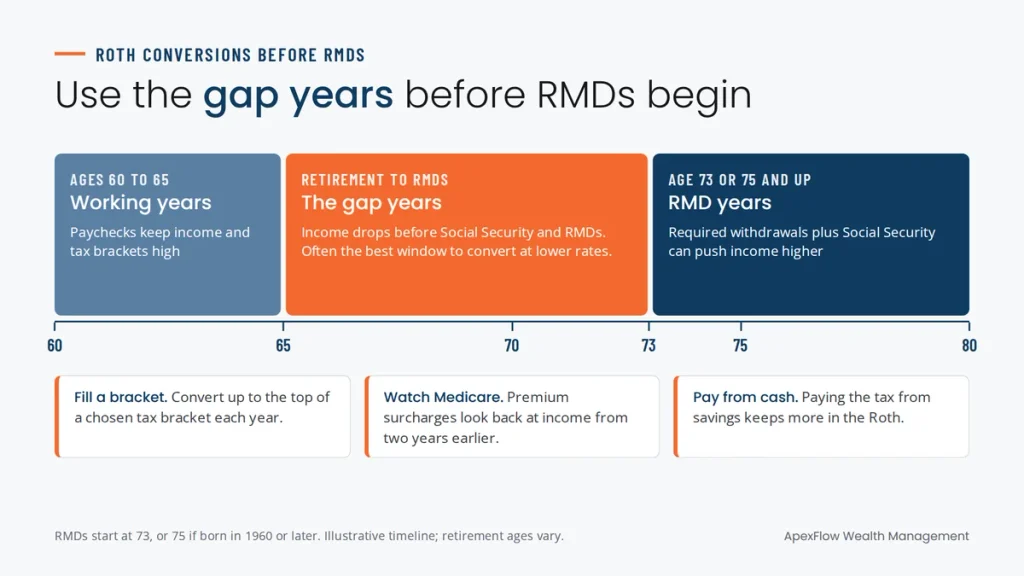
- The “gap years” between retirement and RMDs, which start at 73 or 75 depending on your birth year, are often the best time to convert.
- Conversions have ripple effects on Medicare premiums, the new senior deduction and Social Security taxes, so the right amount is a calculation, not a guess.
What the gap years are
Required minimum distributions now begin at age 73, or 75 if you were born in 1960 or later, under the IRS RMD rules. If you retire at 62 or 65, you may have a decade or more before RMDs start. If you also delay Social Security to grow your benefit, your taxable income in those years can be unusually low.
That’s the opportunity. Every dollar left in a traditional IRA will be taxed eventually, either when you choose to withdraw it, when RMDs force it out or when your heirs inherit it. The gap years let you decide when, and at what rate.
How a Roth conversion works
When you convert, the amount moved from a traditional IRA to a Roth IRA counts as taxable income that year. A few rules matter, according to IRS Publication 590-A and Publication 590-B:
- There’s no income limit on conversions.
- Conversions can’t be undone. Since 2018, a conversion can’t be recharacterized back to a traditional IRA.
- Each conversion has its own five-year clock. Withdrawing converted money within five years can trigger a 10% penalty if you’re under 59½.
- Pay the tax from other money if you can. Withholding tax from the conversion itself shrinks the amount that reaches the Roth.
Why converting before RMDs can pay off
- Smaller RMDs later. Lowering your traditional IRA balance reduces future required withdrawals, which can keep you in lower brackets for the rest of retirement.
- No RMDs on Roth money. Roth IRAs, and since 2024 Roth accounts in workplace plans, have no required distributions during your lifetime.
- Protection for a surviving spouse. When one spouse dies, the survivor usually moves to single tax brackets with roughly half the room. RMDs don’t shrink, so the same income can be taxed at a higher rate, a problem often called the widow’s penalty. Kiplinger points to conversions while both spouses are alive as one way to prepare.
- A better inheritance. Most non-spouse heirs must empty inherited IRAs within 10 years. Inherited Roth money generally comes out tax-free, while traditional IRA money is taxed at their rates, often during their own peak earning years.
The costs to weigh
A Roth conversion raises your income for the year, and income affects more than your tax bracket:
- Medicare premiums. Medicare’s income-related surcharges, known as IRMAA, look back two years. For 2026, surcharges start above $109,000 of income for single filers and $218,000 for joint filers, according to CMS. A large conversion at 64 can raise your premiums at 66.
- The new senior deduction. For 2025 through 2028, people 65 and older can deduct an extra $6,000 each, but it phases out above $75,000 of income for singles and $150,000 for couples, according to the IRS.
- Social Security taxes. Once benefits begin, extra income can make more of your Social Security taxable, under thresholds that aren’t indexed for inflation.
- State taxes. Utah taxes conversions like other income, at 4.45% for 2026. We explain more in Does Utah Tax Retirement Income?
Filling the bracket: a hypothetical example
A common approach is to convert just enough each year to “fill” a chosen tax bracket without spilling into the next one. Here are the 2026 federal brackets from the IRS:
| Tax rate | Single, taxable income up to | Married filing jointly, taxable income up to |
|---|---|---|
| 10% | $12,400 | $24,800 |
| 12% | $50,400 | $100,800 |
| 22% | $105,700 | $211,400 |
| 24% | $201,775 | $403,550 |
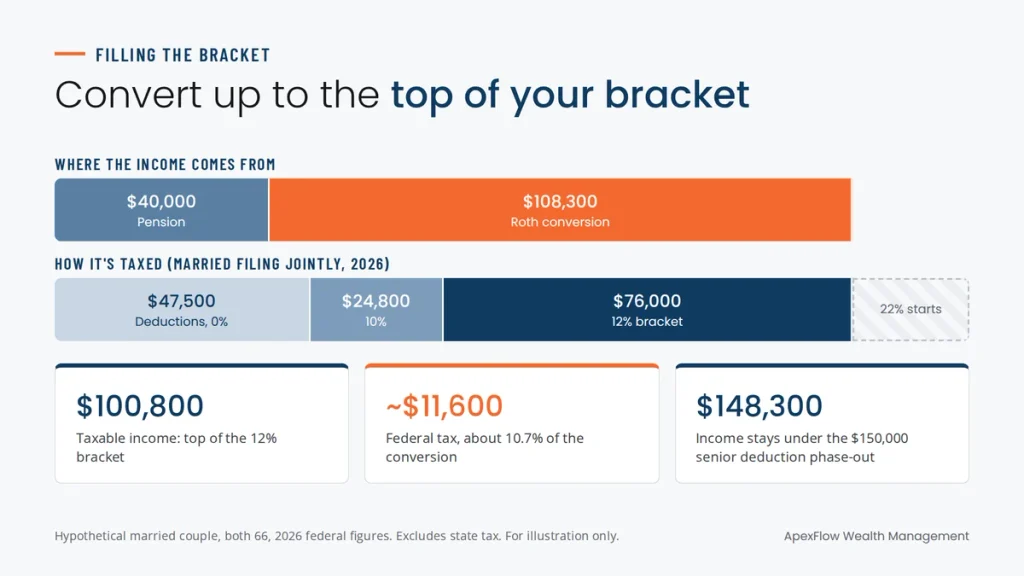
A hypothetical example. A married couple, both 66, retired last year and are delaying Social Security. Their only income is a $40,000 pension. Their deductions total $47,500: the $32,200 standard deduction, $3,300 in additional deductions for being 65 or older and the $12,000 senior deduction. Without a conversion, they owe no federal income tax.
If they convert $108,300 from their traditional IRA, their taxable income lands right at $100,800, the top of the 12% bracket. Their federal tax would be about $11,600, roughly 10.7% of the amount converted. Their income stays below both the $150,000 senior deduction phase-out and the first Medicare surcharge threshold. Repeating this each year before RMDs and Social Security begin could shift a meaningful share of their IRA into tax-free accounts.
This example is hypothetical and for illustration only, uses 2026 federal figures and excludes state taxes. Actual results depend on your full tax picture.
When a conversion may not make sense
- You expect a lower tax rate later, for example a large planned charitable gift or a move to a state with no income tax.
- You’d need to pay the tax from the IRA itself, especially if you’re under 59½.
- You’re receiving health insurance premium tax credits through the marketplace before Medicare, which are tied to income.
- You plan to leave the IRA to charity, which pays no income tax on it anyway.
A gap-year conversion checklist
- Map your income for each year until RMDs, including when Social Security and any pension start.
- Project your RMDs at 73 or 75 to see the tax rates they’ll create.
- Choose a target bracket and Medicare threshold for each year.
- Convert in the fall or winter, once your income for the year is clearer, and before December 31.
- Pay the tax from cash or taxable savings.
- Revisit the plan every year as tax law, markets and your health change.
Where we fit in
Roth conversions work best as part of a full retirement income plan, coordinated with your Social Security timing, withdrawals and tax professional. We compare account types in Roth vs. Traditional IRA for High Earners and map the years leading up to retirement in The 5 Years Before Retirement. It all comes together in the Design stage of our planning process.
Frequently asked questions
Often in the years between retiring and starting RMDs or Social Security, when taxable income is lower. Each year’s amount should be set by your tax bracket, Medicare thresholds and other income.
Age 73, or 75 if you were born in 1960 or later. Roth IRAs and Roth workplace accounts don’t require distributions during the owner’s lifetime.
They can. Medicare surcharges are based on your income from two years earlier. In 2026, they start above $109,000 for single filers and $218,000 for joint filers.
No. Since 2018, Roth conversions can’t be recharacterized, so it’s important to plan the amount carefully.
There’s no annual limit or income limit on conversions. The practical limit is how much tax you’re willing to pay in a given year.
Talk it through with us
If you’re retired or close to it and wondering whether Roth conversions belong in your plan, that’s worth modeling before December 31. Book a 20-minute Fit Call. It’s virtual, no prep is needed and there’s no obligation.
With clarity and confidence,

This material is for informational purposes only. Converting from a traditional IRA to a Roth IRA is a taxable event. A Roth IRA offers tax-free withdrawals on taxable contributions; to qualify, the account must be held for five years and the owner must be age 59½ or older, disabled or deceased, or the withdrawal must be for a first-time home purchase (up to $10,000). Withdrawals before age 59½ may be subject to a 10% penalty. Examples are hypothetical and for illustration only. Tax figures are for 2026 and change annually. Raymond James and its advisors do not offer tax or legal advice. You should discuss any tax or legal matters with the appropriate professional.
Related Articles
Dig deeper into our resource library
-
 October 7, 2026
How to Build a Retirement Budget That Lasts
For decades, your budget had a built-in safety net: the next paycheck. Retirement changes that. Your income now comes from Social Security, maybe a pension,Read more -
 October 7, 2026
Risk Tolerance vs. Risk Capacity in Retirement
Ask most people about their investment risk and you’ll get an answer about how they feel. “I don’t like watching my account drop.” “I canRead more -
 October 7, 2026
How to Talk to Your Adult Children About Inheritance
There’s a particular kind of silence that shows up around estate planning. Parents don’t want to talk about it because it means talking about theirRead more